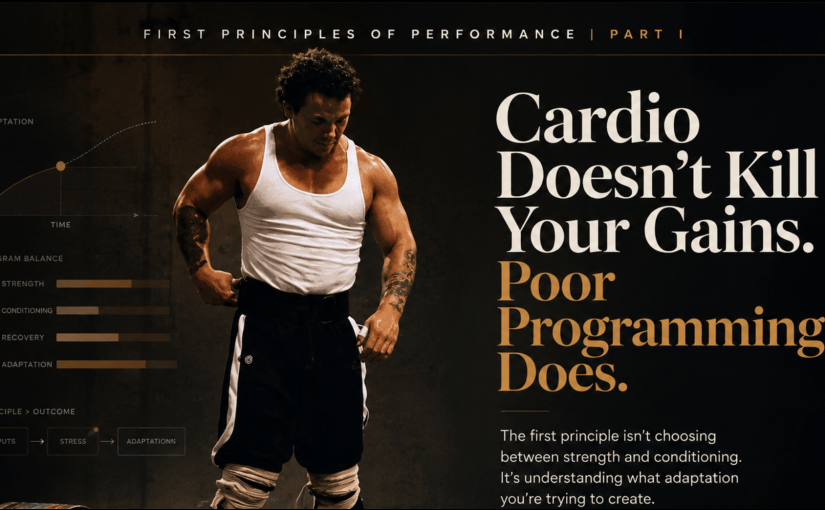
Cardio Doesn’t Kill Your Gains. Poor Programming Does.
“The first principle isn’t choosing between strength and conditioning. It’s understanding what adaptation you’re trying to create.”
For decades, one of the most persistent myths in strength training has been deceptively simple:
“If you want to build muscle, avoid cardio.”
It sounds reasonable. After all, endurance athletes tend to be lean, while bodybuilders are muscular. Somewhere along the way, many people concluded that cardiovascular training and muscle growth must exist at opposite ends of the same spectrum.
Like most fitness myths, there’s a grain of truth buried beneath a mountain of oversimplification.
Can excessive endurance training interfere with maximal hypertrophy? Yes.
Can intelligently programmed cardiovascular training improve your health, enhance your recovery, increase your work capacity, and have little meaningful effect on muscle growth?
Also yes. The difference isn’t cardio. It’s programming
The Wrong Question
People often ask, “How much cardio can I do without losing muscle?” It’s the wrong question. The better question is: What adaptation am I trying to produce?
Every training session asks your body to solve a problem. Heavy squats ask it to produce more force. Tempo intervals ask it to become more efficient at clearing lactate.
Sprints demand explosive power. Long easy efforts improve aerobic efficiency.
These aren’t competing identities. They’re simply different physiological adaptations. Understanding that distinction changes everything.
First, Let’s Define “Cardio”
One reason this discussion becomes so confusing is because we use the word cardio as though it’s a type of exercise.
It isn’t. It’s a physiological demand.
Your cardiovascular system doesn’t know whether you’re running, rowing, cycling, carrying sandbags, or performing twenty-rep squats. It only knows that your muscles require oxygen, nutrients, and energy.
Think about workouts like: – The Standard (Grace – 30 clean and jerks at 135/95, 30 ring muscle ups, Isabel – 30 snatches at 135/95) – Heavy sled pushes – Oly complexes of 5 reps or more – 2k row for time – 5k run – Fran – 20 rep max back squat – Murph
Nobody finishes those wondering whether their cardiovascular system was challenged. Weight training can absolutely become cardiovascular training depending on how it’s programmed.
These variables determine the cardiovascular demand, not whether you’re holding a barbell or running shoes. The conversation isn’t “weights versus cardio.”
It never was.
Where the Myth Came From
The concern isn’t entirely imaginary.
Researchers have long studied what’s known as the interference effect, the observation that combining endurance and resistance training can, under certain conditions, reduce some strength and hypertrophy adaptations compared with resistance training alone.
Notice the language. Can. Under certain conditions.
Not: Always. Those conditions matter.
A competitive marathon runner performing sixty miles each week while trying to maximize leg hypertrophy faces a very different challenge than someone lifting four days a week while adding two thirty-minute conditioning sessions.
Those are not the same training problems. Yet they’re often discussed as though they are.
What Actually Interferes?
For most lifters, muscle isn’t lost because they jogged. It’s lost because recovery becomes the limiting factor.
Poor programming often looks like this: Heavy lower-body lifting followed immediately by long-distance running. High-volume conditioning layered on top of already excessive lifting volume. Poor sleep. Insufficient calories. Inadequate protein intake. Eventually something has to give. Trying to train near maximally, whether it’s loading or intensity, 4-6 days per week.
If training continually exceeds your ability to recover, progress slows—not because cardio is inherently bad, but because the total stress exceeds your adaptive capacity.
The Research Is More Encouraging Than the Internet
Fortunately, the research is considerably more nuanced than the internet. Much of the fear surrounding cardio comes from laboratory discussions about molecular signaling. You’ll often hear that endurance exercise activates one pathway while resistance training activates another, and that these pathways “fight” each other.
There is truth here. But physiology is rarely as binary as social media suggests.
These signals are temporary. They’re influenced by nutrition, training age, exercise selection and most important, recovery.
And they’re often localized to the tissues being trained rather than acting as a simple on-off switch across the entire body.
More importantly, when researchers look beyond the molecular biology and examine actual training outcomes, the picture becomes much less dramatic.
For the overwhelming majority of recreational lifters, and even many competitive athletes, well-designed conditioning has little meaningful effect on muscle growth.
Programming matters far more than the mere presence of cardiovascular exercise.
Numerous studies support the idea that cardio, when programmed intelligently, does not meaningfully hinder muscle growth. For example, a 2015 meta-analysis by Dr. Brad Schoenfeld and colleagues concluded that combining strength and cardio training results in only a negligible impact on muscle and strength gains, provided programming is sound (Schoenfeld, B.J., Ogborn, D., & Krieger, J.W., 2015, Sports Medicine).
Cardio That Supports Muscle Growth
If hypertrophy is your primary objective, conditioning should complement not compete with your lifting.
Generally speaking, it could look like the following:
Shorter, more intense sprint work.
Use interval-based conditioning where appropriate.
Row.
Cycle.
Throw med-balls.
Use the SkiErg.
Carry odd objects.
Push and pull sleds.
Perform tempo intervals.
Carry heavy implements.
Include sprint interval training when recovery allows.
Separate demanding conditioning from heavy lower-body strength sessions whenever practical.
Most importantly, keep the main thing, the main thing.
Conditioning exists to improve health, increase work capacity, and support recovery, not to leave you so fatigued that tomorrow’s strength session suffers.
Keep the Main Thing the Main Thing
The best programs are surprisingly disciplined. They know exactly what they’re trying to improve. Everything else exists to support that objective, not distract from it.
One of the greatest mistakes athletes make is assuming every session must improve every quality simultaneously.
It doesn’t. Training is about emphasis or specificity to the individual and their goals. Some phases prioritize maximal strength. Some emphasize hypertrophy, aerobic capacity gymnastic or Olympic Weightlifting skill. A skill Ive always referred to as barbell gymnastics because of how skill dependent they are.
The art of coaching isn’t teaching every quality simultaneously. It’s knowing which qualities deserve emphasis today, and which can simply be maintained until tomorrow.
That’s programming.
The First Principle
Cardio doesn’t kill your gains. Poor programming does. If your training reflects clear priorities, if recovery matches workload, if nutrition supports adaptation, if conditioning complements rather than competes with strength, then you can become stronger. You will then become stronger, healthier, and better conditioned.
Not because you avoided cardio, but because you finally stopped asking whether strength and conditioning are enemies.
They never were. They simply need a coach who understands how to make them work together.
The principles remain constant. The application is the art.
If you’re curious why all of this works, not merely what to do, we’ll step out of the weight room and into the physiology laboratory. There we’ll explore the molecular conversation taking place inside skeletal muscle every time you lift, sprint, row, or recover, and discover why the story is far more nuanced than the internet would have you believe.
References
Schoenfeld, B. J., Ogborn, D., & Krieger, J. W. (2015). Effect of concurrent aerobic and strength training on maximal strength, power, and hypertrophy in healthy adults: A systematic review and meta-analysis. Sports Medicine, 45(5), 697–708.
Wilson, J. M., Marin, P. J., Rhea, M. R., Wilson, S. M. C., Loenneke, J. P., & Anderson, J. C. (2012). Concurrent training: A meta-analysis examining interference of aerobic and resistance exercises. Journal of Strength and Conditioning Research, 26(8), 2293–2307.
What the Film Accurately Portrays About George Washington and Why That’s More Important Than Historical Precision
I have heard the bullets whistle; and, believe me, there is something charming in the sound.~George Washington, 1754
Historical narratives often introduce extraordinary individuals only after they have already achieved greatness.
We meet George Washington crossing the Delaware on Christmas night, 1776. We remember him accepting the surrender at Yorktown. We picture him presiding over the Constitutional Convention in 1787 with quiet dignity, or possibly voluntarily relinquishing power after two terms as President. These are the images that have become etched into the American imagination.
However, none of these depictions explain the individual behind the achievements. Historical accounts frequently celebrate achievement while overlooking the formative processes. They recall the summit but often neglect the ascent.
The Washington we know, the one who would one day lead the nation, was once just a simple Virginia country boy who surveyed untamed forests, who helped to steer uncertain alliances, and who endured many failures. As Fred Anderson’s Crucible of War illustrates, these foundational years placed a Young Washington not just in the forests of Virginia, but in the midst of a global struggle for empire, where every decision carried consequences far beyond his own ambitions.
While the smoke of the Battle of Culloden had scarcely cleared from the Scottish Highlands, another conflict was already gathering across the forests of North America. The same British Empire that had crushed the Jacobite Rising under the command of the Duke of Cumberland would soon ask a young Virginian to represent its interests on a distant frontier.
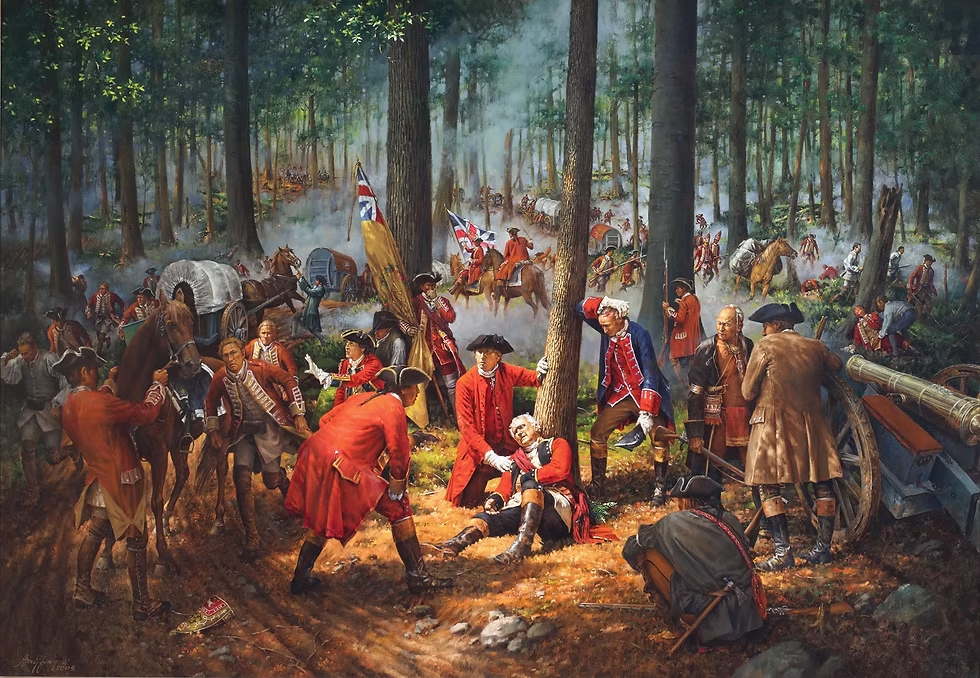
The Battle of Culloden (1746) marked the end of the Jacobite Rising and preceded Washington’s emergence on the Virginia frontier by only a few years.
Contemporary audiences may recognize the Duke through historical fiction like Outlander, where the aftermath of Culloden serves as an important backdrop. Yet only a few years later, Britain’s attention had shifted across the Atlantic.
As Scotland slowly recovered from the Jacobite defeat, George Washington was beginning the experiences that would shape his own understanding of leadership, empire, and war. Only eight years separated Culloden from Fort Necessity. While the Highlands mourned the end of the Jacobite cause, another young officer, this time in Virginia, was taking his first uncertain steps into a conflict that would ultimately reshape not only North America, but the British Empire itself. Washington’s story did not unfold on the margins of British history. It unfolded at the center of an expanding imperial contest whose consequences would be felt across Europe, North America, the Caribbean, India, and eventually the world.
Much of Washington’s early opportunity, and the weight of responsibility, came at the behest of Lieutenant Governor Robert Dinwiddie of Virginia. Dinwiddie’s urgent dispatch of Washington as an emissary to the French, and later as an officer, thrust the young Virginian into imperial diplomacy and conflict, well before he had reached his twenty-third year.
For this reason, Young Washington is quite effective.
There was another detail that struck me before the opening scene ever began. Young Washington was released on July 3, 2026, the anniversary of the Battle of Fort Necessity, fought on July 3, 1754. Whether intentional or coincidental, the timing felt remarkably appropriate. It was at Fort Necessity that Washington first confronted the harsh realities of command, responsibility, and failure. These lessons would continue to shape the man history would so fondly remember.
Its success does not stem from perfectly recreating every historical event. Rather, the film demonstrates that greatness is seldom born during moments of triumph. Instead, it is gradually forged through prolonged periods of uncertainty, hardship, discipline, and service. It tells the story of becoming.
History Begins Too Late
Braddock’s defeat at the Battle of the Monongahela and the Road to the American Revolution
One of the greatest challenges in portraying historical figures is that audiences already know the ending. We know Washington survives. We know he becomes commander of the Continental Army. But what did it feel like, in those first years?
We know he becomes America’s first President. Therefore, the narrative tension cannot arise from questioning the outcome.
Instead, it must derive from an examination of how an individual becomes capable of assuming such responsibilities.
Peter Stark captures this beautifully in Young Washington. His Washington is ambitious without arrogance, courageous without recklessness, and deeply shaped by the Virginia frontier. Stark’s research emphasizes that Washington’s formative encounters on the frontier—marked by both overreach and humility were essential lessons, not just for an officer, but for the man he would become.
At this stage, he’s not even close to the man who would become recognized as “the Father of His Country.” He’s just George, a young man from Virginia, keen to prove himself, and not immune to self-doubt. He is simply a young officer learning that leadership often requires decisions made under conditions of uncertainty.
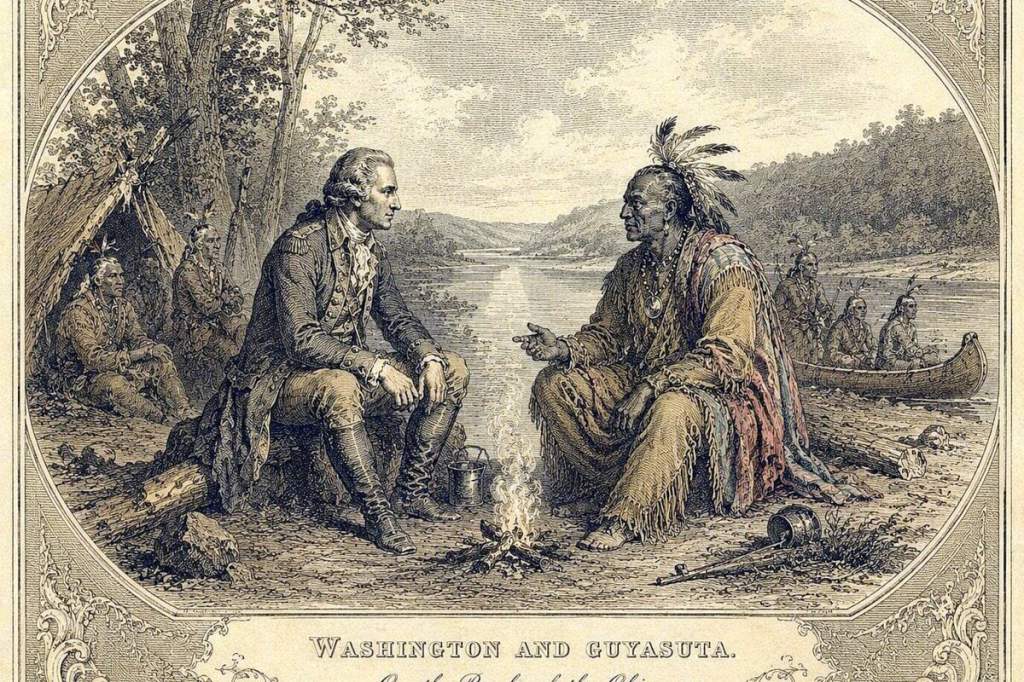
Fred Anderson’s Crucible of War widens that lens even further. It places Washington in the much broader geopolitical struggle between Britain and France for control of North America. Yet Washington’s story unfolds not in isolation, but within the intricate web of Native American diplomacy, imperial rivalry, and transatlantic currents that defined the mid-eighteenth century.
As Anderson notes, it was in these moments of uncertainty and adversity that Washington learned the necessity of adaptation, a lesson that would underpin his later leadership. Against that backdrop, Washington’s early experiences become more than youthful adventures. They become formative encounters with diplomacy, logistics, command, failure, and responsibility.
The film recognizes an aspect that many historical narratives overlook: Washington did not achieve greatness instantaneously; rather, his development was gradual.
The Wilderness Before the Legend
Modern audiences often imagine eighteenth-century Virginia through portraits, plantations, and political assemblies.
The wilderness presented a stark contrast to the trappings of the 18th-century gentleman. The frontier was vast, beautiful, but also unforgiving. His surveying expeditions demanded resilience, observation, patience, and sound judgment. Every mile he traveled had the potential to change his perspective on life or end it. Every river crossed carried risk. Negotiations with Indian nations or colonial authorities demanded diplomacy years ahead of Washington’s experience. He learned the hard way.
The wilderness was not merely a backdrop. More importantly, the frontier served as Washington’s initial instructor. It is particularly appropriate that his career began as a surveyor. Surveyors do not impose order on the land; they first learn to observe it.
Early on, prior to commanding soldiers, a Young Washington learned to navigate the backcountry. Before leading armies, he developed an understanding of the Virginia topography.
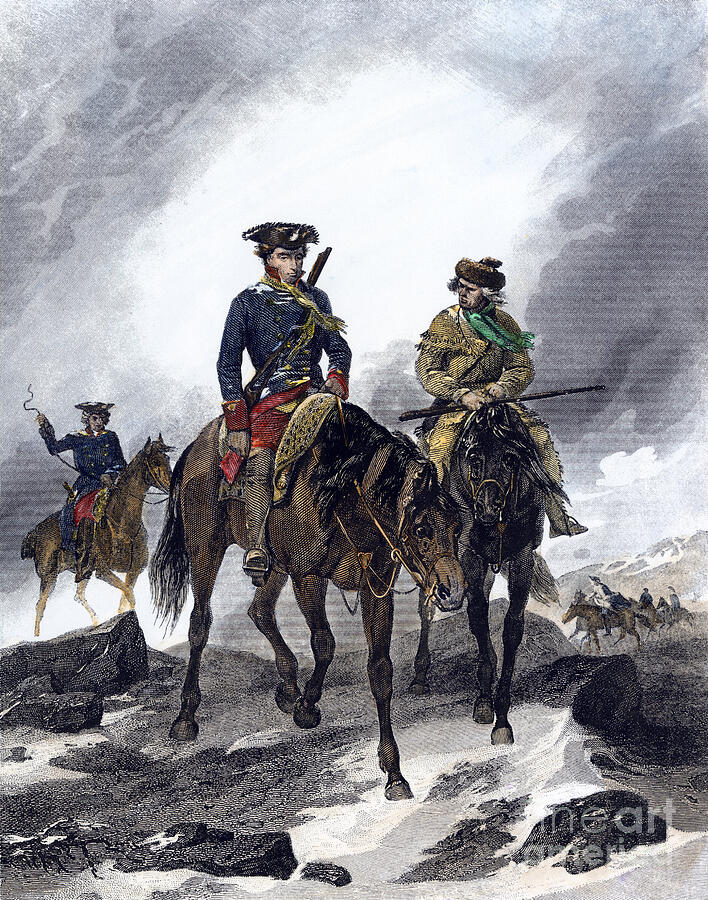
Before leading the nation, he became adept at navigating uncertainty. As portrayed in the movie, one night out on the frontier, he really did almost freeze to death. He was unaware at the time, but these lessons would prove invaluable in the years to come.
Failure Can Be an Extraordinary Teacher
Washington’s early military service during the French and Indian War shaped the judgment that later defined his leadership.
Modern biographies often turn Washington’s early failures into short, concise sections. Then the topic quickly shifts to his many later successes. This tendency is regrettable and often sells the story short.
These failures may, in fact, constitute the most significant aspect of his narrative.
Incidents like the Jumonville affair and the events at Fort Necessity involved misjudgments made under considerable pressure, resulting in lessons learned at high personal and political cost. Both Anderson and Stark argue that these setbacks, often glossed over in myth, were in fact the crucibles where Washington’s resilience and judgment were forged.
Washington’s own letters from this period, as well as official colonial correspondence, reveal the anxieties and aspirations of a young officer navigating the uncertainties of frontier command.
Letters from Governor Dinwiddie reveal not only the trust invested in Washington, but also the pressure of representing Virginia’s interests on the frontier. Dinwiddie’s strong advice and high expectations served as both a challenge and a formative influence for the young officer.
These moments exposed Washington to the realities of command long before he possessed complete confidence or experience. If anything, they show just how much he still had to learn.
The film treats these events with appropriate weight.
It’s not because the film sticks to a strict, precise recreation of every conversation or maintains exact timelines. It does so because the film captures an essential historical truth. Leadership is acquired through experience; each lesson is earned rather than inherited.
Washington’s early victories help to build his confidence and resilience. His early defeats helped to refine his judgment. Almost across the board, the historical Interpretations of Washington’s early military competence vary but are rarely kind. Some, like Anderson, highlight his rapid adaptation under fire, while others note the persistence of youthful missteps. There is consensus that these formative trials were indispensable in shaping the leader he became.
If one must choose between the two, historical evidence suggests that judgment proved to be more valuable.
Historical Accuracy and Historical Truth
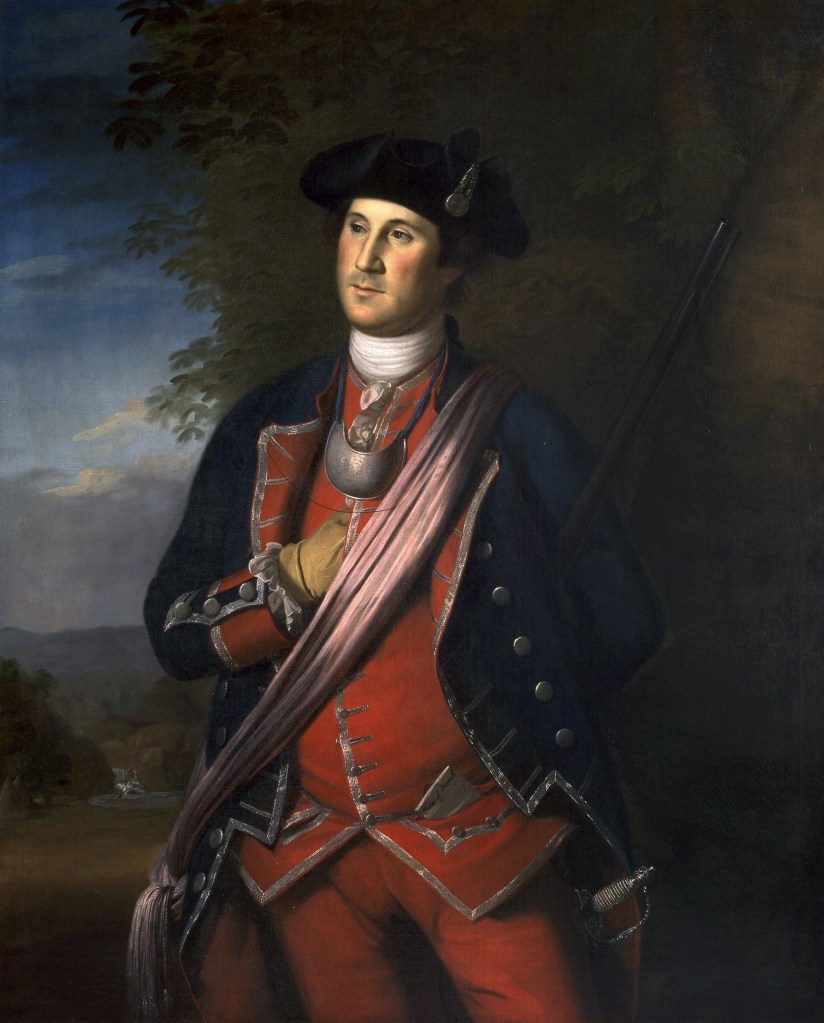
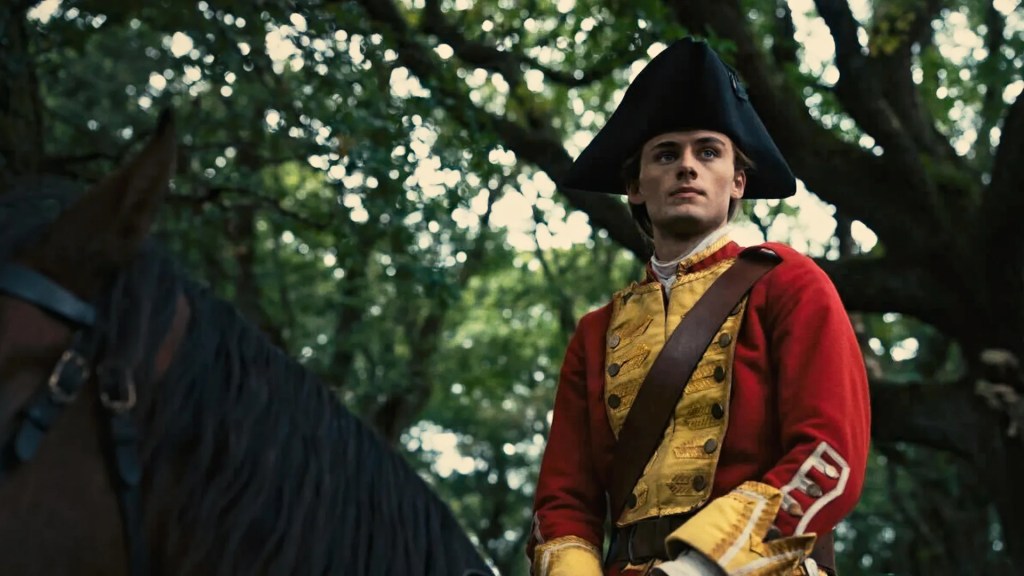
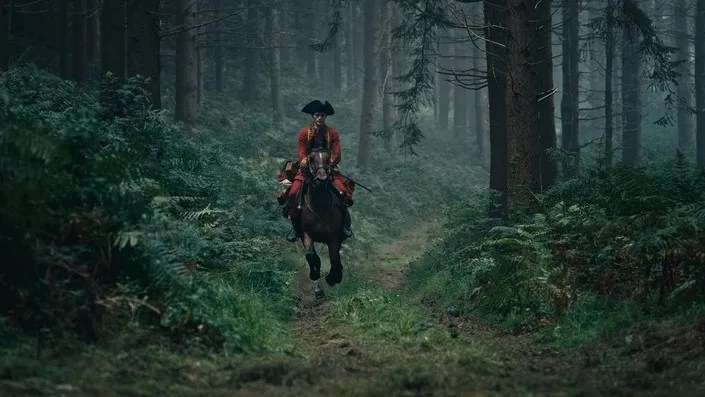
Young Washington, Angel Studios 2026
No historical film achieves perfect accuracy. Nor should audiences expect it to.
This film serves as a medium for storytelling. However, the real story, the real history, is grounded in scholarship. While these objectives can overlap, they are not synonymous.
Characters are often blended together, timelines are compressed, dialogue is imagined, events are simplified or even exaggerated. These creative choices warrant acknowledgment, but they should be evaluated in proportion to their impact. The central question is not whether every detail occurred exactly as depicted.
The more important question is whether the film remains faithful to the character it seeks to portray.
In my assessment, Young Washington is largely successful. The film portrays Washington’s ambition without reducing his character to that single trait. It depicts his confidence without suggesting arrogance, and his patriotism before it had fully manifested in political terms.
Most importantly, the film depicts a young Virginian with a profound attachment to the land that shaped his identity. This aspect is of genuine significance.
Virginia Was More Than Home
One aspect of the film that resonated deeply with me was its portrayal of the importance of Virginia itself.
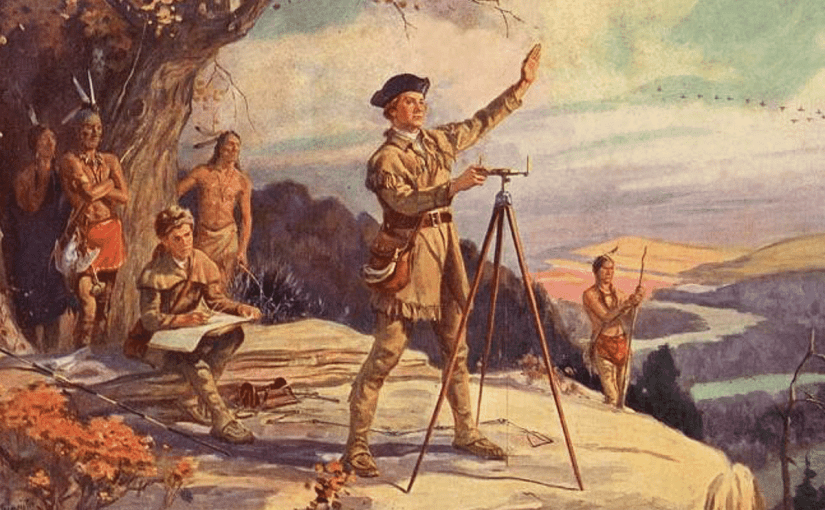
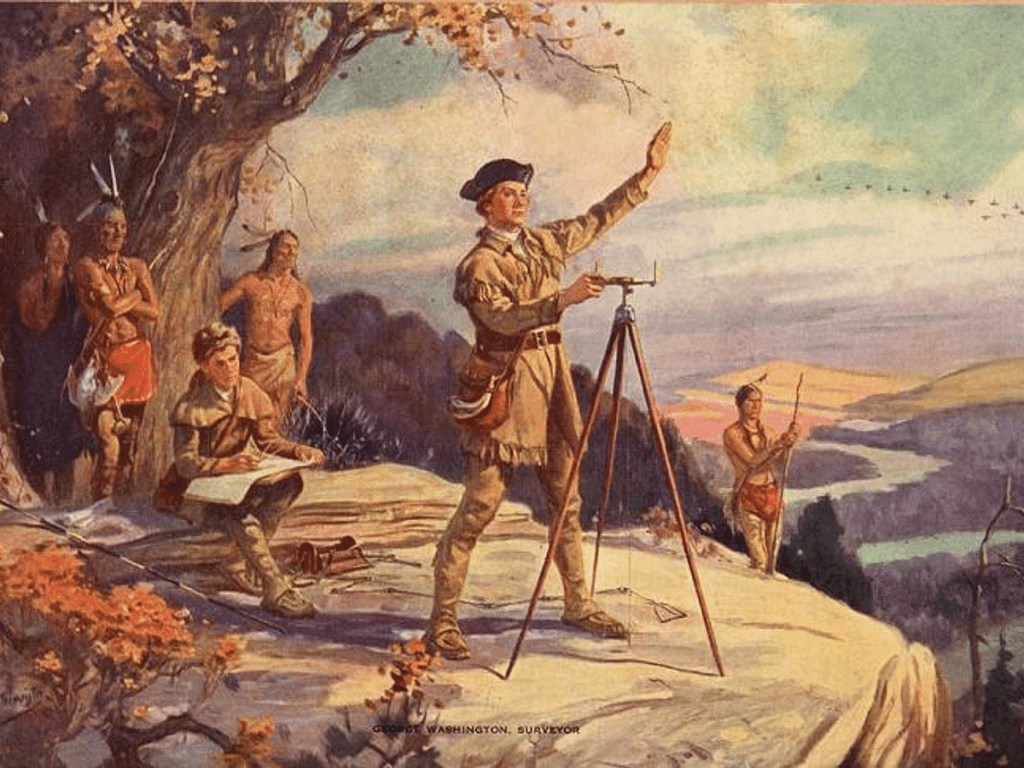
George Washington as a young surveyor on Virginia’s frontier.
For Washington, Virginia was not merely a colony; it was his home and his country. The rivers, forests, Blue Ridge Mountains, the frontier, and its people were integral to his identity.
Washington’s identity was inseparable from the landscape of his upbringing. Stark, in particular, highlights how Washington’s attachment to Virginia’s land and people was not just personal, but foundational to his character and later sense of service.
Throughout these formative years, Washington’s interactions with other prominent Virginians, landowners, officers, and statesmen such as George Mason helped shape his understanding of leadership and public service, grounding him in the networks that would sustain Virginia’s future leaders. This connection is often overlooked in discussions that commence with the Revolution. However, long before he became an American icon, he was distinctly a Virginian.
His understanding and internalization of the importance of duty, honor, public service, and responsibility emerged from this environment. The wilderness shaped his character as profoundly as any subsequent battlefield.
His sense of civic responsibility was also reinforced by the example of the Virginia House of Burgesses, the colony’s elected assembly, which would later honor Washington for his service. The political traditions and debates of the Burgesses provided a living model of self-government that would influence Washington throughout his career. The film deserves considerable recognition for highlighting this aspect.
Becoming Before Greatness
Modern society tends to admire accomplishments while neglecting the formative process as a whole. Achievements such as promotions, victories, championships, and public recognition are frequently celebrated.
Seldom do we acknowledge, or even consider, the years devoted to becoming the individual capable of achieving such accomplishments. Both Crucible of War and Young Washington remind us that the process of becoming through error, endurance, and persistent effort is often the most overlooked part of any life that shapes history.
Washington’s life illustrates the consequence of these formative years. None of his contemporaries in the Ohio Valley could have anticipated the losses of 1776, the turning point of the early war when he crossed the Delaware, or the eventual surrender of the British Empire at Yorktown in 1781.
Not a single one of his surveying companions could have, in their wildest dreams, envisioned the eventual Constitutional Convention. No young officer anticipated becoming the indispensable figure of the American founding. History later recognized the character that had been quietly developing for decades. This lesson extends well beyond the eighteenth century. The lesson is that leadership develops long before it’s ever publicly acknowledged.
Character has to be formed long before it is tested.
Why The Story Still Matters
It may be tempting to dismiss Young Washington as merely another historical drama. It certainly was in parts. However, such a perspective would overlook its most significant contribution. The film demonstrates that remarkable lives are seldom defined solely by extraordinary moments.
Such lives are constructed through thousands of ordinary decisions made consistently over time. As someone who has studied Washington’s life extensively, I observed certain historical liberties, including the compression of some events.
Certain conversations were imagined. Some events were even embellished, glorified, or simplified. However, these choices did not detract from the filmmakers’ ultimate objective. Their aim was to portray more than just the future President, and they accomplished that objective in spades.
What they intended to do was to depict a young man as he was slowly becoming a singular focal point and historical figure. For this reason, and this reason alone, the film merits considerable praise.
If I were to evaluate it solely as a historian, I might deduct points for occasional deviations from clear timelines. If, however, I were to assess it as a storyteller aiming to illuminate the formative years of America’s most prominent leader, I would readily award it 4½ out of 5 stars.
This rating is not due to perfection, but rather because the film demonstrates an understanding of what were the most important parts of the story to tell.
Final Reflections
Arguably, the greatest contribution of Young Washington is its reminder that history records outcomes, whereas life is experienced chronologically and as an ongoing process.
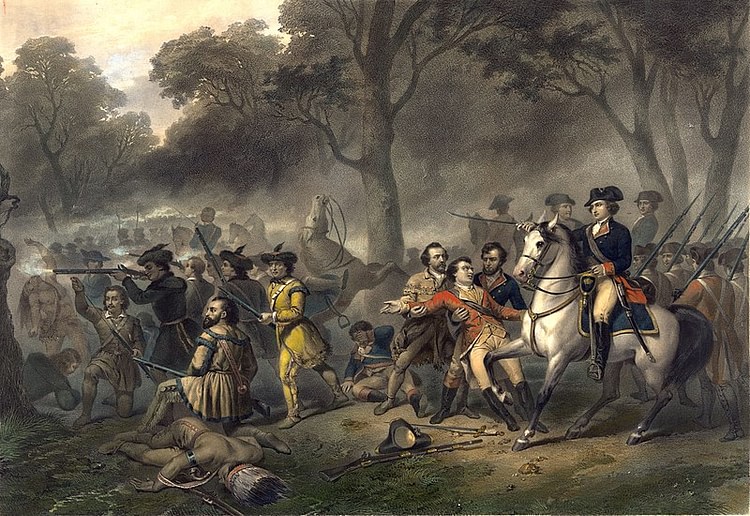
We recall Washington crossing the Delaware, the hero who led his troops from the front, who had his coat shot through with bullets multiple times, and even had his hat shot away, and yet was never wounded in battle. History remembers the British surrendering at Yorktown. They remember the man who resigned his commission in 1783 after he defeated the most powerful empire the world had ever known. They remember him as the statue of a man who became the nation’s first President and could have just as easily become King. It also remembers his Farewell Address and his return home to live out his last few years at his beloved Mount Vernon. Yet none of these moments fully explain the individual.
I can truly say I had rather be at Mount Vernon with a friend or two about me, than to be attended at the seat of government by the officers of state and the representatives of every power in Europe. ~Letter to Dr. James Anderson, December 7, 1795
It is his years as a surveyor, his travails, his triumphs, and, most notably, the wilderness of Virginia and the long track of the Blue Ridge that explain the man history would later remember.
Long before George Washington became known as the indispensable man, he was a young Virginian learning, often imperfectly, how to bear responsibility with integrity.
The vicissitudes of war and the various scenes I have been called to act in, have worn me out, and it is time for me, in the shades of retirement, to seek that tranquility which I have not found elsewhere. ~Letter to David Humphreys, July 25, 1785
And perhaps this is the real story worth remembering. Was Washington always destined for greatness? Hardly. The enduring myth of Washington as an almost preordained hero obscures the reality of a young man shaped by error, ambition, and contingency. Only by embracing this complexity, the messiness, the doubts, and the years of becoming can we truly appreciate the origins of his greatness. While many admire greatness, far fewer appreciate the process of becoming.
Yet it’s in this process that greatness consistently originates.
Morning fog rolling over the Blue Ridge (Greene/Madison County). Slow enough to remind you that time still belongs to the mountains. Song credit: Singing Song by Mipso
The deadlift is a foundational exercise in Olympic weightlifting, crucial for developing overall strength, maximum power, and athletic performance. Improving your deadlift can enhance your performance in the clean and jerk, snatch, and other compound lifts. Below you’ll find detailed strategies to enhance your deadlift, focusing on technique, strength training, range of motion work, and basic recovery strategies.
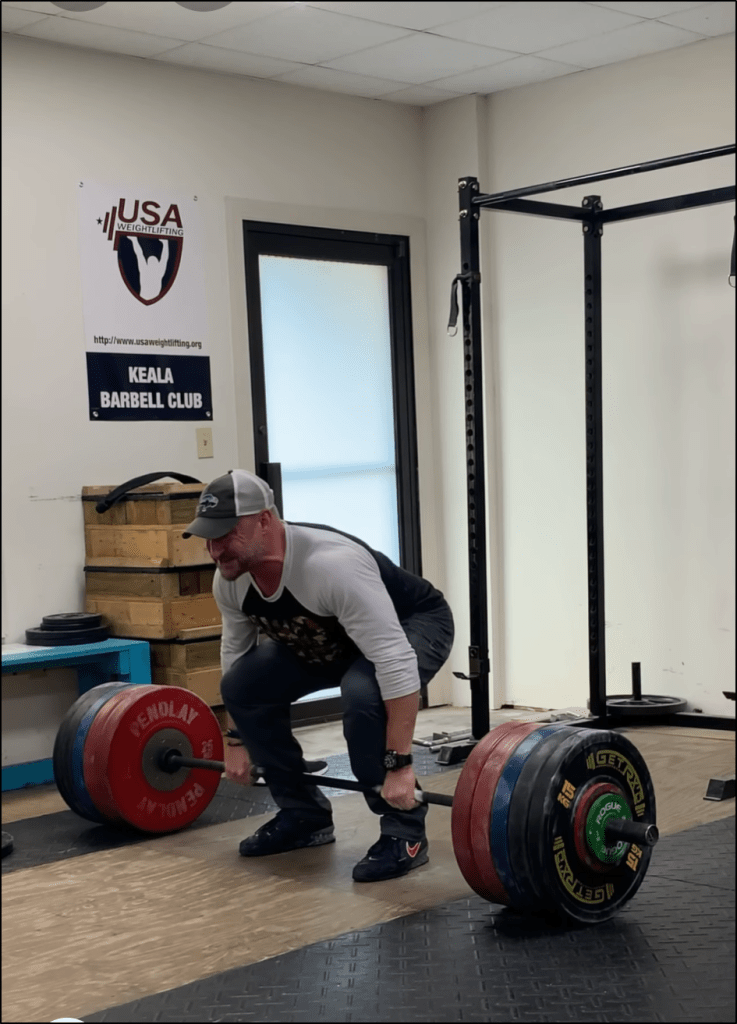
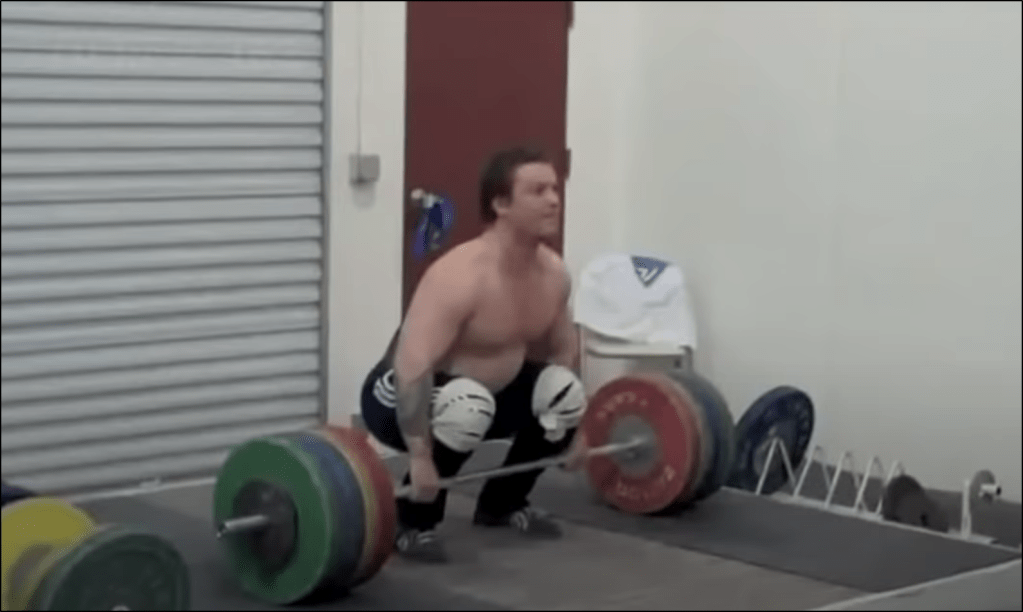
1. Perfect Your Technique — the main point here is this exercise will only help improve your lifts if it looks like the the first pull of the lifts. We are emphasizing the clean variation of the deadlift not the traditional deadlift.
Technique is paramount in the deadlift. Proper movement pattern not only reduces the risk of injury but also maximizes strength gains where it matters most. Here’s a more detailed breakdown of the essential components of deadlift technique:
Foot Positioning:
Stance: From the start, use your pulling position in the clean and/or snatch as reference. Like the conventional deadlift though be sure not to begin with your feet too narrow or too wide. My starting position varies slightly but should almost always be EXACTLY the same. Stand with your feet hip/shoulder-width apart, ensuring your toes are pointing slightly outward. How much your toes point out will determined by your hip structure genetically and your over mobility or lack-there-of. No matter where you begin, you want it to a habitual and it be a position to allow for a stable base and optimal leverage during the 1st pull, i.e. the deadlift portion of the movement.
Setup: Place the barbell over the mid-foot, close to your shins. This minimizes helps prevent the bar from traveling forward off the ground and helps keep it from getting out of position in any other portion of the lift. Even though some of you are not martial artists always remember this phrase — position before submission. This means make sure you put/keep the bar in the correct position throughout the movement so you can have MAXimal control over the bar throughout the movement.
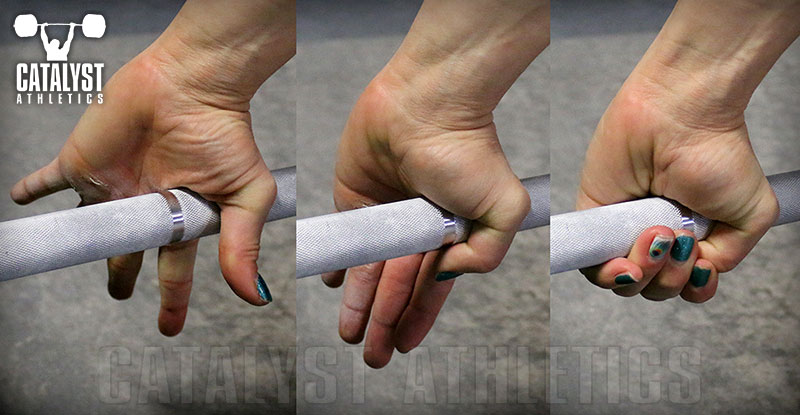
Grip: There’s only one and that’s the hook grip. get used to it early and make it habitual.
Hook Grip: Thumb is wrapped around the bar and secured by the fingers. This grip is more secure but can be uncomfortable initially.
Bar Path:
Proximity: Keep the barbell close to your body throughout the lift. The bar should travel in a straight line from the ground to the lockout position. This minimizes the distance the bar travels and reduces the strain on your lower back.
Hips and Back:
Starting Position: Begin with your hips lower than in a conventional deadlift, and your torso more upright. This engages your legs more effectively and helps you get used to using your legs to DRIVE the earth away.
Spine Position: Maintain a neutral spine throughout the lift. Avoid rounding your back to prevent injuries. Engage your core to stabilize your spine.
Pulling Motion:
Initial Lift: Drive through your WHOLE FOOT, extending your hips and knees simultaneously. Your shoulders should be slightly in front of the bar at the start.
Engagement: Engage your lats to keep the bar close to your body and prevent it from drifting forward.
Lockout: Fully extend your hips and knees at the top of the lift, ensuring your shoulders are back and your chest is up.
2. Build Strength with Accessory Exercises
Incorporate accessory exercises to target the muscles involved in the deadlift. These exercises help to build strength and address any weaknesses:
Execution: Stand in your snatch or clean pulling stance with a clean grip on the bar. Set your back in the same extension you use to pull the snatch and clean and brace your trunk forcefully.
Hinge at the hip while bending the knees very slightly to bring the bar as far down the legs as possible without losing any back extension. Actively keep the bar as close to the legs as possible throughout the motion.
Stay balanced evenly over the whole foot rather than pushing the hips back more than necessary and shifting to the heels. This will limit how much weight you can handle, but it will make the exercise more effective by increasing the force on the hips and back while reinforcing the balance we want in the snatch and clean, as well as strengthening the back and shoulders’ ability to keep the bar close to the body.
Stay braced tightly so as you change directions at the bottom, you don’t allow any softening of the back extension.
If you’re mobile enough to get the plates to the floor with perfect back extension, still stop just short of touching—the changing of direction without compromising back extension is an important element of the exercise.
Benefits: Focuses on the hamstrings and glutes, improving the posterior chain strength essential for a powerful deadlift.
Execution: The good morning is a posterior chain strength exercise that emphasizes isometric back extension strength.
Place the bar on the back as you would for a back squat. You can use either your squat or pulling stance depending on which you want to focus on.
Brace the trunk forcefully with the lower back neutral or slightly more extended and the upper back flattened as much as possible.
Bend the knees very slightly as you hinge at the hips as far as you’re able without losing back extension. Bend forward at a controlled speed, and recover at a natural to quick speed.
Maintain whole foot balance or shift slightly more to the heels, but keep the whole foot in contact with the floor.
Don’t allow your back to soften as you change direction in the bottom to stand again—resisting that force with a rigid trunk is a primary element of the exercise.
The knees can be bent more to shift more of the work to the glutes than the hamstrings, or can be locked straight to maximize hamstring emphasis.
Benefits: Strengthens the lower back, glutes, and hamstrings, promoting better hip hinge mechanics.
Pendlay Rows: AKA Bent-over row, bent forward row, barbell row
Execution: The bent row is a basic but effective upper body pulling exercise that strengthens the upper back, shoulders and arms.
Hold the bar with a clean-width grip, brace your trunk in the same position you would when pulling from the floor, and hinge forward at the hips while bending the knees to bring your trunk just above horizontal, letting the bar hang at arms’ length close to the legs.
Pull the bar to the abdomen, squeezing your shoulder blades back together and forcefully extending the upper back at the top of each rep. Lower the bar to full elbow extension without losing your braced back position.
Notes The bent row can be performed strictly with a controlled tempo, or with a little body English to put some speed on the bar and then reach the trunk into the bar at the top of the row. The angle of the trunk can also be varied depending on the desired effect, from horizontal to closer to 45-degrees—the higher the angle, the more heavily it can be loaded, but the smaller the range of motion.
Benefits: Develops mid-back strength, crucial for maintaining proper bar path and posture during the deadlift.
Execution: Fix the ankles in a glute-ham bench or similar adjusted to place the pad on the upper thighs. Bend at the hip and back to hang straight down from the hip—back relaxed and trunk hanging vertically.
Extend the hip and back together to bring yourself up to an extended position above horizontal in which the entire back, including the upper back, is extended completely and the glutes are forcefully contracted. Lift your head up at the top to reinforce upper back extension.
For unweighted back extensions, placing the hands behind the head is recommended to help encourage better extension of the upper back. For weighted back extensions, hold the weight in the form of a barbell or dumbbell behind the neck to ensure better resistance and better reinforce that upper back extension.
Notes Technically, this execution is combined back and hip extension. Back extension can be isolated by fixing the hips in place with the glutes and flexing and extending only along the spine. This can be assisted by relocating the fulcrum or pad of the bench closer to the hips.
Trunk Work: Copenhagen Plank, Chinese Plank (add weight if/when you can) Russian Twists: Leg Raises: Lying Leg Raises. For the Copenhagen & Chinese planks think doing 3-5 sets of 1min resting 1-2 mins between for all of the others think 3-4 set of 15-25 reps per exercise and also resting 1-2 mins between sets.
Execution: Use a wide grip, similar to a snatch. Perform the deadlift with this grip.
Benefits: Enhances upper back and grip strength and increases the range of motion.
3. Focus on strength in your end ranges of motion not simply “mobility” or being “flexible”
Mobility and flexibility are vital for performing a safe and effective deadlift and overall quality of your movement pattern(s). Think of and possibly implement these movements into your mobility/ROM work exercises into your routine:
Hips: Perform hip flexor stretches, pigeon pose, and hip circles to improve hip flexibility.
For your hamstrings think of using using dynamic and static stretching to enhance hamstring flexibility, allowing for better hip hinge movement. Things like poor man’s GHR, Frankensteins, Hamstring sweeps, and so on.
Ankle Mobility: Incorporate ankle plantar and dorsiflexion exercises to ensure you can maintain proper foot positioning and balance. Worst case scenario just do a couple of slow, controlled bodyweight double and single calf raise to get your calves and ankle complex warm/fired up and ready to lift!
Thoracic Mobility: Here really focus on getting the support structure of your t-spine loose and work on what you need to get yourself closer and closer to the best starting position you can achieve.
Here’s a great exercise The Barbell Physio just dropped on their IG page:
Progressive overload is essential for continuous improvement. Gradually increase the weight you lift, the number of repetitions, or the volume of your training sessions to challenge your muscles and stimulate growth. Here’s how to effectively implement progressive overload:
Linear Progression: Increase the weight lifted in small, consistent increments/percentages each week.
Volume Training: Add more sets and reps to your routine, focusing on maintaining proper form.
Tempo Variations: Incorporating tempo with your lifts, primarily slow eccentrics (lowering phase), to increase time under tension and build strength are of paramount importance. Using slow tempos also help you feel the muscles you use to do the lifts, and can be the greatest tool you’ll be exposed to help you master the positions of the lifts.
5. Last, and certainly not least, prioritize Recovery
Recovery is just as important as training itself. Proper recovery ensures that your muscles repair and grow stronger, and reduces the rick of injury.
Key recovery strategies include:
NUMBER ONE! Adequate Sleep: Aim for 8-9 hours of sleep per night to support muscle recovery and overall health.
Nutrition: As one famous fitness influencer one said — you can only piss in the gas tank for so long and expect elite performance. So, be sure to quality proteins, healthy fats, and lots of fruits and vegetables. Consider post-workout nutrition/protein shakes if you struggle to meet your daily macros to aid muscle repair. But, first and foremost, be sure you are focusing on eating whole foods vs supplementing with any kind of shakes. Yes, use them when necessary but only when necessary.
Hydration: Stay well-hydrated to maintain muscle function and performance.
Active Recovery: Engage in low-intensity activities such as walking, jogging, rowing, swimming or any sort of quality mixed modal training to help promote blood flow and muscle recovery.
Improving your Olympic weightlifting deadlift requires a comprehensive approach that includes perfecting your technique, incorporating accessory exercises, focusing on mobility, implementing progressive overload, and prioritizing recovery. By consistently applying these strategies, you will build the strength, power, and resilience needed to excel in your deadlift and overall Olympic weightlifting performance. Remember, progress takes time and dedication, so stay patient and committed to your training regimen. More importantly, deadlifting feels cool because you can move a lot of weight but don’t forget to actually do the lifts!
Well, well, well, the world has changed a lot since my last post. Definitely have a lot of irons in the fire as the old saying goes. Currently working on the PenTest+ certification from CompTIA. I’ll be following that up with the CEH exam. Between those two certs I’ll be working on and getting the ISACA’s Cybersecurity Audit Certificate. 2024 is shaping up to be another great year!
A1. Incline curls 10, 10, 10, 10 – :03 second lowering/eccentric load; rest 0 A2. Seated hammer curls 20, 20, 20, 20; rest 0 A3. Standard EZ bar curl 20, 20, 20, 20; rest 2mins B1. Bench dips 20 x 3; rest 0 B2. Banded press downs 20, 20, 20; rest 0 – pause for two deep nasal breaths at the top of every 5th rep B3. Triceps push-ups max effort/push to failure; rest 2mins C1. EZ bar close grip curls 15, 15, 15; rest 0 – try to stay at the same weight for all 3 movements C2. EZ bar drag curls 15, 15, 15; rest 0 C3. EZ bar overhead triceps exts. 20, 20, 20; rest 1 + 7 n 7 for 7 7 Hang power cleans & push press 7 walk out burpees without the pushup
On Monday I accepted an offer to begin teaching, part-time, for Chegg/Thinkful.com in their Cyber Security program. I’m really looking forward to helping the next wave of cyber sec professionals. It’ll be another great way to help keep up with current trends, continue to reinforce the fundamentals, and also share past and present experiences with a wide swath of new IT pros. Who knows, before long I just might be able to start posting videos of training and teaching again.
Current affairs:
The bravest are surely those who have the clearest vision of what is before them, glory and danger alike, and yet notwithstanding, go out to meet it.
When I first wrote this, I wasn’t chasing promotions or algorithms. I was just trying to keep showing up to train, to learn, to get a little better each day. Back then, “rep after rep” was more than a training mantra. It was a way to stay grounded when progress felt invisible.
The hardest part wasn’t physical. It was the repetition, the daily grind that felt endless. Whether I was refining form under the barbell or troubleshooting code that refused to run, the challenge was the same: staying patient when nothing seemed to move forward.
Some days you make the lift. Some days the lift makes you. But the point is always to come back tomorrow.
At some point, I stopped expecting each session, physical or mental, to feel like a breakthrough. The breakthrough was the habit itself. The more I showed up, the more the process began to reveal patterns: what worked, what didn’t, and how small adjustments compound over time.
In strength and in cybersecurity, consistency is the quiet multiplier. Each drill, each review, each run-through, one more rep toward mastery.
That same mindset carries through everything I do now — training teams, hardening systems, or writing content. I don’t chase perfect outcomes anymore. I look for steady iterations. A little tighter form. A cleaner line of code. A stronger policy.
That’s how resilience is built, not simply through intensity, but through consistency.
Progress doesn’t shout. It stacks. And one day, you realize the work that used to test you has become the warm-up.
Training for the day:
7 mins of:
7 Banded Sumos
7 Banded bodyweight squats w/moderate band
7 Calf raises
+
A. Back Squat 10, 10,10,10; rest 2/2:30 – 10 RM-ish
B1. Heels elevated air squats x 10 x 3; rest :10
B2. RDL w/an empty bar, sweep away — lumbar focus x 15 x 3; rest 1
C. SL RDL stability, unloaded x 10 x 3; — 5 per leg; rest 1
+
10min alt EMOM:
20 Step-ups – 10 per
15 push-ups
Martial skill work — 5 x 5 min rounds of Z2-Z4 striking, upper push/pull bodyweight movements in trapping/grappling range, and take down defense/sprawling/working underhook escapes et cetera.
Today in my world of Linux and pentesting I worked on building out an Active Directory Lab and worked on the initial attack vectors when attacking an AD based system. Things like LLMNR Poisoning, Capturing NTLMv2 Hashes with Responder, Password Cracking with Hashcat, LLMNR Poisoning Defense, SMB Relay Attacks, Discovering Hosts with SMB Signing Disabled, Start SMB Relay Attack Defenses, & Gaining Shell Access.
Training: A1. Seated Arnold rotations x 20, 20, 20; rest :30 A2. Banded triceps press down 20, 20, 20; rest 1 B1. SA DB row x 10-12 reps x 3; @31X1 on the first 5 reps rest :10 secs b/t arms B2. Snatch grip BTN press w/an empty bar x 15 x 3; rest 1 C1. Assisted pullups using barbell and feet in pullup cage x 6-8 x 3; rest :0 C2. DB push press 15, 15, 15; rest 1 D1. DB shrugs 30, 30, 30, 30; rest :30 D2. Banded upright row 25, 25, 25, 25; rest 90
5 sets of :30secs of work/:30 secs of rest :30secs KBS – 2pd. :30secs rest :30 secs pushups :30secs rest :30 secs DB RDL – 55/h :30secs rest :30secs 24” box step-ups :30secs rest
Today’s professional training covered Linux User Accounts and Groups along with Managing File Ownership and Permission. Then in network penetration we covered privilege using Sudo + about hour of training over at tryhackme.