The Volume Spectrum
Understanding Maintenance Volume (MV), Minimum Effective Volume (MEV), Maximum Adaptive Volume (MAV), Maximum Recoverable Volume (MRV), and Everything Between

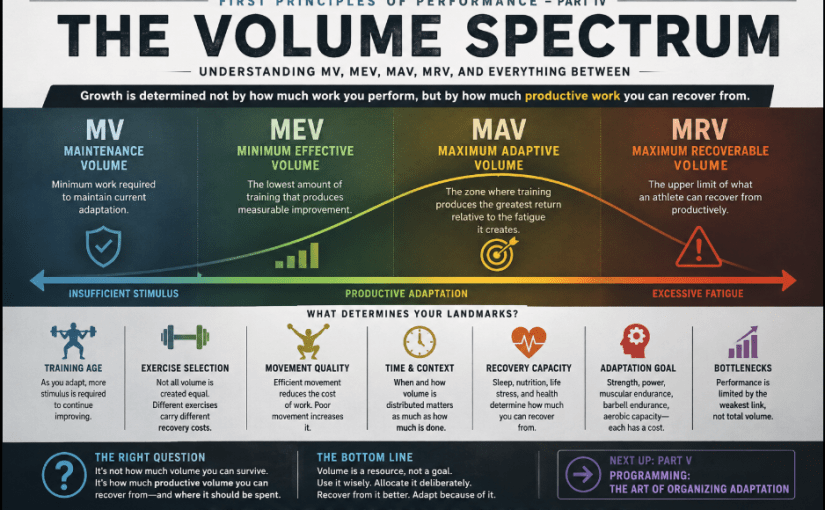
Growth is determined not by how much work you perform, but by how much productive work you can recover from.
Introduction
Walk into almost any Olympic Weightlifting or power lifting gym, CrossFit affiliate, or even the standard Globo gym and you’ll eventually encounter two seemingly opposite philosophies.
One athlete believes progress comes from doing more: more sets, more repetitions, more accessory work, more conditioning, more training days. If some novel amount of work produces results, even more work should produce even better results.
Another takes almost the opposite approach: do as little as necessary to stimulate improvement, then get out and recover.
Curiously, both can point to successful athletes who appear to prove them right.
One can point to the CrossFit athlete training multiple sessions a day, the weightlifter accumulating hundreds of technically demanding repetitions each week, or the bodybuilder thriving on German high volume training. Then another points to an elite powerlifter progressing on surprisingly few max-effort lifts, or an experienced weightlifter whose training becomes more productive after unnecessary volume is removed.
So which approach is correct? Both and neither. Why? Because the question itself is flawed.
The body does not respond to volume in absolute terms. It responds to recoverable stress.
That distinction changes everything.
The objective of training is not to perform the greatest amount of work possible. It is to perform the greatest amount of productive work possible: enough to create the desired adaptation without accumulating so much fatigue that additional work stops contributing meaningfully to it.
There is a difference between training that challenges your capacity and training that simply consumes it.
Understanding where that line exists, and recognizing that it shifts according to the athlete, the adaptation being pursued, the type of training being performed, and where the athlete is in their development, is one of the most valuable skills an athlete or coach can develop.
This is where the Volume Spectrum begins.
More Is Better, Until It Isn’t
One of the oldest assumptions in strength training is beautifully simple: if ten sets build muscle, twenty must build even more. And if twenty works, why not thirty?
The problem is that biological markers rarely, like life, move in straight lines.
The human body is governed by diminishing returns. Initially, increasing training volume can produce greater adaptation. Strength improves, muscle grows, work capacity increases, and technique becomes more refined. But eventually those returns begin to diminish. Progress slows, then plateaus, and if volume continues increasing without sufficient recovery, performance can begin moving backward.
More work has become less productive.
The irony is that many dedicated athletes interpret this decline exactly backward. Feeling stalled, they assume they simply need to work harder, so they add another exercise, another set, another conditioning session, another “finisher.”
Instead of solving the problem, they’ve increased the very stress that caused it.
The Volume Spectrum

Training volume can be understood through four useful landmarks along a continuum. These should not be treated as rigid physiological thresholds or universal numerical prescriptions, but as practical regions that help coaches think about the relationship between training stress and adaptation.
Quick Reference: Training Volume Landmarks
MV (Maintenance Volume): The minimum amount of training needed to maintain current performance and muscle mass. Used during periods of reduced training, deloads, or recovery phases.
MEV (Minimum Effective Volume): The lowest training dose that produces measurable progress or adaptation. Anything below this threshold will not drive improvement.
MAV (Maximum Adaptive Volume): The “sweet spot” where training volume is high enough to maximize gains without causing excess fatigue or risk of overtraining. This is where most productive training occurs.
MRV (Maximum Recoverable Volume): The upper limit of training volume that the body can adapt to and recover from. Exceeding this consistently leads to stagnation, regression, or injury.
In short:
- MV: Enough to maintain, not improve.
- MEV: The minimum to make progress.
- MAV: The most productive range for gains.
- MRV: The most you can recover from, not to be exceeded.
Maintenance Volume (MV)
Maintenance Volume is exactly what it sounds like: the minimum amount of work required to preserve a current level of adaptation.
Notice what it is not. Maintenance volume is not intended to produce meaningful improvement. It provides enough stimulus to prevent meaningful loss.
This matters more than many athletes realize because maintenance allows training resources to be reallocated. A competitive CrossFit athlete may temporarily reduce upper-body hypertrophy work while emphasizing Olympic lifting. A tactical professional preparing for selection may maintain maximal strength while substantially increasing endurance. An older adult may temporarily reduce overall workload while attempting to preserve existing strength and muscle mass.
Maintaining an adaptation generally requires less training than developing it in the first place. That principle becomes one of the coach’s most valuable tools because no athlete can emphasize everything simultaneously.
Sometimes maintaining one quality is precisely what allows another to improve.
Minimum Effective Volume (MEV)
MEV represents the lowest amount of training necessary to produce measurable improvement. Think of it as crossing the threshold where training moves beyond maintenance and begins providing enough stimulus for further adaptation.
Importantly, MEV is highly individual.
A novice lifter may stimulate meaningful progress with relatively little training. An experienced athlete may require substantially more work simply to continue improving. Training age changes the equation because the stronger, more conditioned, and more experienced you become, the greater the stimulus may need to be before the body has sufficient reason to adapt further.
Success changes the rules.
Maximum Adaptive Volume (MAV)
Maximum Adaptive Volume describes the region where training produces the greatest return relative to the fatigue it creates.
Not necessarily the most work. The best work you can do, achieving the intended stimulus, and recover from.
Most productive training should occur somewhere in this range. Performance improves, strength or work capacity develops, recovery remains manageable, technique stays relatively sharp, and the athlete remains capable of continuing to perform quality training.
That distinction matters. MAV is not defined by exhaustion, it’s defined by adaptation.
Maximum Recoverable Volume (MRV)
Eventually every athlete reaches a point where additional work creates more fatigue than useful adaptation. That upper boundary is Maximum Recoverable Volume.
MRV should not be treated as a target. It’s the ceiling.
Experienced athletes may intentionally approach that ceiling during concentrated training blocks before reducing workload and allowing accumulated fatigue to dissipate. Used carefully, periods of functional overreaching can have a place within training.
Living near or above MRV is another matter.
When training chronically exceeds the athlete’s ability to recover, familiar warning signs can begin appearing: declining performance, slower bar speed, persistent soreness or joint discomfort, deteriorating sleep, reduced motivation, worsening session quality, and increased susceptibility to minor illness.
The dedicated athlete may again interpret these symptoms as evidence that more work is required. Often the opposite is true.
Why These Landmarks Move
One of the biggest mistakes coaches make is treating volume landmarks as fixed numbers.
They aren’t.
Your MEV this year may not resemble your MEV five years from now. Your MRV during a period of low life stress may differ considerably from your MRV during a demanding work cycle, caloric deficit, competition season, or period of poor sleep. The amount of volume you can recover from for one physical quality may also differ substantially from what you can tolerate for another.
These landmarks move because the athlete moves. As the old saying goes, “You can’t be in fight shape all the time.”
Training Age
Beginners often require surprisingly little work to improve. Advanced athletes generally require a greater stimulus to continue adapting, while simultaneously becoming capable of creating considerably more stress during each hard working set.
Five sets of squats performed by an athlete squatting 135 pounds do not represent the same physiological event as five sets performed by an athlete squatting 500.
The volume may look identical on paper. The affect on the body is not.
Exercise Selection and Recovery Cost

Not all training stress is created equally.
Three sets of leg extensions, three sets of heavy back squats, three rounds of ring muscle-ups, ten minutes of EMOM barbell cycling, and a 5k row for time all qualify as training volume, but they do not impose the same demand.
Heavy compound lifting can create substantial mechanical and systemic fatigue. High-repetition gymnastics challenge local muscular endurance, connective tissue, grip, coordination, and the ability to maintain movement quality as fatigue (neurological and physical) accumulates.
Repeated cleans or snatches performed under metabolic fatigue combine muscular endurance with technical proficiency, strength, power, timing, and repeated force production. Longer aerobic work may create relatively little mechanical damage while still imposing substantial cardiorespiratory and metabolic demand.
This is why simply counting sets, repetitions, minutes, or meters can become misleading.
Programming volume requires understanding what quality the work is developing, how much useful stimulus it provides, and what it costs the athlete to recover from it.
The body doesn’t count reps, it accumulates stress.
Different Qualities Carry Different Costs
One of the greatest misconceptions in training is assuming every physical quality responds to volume in the same way.
It doesn’t.
Absolute strength and power require exposure to high levels of force and velocity. A strong baseline in movements such as squats, deadlifts, presses, pulls, and Olympic lifts provide a foundation from which explosive force can be expressed.

Muscular endurance requires something different: the local capacity of muscles and the nervous system controlling them to repeatedly produce useful contractions despite accumulating fatigue. In gymnastics, that may mean sustaining pull-ups, push-ups, toes-to-bar, handstand push-ups, or muscle-ups. With a barbell, it may mean repeatedly cycling cleans, snatches, thrusters, or shoulder-to-overhead movements while maintaining enough technical integrity to continue working efficiently.
Cardiorespiratory endurance and stamina place another demand on the athlete. Aerobic and anaerobic metabolism must continually provide energy across efforts lasting seconds, minutes, or hours, while the athlete develops the capacity to sustain output and recover between repeated demands.
Strength, power, muscular endurance, barbell endurance, cardiorespiratory endurance, and stamina coexist, but they are not interchangeable.

A CrossFit athlete preparing for competition may intentionally increase muscular endurance, barbell cycling, aerobic development, and repeated-effort aerobic power and capacity training while maintaining rather than maximizing absolute strength.
An Olympic weightlifter may do almost the opposite, allocating considerably more training toward strength, power, technical consistency, and the competition lifts. A tactical professional may require substantial strength alongside loaded movement, cardiorespiratory endurance, muscular stamina, and repeated performance under fatigue.
An older adult may prioritize strength, muscle mass, aerobic capacity, mobility, balance, and resilience because the objective is preserving capability and independence rather than maximizing competitive performance.
None of these athletes are training incorrectly, they’re simply solving different problems. Volume only becomes meaningful when viewed through the adaptation being pursued.
Movement Quality Changes the Cost of Volume
There is another variable that sets and repetitions alone cannot explain: movement quality.
Before deciding that an athlete needs more squats, gymnastics, barbell work, or conditioning, the coach must understand whether the athlete can efficiently perform the movements being prescribed.
Can they squat through the required range of motion while maintaining position? Can they establish a stable overhead position and safely receive a clean or snatch? Do they possess the ankle, hip, thoracic, and shoulder mobility required for the task? Can they maintain trunk control and coordination as fatigue accumulates?
Flexibility and mobility are not decorative qualities simply sprinkled in at the beginning or at the end of a training session. Adequate range of motion allows the athlete to access the positions required for the task(s); mobility adds the ability to control those positions. Coordination, agility, and balance allow the athlete to organize movement, redirect force, transition between tasks, and preserve technical integrity under changing conditions.
These qualities are essential and non-negotiable under fatigue.

Walking on your hands while fresh is one skill. Maintaining a handstand walk after heavy cleans and/or several minutes of high-output conditioning is another. The same principle applies to receiving a snatch in a deep overhead squat, transitioning efficiently through ring muscle-ups, or maintaining clean mechanics while breathing heavily and losing grip strength.
Poor movement quality increases the cost of work. Efficient movement reduces it.
Two athletes can therefore complete exactly the same prescribed volume while experiencing meaningfully different training loads.
Sometimes the fastest way to improve work capacity isn’t adding more work.
It’s reducing wasted movement. Or, what we used refer to in CrossFit as seeking Virtuosity in movement.
Volume Exists in Time
Twenty weekly sets performed in one session are not equivalent to twenty sets distributed across four sessions.
Fatigue accumulates differently. Performance quality changes. Recovery opportunities change.
The same principle applies outside traditional resistance training. Twenty minutes of high-skill gymnastics performed while fresh is not equivalent to twenty minutes performed after heavy barbell work. Six sprint intervals distributed appropriately across a training week do not necessarily impose the same cost as those same intervals performed immediately after a demanding lower-body session.
Volume therefore cannot be separated from frequency, sequencing, and recovery. Where the work occurs matters, what happens before and after it matters. The body does not simply experience training volume. It experiences stress over time.
The Athlete Changes the Equation

Genetics, sleep, nutrition, age, life stress, occupation, training history, and movement quality all influence the amount and type of training an athlete can productively tolerate.
A firefighter working rotating night shifts may have a very different MRV from a college student sleeping nine hours each night. Two athletes possessing similar strength may tolerate very different amounts of training, and two athletes capable of completing the same workout may require entirely different interventions because their limiting factors are different.
One may lack absolute strength. Another may lack muscular endurance. Another may possess tremendous strength but poor muscular endurance. Another may have excellent local muscular endurance but insufficient aerobic capacity to recover between efforts. Another may simply move inefficiently which can make each training session twice as hard as it needs to be with the most basic of movements like air squats, pushups, pullups or burpees.
That’s why programming that ignores recovery outside the gym ignores half the equation.
And programming that ignores the individual misunderstands the other half.
Autoregulation: Listening Without Guessing
Perhaps the greatest weakness of rigid programming is the assumption that today’s body is identical to yesterday’s.
It isn’t.
Autoregulation recognizes that readiness fluctuates. Instead of blindly completing predetermined workloads regardless of performance, intelligent athletes and coaches adjust training according to relevant objective and subjective information.
Bar speed, repetitions in reserve, perceived exertion, heart-rate recovery, sleep quality, motivation, persistent soreness, session performance, movement quality, and technical deterioration under fatigue can all provide useful information.
No single metric tells the entire story. The purpose is not to replace programming with daily improvisation.
Autoregulation isn’t abandoning structure it’s allowing physiology to inform execution.
Deloads: Adaptation’s Forgotten Partner
One of the greatest misconceptions in training is that progress results from uninterrupted accumulation. It doesn’t. Progress often depends upon strategic reduction.
Deloads intentionally reduce training stress so accumulated fatigue can dissipate while much of the underlying adaptation is preserved. The purpose isn’t simply to rest. It is to restore the athlete’s capacity to perform productive training again.
A deload is not necessarily a step backward. Often it is the point at which accumulated fitness becomes visible beneath accumulated fatigue. We’ll discuss deloading, and its importance in more detail, later in this series
Pacing, Bottlenecks, and Productive Volume
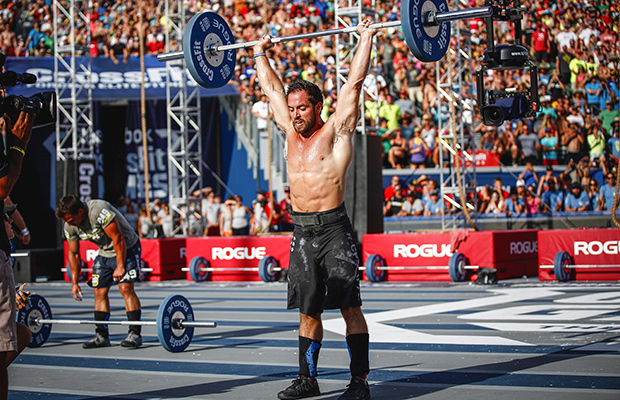
More volume is rarely the solution to poor performance.
Sometimes the athlete needs more strength. Sometimes they need greater muscular endurance, a larger aerobic base, better gymnastic skill, more technical practice, or improved movement economy.
And sometimes they simply need to stop going out too hard. Pacing by itself is a performance skill. Athletes have to learn how much work can be performed now without any degradation in overall performance.
That means learning how quickly your breathing recovers, knowing when to stop just before grip or shoulder failure, or when technically efficient barbell cycling becomes increasingly expensive, and where local muscular fatigue or technical breakdown reliably appears.
Meaning, where is the bottleneck?
An athlete who repeatedly falls apart during the final five minutes of a 20min AMRAP, may not need another conditioning session. They may benefit more from not trying to win the first five minutes.
Likewise, an athlete struggling with high-repetition cleans may assume the problem is conditioning when insufficient absolute strength is making every repetition too expensive. Another athlete may possess enormous strength but lose time because poor economy of motion makes their receiving positions inefficient. Another may possess the engine and strength but lack the coordination required to transition efficiently between gymnastics and other external loading.
The workout reveals the symptom(s) and good assessments identify the cause(s). That distinction matters because training should target the bottleneck, not just accumulate more fatigue around it.
Volume Is a Conversation, Not a Competition
Perhaps the most important lesson from the Volume Spectrum is this: Volume is not something to maximize, it’s something to be optimized.
It’s a training resource to be allocated according to the athlete’s objectives, abilities, limitations, and capacity to recover. The strongest programs are rarely those that demand the most work. They are the ones that consistently produce the greatest useful adaptation relative to their cost.
That balance changes throughout a career. It changes across seasons and according to the physical quality being developed. It changes during periods of occupational stress, poor sleep, illness, caloric restriction, or competition preparation. And it changes as weaknesses become strengths and new bottlenecks emerge.
The best coaches therefore don’t ask: How much volume can this athlete survive?
They ask: How much productive volume can this athlete recover from?
And eventually, they ask an even better question: Where should that volume be spent?
Those are profoundly different questions. One measures work while the other considers adaptation. And that final question brings us to the next principle.
Looking Ahead

By now, we’ve moved far beyond the old argument that strength and conditioning somehow exist in opposition to one another.
We’ve seen that the interference effect is real but contextual. We’ve examined what performance programs actually look like and why athletes with very different objectives still develop many of the same fundamental physical qualities. And now we’ve established that even the amount of training itself exists along a spectrum, from the work required merely to maintain an adaptation to the upper boundary of what the athlete can productively recover from.
But volume alone still cannot tell us what to do.
Knowing that an athlete can recover from twelve hours of training each week tells us nothing about how those twelve hours should be spent.
Should we build absolute strength and power? Develop muscular endurance or barbell cycling skill? Expand cardiorespiratory capacity? Improve flexibility and movement efficiency? Develop coordination, agility, and balance? Improve movement quality or technical skill? Practice pacing? Attack a specific bottleneck?
Or should several of those qualities simply be maintained while training resources are concentrated on the one that matters most right now?
That is where coaching becomes something more than exercise selection.
A bodybuilder, Olympic weightlifter, tactical professional, CrossFit athlete, and older adult may all require some combination of strength, endurance, power, movement competency, and resilience.
But their needs vary in degree and application, not in kind. What changes is the proportion.
What changes is the priority. What also changes is the organization of stress across time.

Good programming does not ask which physical quality is universally best. It asks which quality matters most for this athlete, at this moment, how much of the others must be developed or preserved, where the athlete’s bottlenecks exist, and how those pieces can coexist without obscuring the primary objective.
That is why programming cannot be reduced to exercises written beneath the days of the week, and it certainly isn’t the random accumulation of difficult workouts.
Programming is the deliberate organization of stress in pursuit of adaptation.
It determines what to develop, what to maintain, what to temporarily deprioritize, how much work to perform, when to perform it, when to push, when to pull back, and when the athlete standing in front of you requires something different from what you originally wrote on paper.
In Part V of First Principles of Performance we discover how programming is not the science of writing workouts. It’s the strategic art of organizing adaptation, we bring those pieces together and examine how coaches actually organize adaptation: how strength, power, muscular endurance, cardiorespiratory capacity, movement competency, skill, recovery, and the individual athlete become a coherent training system rather than a collection of disconnected workouts.
Because knowing the physiology is important, knowing the how and why we utilize MGW is foundational, and how and why knowing all of the movements is elemental. But, knowing how to organize them around the needs of the individual is where knowledge becomes art.
Programming is not simply the science of writing workouts. It is the art of organizing adaptation. As always, the principles remain constant.
The application is the art. And that’s what quality coaching is all about.