First Principles of Performance – Part II

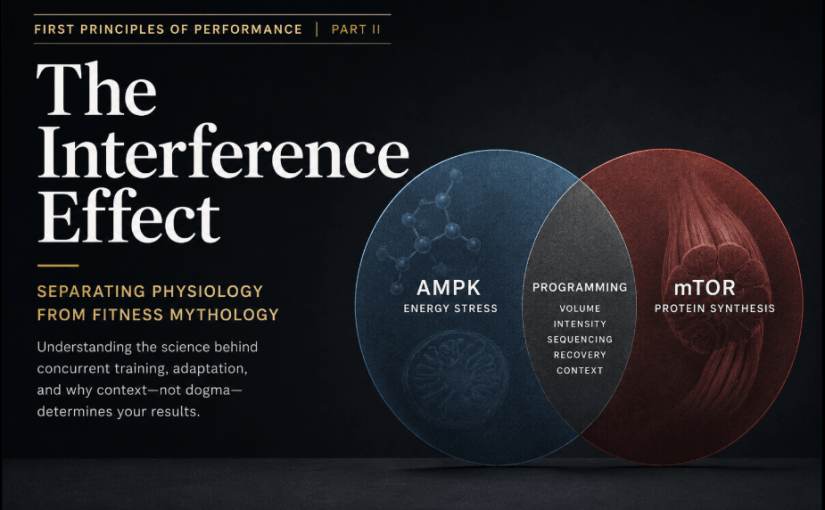
The Interference Effect: Separating Physiology from Fitness Mythology

“Understanding what works is valuable. Understanding why it works changes the way you think forever.”

In the previous article, Cardio Doesn’t Kill Your Gains. Poor Programming Does, we challenged one of the most persistent myths in strength and conditioning.

The conclusion was straightforward.

Cardiovascular training does not inherently prevent muscle growth. Rather, poorly designed training, excessive volume, inadequate recovery, insufficient nutrition, and conflicting priorities, is what most often limits progress.

For the overwhelming majority of lifters, the question isn’t whether they should perform cardiovascular training. The question is how to integrate it intelligently into a well-designed program.

That practical advice is enough for most people.

But for coaches, athletes, and those who simply enjoy understanding why the body behaves the way it does, there is a much deeper story waiting beneath the surface.

That story begins inside a single muscle cell.

The Conversation Inside the Cell

Every training session asks your body a question.

Heavy squats ask:

“Can you produce more force?”

A sprint interval asks:

“Can you generate enormous amounts of energy very quickly?”

A thirty-minute Zone 2 session asks:

“Can you become more efficient?”

Your muscles answer each of these questions by activating different signaling pathways that regulate adaptation.

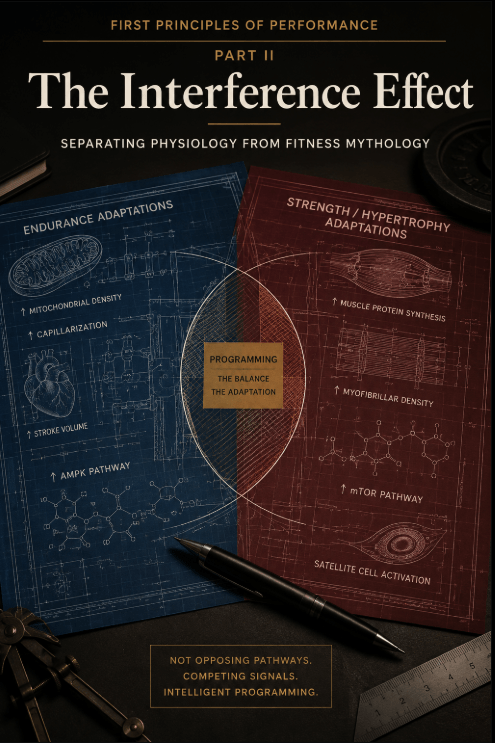
These pathways are often portrayed as opposing armies locked in constant battle. One builds muscle. The other builds endurance. One must win while the other loses. It’s an appealing narrative. It’s also an oversimplification because biology is rarely that binary.

Meet the Two Most Famous Molecules in Exercise Physiology

If you’ve spent any time reading about muscle growth or endurance training, you’ve almost certainly encountered two acronyms:

AMPK

and

mTOR.

They’re frequently described as rivals. While that’s directionally true, the relationship is considerably more nuanced than the internet often suggests.

AMPK functions as the cell’s energy sensor. Whenever energy availability begins to decline, as happens during prolonged or demanding exercise, AMPK becomes activated.

Its job is straightforward and that’s to restore energy balance.

It encourages the body to become more metabolically efficient, increase glucose uptake, enhance fat oxidation, and promote mitochondrial adaptations that improve endurance over time.

mTOR serves a different purpose.

Rather than conserving energy, mTOR responds to mechanical tension, amino acid availability, particularly leucine, and adequate cellular energy by promoting protein synthesis, tissue repair, and muscle growth.

One pathway asks,

“How do we survive this demand?”

The other asks,

“How do we become stronger for the next one?”

Both are essential an neither is the enemy.

Where the Myth Begins

Here’s where decades of misunderstanding started. Researchers discovered that AMPK can suppress certain components of the mTOR pathway.

That finding quickly evolved into a popular conclusion:

“Cardio turns on AMPK.

AMPK turns off mTOR.

Therefore cardio kills muscle growth.”

Simple but also wrong, or at least incomplete. Because physiology almost never operates like a light switch.

Biology Prefers Dimmers Over Switches

One of the most overlooked aspects of exercise physiology is time. AMPK responds rapidly to energetic stress. During demanding exercise, it rises quickly.

Then, once the exercise ends and energy balance begins to recover, AMPK activity declines just as rapidly, often within minutes to a few hours.

mTOR behaves differently.

Following resistance training, especially when combined with adequate protein intake, mTOR signaling can remain elevated for many hours and, in some cases, more than a day as muscle protein synthesis continues.

These aren’t two permanent states competing for dominance. They’re temporary responses to changing physiological demands. Your body constantly adjusts which pathway receives greater emphasis based on what it needs at that moment.

Location Matters

Another misconception is that these pathways somehow control the entire body equally at all times. They don’t. Many signaling responses are remarkably localized.

The muscle fibers performing repeated contractions experience different metabolic demands than surrounding tissues. The cardiovascular system responds differently than skeletal muscle. The liver behaves differently than adipose tissue.

Even within skeletal muscle, fiber type influences adaptation. The body isn’t issuing a single command. It’s conducting an orchestra. Different sections play different parts. Together they produce adaptation.

The Body Doesn’t Choose Between Building and Improving

Perhaps the most fascinating aspect of this entire discussion is that AMPK and mTOR are not always mutually exclusive. Under certain physiological conditions, aspects of both pathways can be active simultaneously. Cells routinely remove damaged proteins while synthesizing new ones.

Energy availability can improve while structural remodeling occurs. Recovery itself is an ongoing process of destruction and regeneration. Our physiology isn’t designed around choosing one adaptation. It’s designed around balancing competing demands with extraordinary precision.

What the Research Shows

This is where molecular biology meets coaching.

When researchers move beyond isolated signaling pathways and study actual athletes over weeks and months, the dramatic interference many people fear becomes surprisingly difficult to reproduce outside very high volumes of endurance training.

Concurrent training research consistently demonstrates that the magnitude of the interference effect depends on factors such as:

  • Total endurance volume
  • Exercise modality
  • Session timing
  • Recovery
  • Nutritional status
  • Training experience
  • Overall programming

In other words, the molecular biology doesn’t invalidate the conclusions from the previous article, it explains them.

Recent research confirms that the so-called “interference effect” is real, but its magnitude depends on how training is programmed. For example, a 2016 study by Jones et al. found that, while concurrent training can slightly reduce strength gains compared to strength training alone, the effect is modest and can be minimized with thoughtful sequencing and recovery (Jones et al., 2016).

Why Running Sometimes Differs from Cycling

One particularly interesting finding is that not all endurance training produces the same interference.

High-volume running often creates greater reductions in hypertrophy than cycling or rowing.

Why?

Part of the explanation likely lies in mechanical loading. Running introduces thousands of eccentric foot strikes that generate additional muscular damage and recovery demands.

Cycling and rowing produce far less eccentric stress while still developing robust cardiovascular adaptations. The heart doesn’t particularly care how you elevate its workload.

Your joints and muscles often do. For athletes prioritizing hypertrophy, choosing lower-impact conditioning modalities can preserve more recovery capacity for strength training.

The First Principle
Understanding physiology should never replace good coaching.

It should explain it. The interference effect is real. But it is conditional, contextual, and frequently exaggerated. Most athletes don’t need to fear cardiovascular training. They need to respect recovery.

They need to understand adaptation. And above all, they need to remember that physiology doesn’t reward extremes. It rewards appropriate stress followed by appropriate recovery. That’s how stronger muscles are built. That’s how better cardiovascular systems are developed.

And that’s how thoughtful programming transforms isolated workouts into long-term performance.

Closing Thoughts

Perhaps the greatest lesson from the interference effect has nothing to do with AMPK or mTOR. It is a reminder that biology rarely conforms to the tidy, binary explanations we often prefer.

Strength or endurance. Cardio or muscle. Building or recovering. These are useful categories for conversation, but they are poor descriptions of how the human body actually functions. Our physiology is not governed by absolutes. It is governed by balance, adaptation, and context.

The best coaches understand this instinctively. Science simply helps explain why.

Next time we’ll discuss what performance programs actually look like. They’re the same physical qualities, simply applied with different priorities.

As always, the principles remain the same. The art is in the application of that knowledge.

References
Jones, T. W., Howatson, G., Russell, M., French, D. N., & Thomas, K. (2016). Performance and physiological differences between concurrent training and strength training. European Journal of Applied Physiology, 116(3), 665-678.

First Principles of Performance –Part I

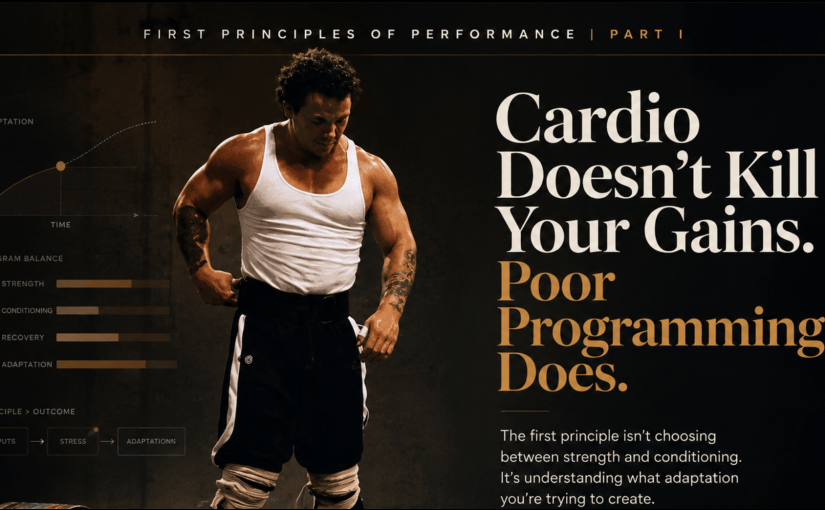
Cardio Doesn’t Kill Your Gains. Poor Programming Does.

“The first principle isn’t choosing between strength and conditioning. It’s understanding what adaptation you’re trying to create.”

Cardio Doesn’t Kill Your Gains. Poor Programming Does.

The Lion Killer

For decades, one of the most persistent myths in strength training has been deceptively simple:

“If you want to build muscle, avoid cardio.”

It sounds reasonable. After all, endurance athletes tend to be lean, while bodybuilders are muscular. Somewhere along the way, many people concluded that cardiovascular training and muscle growth must exist at opposite ends of the same spectrum.

Like most fitness myths, there’s a grain of truth buried beneath a mountain of oversimplification.

Can excessive endurance training interfere with maximal hypertrophy? Yes.

Can intelligently programmed cardiovascular training improve your health, enhance your recovery, increase your work capacity, and have little meaningful effect on muscle growth?

Also yes. The difference isn’t cardio. It’s programming

The Wrong Question

People often ask, “How much cardio can I do without losing muscle?” It’s the wrong question. The better question is: What adaptation am I trying to produce?

Every training session asks your body to solve a problem. Heavy squats ask it to produce more force. Tempo intervals ask it to become more efficient at clearing lactate.

Sprints demand explosive power. Long easy efforts improve aerobic efficiency.

These aren’t competing identities. They’re simply different physiological adaptations. Understanding that distinction changes everything.

First, Let’s Define “Cardio”

One reason this discussion becomes so confusing is because we use the word cardio as though it’s a type of exercise.

It isn’t. It’s a physiological demand.

Your cardiovascular system doesn’t know whether you’re running, rowing, cycling, carrying sandbags, or performing twenty-rep squats. It only knows that your muscles require oxygen, nutrients, and energy.

Think about workouts like:
– The Standard (Grace – 30 clean and jerks at 135/95, 30 ring muscle ups, Isabel – 30 snatches at 135/95)
– Heavy sled pushes
– Oly complexes of 5 reps or more
– 2k row for time
– 5k run
– Fran
– 20 rep max back squat
– Murph

Nobody finishes those wondering whether their cardiovascular system was challenged. Weight training can absolutely become cardiovascular training depending on how it’s programmed.

Intensity.
Density.
Rest intervals.
Exercise selection.
Volume.

These variables determine the cardiovascular demand, not whether you’re holding a barbell or running shoes. The conversation isn’t “weights versus cardio.”

It never was.

Where the Myth Came From

The concern isn’t entirely imaginary.

Researchers have long studied what’s known as the interference effect, the observation that combining endurance and resistance training can, under certain conditions, reduce some strength and hypertrophy adaptations compared with resistance training alone.

Notice the language. Can. Under certain conditions.

Not: Always. Those conditions matter.

A competitive marathon runner performing sixty miles each week while trying to maximize leg hypertrophy faces a very different challenge than someone lifting four days a week while adding two thirty-minute conditioning sessions.

Those are not the same training problems. Yet they’re often discussed as though they are.

What Actually Interferes?

For most lifters, muscle isn’t lost because they jogged. It’s lost because recovery becomes the limiting factor.

Poor programming often looks like this:
Heavy lower-body lifting followed immediately by long-distance running.
High-volume conditioning layered on top of already excessive lifting volume.
Poor sleep.
Insufficient calories.
Inadequate protein intake.
Eventually something has to give.
Trying to train near maximally, whether it’s loading or intensity, 4-6 days per week.

If training continually exceeds your ability to recover, progress slows—not because cardio is inherently bad, but because the total stress exceeds your adaptive capacity.

The Research Is More Encouraging Than the Internet

Fortunately, the research is considerably more nuanced than the internet. Much of the fear surrounding cardio comes from laboratory discussions about molecular signaling. You’ll often hear that endurance exercise activates one pathway while resistance training activates another, and that these pathways “fight” each other.

There is truth here. But physiology is rarely as binary as social media suggests.

These signals are temporary. They’re influenced by nutrition, training age, exercise selection and most important, recovery.

And they’re often localized to the tissues being trained rather than acting as a simple on-off switch across the entire body.

More importantly, when researchers look beyond the molecular biology and examine actual training outcomes, the picture becomes much less dramatic.

For the overwhelming majority of recreational lifters, and even many competitive athletes, well-designed conditioning has little meaningful effect on muscle growth.

Programming matters far more than the mere presence of cardiovascular exercise.

I hope the archive of this blog never disappears.

Optimum Performance Training (OPT) James Fitzgerald

Numerous studies support the idea that cardio, when programmed intelligently, does not meaningfully hinder muscle growth. For example, a 2015 meta-analysis by Dr. Brad Schoenfeld and colleagues concluded that combining strength and cardio training results in only a negligible impact on muscle and strength gains, provided programming is sound (Schoenfeld, B.J., Ogborn, D., & Krieger, J.W., 2015, Sports Medicine).

Cardio That Supports Muscle Growth

If hypertrophy is your primary objective, conditioning should complement not compete with your lifting.

Generally speaking, it could look like the following:

  • Shorter, more intense sprint work.
  • Use interval-based conditioning where appropriate.
  • Row.
  • Cycle.
  • Throw med-balls.
  • Use the SkiErg.
  • Carry odd objects.
  • Push and pull sleds.
  • Perform tempo intervals.
  • Carry heavy implements.
  • Include sprint interval training when recovery allows.
  • Separate demanding conditioning from heavy lower-body strength sessions whenever practical.

Most importantly, keep the main thing, the main thing.

Conditioning exists to improve health, increase work capacity, and support recovery, not to leave you so fatigued that tomorrow’s strength session suffers.

Keep the Main Thing the Main Thing

The best programs are surprisingly disciplined. They know exactly what they’re trying to improve. Everything else exists to support that objective, not distract from it.

One of the greatest mistakes athletes make is assuming every session must improve every quality simultaneously.

It doesn’t. Training is about emphasis or specificity to the individual and their goals. Some phases prioritize maximal strength. Some emphasize hypertrophy, aerobic capacity gymnastic or Olympic Weightlifting skill. A skill Ive always referred to as barbell gymnastics because of how skill dependent they are.

The art of coaching isn’t teaching every quality simultaneously. It’s knowing which qualities deserve emphasis today, and which can simply be maintained until tomorrow.

That’s programming.

Paleo - BJJ - white belt - black belt - earned not issued

The First Principle

Cardio doesn’t kill your gains. Poor programming does. If your training reflects clear priorities, if recovery matches workload, if nutrition supports adaptation, if conditioning complements rather than competes with strength, then you can become stronger. You will then become stronger, healthier, and better conditioned.

Not because you avoided cardio, but because you finally stopped asking whether strength and conditioning are enemies.

They never were. They simply need a coach who understands how to make them work together.

The principles remain constant. The application is the art.

If you’re curious why all of this works, not merely what to do, we’ll step out of the weight room and into the physiology laboratory. There we’ll explore the molecular conversation taking place inside skeletal muscle every time you lift, sprint, row, or recover, and discover why the story is far more nuanced than the internet would have you believe.

References

Schoenfeld, B. J., Ogborn, D., & Krieger, J. W. (2015). Effect of concurrent aerobic and strength training on maximal strength, power, and hypertrophy in healthy adults: A systematic review and meta-analysis. Sports Medicine, 45(5), 697–708.

Wilson, J. M., Marin, P. J., Rhea, M. R., Wilson, S. M. C., Loenneke, J. P., & Anderson, J. C. (2012). Concurrent training: A meta-analysis examining interference of aerobic and resistance exercises. Journal of Strength and Conditioning Research, 26(8), 2293–2307.

BCAAs Are Overrated — Here’s What to Do Instead

There was a time when tossing a neon scoop of BCAAs into your shaker cup felt like a secret code, like a sign that you were truly “dialed in.” Fast forward a few years, and the science is pretty blunt: if you’re already eating enough high-quality protein, those branched-chain amino acids aren’t doing much besides lightening your wallet.

Let’s break it down.

1. You’re Already Getting Plenty

BCAAs (leucine, isoleucine, valine) are just three of the nine essential amino acids your body needs to repair and build muscle. They’re naturally found in every solid protein source: meat, fish, eggs, dairy, and even plants. In fact, most whole protein sources already contain the 2-3 grams of leucine per meal needed to maximize muscle protein synthesis, making isolated BCAA supplements redundant.

If you eat real food and hit roughly 1.6–2.2 grams of protein per kilogram of body weight, you’re already covered. Studies keep confirming it: supplementing with BCAAs doesn’t outperform simply consuming complete protein. Here’s why: muscle protein synthesis requires all nine essential amino acids to activate mTOR signaling, the metabolic pathway that triggers muscle growth. BCAAs alone can’t complete the job. Without the full amino acid lineup, your body can’t finish the muscle-building process.

Unless your diet is severely lacking protein, that fancy powder isn’t rescuing anything.

2. Pop Culture Made It Cool — But Not Useful

Let’s be honest: a lot of this stuck around because of marketing and muscle culture. The fitness industry turned hydration into a brand identity with bright colors, bold claims, and goofy influencers sipping between sets like it’s rocket fuel.

It looks serious. It feels like doing something extra. But feeling busy isn’t the same as being productive. In truth, most BCAA use today is psychological, the ritual of “recovery in a cup” more than any measurable physiological edge.

Field note: I’ve worked with hundreds of lifters and athletes and not one of them ever turned a corner in strength, body comp, or recovery because they added BCAAs. But I’ve seen countless athletes break plateaus when they fixed their sleep schedule, added 20 grams of protein to breakfast, or simply trained with more consistency. The wins come from the boring fundamentals, not the colorful supplements.

3. The Paleo/Keto Twist

Here’s where a lot of people overcomplicate it.

If you’re following Paleo or keto and already eating quality animal protein, steak, tuna, salmon, eggs, you’re getting plenty of BCAAs naturally. The supplement is redundant.

But here’s the real issue: many low-carb folks turn to BCAAs because they’re afraid strategic carbs will derail their progress. They won’t. If you’re training hard two or three times a week, your muscles need readily available fuel. Natural carb sources like fruit, bananas, berries, oranges, apples, et cetera, around your training window will do more for performance and recovery than any BCAA powder.

That’s not breaking Paleo. That’s being smart. And it’s cheaper than another tub of supplements.

4. When Supplements Actually Make Sense

To be fair, there are scenarios where amino acid supplementation has merit but even then, BCAAs aren’t your best option.

If you’re training fasted (early morning workouts before you can eat), recovering from an injury where whole food intake is compromised, or genuinely struggling to meet your protein needs through diet alone, a full EAA supplement or quality whey protein makes far more sense than BCAAs.

Why? They deliver the complete amino acid profile your body needs to rebuild tissue and trigger muscle protein synthesis, not just the marketing-friendly three. You’re getting the full toolkit, not just a hammer.

Otherwise? Eat real food, train with purpose, sleep hard, repeat. Oh, and if you’re a vegan or vegetarian, you will need to use supplements to meet your BCAA and EAA needs, but that’s a story for another time.

The Takeaway

Most people sipping BCAAs are already getting what they need from their plate.

The supplement industry thrives on making simple things feel complicated. They profit when you believe that food alone isn’t enough—that you need their powders, their timing protocols, their proprietary blends to unlock results.

But the truth is simpler and cheaper: eat quality protein, train consistently, sleep well, and your body will handle the rest. The fundamentals work. They’ve always worked. And no neon powder changes that.

Save your money for real food, a good night’s sleep, or maybe a new pair of shoes for the trail. If you’re eating enough quality protein, you’re already doing what BCAAs promise — only better, and for less.