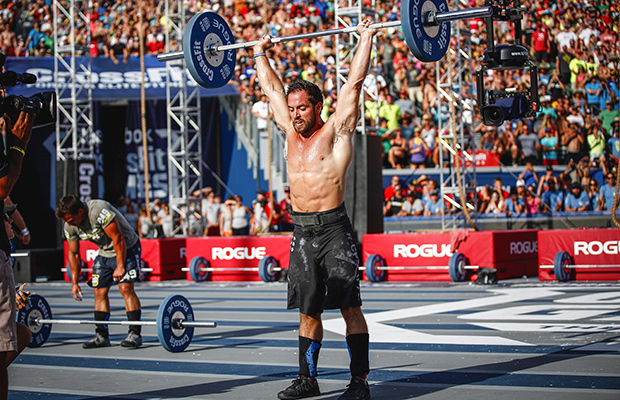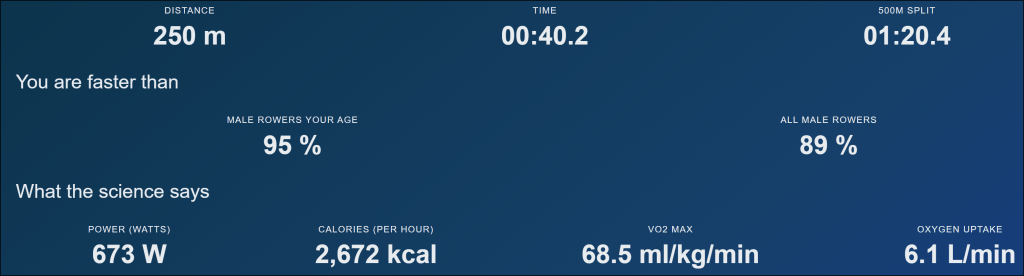
The Five Physiological Limiters of CrossFit Performance

In the early days of CrossFit, the prevailing training methodology was simple: work until you drop, ignore the burning in your lungs, and let sheer grit carry you across the finish line. If you blew up mid-workout, you simply weren’t tough enough.

Today, the sport has evolved. Elite coaches and athletes see the human body not as a sledgehammer swung mindlessly, but as an intricate thermodynamic engine. In high-intensity functional fitness, going “unbroken” is no longer viewed as a universal badge of honor; often, it is a sign of poor physiological intelligence. See the Theoretical Hierarchy Of Development from the 2002 CrossFit Journal article, What is Fitness?

To build an engine that’s nearly impossible to redline, you must understand, respect, and systematically train five deeply interdependent physiological systems, while navigating the hidden biomechanical bottlenecks that govern human performance. Neglect even one, and it can sabotage the others.

1. VO2 Max: The Engine’s Ceiling

The Science

VO2 Max is the absolute maximum volume of oxygen your body can consume, transport, and use per minute during intense exercise. It dictates the upper structural limit, the literal displacement, of your cardiorespiratory engine.

The CrossFit Application & Limitations

In CrossFit, your VO2 Max establishes your recovery rate between high-power movements or intervals. Imagine executing a heavy set of thrusters. Your body incurs a massive, immediate oxygen debt. If you possess a high VO2 Max, your cardiorespiratory system can clear that debt rapidly, lowering your heart rate and readying your muscles to pick up the next barbell. If your ceiling is low, your pacing will collapse as you stand over the bar gasping for air, waiting for your system to catch up.

Overcoming the Limitation

Your genetic profile limits your absolute VO2 Max, but many athletes fail to maximize it because they confuse generic “metcons” with true high-intensity interval training (HIIT). To expand the stroke volume of the heart, you must accumulate time spent right at your peak heart rate.

The Workout Protocol: Upgrading your Engine

  • The Format: 4 x 4 minute intervals at the sweet spot of 85-95% of max HR with 4 Minutes of complete rest. Also known as Norwegian Intervals which were designed maximize VO₂ and heart efficiency.
  • The Execution: Utilize a cyclical modality like rowing or an Echo bike. This must be a true 9/10 effort where you hit and maintain your peak heart rate for the final 2 minutes of every working interval. The 1:1 rest ratio is mandatory to allow your system to reset so you can hit the next round with equal intensity.

2. Aerobic Capacity: Build the Size of Your Gas Tank

The Science

While VO2 Max defines your physiological ceiling, Aerobic Capacity determines how much of that ceiling you can sustain over time. It depends heavily on peripheral adaptations such as mitochondrial content, capillarization, oxidative enzyme activity, and metabolic economy. Sustained aerobic training also improves the ability to deliver and use oxygen at a given workload. Also review training techniques to improve endurance exercise performance.

The CrossFit Application & Limitations

Aerobic capacity operates as the “metabolic vacuum cleaner” of your body. During long workouts like Murph or a 20-minute mixed-modal AMRAP, the oxidative system increasingly contributes to ATP production, helps oxidize lactate through the lactate shuttle, and allows you to sustain work without relying as heavily on higher-cost anaerobic pathways.

The common limitation here is the “one-gear athlete”: someone who can sprint like a rocket for three minutes but completely falls apart by minute ten because they lack the aerobic machinery to sustain output, recover between efforts, and maintain metabolic stability as fatigue accumulates.

Overcoming the Limitation

One of the most effective ways to expand the fuel tank is through regular low-intensity steady-state work, commonly referred to as Zone 2. The purpose is to accumulate meaningful aerobic volume at an intensity low enough to remain sustainable and repeatable without creating excessive fatigue.

The Workout Protocol: The Low-Gear Flush
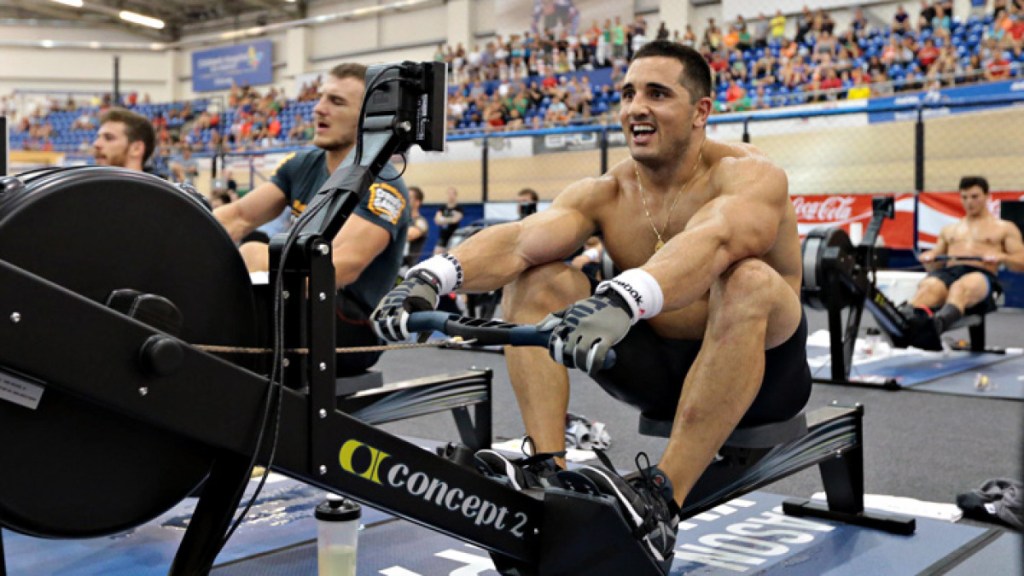
  • The Format: 30, 45, 60, and eventually even 90 minutes of continuous movement. This can be performed as a single modality or as carefully selected mixed-modal work
  • The Execution: Row, ski, jog, bike, or use low-complexity mixed-modal MAP 10-style training. Exercise selection should remain simple enough that local muscular fatigue does not become the limiter. Work at an intensity just below your first ventilatory/lactate threshold. For most recreational athletes, the easiest practical check is the talk test: you should be able to carry on a continuous conversation without gasping.

    The goal isn’t to chase fatigue. It’s to accumulate high-quality aerobic work that supports mitochondrial adaptation, capillarization, improved oxygen delivery and utilization, and better recovery between harder efforts.

The Intent

The intent is to build aerobic durability, not simply burn calories or “get some cardio in.”

You are trying to improve the athlete’s ability to:

  • sustain a greater percentage of VO2 max;
  • produce ATP aerobically for longer;
  • recover more quickly between harder bouts;
  • rely less heavily on glycolytic contribution at a given workload;
  • and accumulate training volume without adding substantial recovery cost.

The Expected outcome

Athletes should gradually see:

same pace/power with lower HR and lower perceived effort
or:
same HR/perceived effort with higher sustainable pace or power

They should also recover faster between rounds and movements, maintain steadier pacing deeper into longer metcons, and experience less of the “three minutes great, ten minutes dead” pattern.

That is the adaptation you want.

3. The Lactate Threshold: The Boundary Line

The Science

The Lactate Threshold (LT) is the exact exercise intensity at which blood lactate accumulates faster than your body can clear it. Once you cross this line, hydrogen ions flood the muscle tissue, acidity skyrockets, and rapid muscular failure can happen more easily. Also worthy of note is that contemporary physiology treats lactate production as associated with, and in some contexts helpful in managing, proton accumulation rather than being the acid-producing villain it was once considered.

The CrossFit Application & Limitations

CrossFit workouts are systematically designed to force you over your LT. When your forearms freeze up on pull-ups, or your legs turn to lead on wall balls, you have crossed the line. The limitation isn’t necessarily that elite athletes don’t produce lactate; it’s that they have trained their bodies to work right on the razor’s edge of their threshold (often at 85–90% of their max heart rate) without tipping over into a catastrophic redline.

Overcoming the Limitation

To push your threshold higher, you must spend extended intervals, over time, at or just below that uncomfortable boundary line, helping you adapt to buffer acidity more efficiently.

The Workout Protocol: Threshold Repeaters

  • The Format: 3 Rounds of 10 Minutes on, 3 Minutes Active Recovery.
  • The Execution: On an Assault Bike, Echo Bike, or rower, maintain a pace that feels “comfortably hard.” Your breathing should be deep and rhythmic, but you should not be gasping. The goal is to keep output relatively consistent across all three intervals. If your pace drops sharply from round to round, you went out too hard. Back off slightly and hold the line.

4. Rate Pressure Product (RPP): The Myocardial Tax
The Science

Rate Pressure Product (RPP) is calculated as Heart Rate × Systolic Blood Pressure. It is the premier clinical index used to measure the actual physical workload and oxygen demand placed directly on the muscle walls of your heart (myocardial oxygen consumption) NCBI Myocardial Strain.

The CrossFit Application & Limitations

In standard cardio like running, RPP climbs smoothly and predictably. In CrossFit, RPP spikes violently. When you perform high-rep, moderately heavy lifting (like clean & jerks, thrusters, or deadlifts), your contracting muscles physically compress your local blood vessels. This is called muscular occlusion. To force blood past these squeezed vessels, your blood pressure skyrockets. Combined with an elevated heart rate, your heart faces an extreme workload. This sudden “myocardial tax” explains why a short lifting metcon can leave you far more exhausted and lightheaded than a long run.

Overcoming the Limitation

You cannot bypass the physics of muscular occlusion, but you can manipulate your execution mechanics to give your heart and local capillary beds micro-breaks.

The Workout Protocol: Building The Tactical Single

  • The Format: For Time: 20 Squat Cleans at 75% of your 1RM.
  • The Execution: As many of you already know, it’s best not to do touch-and-go reps at this weight. Instead, perform steady singles ~every :10-:12. Also, always use the hook grip. Utilizing the hook grip locks the hand mechanically to the bar vs holding on to it. This drastically reduces the active muscle contraction required by your forearm and wrist flexors during the pull. Also, the exact moment you stand fully, with the hips and knees reaching full extension, drop the bar. Dropping the bar and releasing the grip unlocks the muscular occlusion, causing an immediate burst of fresh, oxygenated blood (reactive hyperemia) that flushes out trapped hydrogen ions, drops peripheral vascular resistance, and can lower peak RPP stress.

5. Cardiovascular Drift: The Pacer’s Enemy

The Science

Cardiovascular Drift (CV Drift) is the phenomenon in which heart rate gradually rises over the course of prolonged exercise even though power output, speed, or physical intensity remains constant (Wikipedia’s Cardiovascular Drift Analysis).

The CrossFit Application & Limitations

As you sweat during a long, hot workout, plasma volume can fall and stroke volume can decrease. As stroke volume falls, heart rate rises in an attempt to maintain cardiovascular output and sustain the same workload.

The limitation here is a pacing trap: if you pace a 30-minute workout (or 60 minute workout) purely by how your muscles feel in the first five minutes, cardiovascular drift can progressively increase the relative cardiovascular cost of that same pace, eventually pushing you toward or beyond a sustainable threshold and causing a late-workout collapse.

Overcoming the Limitation

Defeating cardio drift requires a combination of situation-specific hydration and active, conscious down-regulation of your nervous system during transitions.

The Workout Protocol: Murph Drift Prevention

The Format: 3 Rounds
2–3 Minutes of controlled running at a predetermined, repeatable pace
1–2 Rounds of Cindy
5 Pull-ups
10 Push-ups
15 Air Squats
1 Minute walking recovery while deliberately relaxing the hands, shoulders, and jaw and regaining controlled breathing
2–3 Minutes on the BikeErg at a predetermined, repeatable split or wattage
1–2 Rounds of Cindy
1 Minute walking recovery with the same down-regulation focus

The full session should initially fall somewhere around 30 minutes.

Scaling the Prescription
For newer athletes, begin with one round of Cindy after each monostructural effort. Across three rounds, that produces six total rounds of Cindy:

  • 30 Pull-ups
  • 60 Push-ups
  • 90 Air Squats

That’s enough volume to provide meaningful exposure to the movements without allowing local muscular endurance to overwhelm the cardiovascular purpose of the session.

For experienced recreational CrossFit athletes who already tolerate gymnastics volume well, two rounds of Cindy is entirely appropriate. Across the session, that produces twelve total rounds:

  • 60 Pull-ups
  • 120 Push-ups
  • 180 Air Squats

The determining factor is not whether the athlete can complete the higher volume. It is whether they can complete it while preserving full range of motion, movement integrity, and the intended pacing stimulus.

If the pull-ups deteriorate, the push-ups become half reps, or the squats lose depth simply to keep moving, the athlete has changed the limitation being trained. Local muscular failure has taken over the session.

Scale before that happens. Scaling does not diminish the work. Poor repetitions do.

The Execution

The monostructural pieces should be performed at a fixed, repeatable external workload, not by chasing a predetermined heart rate.

For example:

  • Run at the same pace each round.
  • Hold the same BikeErg wattage or split each round.

Then observe what happens to heart rate. If the athlete runs the same pace at 138 bpm during the first round, 148 bpm during the second, and 158 bpm during the third, cardiovascular drift is becoming visible.

The goal over time is not necessarily a lower heart rate at every moment. The goal is a smaller rise in heart rate while maintaining the same external work.

Several weeks later, the same athlete might produce:

138, 143, and then 148 bpm at the same running pace, same BikeErg output, and same bodyweight volume. That’s a measurable improvement.

Why the Walking Recovery Matters

The one minute walking intervals are not designed to make the workout easy. They teach the athlete to actively manage transitions rather than allowing every transition to become another uncontrolled effort.

Walk. Drop the hands. Relax the shoulders and jaw. Regain control of the breathing pattern. Then begin the next piece deliberately rather than sprinting blindly into it.

This creates repeated opportunities to practice controlling unnecessary sympathetic escalation while maintaining enough movement to keep the cardiovascular system engaged.

The athlete is learning to recover while still working. That matters in Murph, but it also matters in almost every other CrossFit workout.

Progressing the Session

Progress the workout gradually rather than simply making everything harder at once.

A simple progression might look like:

Week 1: 3 rounds with 2-minute monostructural efforts and 1 round of Cindy per station.

Week 2: Increase the run and BikeErg pieces to 3 minutes.

Week 3: Maintain duration but slightly increase the prescribed pace or power.

Week 4: For athletes demonstrating excellent movement quality and recovery, introduce a second round of Cindy at beginning or the end.

Later progressions may include longer total duration, warmer environmental conditions, and eventually a weight vest. But these progressions only happen after the athlete can maintain full range of motion and consistent pacing without the workout deteriorating into survival.

The goal is not to manufacture suffering. The goal is to build an athlete who can sustain increasingly demanding work while controlling the cardiovascular cost.

The Expected Outcome

With consistent exposure, the athlete should begin to demonstrate:

  • less heart-rate drift at the same running pace or BikeErg output
  • faster recovery during transitions
  • improved ability to maintain breathing control under accumulating fatigue
  • greater consistency from the first round to the last
  • improved tolerance of mixed-modal work without premature redlining
  • better preservation of pull-up, push-up, and squat mechanics late in the session
  • and ultimately, improved performance when those qualities are tested in longer workouts such as Murph

Murph then becomes what it should be: the expression of the capacity you developed in training, not the only place you ever practice it.

And no matter what, DO NOT cheat the reps. Do legitimate pullups, pushups, and squats. Don’t wear the vest if you can’t do the FULL ROM on every rep. Scaling does NOT diminish the work you’re doing. No one cares if you scaled the workout, everyone cares if you cheated.

A Note on System Interdependency: The Multi-Pillar Bleed-Over

While it is helpful to categorize your engine into five distinct pillars for diagnostic purposes, the human body does not operate in isolated, clinical buckets. In the human machine, a breakdown in one pillar triggers a catastrophic domino effect across multiple systems simultaneously.

Consider how easily the boundaries blur mid-workout:
If your Aerobic Capacity (Pillar 2) is weak, your body cannot efficiently clear metabolic waste. This forces you to cross your Lactate Threshold (Pillar 3) much earlier in the workout than expected. The moment you cross that threshold, your breathing becomes rapid and shallow to buffer the rising blood acidity. This frantic breathing pattern spikes your autonomic panic response and drives your heart rate up.

That spiked heart rate, combined with the heavy muscle occlusion of a lifting movement, sends your Rate Pressure Product (Pillar 4) into the red zone. Worse, the heat generated by this systemic panic accelerates sweat loss, triggering early Cardiovascular Drift (Pillar 5) and forcing you to hit your absolute VO2 Max ceiling (Pillar 1) just to maintain a basic walking pace.

You aren’t managing five separate systems; you are balancing a web. A leak in one corner of the engine will inevitably drown the rest.

For the Beginner: Avoid Learning the Hard Way

Every veteran athlete you see executing smooth, steady singles with a calm expression has a graveyard of workouts behind them where they blew up, choked on their own pace, and ended up flat on their back questioning their life choices.

As a beginner, your mind loves to learn lessons the hard way. When a coach gives you a pacing strategy, your ego will whisper, “You feel great, go faster, go unbroken.”

To bypass years of unnecessary metabolic suffering, write these three rules in your training diary of wherever you keep mission-critical information:

  1. Intensity is an Asset, Not a Strategy: Blind toughness is a finite resource. If you redline your engine in the first two minutes of a ten-minute workout, no amount of mental toughness will override the biochemistry of acidic muscle tissue.
  2. Pacing is the True Secret Sauce: Pacing isn’t about moving slowly; it’s about defending your thresholds. Your goal should be to move at a speed that allows you to finish the final minute of a workout at the exact same intensity (or faster) than your first minute.
  3. Trust the Coach’s Intent: If a coach tells you a workout should take 8 minutes, and you pick a weight that forces you to take 20 minutes, you didn’t get a better workout, you completely missed the intended physiological stimulus. You trained a different energy system entirely.

Listen to the mapmakers. The coaches and veteran athletes who came before you ran full speed into the physiological walls so you wouldn’t have to. Respect the biology, master your pacing, use the mechanical shortcuts like the hook grip, and turn your engine into a finely tuned, unstoppable machine.

The Hidden Nuances of Elite Performance

To transition fully from a standard textbook understanding of physiology to the reality of competitive sports, athletes must master two final unwritten variables:

Nuance 1: The Biomechanical Shunt – Postural Occlusion

Most people assume muscle occlusion only happens because you are lifting heavy weights. They forget about the physiological tax of changing your body’s physical position under gravity. When you transition rapidly from a horizontal position to a vertical position (like jumping up from a burpee to perform a thruster, or dropping off a pull-up bar into a heavy deadlift), your cardiovascular system has to violently shift blood pressure dynamics to prevent blood pooling in your lower extremities. Your heart has to contract significantly harder to maintain stroke volume, causing an immediate, artificial spike in your RPP.

  • The Fix: Athletes shouldn’t just pace the reps; they must pace the transitions. Taking a deliberate pause at the top of a burpee, 3-5 seconds, before grabbing the barbell allows the vascular system to normalize pressure, preventing an autonomic panic surge.

Nuance 2: The CO₂ Tolerance Deficit – The Brain’s Panic Button

Athletes often mistake a gasping, redlined feeling for a lack of oxygen. In reality, the human brain rarely panics because of low oxygen; it panics because of a buildup of carbon dioxide (CO₂). When your muscles burn, they produce hydrogen ions, which your blood buffers by turning them into CO₂. Your brain’s respiratory center detects this rising CO₂ and triggers a frantic, survival-driven command to breathe faster. If an athlete has a low tolerance for CO₂, they begin hyperventilating prematurely. This shallow, rapid breathing increases anatomical “dead space” in the airways, accelerates Cardiovascular Drift, and causes the brain’s Central Governor (model/theory) to pull the emergency brake.

  • The Fix: This explains why elite CrossFit athletes are increasingly turning to respiratory muscle training behind the scenes to optimize their engines (The Barbell Spin). Renowned coaches use these methods to elevate baseline conditioning. Targeted Inspiratory Muscle Training (IMT), using isolated breathing-resistance tools (like the O2 Trainer), acts as a legal cheat code. They do not just mechanically thicken and strengthen the diaphragm muscle to prevent it from “stealing” blood from your limbs via the respiratory metaboreflex (PMC Respiratory Metaboreflex). They force your nervous system to tolerate higher intracellular pressures and controlled CO₂ accumulation without triggering a psychological panic response (Isocapnic BWB Strength Features).

Quick Reference: Assessing and Addressing Each Limiter

• VO2 Max: Assess with all-out, short interval efforts (e.g., 4-min max effort test). Improve with high-intensity intervals at peak heart rate and full recovery.

• Aerobic Capacity: Assess with sustained efforts (e.g., 60-min continuous movement). Improve with consistent Zone 2, low-intensity steady-state work.

• Lactate Threshold: Assess with pace/effort you can hold for 20–40 minutes before sharp muscular fatigue. Improve with threshold repeat intervals at a “comfortably hard” pace.

• Rate Pressure Product: Assess with moderate-load, high-rep lifting under fatigue. Improve by managing rest, using hook grip, and breaking up reps to reduce occlusion.

  • Cardiovascular Drift: Assess by monitoring heart rate in long, hot workouts for upward drift. Improve with hydration, conscious down-regulation, and transition protocols.
  • For all limiters, log workouts and physiological responses to identify which system fails first during high-intensity sessions.

Glossary for Novices

• VO2 Max: The maximum amount of oxygen your body can use during intense exercise.

• Aerobic Capacity: How long you can sustain exercise using oxygen efficiently.

• Lactate Threshold: The intensity where your body starts accumulating fatigue-causing byproducts faster than it can clear them.

• Rate Pressure Product: A measure of how hard your heart is working (heart rate × blood pressure).

• Cardiovascular Drift: When your heart rate rises during long workouts even if you’re not working harder.

• Muscular Occlusion: When working muscles temporarily restrict blood flow because they’re contracting.

• Angiogenesis: The process of growing new blood vessels.

• Reactive Hyperemia: The rush of blood that occurs when a muscle relaxes after being contracted.

• Central Governor: The brain’s way of limiting effort to protect you from harm.

• Zone 2: A training intensity where you can carry on a conversation easily, usually 60–70% of your maximum heart rate.

Refer to this glossary as you read, and use the quick reference section to help guide athlete assessments and target training interventions.
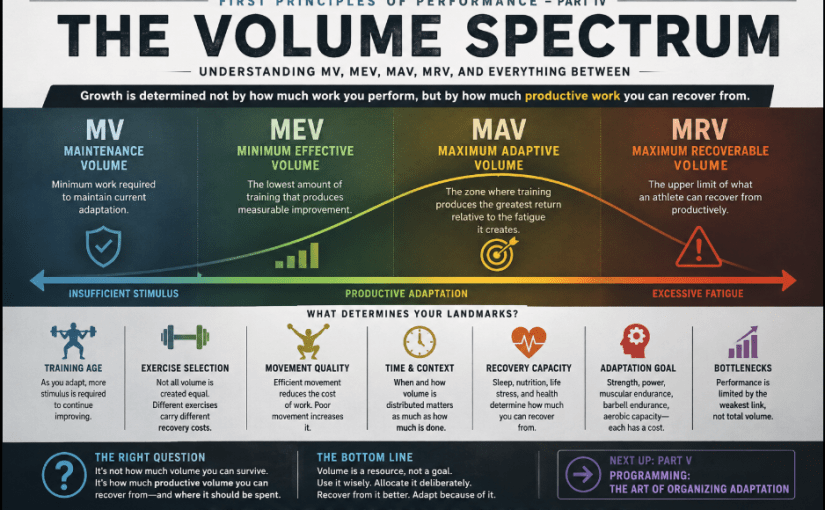
First Principles of Performance Part IV

The Volume Spectrum

Understanding Maintenance Volume (MV), Minimum Effective Volume (MEV), Maximum Adaptive Volume (MAV), Maximum Recoverable Volume (MRV), and Everything Between

Growth is determined not by how much work you perform, but by how much productive work you can recover from.

Introduction

Walk into almost any Olympic Weightlifting or power lifting gym, CrossFit affiliate, or even the standard Globo gym and you’ll eventually encounter two seemingly opposite philosophies.

One athlete believes progress comes from doing more: more sets, more repetitions, more accessory work, more conditioning, more training days. If some novel amount of work produces results, even more work should produce even better results.

Another takes almost the opposite approach: do as little as necessary to stimulate improvement, then get out and recover.

Curiously, both can point to successful athletes who appear to prove them right.

One can point to the CrossFit athlete training multiple sessions a day, the weightlifter accumulating hundreds of technically demanding repetitions each week, or the bodybuilder thriving on German high volume training. Then another points to an elite powerlifter progressing on surprisingly few max-effort lifts, or an experienced weightlifter whose training becomes more productive after unnecessary volume is removed.

So which approach is correct? Both and neither. Why? Because the question itself is flawed.

The body does not respond to volume in absolute terms. It responds to recoverable stress.

That distinction changes everything.

The objective of training is not to perform the greatest amount of work possible. It is to perform the greatest amount of productive work possible: enough to create the desired adaptation without accumulating so much fatigue that additional work stops contributing meaningfully to it.

There is a difference between training that challenges your capacity and training that simply consumes it.

Understanding where that line exists, and recognizing that it shifts according to the athlete, the adaptation being pursued, the type of training being performed, and where the athlete is in their development, is one of the most valuable skills an athlete or coach can develop.

This is where the Volume Spectrum begins.

More Is Better, Until It Isn’t

One of the oldest assumptions in strength training is beautifully simple: if ten sets build muscle, twenty must build even more. And if twenty works, why not thirty?

The problem is that biological markers rarely, like life, move in straight lines.

The human body is governed by diminishing returns. Initially, increasing training volume can produce greater adaptation. Strength improves, muscle grows, work capacity increases, and technique becomes more refined. But eventually those returns begin to diminish. Progress slows, then plateaus, and if volume continues increasing without sufficient recovery, performance can begin moving backward.

More work has become less productive.

The irony is that many dedicated athletes interpret this decline exactly backward. Feeling stalled, they assume they simply need to work harder, so they add another exercise, another set, another conditioning session, another “finisher.”

Instead of solving the problem, they’ve increased the very stress that caused it.

The Volume Spectrum

Training volume can be understood through four useful landmarks along a continuum. These should not be treated as rigid physiological thresholds or universal numerical prescriptions, but as practical regions that help coaches think about the relationship between training stress and adaptation.

Quick Reference: Training Volume Landmarks

MV (Maintenance Volume): The minimum amount of training needed to maintain current performance and muscle mass. Used during periods of reduced training, deloads, or recovery phases.

MEV (Minimum Effective Volume): The lowest training dose that produces measurable progress or adaptation. Anything below this threshold will not drive improvement.

MAV (Maximum Adaptive Volume): The “sweet spot” where training volume is high enough to maximize gains without causing excess fatigue or risk of overtraining. This is where most productive training occurs.

MRV (Maximum Recoverable Volume): The upper limit of training volume that the body can adapt to and recover from. Exceeding this consistently leads to stagnation, regression, or injury.

In short:

  • MV: Enough to maintain, not improve.
  • MEV: The minimum to make progress.
  • MAV: The most productive range for gains.
  • MRV: The most you can recover from, not to be exceeded.

Maintenance Volume (MV)

Maintenance Volume is exactly what it sounds like: the minimum amount of work required to preserve a current level of adaptation.

Notice what it is not. Maintenance volume is not intended to produce meaningful improvement. It provides enough stimulus to prevent meaningful loss.

This matters more than many athletes realize because maintenance allows training resources to be reallocated. A competitive CrossFit athlete may temporarily reduce upper-body hypertrophy work while emphasizing Olympic lifting. A tactical professional preparing for selection may maintain maximal strength while substantially increasing endurance. An older adult may temporarily reduce overall workload while attempting to preserve existing strength and muscle mass.

Maintaining an adaptation generally requires less training than developing it in the first place. That principle becomes one of the coach’s most valuable tools because no athlete can emphasize everything simultaneously.

Sometimes maintaining one quality is precisely what allows another to improve.

Minimum Effective Volume (MEV)

MEV represents the lowest amount of training necessary to produce measurable improvement. Think of it as crossing the threshold where training moves beyond maintenance and begins providing enough stimulus for further adaptation.

Importantly, MEV is highly individual.

A novice lifter may stimulate meaningful progress with relatively little training. An experienced athlete may require substantially more work simply to continue improving. Training age changes the equation because the stronger, more conditioned, and more experienced you become, the greater the stimulus may need to be before the body has sufficient reason to adapt further.

Success changes the rules.

Maximum Adaptive Volume (MAV)

Maximum Adaptive Volume describes the region where training produces the greatest return relative to the fatigue it creates.

Not necessarily the most work. The best work you can do, achieving the intended stimulus, and recover from.

Most productive training should occur somewhere in this range. Performance improves, strength or work capacity develops, recovery remains manageable, technique stays relatively sharp, and the athlete remains capable of continuing to perform quality training.

That distinction matters. MAV is not defined by exhaustion, it’s defined by adaptation.

Maximum Recoverable Volume (MRV)

Eventually every athlete reaches a point where additional work creates more fatigue than useful adaptation. That upper boundary is Maximum Recoverable Volume.

MRV should not be treated as a target. It’s the ceiling.

Experienced athletes may intentionally approach that ceiling during concentrated training blocks before reducing workload and allowing accumulated fatigue to dissipate. Used carefully, periods of functional overreaching can have a place within training.

Living near or above MRV is another matter.

When training chronically exceeds the athlete’s ability to recover, familiar warning signs can begin appearing: declining performance, slower bar speed, persistent soreness or joint discomfort, deteriorating sleep, reduced motivation, worsening session quality, and increased susceptibility to minor illness.

The dedicated athlete may again interpret these symptoms as evidence that more work is required. Often the opposite is true.

Why These Landmarks Move

One of the biggest mistakes coaches make is treating volume landmarks as fixed numbers.

They aren’t.

Your MEV this year may not resemble your MEV five years from now. Your MRV during a period of low life stress may differ considerably from your MRV during a demanding work cycle, caloric deficit, competition season, or period of poor sleep. The amount of volume you can recover from for one physical quality may also differ substantially from what you can tolerate for another.

These landmarks move because the athlete moves. As the old saying goes, “You can’t be in fight shape all the time.”

Training Age

Beginners often require surprisingly little work to improve. Advanced athletes generally require a greater stimulus to continue adapting, while simultaneously becoming capable of creating considerably more stress during each hard working set.

Five sets of squats performed by an athlete squatting 135 pounds do not represent the same physiological event as five sets performed by an athlete squatting 500.

The volume may look identical on paper. The affect on the body is not.

Exercise Selection and Recovery Cost

Not all training stress is created equally.

Three sets of leg extensions, three sets of heavy back squats, three rounds of ring muscle-ups, ten minutes of EMOM barbell cycling, and a 5k row for time all qualify as training volume, but they do not impose the same demand.

Heavy compound lifting can create substantial mechanical and systemic fatigue. High-repetition gymnastics challenge local muscular endurance, connective tissue, grip, coordination, and the ability to maintain movement quality as fatigue (neurological and physical) accumulates.

Repeated cleans or snatches performed under metabolic fatigue combine muscular endurance with technical proficiency, strength, power, timing, and repeated force production. Longer aerobic work may create relatively little mechanical damage while still imposing substantial cardiorespiratory and metabolic demand.

This is why simply counting sets, repetitions, minutes, or meters can become misleading.

Programming volume requires understanding what quality the work is developing, how much useful stimulus it provides, and what it costs the athlete to recover from it.

The body doesn’t count reps, it accumulates stress.

Different Qualities Carry Different Costs

One of the greatest misconceptions in training is assuming every physical quality responds to volume in the same way.

It doesn’t.

Absolute strength and power require exposure to high levels of force and velocity. A strong baseline in movements such as squats, deadlifts, presses, pulls, and Olympic lifts provide a foundation from which explosive force can be expressed.

Muscular endurance requires something different: the local capacity of muscles and the nervous system controlling them to repeatedly produce useful contractions despite accumulating fatigue. In gymnastics, that may mean sustaining pull-ups, push-ups, toes-to-bar, handstand push-ups, or muscle-ups. With a barbell, it may mean repeatedly cycling cleans, snatches, thrusters, or shoulder-to-overhead movements while maintaining enough technical integrity to continue working efficiently.

Cardiorespiratory endurance and stamina place another demand on the athlete. Aerobic and anaerobic metabolism must continually provide energy across efforts lasting seconds, minutes, or hours, while the athlete develops the capacity to sustain output and recover between repeated demands.

Strength, power, muscular endurance, barbell endurance, cardiorespiratory endurance, and stamina coexist, but they are not interchangeable.

A CrossFit athlete preparing for competition may intentionally increase muscular endurance, barbell cycling, aerobic development, and repeated-effort aerobic power and capacity training while maintaining rather than maximizing absolute strength.

An Olympic weightlifter may do almost the opposite, allocating considerably more training toward strength, power, technical consistency, and the competition lifts. A tactical professional may require substantial strength alongside loaded movement, cardiorespiratory endurance, muscular stamina, and repeated performance under fatigue.

An older adult may prioritize strength, muscle mass, aerobic capacity, mobility, balance, and resilience because the objective is preserving capability and independence rather than maximizing competitive performance.

None of these athletes are training incorrectly, they’re simply solving different problems. Volume only becomes meaningful when viewed through the adaptation being pursued.

Movement Quality Changes the Cost of Volume

There is another variable that sets and repetitions alone cannot explain: movement quality.

Before deciding that an athlete needs more squats, gymnastics, barbell work, or conditioning, the coach must understand whether the athlete can efficiently perform the movements being prescribed.

Can they squat through the required range of motion while maintaining position? Can they establish a stable overhead position and safely receive a clean or snatch? Do they possess the ankle, hip, thoracic, and shoulder mobility required for the task? Can they maintain trunk control and coordination as fatigue accumulates?

Flexibility and mobility are not decorative qualities simply sprinkled in at the beginning or at the end of a training session. Adequate range of motion allows the athlete to access the positions required for the task(s); mobility adds the ability to control those positions. Coordination, agility, and balance allow the athlete to organize movement, redirect force, transition between tasks, and preserve technical integrity under changing conditions.

These qualities are essential and non-negotiable under fatigue.

Walking on your hands while fresh is one skill. Maintaining a handstand walk after heavy cleans and/or several minutes of high-output conditioning is another. The same principle applies to receiving a snatch in a deep overhead squat, transitioning efficiently through ring muscle-ups, or maintaining clean mechanics while breathing heavily and losing grip strength.

Poor movement quality increases the cost of work. Efficient movement reduces it.

Two athletes can therefore complete exactly the same prescribed volume while experiencing meaningfully different training loads.

Sometimes the fastest way to improve work capacity isn’t adding more work.

It’s reducing wasted movement. Or, what we used refer to in CrossFit as seeking Virtuosity in movement.

Volume Exists in Time

Twenty weekly sets performed in one session are not equivalent to twenty sets distributed across four sessions.

Fatigue accumulates differently. Performance quality changes. Recovery opportunities change.

The same principle applies outside traditional resistance training. Twenty minutes of high-skill gymnastics performed while fresh is not equivalent to twenty minutes performed after heavy barbell work. Six sprint intervals distributed appropriately across a training week do not necessarily impose the same cost as those same intervals performed immediately after a demanding lower-body session.

Volume therefore cannot be separated from frequency, sequencing, and recovery. Where the work occurs matters, what happens before and after it matters. The body does not simply experience training volume. It experiences stress over time.

The Athlete Changes the Equation

Dynamis 

Genetics, sleep, nutrition, age, life stress, occupation, training history, and movement quality all influence the amount and type of training an athlete can productively tolerate.

A firefighter working rotating night shifts may have a very different MRV from a college student sleeping nine hours each night. Two athletes possessing similar strength may tolerate very different amounts of training, and two athletes capable of completing the same workout may require entirely different interventions because their limiting factors are different.

One may lack absolute strength. Another may lack muscular endurance. Another may possess tremendous strength but poor muscular endurance. Another may have excellent local muscular endurance but insufficient aerobic capacity to recover between efforts. Another may simply move inefficiently which can make each training session twice as hard as it needs to be with the most basic of movements like air squats, pushups, pullups or burpees.

That’s why programming that ignores recovery outside the gym ignores half the equation.

And programming that ignores the individual misunderstands the other half.

Autoregulation: Listening Without Guessing

Perhaps the greatest weakness of rigid programming is the assumption that today’s body is identical to yesterday’s.

It isn’t.

Autoregulation recognizes that readiness fluctuates. Instead of blindly completing predetermined workloads regardless of performance, intelligent athletes and coaches adjust training according to relevant objective and subjective information.

Bar speed, repetitions in reserve, perceived exertion, heart-rate recovery, sleep quality, motivation, persistent soreness, session performance, movement quality, and technical deterioration under fatigue can all provide useful information.

No single metric tells the entire story. The purpose is not to replace programming with daily improvisation.

Autoregulation isn’t abandoning structure it’s allowing physiology to inform execution.

Deloads: Adaptation’s Forgotten Partner

One of the greatest misconceptions in training is that progress results from uninterrupted accumulation. It doesn’t. Progress often depends upon strategic reduction.

Deloads intentionally reduce training stress so accumulated fatigue can dissipate while much of the underlying adaptation is preserved. The purpose isn’t simply to rest. It is to restore the athlete’s capacity to perform productive training again.

A deload is not necessarily a step backward. Often it is the point at which accumulated fitness becomes visible beneath accumulated fatigue. We’ll discuss deloading, and its importance in more detail, later in this series

Pacing, Bottlenecks, and Productive Volume

More volume is rarely the solution to poor performance.

Sometimes the athlete needs more strength. Sometimes they need greater muscular endurance, a larger aerobic base, better gymnastic skill, more technical practice, or improved movement economy.

And sometimes they simply need to stop going out too hard. Pacing by itself is a performance skill. Athletes have to learn how much work can be performed now without any degradation in overall performance.

That means learning how quickly your breathing recovers, knowing when to stop just before grip or shoulder failure, or when technically efficient barbell cycling becomes increasingly expensive, and where local muscular fatigue or technical breakdown reliably appears.

Meaning, where is the bottleneck?

An athlete who repeatedly falls apart during the final five minutes of a 20min AMRAP, may not need another conditioning session. They may benefit more from not trying to win the first five minutes.

Likewise, an athlete struggling with high-repetition cleans may assume the problem is conditioning when insufficient absolute strength is making every repetition too expensive. Another athlete may possess enormous strength but lose time because poor economy of motion makes their receiving positions inefficient. Another may possess the engine and strength but lack the coordination required to transition efficiently between gymnastics and other external loading.

The workout reveals the symptom(s) and good assessments identify the cause(s). That distinction matters because training should target the bottleneck, not just accumulate more fatigue around it.

Volume Is a Conversation, Not a Competition

Perhaps the most important lesson from the Volume Spectrum is this: Volume is not something to maximize, it’s something to be optimized.

It’s a training resource to be allocated according to the athlete’s objectives, abilities, limitations, and capacity to recover. The strongest programs are rarely those that demand the most work. They are the ones that consistently produce the greatest useful adaptation relative to their cost.

That balance changes throughout a career. It changes across seasons and according to the physical quality being developed. It changes during periods of occupational stress, poor sleep, illness, caloric restriction, or competition preparation. And it changes as weaknesses become strengths and new bottlenecks emerge.

The best coaches therefore don’t ask: How much volume can this athlete survive?

They ask: How much productive volume can this athlete recover from?

And eventually, they ask an even better question: Where should that volume be spent?

Those are profoundly different questions. One measures work while the other considers adaptation. And that final question brings us to the next principle.

Looking Ahead

By now, we’ve moved far beyond the old argument that strength and conditioning somehow exist in opposition to one another.

We’ve seen that the interference effect is real but contextual. We’ve examined what performance programs actually look like and why athletes with very different objectives still develop many of the same fundamental physical qualities. And now we’ve established that even the amount of training itself exists along a spectrum, from the work required merely to maintain an adaptation to the upper boundary of what the athlete can productively recover from.

But volume alone still cannot tell us what to do.

Knowing that an athlete can recover from twelve hours of training each week tells us nothing about how those twelve hours should be spent.

Should we build absolute strength and power? Develop muscular endurance or barbell cycling skill? Expand cardiorespiratory capacity? Improve flexibility and movement efficiency? Develop coordination, agility, and balance? Improve movement quality or technical skill? Practice pacing? Attack a specific bottleneck?

Or should several of those qualities simply be maintained while training resources are concentrated on the one that matters most right now?

That is where coaching becomes something more than exercise selection.

A bodybuilder, Olympic weightlifter, tactical professional, CrossFit athlete, and older adult may all require some combination of strength, endurance, power, movement competency, and resilience.

But their needs vary in degree and application, not in kind. What changes is the proportion.

What changes is the priority. What also changes is the organization of stress across time.

Good programming does not ask which physical quality is universally best. It asks which quality matters most for this athlete, at this moment, how much of the others must be developed or preserved, where the athlete’s bottlenecks exist, and how those pieces can coexist without obscuring the primary objective.

That is why programming cannot be reduced to exercises written beneath the days of the week, and it certainly isn’t the random accumulation of difficult workouts.

Programming is the deliberate organization of stress in pursuit of adaptation.

It determines what to develop, what to maintain, what to temporarily deprioritize, how much work to perform, when to perform it, when to push, when to pull back, and when the athlete standing in front of you requires something different from what you originally wrote on paper.

In Part V of First Principles of Performance we discover how programming is not the science of writing workouts. It’s the strategic art of organizing adaptation, we bring those pieces together and examine how coaches actually organize adaptation: how strength, power, muscular endurance, cardiorespiratory capacity, movement competency, skill, recovery, and the individual athlete become a coherent training system rather than a collection of disconnected workouts.

Because knowing the physiology is important, knowing the how and why we utilize MGW is foundational, and how and why knowing all of the movements is elemental. But, knowing how to organize them around the needs of the individual is where knowledge becomes art.

Programming is not simply the science of writing workouts. It is the art of organizing adaptation. As always, the principles remain constant.

The application is the art. And that’s what quality coaching is all about.

Ladies, Lifting Weights Won’t Make You “Bulky,”  It Will Make You Stronger, Healthier, and Harder to Break

Ever take a look in the mirror after your first week of serious lifting and thought, “Wait, am I getting bigger?” Here’s what’s really happening…

The Real Problem Isn’t Lifting, It’s Perception

Most women don’t avoid lifting because they’re lazy. They avoid it because they’ve been given the wrong framework. Somewhere along the way, strength training got tied to a single fear:

“If I lift weights, I’ll get bulky.”

That belief isn’t based on physiology. It’s based on misunderstanding. And if the foundation is wrong, every decision built on top of it will be, too.

Think: Understand What Actually Drives Muscle Growth

Muscle doesn’t appear by accident.

It requires:

  • Progressive overload
  • Sufficient calorie intake
  • Adequate protein
  • Consistency over months and years

Even under ideal conditions, muscle growth is slow.

Now layer in reality:

  • Women have significantly lower testosterone levels
  • Most people are not eating in a surplus
  • Most training programs are not optimized for maximal hypertrophy

The result?

Most women don’t accidentally get bulky. They struggle to build muscle at all.

Lift: Train for Strength, Not Fear

If your goal is to be healthier, stronger, and more capable, your training should reflect that.

That means:

  • Lifting with intent
  • Progressively increasing load over time
  • Training consistently across weeks, months, and years

Not:

  • Avoiding moderate to heavy weightlifting
  • Staying in low-intensity comfort zones
  • Making decisions based on appearance fears

Because here’s the reality: Strength training builds overall capacity, not excess.

Quick Facts: Muscle vs. Bulk

– Muscle gain is slow and is achieved intentionally, not accidentally.

– Most women gain strength, improved muscle tone, and confidence, not size.

– Temporary changes (pump or water retention) fade within hours to days.

What most women experience when they lift properly:

  • Improved muscle tone
  • Better posture
  • Increased strength
  • Reduced body fat
  • Higher confidence in movement

That’s not bulk. That’s functional strength.

Live: Strength Is a Long-Term Investment

This is where the conversation shifts. Not aesthetics. Not trends. Outcomes.

If you don’t build strength over time:

  • Muscle mass declines with age (sarcopenia)
  • Bone density decreases
  • Injury risk increases
  • Daily tasks become harder
  • Metabolic health worsens

This isn’t hypothetical. It’s guaranteed to happen to everyone.

Now flip that and you’ll find that strength training supports:

  • Longevity and independence
  • Bone density and joint health
  • Metabolic resilience
  • Cognitive and emotional stability
  • The ability to live life without unnecessary limitation

Strength training isn’t just about today’s confidence, it’s your ticket to stronger bones, better balance, and staying independent for decades. That’s why a change in mindset is important.

Thinking before: Avoided weights, worried about getting ‘big.’

Thinking after: Trained with intention, gained strength, energy, and self-assurance, no bulk in sight.

What “Bulky” Actually Means and Why It’s Misunderstood

Most people don’t define “bulky” clearly.

In practice, what they’re reacting to is:

  • Seeing muscle definition for the first time
  • Temporary muscle fullness (“pump”): This can cause a temporary feeling of ‘swelling’ or looking puffier, don’t panic. It’s just increased blood flow and water retention in the muscle, and it fades quickly.
  • A change in body composition they’re not used to

Actual muscular size:

  • Takes years to build
  • Requires intention
  • Requires nutrition to support it

You don’t drift aimlessly into it, and you couldn’t even if you tried.

The Reality Most People Don’t Say Out Loud

Many women would benefit from more muscle, not less.

In fact:

  • Many struggle to gain even a few pounds of lean mass
  • Many under-eat relative to their activity
  • Many never train with enough load to stimulate growth

The result isn’t “too bulky.”

It’s:

  • Underdeveloped strength
  • Lower resilience
  • Missed potential

Action: Train Systematically, Not Emotionally

Scientific Insight:

A 2022 study in the Journal of Strength and Conditioning Research found that women who strength trained 2–4x per week improved bone density, confidence, and body composition, without significant increases in body size.

The World Health Organization and American College of Sports Medicine both recommend women include strength training at least two days per week for optimal health, resilience, and longevity.

If your decisions are driven by fear, your results will be limited.

Instead:

  • Train 2–4x per week with resistance
  • Focus on progression, not perfection
  • Eat enough protein to support recovery
  • Give it time

Let outcomes guide adjustments, not assumptions.

Coach’s Notes

  • Muscle is difficult to build and easy to lose. Act accordingly.
  • Strength is protective. It supports everything else you do.
  • If you ever reach a point where you feel “too muscular,” you can adjust. But, fear not, 99% of the population never even get close to that point.

Final Thought

I doubt Olympic Weightlifters like Olivia Reeves or Mattie Rogers ever think twice about “getting too bulky,” and you shouldn’t either. Strong women aren’t bulky; they’re confident, capable, and resilient.

The goal is to become stronger and more capable. That means more strength, more tenacity, more control over your body, and your overall well-being.

So always remember, lifting weights won’t make you bulky. It will make you unbreakable.

What Do Performance Meals Actually Look Like?

Picking Up Where We Left Off

In Week 3, we learned that nutrient timing matters for performance.
In Week 4, we reframed carbs not as villains but as essential performance fuel.
In Week 5, we cleared the deck on dietary fat, not evil, not unlimited, just essential when used right.

This week, we put it all together.

Now that you understand why macros matter, the next question becomes:
“Okay… so what does a real performance meal look like?”

That’s what we’ll answer today, without rigid rules, caloric obsession, or influencer mythology.

Ever find yourself staring at a fridge full of random leftovers, wondering how to build a meal that actually fuels you? That’s where the performance plate turns chaos into confidence.

The Goal: Balanced, Functional, Repeatable Meals

A performance meal supports:

  • Training intensity and output
  • Smart recovery
  • Stable energy
  • Hormone balance
  • Cognitive performance

A performance plate isn’t perfection; it’s consistency with intention.

The Anatomy of a Performance Plate

Instead of calories, think in functional portions:

1. Protein — the Foundation

25–40g per meal
Purpose: repair, rebuild, satiety
Examples:

  • Skinless chicken, turkey, lean beef
  • Fish/seafood
  • Eggs or egg whites
  • Greek yogurt, cottage cheese
  • Whey, casein, and high‑quality protein powders

2. Carbohydrates — the Fuel

Enough to support your output

  • Pre‑training: moderate → high
  • Post‑training: moderate (to replenish glycogen)
  • Low‑intensity or rest days: moderate → low

Good sources:

  • Rice, oats, potatoes, sweet potatoes
  • Fruit
  • Whole‑grain bread/pasta
  • Beans, legumes

3. Fats — the Modulator

Small, intentional amounts

  • Avocado
  • Nuts & seeds
  • Olive oil, nut oils
  • Fatty fish (salmon, sardines)

Fats slow digestion and support hormone signaling, but not 100% of the time.

Anti-Hero Myth:

Carbs are not just for athletes; your brain and muscles both need them, especially after training. Skipping carbs post-workout is one of the fastest ways to sabotage recovery and performance.

A Simple Performance Plate Template

Protein~25–40gRepair, maintain muscle, recovery
CarbohydratesModerateFuel, glycogen resynthesis
VegetablesGenerousMicronutrients & fiber
FatsModestHormones, satiety, absorption

Quick Performance Meal Summary:

  • 1 palm-sized serving of protein (chicken, fish, tofu)
  • 1 fist-sized serving of carbs (rice, potato, beans)
  • 1 thumb-sized serving of healthy fat (olive oil, avocado)
  • Unlimited non-starchy vegetables
  • Hydrate: 12–16 oz of water with every meal

Example Plate (Post‑Training)

  • 6 oz grilled chicken (~35g protein)
  • 1 cup cooked rice (~45g carbs)
  • 1 cup mixed vegetables
  • 1 tbsp olive oil (~14g fat)

Example Plate (Rest/Easy Day)

  • 5 oz salmon (~30g protein + healthy fats)
  • 1 sweet potato (~30–40g carbs)
  • Large salad with olive oil

How This Adjusts for Different Days

Training Day (Morning/Afternoon)

  • Higher carbs around training
  • Moderate protein
  • Light fats pre‑workout

Training Day (Evening)

  • Moderate carbs in the afternoon or post‑session
  • Protein at every meal
  • Fat later slows evening digestion

Non‑Training Day

  • Maintain protein
  • Scale carbs to activity (lower than training days)
  • Maintain healthy fats

Action Challenge

For the next 3 days:

  1. Construct at least one performance meal per day using the template above.
  2. Log it with a simple note on intention:
    • Was it pre-training fuel?
    • For recovery?
    • A rest day meal?
  3. Reflect:
    • How did you feel 2–3 hours after eating?
    • How was your training quality?
    • Any energy lows or highs?

This isn’t about perfection; it’s about pattern recognition and learning what works for your body and schedule.

Coach’s Corner

  • Protein at every meal makes everything else easier.
  • Carbs are your performance currency; spend them where they matter (training/mental load).
  • Fats are intention modifiers, not fillers.
  • A structure beats motivation every time.

Suggested Reading

“The Performance Cortex” by Zach Schonbrun
Not a diet book, but a deep look at how nervous systems and fuel interact. It’s perfect for understanding how food enables performance.

Science Insight:

A 2022 meta-analysis in Sports Medicine found that balanced meals with protein, carbs, and healthy fats significantly improve training recovery, sustained energy, and muscle adaptation compared to single-macro meals.

Key Takeaway

A performance plate is not a restrictive template, it’s a balanced framework that supports energy, training, recovery, and long‑term resilience. Build one intentional plate every day, regardless of chaos around you. Consistency beats perfection, every time.

Once you understand how to build a meal based on function, not fear, your nutrition becomes simpler, more repeatable, and far more effective.

You don’t need to eat perfectly; you eat purposefully.

Fat Isn’t Evil: It’s Essential

Picking up from where we left off last week — we’ve already dismantled the myths around protein and carbohydrates, now it’s time to put the final macronutrient into proper context.

In Week 3, we covered nutrient timing and why eating with intention matters. In Week 4, we cleared the air around carbs, showing they’re a necessary tool for fueling performance, not something to fear.

This week, we’re doing the same with fat, one of the most demonized and misunderstood components of the human diet.

Why This Matters:

Most people trying to ‘eat healthy’ unknowingly sabotage their energy, focus, and results by fearing fat. Understanding the truth lets you make smarter, less stressful choices in and out of the gym.

The Problem: Fat Got Blamed for What Sugar (and Sedentary Living) Did

The war on fat started in the 1970s and 80s, pushing people toward fat-free everything, from cookies to frozen dinners. What happened next?
• Obesity skyrocketed.
• Type 2 diabetes surged.
• People got sicker, not healthier.

Why? Because removing fat didn’t remove the problem. It just made food more processed, more sugary, and less satisfying.

Question:

Ever skip the avocado on your salad because you thought it was ‘too fattening’, then ended up hungry an hour later? Now, youre beginning to pick up what I’m puttin’ down.

What Fat Actually Does in the Body

Fat isn’t the enemy. It’s a required nutrient for:
• Hormone production (testosterone, estrogen, cortisol)
• Brain health and cognition
• Joint lubrication and recovery
• Fat-soluble vitamin absorption (A, D, E, and K)
• Cellular structure (yes, your cells are literally built from it)

But here’s the key: fat is fuel for low-intensity output and recovery, not high-performance explosive training. That’s where carbs step in.

Quick Fat Facts:

• Unsaturated fats (olive oil, nuts, avocado, fatty fish) support heart and brain health.

• Saturated fats (animal fats, butter, coconut oil) are fine in moderation, especially from whole foods.

• Trans fats (partially hydrogenated oils) are in a different league; avoid them entirely. They wreak havoc on cholesterol and inflammation.

You need both fat and carbs, but at the right doses for the right goals.

Data Point:

Fat slows gastric emptying, helping you feel fuller for longer—a secret weapon against late-night snacking (British Journal of Nutrition, 2021).

Why “Healthy Fats” Doesn’t Mean “Unlimited Fats”

Yes, olive oil, avocado, nuts, and salmon are great, but overconsumption is still overconsumption.

Fat is energy-dense.
• 1 gram of fat = 9 calories
• That’s more than double protein or carbs (4 calories per gram)

So while you need it, you don’t need as much as you might think, especially if you’re already fueling with protein and carbs.

Most Common Fat Mistake:

Dousing salads, veggies, or “healthy” bowls with extra oil or nuts. Even good fats add up fast, so measure, don’t guess.

What This Looks Like in Practice

Swap:

Instead of fat-free salad dressing (loaded with sugar), use olive oil and vinegar for flavor, better absorption of nutrients, and longer-lasting energy.

Here’s how to build smart, balanced fat intake into your day:

• Add a thumb-sized portion of fat to your main meals (nuts, oil, nut butter, avocado)
• Don’t dump oil or butter onto every dish “for health;” it adds up fast
• Keep fats lighter pre-workout, so digestion doesn’t slow you down
• Post-workout, prioritize protein + carbs, not a heavy fat load
• Evening meals can include more fats to help slow digestion and promote satiety

You don’t need to avoid fat, you need to respect it.

Visual Analogy:

Think of fat as the steady-burning logs on a campfire versus using pine needles: the dry pine needles can get the fire going, but don’t last. The logs are for warmth that lasts all night.

Now that we’ve set the record straight, here’s how to use fat like an anti-hero: deliberately, strategically, and never just because the label says “healthy.”

Action Challenge

For the next 3 days:
• Track how much fat you’re eating (rough estimate is fine)
• Identify where it’s coming from (meals vs snacks vs sauces/oils)
• Adjust one meal per day to intentionally include a measured fat source (e.g., 1 tbsp olive oil, 1/4 avocado, or 10 almonds)

You’ll start to see how easily fat sneaks in and how powerful it can be when used deliberately.

Coach’s Corner

• Fat is a recovery nutrient, not a performance one.
• Don’t go to war with it, just don’t treat it like a free-for-all either.
• Balance is your ally. Fat has its place, use it like a tool, not a reward.

Suggested Reading

“Deep Nutrition” by Dr. Cate Shanahan
A sharp breakdown of how traditional diets used fats well, and how we can reclaim that without getting lost in the noise.

Real-World Headline:

In 2024, a major study published in JAMA found that replacing just 5% of calories from saturated to unsaturated fat was associated with a significant reduction in cardiovascular risk. (Source: JAMA, April 2024)

Science Insight:

Regular consumption of omega-3 fatty acids (found in fatty fish, chia, and flaxseed) is associated with improved heart health and reduced inflammation, according to the American Heart Association (2023).

Quick Fact:

Contrary to old myths, moderate whole-egg consumption does not increase heart disease risk for most people (Harvard School of Public Health, 2022).

Key Takeaway: Your hormones, brain, and cells are built from fats. Don’t fear them, but definitely manage them.

Key Anti-Hero Move: Use fat on your terms, not the food industry’s. Portion is power.

Empowerment Challenge:

What’s one fat source you’ll add back this week? Try it, track it, and notice the difference. Anti-heroes don’t just read, they act.

What’s Coming Next

You’ve now got a full picture of the big three macros, but how do you put them together? In Week 6, we’ll map out what a real-world performance meal looks like, and how to adjust it for your goals, whether that’s training, leaning out, or staying sharp at work.

In Defense of Carbs: Energy, Recovery, and the Science You Need

Most people fear carbs because they’ve been sold the idea that carbs equal fat gain. But for anyone who trains, thinks deeply, or recovers with intent, carbs aren’t optional; they’re essential.

This isn’t about eating gummy bears or Pop-Tarts and calling it “fuel.” It’s about understanding the physiological role of carbohydrates and using them to enhance output, mood, muscle retention, and recovery.

Let’s break it down.

1. Carbs = Performance

Glycogen (stored carbs) is your muscle’s preferred fuel during strength training, sparring, sprints, or any high-output effort. Without enough:

  • Strength drops
  • Endurance tanks
  • Motor control falters

Carbs refill that tank. Fewer reps and less intensity? That’s not a motivation problem; it might be a glycogen one. There’s a term known as “bonking” in a workout. To “bonk” in a workout is to reach the functional depletion of glycogen, brought on by exercise. In other words, it’s the condition in which your muscles run out of fuel, with profound effects on performance and well-being. And how do you avoid it? Adequate carbohydrate fueling for your level of performance.

Science Sidebar: When you eat carbs, insulin helps shuttle glucose into muscle cells to refill glycogen. This is why carbs matter most around activity, not when you’re sedentary. Research shows that athletes and active individuals who time carbs around exercise have better performance and recovery (Burke et al., 2011).

2. Carbs = Cognitive Clarity

Your brain runs on glucose. Low-carb fog is real. It shows up in several ways, such as decision fatigue, irritability, difficulty focusing, and a short attention span. Yes, ketones can serve as a backup fuel, but they’re not the most efficient during high-stress or high-focus days.

Carbs sharpen cognition, boost mood, and reduce stress response.

3. Carbs = Recovery and Muscle Retention

Carbs after training:

  • Restore depleted glycogen
  • Support protein synthesis
  • Lower post-training cortisol

They’re also “protein-sparing,” meaning your body doesn’t need to break down muscle for energy.

4. Carbs = Hormonal Stability

Low-carb diets for too long can suppress:

  • Thyroid output (especially T3)
  • Leptin (your satiety and metabolic rate signal)
  • Sleep quality and parasympathetic recovery

Especially for athletes, hard trainers, or people under high stress, this is a deal-breaker.

5. Carbs = Better Sleep

Moderate carbs in the evening:

  • Support serotonin → melatonin conversion
  • Lower cortisol
  • Help shift the body into parasympathetic mode.

Sleep: Carbs help lower cortisol levels and promote relaxation. Carbs also help raise serotonin, a neurotransmitter that supports relaxation and sleep. It’s one reason why a small carb snack before bed can improve sleep quality for some people. This is why low-carb diets can sometimes disrupt sleep.

Pro tip: Avoid eating after 8:00 PM. If you must have something, keep it light and digestible:

  • 1 banana
  • 1 scoop whey
  • 1 Fairlife 26g protein shake
  • Optional: 1 tbsp PB2

That’s ~350 kcal – just enough to support recovery without interrupting your sleep cycle.

The Real Issue Isn’t Carbs, It’s Unstructured Eating

People don’t “gain fat” from potatoes. They gain fat from:

  • Chronic snacking
  • Emotional eating
  • Under-fueling during the day and overeating at night

Carbs are fine; reactivity and randomness aren’t.

Coach’s Notes: Carb needs vary from person to person; listen to your body and adjust based on your activity, stress, and recovery.

  • Start with structure, not restriction.
  • Place carbs around output: morning, post-training, early dinner.
  • Observe how your sleep and recovery improve when you fuel with intention.

As silly as it may sound, a palm-sized portion of rice, potatoes, or fruit is a good place to start if you don’t want to count grams. Use your hand as a guide for portions.

Bonus tip: Carbs that are high in fiber, like fruit, potatoes, and whole grains, not only support performance, but also feed your gut microbiome, helping with digestion and immunity. And just in case you need a reminder, any fruit or vegetable is a carbohydrate source. Some are better than others, but the key is to eat the ones you like vs. trying to force yourself to eat anything you don’t like.

Suggested Reading:

Good Calories, Bad Calories – Gary Taubes
A well-researched, critical look at nutritional dogma and food myths, especially around carbs and fat.

Myth: Carbs make you fat. Truth: Excess calories, not carbs, drive weight gain.

Carbs don’t kill gains; they help sustain them. Used wisely, they improve output, cognition, mood, sleep, and recovery. However, as with any caloric intake, excess leads to consuming more calories than you burn, i.e., a caloric surplus = “weight gain.”

Action Challenge:

Track your carb intake for 3 days, but not just the grams. Track when and why you ate when you did:

  • Was it training-related?
  • Emotional?
  • Habitual?
  • Based on energy need?

Awareness creates clarity, and clarity can help drive consistency.

Next Week: You’ve dialed in protein and carbs. Now we’ll cover the most misunderstood macronutrient of all: fats.

How to use them for satiety, hormones, and cognitive support without overdoing it.

Does Nutrient Timing Matter? Yes, But Not the Way You Think

Stop obsessing over windows. Start building systems.

If you train hard, care about body composition, and want real-world energy, you’ve probably heard people say:

“You have to eat protein within 30 minutes of lifting.”
“Don’t eat carbs after 8 PM.”
“Fasting boosts growth hormone, just train fasted.”
“Breakfast is optional if your willpower is high enough.”

None of this is completely wrong, but none of them is 100% valid or effective for all, so don’t waste any mental space on them and focus on what’s been proven to work over decades.

Let’s cut through the BS.

The Truth About Nutrient Timing

Nutrient timing can matter, but it’s not the magic some claim, and it’s not completely useless like others claim.

It doesn’t override your daily totals. But it does influence:

  • How well you train.
  • How fast you recover.
  • How consistent is your energy, mood, and hunger?

Here’s the simplified hierarchy:

  1. Daily intake = most important
  2. Meal timing = performance lever
  3. Meal composition = precision tool
  4. Supplement timing = tiny bonus

Myth: If you miss the post-workout window, your workout is wasted.
Fact: Muscle protein synthesis remains elevated for hours; what matters most is your overall daily intake and rhythm.

Science Sidebar: Why does timing matter? Protein synthesis is elevated for several hours after training, so spacing protein throughout the day maximizes muscle repair. Carbohydrates around workouts help refill glycogen and lower stress hormones like cortisol.

What You Need to Know

1. Protein Timing

Protein intake is about distribution, not hitting a “window.”

Aim for:

  • 25–40g of protein per meal
  • Every 3–5 hours
  • Starting within 1–2 hours of waking
  • Ending within 2 hours post-training

Even distribution improves muscle protein synthesis, recovery, and satiety. Research shows that even protein distribution (every 3–5 hours) is linked to greater muscle protein synthesis and recovery (Areta et al., 2013).

2. Carbohydrate Timing

Carbs are fuel, especially around training.

Pre-workout: 30–60g (1–2 hours prior)
Post-workout: 30–60g + protein (within 1–2 hours)

This replenishes glycogen, blunts cortisol, and enhances recovery.
It’s not “dirty.” It’s just useful.

3. Fat Timing

Fat slows digestion. That’s helpful during the day but not ideal around training.

Keep fat moderate pre-workout. Go higher-fat during lower-carb meals later in the day.

Fat: It’s less about timing, more about portion. Eating a high-fat meal before training can slow digestion and make some people feel sluggish. Experiment with your pre-workout meals to find what feels best.

Generally: moderate fat at main meals, lower fat pre/post-workout.

Example Timing Strategy (Strength Training Day)

When I started having a balanced meal within 90 minutes of training, my recovery and afternoon energy noticeably improved.

  • 8:00 AM: 3 eggs, oats, berries (protein + carbs + fat)
  • 12:00 PM: Chicken, veggies, avocado (protein + carbs + fat)
  • 3:00 PM: Pre-workout shake 1 scoop whey + 50g carbs from a fruit source
  • 5:00 PM: Train
  • 6:30 PM: Post-workout, beef and sweet potato + Kerry gold butter (protein + carbs + fat)
  • 730/8 PM: Greek yogurt + whey or casein and a handful of nuts

Total protein: ~180-200g
Balanced carbs, front-loaded around training
Fats used to stabilize energy later

Action Challenge:

Pick one meal to move closer to your training time and one post-workout meal to optimize.

Your goal:

  • Protein: 30g
  • Carbs: 30–50g
  • Minimal fat
  • Eaten within 1–2 hours of finishing your workout

Coach’s Corner:

  • Don’t try to “hack” your metabolism with clever meal timing.
  • Build rhythm that supports your output.
  • Use timing to reduce stress, not increase it.

Suggested Reading:

“Nutrient Timing: The Future of Sports Nutrition by Ivy & Portman
A classic foundation on how timing influences performance and recovery. A bit dated, but still useful.

Key Takeaway:

Nutrient timing isn’t magic; it’s just another way to support what matters most: consistency and recovery.

Timing isn’t a rulebook. It’s a framework. Daily totals matter most, but if you train hard, timing helps you show up stronger, recover faster, and stay more consistent.

Next Week: The Carbohydrate Question

Once your daily intake is dialed in and you start thinking about timing, the next question always comes up:

“Do carbs still matter? Or should I be avoiding them?”

That’s where we’re headed next. In Week 4, we’ll break down the truth about carbs. Not hype. Not fear. Just what they actually do, and how to use them to train, recover, and function better in daily life.

New Year’s Day: The Moment Between Who You Were and Who You’re Becoming

There’s a quiet, almost sacred moment in the days around the New Year, a pause between what’s behind you and what’s ahead.

A moment when the noise drops, the pace slows, and you can finally hear yourself think.

This is the place where growth actually happens. Not in the fireworks, not in resolutions shouted into the void, but in the stillness where you decide, honestly and without ego, who you want to be in the year ahead.

Before we talk about goals, habits, or protocols, take one breath and look back at the year you lived.

Not with judgment. With gratitude.

You made it through things you didn’t plan for and didn’t ask for.
You showed up on days when the last thing you wanted was responsibility.
You trained when you were tired, worked when you were stretched thin, and grew in ways you didn’t see happening in real time.

You earned wisdom this year, through effort, mistakes, repetition, and resilience.

Before stepping forward, be sure to honor what got you here.

What the Old Year Teaches Us (If We Let It)

Every year leaves you with lessons, most of which don’t announce themselves loudly:

  • You learned what drains you and what restores you.
  • You learned who adds to your life and who subtracts from it.
  • You learned which habits pull you closer to the person you want to be, and which ones drag you away.
  • You learned exactly how strong you can be when you don’t have a choice.

And if the year felt heavy? Good. Heaviness can teach, build, and help you reveal what’s real.

Gratitude doesn’t erase difficulty, but it can help you reframe it.

The Catalyst: Where Reflection Meets Action

Reflection is where wisdom is found. Action is where progress is made.

And New Year’s Day is the catalyst between the two, the moment you get to carry forward everything that served you and release everything that didn’t.

The turning of the calendar doesn’t magically transform you. It simply provides a precise date to keep measuring from.

It’s not a “new version” of yourself, just a more consistent one.

The New Year Activation Protocol

Your blueprint for the next 30, 60, and 90 days. These are the habits that actually move the needle.

These aren’t resolutions. They’re behaviors and behaviors build identity.

No more, “New year, new me!” Nonsense.

1. Choose Your Anchor Habit

Start with one non-negotiable daily action you can sustain even on your busiest days:

  • 20-minute walk
  • Protein at every meal
  • 10 minutes of mobility
  • 15 minutes of reading each night before bed
  • One short lift session – make it 10-20 minutes to help get the ball rolling if you have to

Your anchor habit becomes the spine of your discipline.

2. Clarity Over Motivation

Motivation is a spark, but sparks fade fast. Discipline and clarity are your compass.

Define your goals in behaviors, not wishes:

No: “I want to lose weight.”
Yes: “I’m hitting my protein target daily.”

No: “I want to get healthier.”
Yes: “I’m sleeping 7-8 hours per night (and make the necessary changes to make it happen)  and 15-20 minute walk daily. ”

Specific. Measurable. Repeatable.

3. Identity-Based Goals

Willpower is unreliable. Discipline is consistent.

Decide:

“I am someone who trains.”
“I am someone who eats with intention.”
“I am someone who gets up when life knocks me down.”

Then act in alignment, chasing persistence, not perfection.

4. Protein, Hydration, Sleep – the Unbreakable Trio

Forget New Year fads. These three change everything:

  • 30–40g protein per meal
  • 2–3L water per day
  • A sleep routine (sleep hygiene) that doesn’t involve doom scrolling – think reading…a book, that’s not on your phone!

These give you strength, recovery, mental clarity, emotional bandwidth, and energy.

5. The Rhythm → Not the Rush

Don’t sprint into January. Build a rhythm you can maintain into February, March, and beyond.

Your goal isn’t intensity, it’s consistency. Next thing you know it will be January of 2027.

Why This Year Will Be Different

Because this year, you’re not chasing perfection. You’re choosing persistence and consistency in your decision-making.

You’re not rewriting or “redefining” yourself, you’re simply refining yourself. You’re not waiting to feel ready. You’re starting *now* with small, steady, confident decisions.

This is the year you build momentum quietly, relentlessly, and intentionally.

And by the time you look up, you’ll be further along than you expected, not because you changed who you are, but because you committed to who you’re becoming.

Final Note – person to person

You don’t owe the world a reinvention this year. You owe yourself consistency.

Be thankful to yourself for showing up.
Be thankful to yourself for putting in the effort.
Be thankful to yourself for your strength, discipline, humor, humility, and humanity.

On the Lunar calendar, this is the Year of the Fire Horse. In Chinese tradition, the Fire Horse isn’t about luck or superstition; it’s about momentum. It’s about energy that moves forward on its own. Strong, independent, and restless in a good way. The kind of year that rewards people who are relentlessly moving forward and who enjoy the process.

So don’t rush. Just keep moving with a purpose. Do the work that matters to you. Build your momentum quietly and simply let it compound.

Keep fueling your fire and honoring your desires. May this New Year be steady and strong, full of the kind of momentum you earn, protect, and carry with you everywhere you go.

Happy New Year, my friend. Let’s make it count.

And remember: at midnight, open the back door to release the old year and whatever hardships came with it. Then open the front door to welcome the new year in, inviting luck, health, and fresh starts.

And be sure to wish your neighbors Athbhliain faoi mhaise duit!

Onward and Upward!

Fuel to Perform: The Athlete’s Edge in Everyday Eating

If you show up on the mats, under the barbell, or work hard to refine your gymnastic skills with any kind of serious intent, you’re not just training. You’re preparing and refining, often asking your body to do more than the day before. In our world, what you eat becomes the difference between a “good session” and a “great session,” and between strategic recovery and systemic breakdown. It’s the small details that separate showing up from showing out!

Let’s skip the noise and get tactical: how do semi-competitive athletes or serious recreational competitors fuel performance when life’s messy—work, travel, kids, and tired mornings? Let’s make it real.

The Big Picture

Research shows nutrient timing matters, especially around workouts. The ISSN says, “Purposeful ingestion of nutrients at various times throughout the day” (source) supports strength, power, body composition, and performance.

But for your average serious athlete? The “anabolic window” isn’t a specific, narrow window where you must cram in a meal. That “window” is basically as wide as a garage door. You don’t need perfect timing; it’s about being prepared at the right time.

Three Fuel Strategies That Work

1. Pre-training Anchor Meal
Eat something 60-90 minutes before your session: a moderate amount of carbs, lean protein, and a lighter amount of fat. Example: oatmeal with banana + a scoop of whey or Greek yogurt. Why? You’re topping off glycogen and priming your engine. If you train early and can’t eat, choose a liquid option: an easy-to-digest protein and carb-balanced smoothie.

2. In Training Mini Feeding (When It’s Longer or More Intense)
If your session lasts more than 60 minutes or you’re doing back-to-back days, plan a quick carb hit mid-session (30–60g) and hydrate thoroughly. Why? To prevent an energy crash during your training and help protect your neurologic control.

3. Post Training Recovery Meal
Hit carbs + protein within 1–2 hours after intense work. Aim for a carb-to-protein ratio of roughly 3:1 to 4:1. Why? To replenish muscle glycogen, repair muscle, and prepare for your next session. Example: 4-6oz chicken breast, 1/2 sweet potato, 1 cup of roasted veggies drizzled with garlic-infused olive oil + 1 banana + 1 tbsp peanut butter.

How to adjust for workload (without going neurotic)

• Light day/skill day: Reduce carbs by ~20–30% and keep protein moderate.
• Heavy day/max effort session: Increase carbs by 10–20%, keep protein steady.
• Rest day: Keep protein consistent, reduce carbs/fats based on hunger, not fear.

You don’t need daily macro spreadsheets. Just know your baseline, use a fuel strategy, and build awareness. This gets easier each week and with every rep.

matt shannon glory days of crossfit


Notes from the Field

I’ve watched CrossFit athletes and tactical team members burn themselves out because they consistently skipped their pre-session carbs or failed to track and meet their protein intake for 2 or 3 consecutive days. When your training really matters, you have to treat eating like it’s a part-time job. I’ve run a meal prep business, coached fighters, been a fighter, and lived and trained overseas. I know that life because I’ve lived and breathed it for years. Fueling with purpose is fundamental.

Super Simple Action Steps You Can Take This Week

Pick one heavy training day and one rest/light day. Write down your usual food. For the heavy day, increase pre- and post-training carbs. On a rest day, maintain a steady protein intake and reduce carbohydrates by approximately 20%. Have a pre-workout anchor meal 60 minutes before a session. Note your energy, focus, and performance.

Log your post-training recovery meal within 2 hours after a session—get your carb and protein hit. Track how you feel the next day.

The key takeaways: Fuel consistently, match carbs to your workload, prioritize recovery, and make eating part of your training routine.

Train. Eat. Recover. Repeat.

If you’re training to lead from the front, fuel like someone already ahead of the pack.

Forty Point Two

3, 2, 1 get some!

Five weeks ago, I pulled a 41.3-second 250 meter row. Today, I hit 40.2. Just over a second faster.

Most wouldn’t notice the difference, but if you’ve ever chased improvement in anything, lifting, rowing, writing, or career-related, you know what that second really means.

It’s not one test. It’s everything between the test and the retest.

Early mornings. Late nights. Lifting after focusing on a screen all day, securing cloud configs, writing incident reports, and drafting security policies. Endless meetings, collaborating with stakeholders, or staying disciplined enough to meal prep when convenience is whispering your name.

The first test showed where I was. The weeks that followed demonstrated what I was willing to do to get a little bit better every day.

That one second didn’t come from luck. It came from honesty. From taking stock of where my form slipped when fatigue hit, where breathing got shallow, where my leg drive gave too early, and where comfort started whispering, “Hey man, you’ve done enough.”

It came from the same place real growth always hides: the re-tests, not the first runs. Every domain follows the same law: test, learn, refine, retest. That’s how systems harden. That’s how people do, too.

The next time you test something, whether it’s a lift, a sprint, IAM permissions, or a personal limit, remember this: progress rarely looks dramatic as it happens. It might seem minor, but the one second I cut over five weeks shows the value of steady effort. Others might have said, “Hey man, that 41.3 is pretty damn good for a man your age.” For me, that will never be enough.

What “the science” says:

  • Power output was 673 Watts
  • VO2 Max is 68.5 ml/kg/min
  • Faster than 95% of male rowers your age
  • 89% faster than all male rowers

No matter what, 41.3 → 40.2 is proof that attention to detail and small improvements over time are earned, never issued, and that’s the real story.