First Principles of Performance Part IV

The Volume Spectrum

Understanding Maintenance Volume (MV), Minimum Effective Volume (MEV), Maximum Adaptive Volume (MAV), Maximum Recoverable Volume (MRV), and Everything Between

Growth is determined not by how much work you perform, but by how much productive work you can recover from.

Introduction

Walk into almost any Olympic Weightlifting or power lifting gym, CrossFit affiliate, or even the standard Globo gym and you’ll eventually encounter two seemingly opposite philosophies.

One athlete believes progress comes from doing more: more sets, more repetitions, more accessory work, more conditioning, more training days. If some novel amount of work produces results, even more work should produce even better results.

Another takes almost the opposite approach: do as little as necessary to stimulate improvement, then get out and recover.

Curiously, both can point to successful athletes who appear to prove them right.

One can point to the CrossFit athlete training multiple sessions a day, the weightlifter accumulating hundreds of technically demanding repetitions each week, or the bodybuilder thriving on German high volume training. Then another points to an elite powerlifter progressing on surprisingly few max-effort lifts, or an experienced weightlifter whose training becomes more productive after unnecessary volume is removed.

So which approach is correct? Both and neither. Why? Because the question itself is flawed.

The body does not respond to volume in absolute terms. It responds to recoverable stress.

That distinction changes everything.

The objective of training is not to perform the greatest amount of work possible. It is to perform the greatest amount of productive work possible: enough to create the desired adaptation without accumulating so much fatigue that additional work stops contributing meaningfully to it.

There is a difference between training that challenges your capacity and training that simply consumes it.

Understanding where that line exists, and recognizing that it shifts according to the athlete, the adaptation being pursued, the type of training being performed, and where the athlete is in their development, is one of the most valuable skills an athlete or coach can develop.

This is where the Volume Spectrum begins.

More Is Better, Until It Isn’t

One of the oldest assumptions in strength training is beautifully simple: if ten sets build muscle, twenty must build even more. And if twenty works, why not thirty?

The problem is that biological markers rarely, like life, move in straight lines.

The human body is governed by diminishing returns. Initially, increasing training volume can produce greater adaptation. Strength improves, muscle grows, work capacity increases, and technique becomes more refined. But eventually those returns begin to diminish. Progress slows, then plateaus, and if volume continues increasing without sufficient recovery, performance can begin moving backward.

More work has become less productive.

The irony is that many dedicated athletes interpret this decline exactly backward. Feeling stalled, they assume they simply need to work harder, so they add another exercise, another set, another conditioning session, another “finisher.”

Instead of solving the problem, they’ve increased the very stress that caused it.

The Volume Spectrum

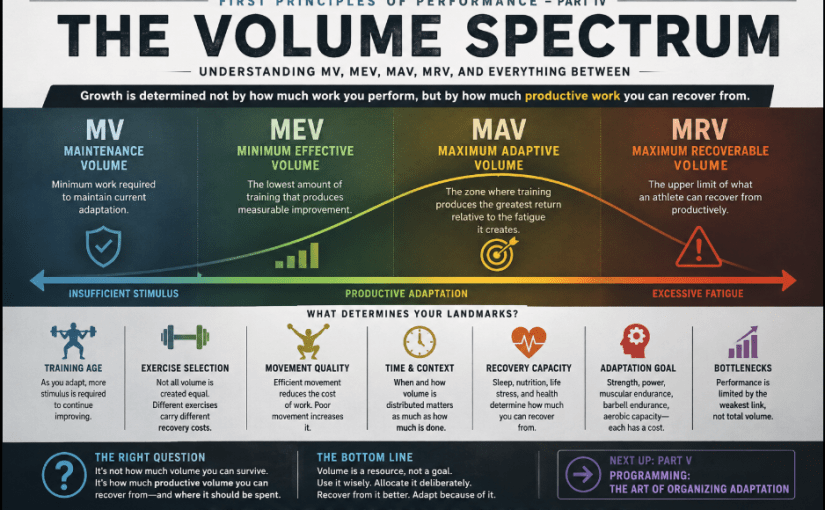
Training volume can be understood through four useful landmarks along a continuum. These should not be treated as rigid physiological thresholds or universal numerical prescriptions, but as practical regions that help coaches think about the relationship between training stress and adaptation.

Quick Reference: Training Volume Landmarks

MV (Maintenance Volume): The minimum amount of training needed to maintain current performance and muscle mass. Used during periods of reduced training, deloads, or recovery phases.

MEV (Minimum Effective Volume): The lowest training dose that produces measurable progress or adaptation. Anything below this threshold will not drive improvement.

MAV (Maximum Adaptive Volume): The “sweet spot” where training volume is high enough to maximize gains without causing excess fatigue or risk of overtraining. This is where most productive training occurs.

MRV (Maximum Recoverable Volume): The upper limit of training volume that the body can adapt to and recover from. Exceeding this consistently leads to stagnation, regression, or injury.

In short:

  • MV: Enough to maintain, not improve.
  • MEV: The minimum to make progress.
  • MAV: The most productive range for gains.
  • MRV: The most you can recover from, not to be exceeded.

Maintenance Volume (MV)

Maintenance Volume is exactly what it sounds like: the minimum amount of work required to preserve a current level of adaptation.

Notice what it is not. Maintenance volume is not intended to produce meaningful improvement. It provides enough stimulus to prevent meaningful loss.

This matters more than many athletes realize because maintenance allows training resources to be reallocated. A competitive CrossFit athlete may temporarily reduce upper-body hypertrophy work while emphasizing Olympic lifting. A tactical professional preparing for selection may maintain maximal strength while substantially increasing endurance. An older adult may temporarily reduce overall workload while attempting to preserve existing strength and muscle mass.

Maintaining an adaptation generally requires less training than developing it in the first place. That principle becomes one of the coach’s most valuable tools because no athlete can emphasize everything simultaneously.

Sometimes maintaining one quality is precisely what allows another to improve.

Minimum Effective Volume (MEV)

MEV represents the lowest amount of training necessary to produce measurable improvement. Think of it as crossing the threshold where training moves beyond maintenance and begins providing enough stimulus for further adaptation.

Importantly, MEV is highly individual.

A novice lifter may stimulate meaningful progress with relatively little training. An experienced athlete may require substantially more work simply to continue improving. Training age changes the equation because the stronger, more conditioned, and more experienced you become, the greater the stimulus may need to be before the body has sufficient reason to adapt further.

Success changes the rules.

Maximum Adaptive Volume (MAV)

Maximum Adaptive Volume describes the region where training produces the greatest return relative to the fatigue it creates.

Not necessarily the most work. The best work you can do, achieving the intended stimulus, and recover from.

Most productive training should occur somewhere in this range. Performance improves, strength or work capacity develops, recovery remains manageable, technique stays relatively sharp, and the athlete remains capable of continuing to perform quality training.

That distinction matters. MAV is not defined by exhaustion, it’s defined by adaptation.

Maximum Recoverable Volume (MRV)

Eventually every athlete reaches a point where additional work creates more fatigue than useful adaptation. That upper boundary is Maximum Recoverable Volume.

MRV should not be treated as a target. It’s the ceiling.

Experienced athletes may intentionally approach that ceiling during concentrated training blocks before reducing workload and allowing accumulated fatigue to dissipate. Used carefully, periods of functional overreaching can have a place within training.

Living near or above MRV is another matter.

When training chronically exceeds the athlete’s ability to recover, familiar warning signs can begin appearing: declining performance, slower bar speed, persistent soreness or joint discomfort, deteriorating sleep, reduced motivation, worsening session quality, and increased susceptibility to minor illness.

The dedicated athlete may again interpret these symptoms as evidence that more work is required. Often the opposite is true.

Why These Landmarks Move

One of the biggest mistakes coaches make is treating volume landmarks as fixed numbers.

They aren’t.

Your MEV this year may not resemble your MEV five years from now. Your MRV during a period of low life stress may differ considerably from your MRV during a demanding work cycle, caloric deficit, competition season, or period of poor sleep. The amount of volume you can recover from for one physical quality may also differ substantially from what you can tolerate for another.

These landmarks move because the athlete moves. As the old saying goes, “You can’t be in fight shape all the time.”

Training Age

Beginners often require surprisingly little work to improve. Advanced athletes generally require a greater stimulus to continue adapting, while simultaneously becoming capable of creating considerably more stress during each hard working set.

Five sets of squats performed by an athlete squatting 135 pounds do not represent the same physiological event as five sets performed by an athlete squatting 500.

The volume may look identical on paper. The affect on the body is not.

Exercise Selection and Recovery Cost

Not all training stress is created equally.

Three sets of leg extensions, three sets of heavy back squats, three rounds of ring muscle-ups, ten minutes of EMOM barbell cycling, and a 5k row for time all qualify as training volume, but they do not impose the same demand.

Heavy compound lifting can create substantial mechanical and systemic fatigue. High-repetition gymnastics challenge local muscular endurance, connective tissue, grip, coordination, and the ability to maintain movement quality as fatigue (neurological and physical) accumulates.

Repeated cleans or snatches performed under metabolic fatigue combine muscular endurance with technical proficiency, strength, power, timing, and repeated force production. Longer aerobic work may create relatively little mechanical damage while still imposing substantial cardiorespiratory and metabolic demand.

This is why simply counting sets, repetitions, minutes, or meters can become misleading.

Programming volume requires understanding what quality the work is developing, how much useful stimulus it provides, and what it costs the athlete to recover from it.

The body doesn’t count reps, it accumulates stress.

Different Qualities Carry Different Costs

One of the greatest misconceptions in training is assuming every physical quality responds to volume in the same way.

It doesn’t.

Absolute strength and power require exposure to high levels of force and velocity. A strong baseline in movements such as squats, deadlifts, presses, pulls, and Olympic lifts provide a foundation from which explosive force can be expressed.

Muscular endurance requires something different: the local capacity of muscles and the nervous system controlling them to repeatedly produce useful contractions despite accumulating fatigue. In gymnastics, that may mean sustaining pull-ups, push-ups, toes-to-bar, handstand push-ups, or muscle-ups. With a barbell, it may mean repeatedly cycling cleans, snatches, thrusters, or shoulder-to-overhead movements while maintaining enough technical integrity to continue working efficiently.

Cardiorespiratory endurance and stamina place another demand on the athlete. Aerobic and anaerobic metabolism must continually provide energy across efforts lasting seconds, minutes, or hours, while the athlete develops the capacity to sustain output and recover between repeated demands.

Strength, power, muscular endurance, barbell endurance, cardiorespiratory endurance, and stamina coexist, but they are not interchangeable.

A CrossFit athlete preparing for competition may intentionally increase muscular endurance, barbell cycling, aerobic development, and repeated-effort aerobic power and capacity training while maintaining rather than maximizing absolute strength.

An Olympic weightlifter may do almost the opposite, allocating considerably more training toward strength, power, technical consistency, and the competition lifts. A tactical professional may require substantial strength alongside loaded movement, cardiorespiratory endurance, muscular stamina, and repeated performance under fatigue.

An older adult may prioritize strength, muscle mass, aerobic capacity, mobility, balance, and resilience because the objective is preserving capability and independence rather than maximizing competitive performance.

None of these athletes are training incorrectly, they’re simply solving different problems. Volume only becomes meaningful when viewed through the adaptation being pursued.

Movement Quality Changes the Cost of Volume

There is another variable that sets and repetitions alone cannot explain: movement quality.

Before deciding that an athlete needs more squats, gymnastics, barbell work, or conditioning, the coach must understand whether the athlete can efficiently perform the movements being prescribed.

Can they squat through the required range of motion while maintaining position? Can they establish a stable overhead position and safely receive a clean or snatch? Do they possess the ankle, hip, thoracic, and shoulder mobility required for the task? Can they maintain trunk control and coordination as fatigue accumulates?

Flexibility and mobility are not decorative qualities simply sprinkled in at the beginning or at the end of a training session. Adequate range of motion allows the athlete to access the positions required for the task(s); mobility adds the ability to control those positions. Coordination, agility, and balance allow the athlete to organize movement, redirect force, transition between tasks, and preserve technical integrity under changing conditions.

These qualities are essential and non-negotiable under fatigue.

Walking on your hands while fresh is one skill. Maintaining a handstand walk after heavy cleans and/or several minutes of high-output conditioning is another. The same principle applies to receiving a snatch in a deep overhead squat, transitioning efficiently through ring muscle-ups, or maintaining clean mechanics while breathing heavily and losing grip strength.

Poor movement quality increases the cost of work. Efficient movement reduces it.

Two athletes can therefore complete exactly the same prescribed volume while experiencing meaningfully different training loads.

Sometimes the fastest way to improve work capacity isn’t adding more work.

It’s reducing wasted movement. Or, what we used refer to in CrossFit as seeking Virtuosity in movement.

Volume Exists in Time

Twenty weekly sets performed in one session are not equivalent to twenty sets distributed across four sessions.

Fatigue accumulates differently. Performance quality changes. Recovery opportunities change.

The same principle applies outside traditional resistance training. Twenty minutes of high-skill gymnastics performed while fresh is not equivalent to twenty minutes performed after heavy barbell work. Six sprint intervals distributed appropriately across a training week do not necessarily impose the same cost as those same intervals performed immediately after a demanding lower-body session.

Volume therefore cannot be separated from frequency, sequencing, and recovery. Where the work occurs matters, what happens before and after it matters. The body does not simply experience training volume. It experiences stress over time.

The Athlete Changes the Equation

Dynamis 

Genetics, sleep, nutrition, age, life stress, occupation, training history, and movement quality all influence the amount and type of training an athlete can productively tolerate.

A firefighter working rotating night shifts may have a very different MRV from a college student sleeping nine hours each night. Two athletes possessing similar strength may tolerate very different amounts of training, and two athletes capable of completing the same workout may require entirely different interventions because their limiting factors are different.

One may lack absolute strength. Another may lack muscular endurance. Another may possess tremendous strength but poor muscular endurance. Another may have excellent local muscular endurance but insufficient aerobic capacity to recover between efforts. Another may simply move inefficiently which can make each training session twice as hard as it needs to be with the most basic of movements like air squats, pushups, pullups or burpees.

That’s why programming that ignores recovery outside the gym ignores half the equation.

And programming that ignores the individual misunderstands the other half.

Autoregulation: Listening Without Guessing

Perhaps the greatest weakness of rigid programming is the assumption that today’s body is identical to yesterday’s.

It isn’t.

Autoregulation recognizes that readiness fluctuates. Instead of blindly completing predetermined workloads regardless of performance, intelligent athletes and coaches adjust training according to relevant objective and subjective information.

Bar speed, repetitions in reserve, perceived exertion, heart-rate recovery, sleep quality, motivation, persistent soreness, session performance, movement quality, and technical deterioration under fatigue can all provide useful information.

No single metric tells the entire story. The purpose is not to replace programming with daily improvisation.

Autoregulation isn’t abandoning structure it’s allowing physiology to inform execution.

Deloads: Adaptation’s Forgotten Partner

One of the greatest misconceptions in training is that progress results from uninterrupted accumulation. It doesn’t. Progress often depends upon strategic reduction.

Deloads intentionally reduce training stress so accumulated fatigue can dissipate while much of the underlying adaptation is preserved. The purpose isn’t simply to rest. It is to restore the athlete’s capacity to perform productive training again.

A deload is not necessarily a step backward. Often it is the point at which accumulated fitness becomes visible beneath accumulated fatigue. We’ll discuss deloading, and its importance in more detail, later in this series

Pacing, Bottlenecks, and Productive Volume
More volume is rarely the solution to poor performance.

Sometimes the athlete needs more strength. Sometimes they need greater muscular endurance, a larger aerobic base, better gymnastic skill, more technical practice, or improved movement economy.

And sometimes they simply need to stop going out too hard. Pacing by itself is a performance skill. Athletes have to learn how much work can be performed now without any degradation in overall performance.

That means learning how quickly your breathing recovers, knowing when to stop just before grip or shoulder failure, or when technically efficient barbell cycling becomes increasingly expensive, and where local muscular fatigue or technical breakdown reliably appears.

Meaning, where is the bottleneck?

An athlete who repeatedly falls apart during the final five minutes of a 20min AMRAP, may not need another conditioning session. They may benefit more from not trying to win the first five minutes.

Likewise, an athlete struggling with high-repetition cleans may assume the problem is conditioning when insufficient absolute strength is making every repetition too expensive. Another athlete may possess enormous strength but lose time because poor economy of motion makes their receiving positions inefficient. Another may possess the engine and strength but lack the coordination required to transition efficiently between gymnastics and other external loading.

The workout reveals the symptom(s) and good assessments identify the cause(s). That distinction matters because training should target the bottleneck, not just accumulate more fatigue around it.

Volume Is a Conversation, Not a Competition

Perhaps the most important lesson from the Volume Spectrum is this: Volume is not something to maximize, it’s something to be optimized.

It’s a training resource to be allocated according to the athlete’s objectives, abilities, limitations, and capacity to recover. The strongest programs are rarely those that demand the most work. They are the ones that consistently produce the greatest useful adaptation relative to their cost.

That balance changes throughout a career. It changes across seasons and according to the physical quality being developed. It changes during periods of occupational stress, poor sleep, illness, caloric restriction, or competition preparation. And it changes as weaknesses become strengths and new bottlenecks emerge.

The best coaches therefore don’t ask: How much volume can this athlete survive?

They ask: How much productive volume can this athlete recover from?

And eventually, they ask an even better question: Where should that volume be spent?

Those are profoundly different questions. One measures work while the other considers adaptation. And that final question brings us to the next principle.

Looking Ahead

By now, we’ve moved far beyond the old argument that strength and conditioning somehow exist in opposition to one another.

We’ve seen that the interference effect is real but contextual. We’ve examined what performance programs actually look like and why athletes with very different objectives still develop many of the same fundamental physical qualities. And now we’ve established that even the amount of training itself exists along a spectrum, from the work required merely to maintain an adaptation to the upper boundary of what the athlete can productively recover from.

But volume alone still cannot tell us what to do.

Knowing that an athlete can recover from twelve hours of training each week tells us nothing about how those twelve hours should be spent.

Should we build absolute strength and power? Develop muscular endurance or barbell cycling skill? Expand cardiorespiratory capacity? Improve flexibility and movement efficiency? Develop coordination, agility, and balance? Improve movement quality or technical skill? Practice pacing? Attack a specific bottleneck?

Or should several of those qualities simply be maintained while training resources are concentrated on the one that matters most right now?

That is where coaching becomes something more than exercise selection.

A bodybuilder, Olympic weightlifter, tactical professional, CrossFit athlete, and older adult may all require some combination of strength, endurance, power, movement competency, and resilience.

But their needs vary in degree and application, not in kind. What changes is the proportion.

What changes is the priority. What also changes is the organization of stress across time.

Good programming does not ask which physical quality is universally best. It asks which quality matters most for this athlete, at this moment, how much of the others must be developed or preserved, where the athlete’s bottlenecks exist, and how those pieces can coexist without obscuring the primary objective.

That is why programming cannot be reduced to exercises written beneath the days of the week, and it certainly isn’t the random accumulation of difficult workouts.

Programming is the deliberate organization of stress in pursuit of adaptation.

It determines what to develop, what to maintain, what to temporarily deprioritize, how much work to perform, when to perform it, when to push, when to pull back, and when the athlete standing in front of you requires something different from what you originally wrote on paper.

In Part V of First Principles of Performance we discover how programming is not the science of writing workouts. It’s the strategic art of organizing adaptation, we bring those pieces together and examine how coaches actually organize adaptation: how strength, power, muscular endurance, cardiorespiratory capacity, movement competency, skill, recovery, and the individual athlete become a coherent training system rather than a collection of disconnected workouts.

Because knowing the physiology is important, knowing the how and why we utilize MGW is foundational, and how and why knowing all of the movements is elemental. But, knowing how to organize them around the needs of the individual is where knowledge becomes art.

Programming is not simply the science of writing workouts. It is the art of organizing adaptation. As always, the principles remain constant.

The application is the art. And that’s what quality coaching is all about.
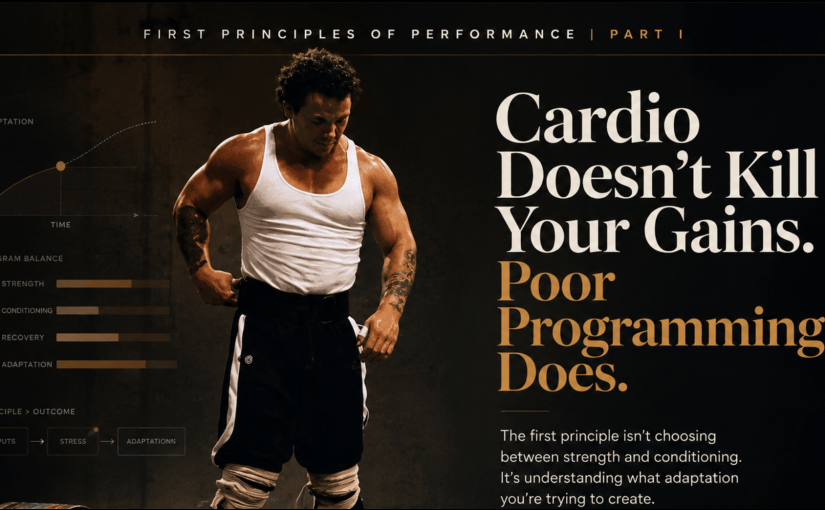
First Principles of Performance | Part I

Cardio Doesn’t Kill Your Gains. Poor Programming Does.

“The first principle isn’t choosing between strength and conditioning. It’s understanding what adaptation you’re trying to create.”

The Lion Killer

For decades, one of the most persistent myths in strength training has been deceptively simple:

“If you want to build muscle, avoid cardio.”

It sounds reasonable. After all, endurance athletes tend to be lean, while bodybuilders are muscular. Somewhere along the way, many people concluded that cardiovascular training and muscle growth must exist at opposite ends of the same spectrum.

Like most fitness myths, there’s a grain of truth buried beneath a mountain of oversimplification.

Can excessive endurance training interfere with maximal hypertrophy? Yes.

Can intelligently programmed cardiovascular training improve your health, enhance your recovery, increase your work capacity, and have little meaningful effect on muscle growth?

Also yes. The difference isn’t cardio. It’s programming

The Wrong Question

People often ask, “How much cardio can I do without losing muscle?” It’s the wrong question. The better question is: What adaptation am I trying to produce?

Every training session asks your body to solve a problem. Heavy squats ask it to produce more force. Tempo intervals ask it to become more efficient at clearing lactate.

Sprints demand explosive power. Long easy efforts improve aerobic efficiency.

These aren’t competing identities. They’re simply different physiological adaptations. Understanding that distinction changes everything.

First, Let’s Define “Cardio”

One reason this discussion becomes so confusing is because we use the word cardio as though it’s a type of exercise.

It isn’t. It’s a physiological demand.

Your cardiovascular system doesn’t know whether you’re running, rowing, cycling, carrying sandbags, or performing twenty-rep squats. It only knows that your muscles require oxygen, nutrients, and energy.

Think about workouts like:
– The Standard (Grace – 30 clean and jerks at 135/95, 30 ring muscle ups, Isabel – 30 snatches at 135/95)
– Heavy sled pushes
– Oly complexes of 5 reps or more
– 2k row for time
– 5k run
– Fran
– 20 rep max back squat
– Murph

Nobody finishes those wondering whether their cardiovascular system was challenged. Weight training can absolutely become cardiovascular training depending on how it’s programmed.

Intensity.
Density.
Rest intervals.
Exercise selection.
Volume.

These variables determine the cardiovascular demand, not whether you’re holding a barbell or running shoes. The conversation isn’t “weights versus cardio.”

It never was.

Where the Myth Came From

The concern isn’t entirely imaginary.

Researchers have long studied what’s known as the interference effect, the observation that combining endurance and resistance training can, under certain conditions, reduce some strength and hypertrophy adaptations compared with resistance training alone.

Notice the language. Can. Under certain conditions.

Not: Always. Those conditions matter.

A competitive marathon runner performing sixty miles each week while trying to maximize leg hypertrophy faces a very different challenge than someone lifting four days a week while adding two thirty-minute conditioning sessions.

Those are not the same training problems. Yet they’re often discussed as though they are.

What Actually Interferes?

For most lifters, muscle isn’t lost because they jogged. It’s lost because recovery becomes the limiting factor.

Poor programming often looks like this:
Heavy lower-body lifting followed immediately by long-distance running.
High-volume conditioning layered on top of already excessive lifting volume.
Poor sleep.
Insufficient calories.
Inadequate protein intake.
Eventually something has to give.
Trying to train near maximally, whether it’s loading or intensity, 4-6 days per week.

If training continually exceeds your ability to recover, progress slows—not because cardio is inherently bad, but because the total stress exceeds your adaptive capacity.

The Research Is More Encouraging Than the Internet

Fortunately, the research is considerably more nuanced than the internet. Much of the fear surrounding cardio comes from laboratory discussions about molecular signaling. You’ll often hear that endurance exercise activates one pathway while resistance training activates another, and that these pathways “fight” each other.

There is truth here. But physiology is rarely as binary as social media suggests.

These signals are temporary. They’re influenced by nutrition, training age, exercise selection and most important, recovery.

And they’re often localized to the tissues being trained rather than acting as a simple on-off switch across the entire body.

More importantly, when researchers look beyond the molecular biology and examine actual training outcomes, the picture becomes much less dramatic.

For the overwhelming majority of recreational lifters, and even many competitive athletes, well-designed conditioning has little meaningful effect on muscle growth.

Programming matters far more than the mere presence of cardiovascular exercise.

I hope the archive of this blog never disappears.

Optimum Performance Training (OPT) James Fitzgerald

Numerous studies support the idea that cardio, when programmed intelligently, does not meaningfully hinder muscle growth. For example, a 2015 meta-analysis by Dr. Brad Schoenfeld and colleagues concluded that combining strength and cardio training results in only a negligible impact on muscle and strength gains, provided programming is sound (Schoenfeld, B.J., Ogborn, D., & Krieger, J.W., 2015, Sports Medicine).

Cardio That Supports Muscle Growth

If hypertrophy is your primary objective, conditioning should complement not compete with your lifting.

Generally speaking, it could look like the following:

  • Shorter, more intense sprint work.
  • Use interval-based conditioning where appropriate.
  • Row.
  • Cycle.
  • Throw med-balls.
  • Use the SkiErg.
  • Carry odd objects.
  • Push and pull sleds.
  • Perform tempo intervals.
  • Carry heavy implements.
  • Include sprint interval training when recovery allows.
  • Separate demanding conditioning from heavy lower-body strength sessions whenever practical.

Most importantly, keep the main thing, the main thing.

Conditioning exists to improve health, increase work capacity, and support recovery, not to leave you so fatigued that tomorrow’s strength session suffers.

Keep the Main Thing the Main Thing

The best programs are surprisingly disciplined. They know exactly what they’re trying to improve. Everything else exists to support that objective, not distract from it.

One of the greatest mistakes athletes make is assuming every session must improve every quality simultaneously.

It doesn’t. Training is about emphasis or specificity to the individual and their goals. Some phases prioritize maximal strength. Some emphasize hypertrophy, aerobic capacity gymnastic or Olympic Weightlifting skill. A skill Ive always referred to as barbell gymnastics because of how skill dependent they are.

The art of coaching isn’t teaching every quality simultaneously. It’s knowing which qualities deserve emphasis today, and which can simply be maintained until tomorrow.

That’s programming.

Paleo - BJJ - white belt - black belt - earned not issued

The First Principle

Cardio doesn’t kill your gains. Poor programming does. If your training reflects clear priorities, if recovery matches workload, if nutrition supports adaptation, if conditioning complements rather than competes with strength, then you can become stronger. You will then become stronger, healthier, and better conditioned.

Not because you avoided cardio, but because you finally stopped asking whether strength and conditioning are enemies.

They never were. They simply need a coach who understands how to make them work together.

The principles remain constant. The application is the art.

If you’re curious why all of this works, not merely what to do, we’ll step out of the weight room and into the physiology laboratory. There we’ll explore the molecular conversation taking place inside skeletal muscle every time you lift, sprint, row, or recover, and discover why the story is far more nuanced than the internet would have you believe.

References

Schoenfeld, B. J., Ogborn, D., & Krieger, J. W. (2015). Effect of concurrent aerobic and strength training on maximal strength, power, and hypertrophy in healthy adults: A systematic review and meta-analysis. Sports Medicine, 45(5), 697–708.

Wilson, J. M., Marin, P. J., Rhea, M. R., Wilson, S. M. C., Loenneke, J. P., & Anderson, J. C. (2012). Concurrent training: A meta-analysis examining interference of aerobic and resistance exercises. Journal of Strength and Conditioning Research, 26(8), 2293–2307.

Nutrition for Female Athletes: Building Strength, Performance, and Longevity

Nutrition for female athletes is about fueling strength, performance, and long-term vitality, not restriction or “losing weight.”

Performance Over Perception

Most nutrition advice aimed at women is still built around restriction, aesthetics, or outdated assumptions about metabolism and training. Training for ladies varies in degree, not kind.

That’s a problem.

If you are training 3–5 days per week, lifting with intent, and layering in conditioning, your body is not asking for less. It is asking for structure, consistency, and sufficient nutritional intake to support your output.

This is not about eating less. It’s about eating appropriately for what you demand of your body.

Myth vs. Reality

Myth: Eating more carbs or fats for performance will automatically lead to fat gain.

Reality: Adequate carbs and fats are essential for training intensity, hormonal health, and recovery. Under-fueling is far riskier for female athletes.

What Changes for Female Athletes?

Physiologically, women:

  • Oxidize slightly more fat at rest and during lower intensity work
  • May rely more heavily on carbohydrate during higher intensity training
  • Are more sensitive to low energy availability, which can disrupt:
    • Hormonal health
    • Bone density
    • Recovery and performance

This makes under-fueling a much bigger issue than over-fueling.

Key concept: Performance nutrition for women is not scaled-down male nutrition. It requires adequate intake and consistency, not chronic restriction.

Caloric Baseline – Your Starting Point

For most beginner to intermediate female athletes:

  • ~12–16 calories per lb bodyweight/day

Adjust based on:

  • Training frequency and intensity
  • Body composition goals
  • Recovery and energy levels

Macro Quick Reference (per lb bodyweight)

• Calories: 12–16/day
• Protein: 0.8–1.1g
• Carbs: 1.5–2.5g
• Fat: 0.3–0.5g

Protein: The Non-Negotiable

Recommendation

  • 0.8 – 1.1 g per lb bodyweight per day

Why does it matter?

Protein supports:

  • Muscle repair and growth
  • Tendon and ligament integrity
  • Immune function
  • Hormonal signaling

Women often under-consume protein, especially earlier in the day.

Distribution

Aim for:

  • 25–40g per meal
  • 3–4 meals per day

This supports repeated stimulation of muscle protein synthesis (MPS).

Scientific Support

  • Morton et al., 2018 (Br J Sports Med)
    → ~1.6 g/kg (~0.7 g/lb) minimum, with higher intakes beneficial for active individuals
  • Areta et al., 2013 (J Physiol)
    → Even protein distribution improves MPS vs skewed intake

Carbohydrates: The Performance Driver

Recommendation

  • 1.5 – 2.5 g per lb bodyweight per day

Adjust based on:

  • Conditioning volume
  • Training intensity
  • Recovery demands

Why Carbs Matter

Carbohydrates:

  • Fuel resistance training and conditioning
  • Support glycogen replenishment
  • Improve performance output and training quality
  • Help regulate cortisol post-training

For Hybrid Training (Lifting + Conditioning)

With 2 days of added metabolic work:

  • Bias carbs around training windows
  • Slightly higher intake on those days

Scientific Support

  • Kerksick et al., 2017 (JISSN Position Stand)
    Carbs critical for performance and recovery in high-intensity training
  • Burke et al., 2011 (J Sports Sci)
    Glycogen availability directly impacts training capacity

Fats: Essential, Not Optional

Recommendation

  • 0.3 – 0.5 g per lb bodyweight per day

Why It Matters

Fats support:

  • Hormone production (including estrogen)
  • Brain function
  • Nutrient absorption
  • Long-term health

Chronically low fat intake in women is linked to:

  • Hormonal disruption
  • Menstrual irregularities
  • Reduced recovery capacity

Scientific Support

  • De Souza et al., 2014 (Br J Sports Med)
    Low energy and fat intake linked to endocrine disruption

Nutrient Timing: Useful, Not Obsessive

Pre-Training

  • Protein + carbohydrates
  • Example: Greek yogurt + fruit, or protein + oats

Post-Training

  • Protein + carbohydrates
  • Example: whey + fruit, or whole meal

Evening Eating

Avoid large meals too close to sleep.

If needed:

  • Smaller protein + carb option
  • Example: 1 serving of fat-free Greek yogurt, 1 serving of your favorite protein powder + 1 serving of fruit

Hydration & Electrolytes

Especially important for:

  • Conditioning sessions
  • Longer training days

Baseline

  • ~0.5–0.7 oz water per lb bodyweight daily

Add electrolytes if:

  • Sweating heavily
  • Training in heat
  • Doing longer sessions

Common Mistakes That Limit Progress

1. Under-eating protein
2. Avoiding carbohydrates
3. Skipping meals and “catching up” later
4. Relying on snacks instead of structured meals
5. Treating food as a reward or a punishment

Practical Daily Structure

Example Day

Meal 1

  • Eggs + oats + fruit

Meal 2

  • Chicken + white rice + vegetables + olive oil

Meal 3 (Pre/Post Training)

  • Protein shake + banana

Meal 4

  • Salmon + potatoes + vegetables

Action Challenge

For the next 3 days:

  1. Hit your protein target
  2. Add carbohydrates to support training
  3. Eat 3–4 structured meals

No tracking perfection required. Just consistency.

Coach’s Notes

  • You don’t need a perfect plan. You need a repeatable one.
  • Consistency builds performance.
  • Intensity in training requires support from nutrition
  • If you feel constantly fatigued, flat, or under-recovered, you are likely under-fueling

Suggested Reading

“Roar” by Stacy Sims — Focuses on female-specific physiology and performance nutrition.

One athlete I worked with spent years fearing carbs and eating as little fat as possible. When she finally fueled for her training, hitting just her protein and carb targets, she broke her plateau, gained strength, and recovered faster than ever. Performance nutrition changed her body and her confidence.

Key Takeaways

Lifting and conditioning place real demands on your body.

If you want:

  • Strength
  • Performance
  • Longevity

Then your nutrition must reflect that and not focus on eating less to “lose weight” or simply “be skinnier.”

What Do Performance Meals Actually Look Like?

Picking Up Where We Left Off

In Week 3, we learned that nutrient timing matters for performance.
In Week 4, we reframed carbs not as villains but as essential performance fuel.
In Week 5, we cleared the deck on dietary fat, not evil, not unlimited, just essential when used right.

This week, we put it all together.

Now that you understand why macros matter, the next question becomes:
“Okay… so what does a real performance meal look like?”

That’s what we’ll answer today, without rigid rules, caloric obsession, or influencer mythology.

Ever find yourself staring at a fridge full of random leftovers, wondering how to build a meal that actually fuels you? That’s where the performance plate turns chaos into confidence.

The Goal: Balanced, Functional, Repeatable Meals

A performance meal supports:

  • Training intensity and output
  • Smart recovery
  • Stable energy
  • Hormone balance
  • Cognitive performance

A performance plate isn’t perfection; it’s consistency with intention.

The Anatomy of a Performance Plate

Instead of calories, think in functional portions:

1. Protein — the Foundation

25–40g per meal
Purpose: repair, rebuild, satiety
Examples:

  • Skinless chicken, turkey, lean beef
  • Fish/seafood
  • Eggs or egg whites
  • Greek yogurt, cottage cheese
  • Whey, casein, and high‑quality protein powders

2. Carbohydrates — the Fuel

Enough to support your output

  • Pre‑training: moderate → high
  • Post‑training: moderate (to replenish glycogen)
  • Low‑intensity or rest days: moderate → low

Good sources:

  • Rice, oats, potatoes, sweet potatoes
  • Fruit
  • Whole‑grain bread/pasta
  • Beans, legumes

3. Fats — the Modulator

Small, intentional amounts

  • Avocado
  • Nuts & seeds
  • Olive oil, nut oils
  • Fatty fish (salmon, sardines)

Fats slow digestion and support hormone signaling, but not 100% of the time.

Anti-Hero Myth:

Carbs are not just for athletes; your brain and muscles both need them, especially after training. Skipping carbs post-workout is one of the fastest ways to sabotage recovery and performance.

A Simple Performance Plate Template

Protein~25–40gRepair, maintain muscle, recovery
CarbohydratesModerateFuel, glycogen resynthesis
VegetablesGenerousMicronutrients & fiber
FatsModestHormones, satiety, absorption

Quick Performance Meal Summary:

  • 1 palm-sized serving of protein (chicken, fish, tofu)
  • 1 fist-sized serving of carbs (rice, potato, beans)
  • 1 thumb-sized serving of healthy fat (olive oil, avocado)
  • Unlimited non-starchy vegetables
  • Hydrate: 12–16 oz of water with every meal

Example Plate (Post‑Training)

  • 6 oz grilled chicken (~35g protein)
  • 1 cup cooked rice (~45g carbs)
  • 1 cup mixed vegetables
  • 1 tbsp olive oil (~14g fat)

Example Plate (Rest/Easy Day)

  • 5 oz salmon (~30g protein + healthy fats)
  • 1 sweet potato (~30–40g carbs)
  • Large salad with olive oil

How This Adjusts for Different Days

Training Day (Morning/Afternoon)

  • Higher carbs around training
  • Moderate protein
  • Light fats pre‑workout

Training Day (Evening)

  • Moderate carbs in the afternoon or post‑session
  • Protein at every meal
  • Fat later slows evening digestion

Non‑Training Day

  • Maintain protein
  • Scale carbs to activity (lower than training days)
  • Maintain healthy fats

Action Challenge

For the next 3 days:

  1. Construct at least one performance meal per day using the template above.
  2. Log it with a simple note on intention:
    • Was it pre-training fuel?
    • For recovery?
    • A rest day meal?
  3. Reflect:
    • How did you feel 2–3 hours after eating?
    • How was your training quality?
    • Any energy lows or highs?

This isn’t about perfection; it’s about pattern recognition and learning what works for your body and schedule.

Coach’s Corner

  • Protein at every meal makes everything else easier.
  • Carbs are your performance currency; spend them where they matter (training/mental load).
  • Fats are intention modifiers, not fillers.
  • A structure beats motivation every time.

Suggested Reading

“The Performance Cortex” by Zach Schonbrun
Not a diet book, but a deep look at how nervous systems and fuel interact. It’s perfect for understanding how food enables performance.

Science Insight:

A 2022 meta-analysis in Sports Medicine found that balanced meals with protein, carbs, and healthy fats significantly improve training recovery, sustained energy, and muscle adaptation compared to single-macro meals.

Key Takeaway

A performance plate is not a restrictive template, it’s a balanced framework that supports energy, training, recovery, and long‑term resilience. Build one intentional plate every day, regardless of chaos around you. Consistency beats perfection, every time.

Once you understand how to build a meal based on function, not fear, your nutrition becomes simpler, more repeatable, and far more effective.

You don’t need to eat perfectly; you eat purposefully.

Fat Isn’t Evil: It’s Essential

Picking up from where we left off last week — we’ve already dismantled the myths around protein and carbohydrates, now it’s time to put the final macronutrient into proper context.

In Week 3, we covered nutrient timing and why eating with intention matters. In Week 4, we cleared the air around carbs, showing they’re a necessary tool for fueling performance, not something to fear.

This week, we’re doing the same with fat, one of the most demonized and misunderstood components of the human diet.

Why This Matters:

Most people trying to ‘eat healthy’ unknowingly sabotage their energy, focus, and results by fearing fat. Understanding the truth lets you make smarter, less stressful choices in and out of the gym.

The Problem: Fat Got Blamed for What Sugar (and Sedentary Living) Did

The war on fat started in the 1970s and 80s, pushing people toward fat-free everything, from cookies to frozen dinners. What happened next?
• Obesity skyrocketed.
• Type 2 diabetes surged.
• People got sicker, not healthier.

Why? Because removing fat didn’t remove the problem. It just made food more processed, more sugary, and less satisfying.

Question:

Ever skip the avocado on your salad because you thought it was ‘too fattening’, then ended up hungry an hour later? Now, youre beginning to pick up what I’m puttin’ down.

What Fat Actually Does in the Body

Fat isn’t the enemy. It’s a required nutrient for:
• Hormone production (testosterone, estrogen, cortisol)
• Brain health and cognition
• Joint lubrication and recovery
• Fat-soluble vitamin absorption (A, D, E, and K)
• Cellular structure (yes, your cells are literally built from it)

But here’s the key: fat is fuel for low-intensity output and recovery, not high-performance explosive training. That’s where carbs step in.

Quick Fat Facts:

• Unsaturated fats (olive oil, nuts, avocado, fatty fish) support heart and brain health.

• Saturated fats (animal fats, butter, coconut oil) are fine in moderation, especially from whole foods.

• Trans fats (partially hydrogenated oils) are in a different league; avoid them entirely. They wreak havoc on cholesterol and inflammation.

You need both fat and carbs, but at the right doses for the right goals.

Data Point:

Fat slows gastric emptying, helping you feel fuller for longer—a secret weapon against late-night snacking (British Journal of Nutrition, 2021).

Why “Healthy Fats” Doesn’t Mean “Unlimited Fats”

Yes, olive oil, avocado, nuts, and salmon are great, but overconsumption is still overconsumption.

Fat is energy-dense.
• 1 gram of fat = 9 calories
• That’s more than double protein or carbs (4 calories per gram)

So while you need it, you don’t need as much as you might think, especially if you’re already fueling with protein and carbs.

Most Common Fat Mistake:

Dousing salads, veggies, or “healthy” bowls with extra oil or nuts. Even good fats add up fast, so measure, don’t guess.

What This Looks Like in Practice

Swap:

Instead of fat-free salad dressing (loaded with sugar), use olive oil and vinegar for flavor, better absorption of nutrients, and longer-lasting energy.

Here’s how to build smart, balanced fat intake into your day:

• Add a thumb-sized portion of fat to your main meals (nuts, oil, nut butter, avocado)
• Don’t dump oil or butter onto every dish “for health;” it adds up fast
• Keep fats lighter pre-workout, so digestion doesn’t slow you down
• Post-workout, prioritize protein + carbs, not a heavy fat load
• Evening meals can include more fats to help slow digestion and promote satiety

You don’t need to avoid fat, you need to respect it.

Visual Analogy:

Think of fat as the steady-burning logs on a campfire versus using pine needles: the dry pine needles can get the fire going, but don’t last. The logs are for warmth that lasts all night.

Now that we’ve set the record straight, here’s how to use fat like an anti-hero: deliberately, strategically, and never just because the label says “healthy.”

Action Challenge

For the next 3 days:
• Track how much fat you’re eating (rough estimate is fine)
• Identify where it’s coming from (meals vs snacks vs sauces/oils)
• Adjust one meal per day to intentionally include a measured fat source (e.g., 1 tbsp olive oil, 1/4 avocado, or 10 almonds)

You’ll start to see how easily fat sneaks in and how powerful it can be when used deliberately.

Coach’s Corner

• Fat is a recovery nutrient, not a performance one.
• Don’t go to war with it, just don’t treat it like a free-for-all either.
• Balance is your ally. Fat has its place, use it like a tool, not a reward.

Suggested Reading

“Deep Nutrition” by Dr. Cate Shanahan
A sharp breakdown of how traditional diets used fats well, and how we can reclaim that without getting lost in the noise.

Real-World Headline:

In 2024, a major study published in JAMA found that replacing just 5% of calories from saturated to unsaturated fat was associated with a significant reduction in cardiovascular risk. (Source: JAMA, April 2024)

Science Insight:

Regular consumption of omega-3 fatty acids (found in fatty fish, chia, and flaxseed) is associated with improved heart health and reduced inflammation, according to the American Heart Association (2023).

Quick Fact:

Contrary to old myths, moderate whole-egg consumption does not increase heart disease risk for most people (Harvard School of Public Health, 2022).

Key Takeaway: Your hormones, brain, and cells are built from fats. Don’t fear them, but definitely manage them.

Key Anti-Hero Move: Use fat on your terms, not the food industry’s. Portion is power.

Empowerment Challenge:

What’s one fat source you’ll add back this week? Try it, track it, and notice the difference. Anti-heroes don’t just read, they act.

What’s Coming Next

You’ve now got a full picture of the big three macros, but how do you put them together? In Week 6, we’ll map out what a real-world performance meal looks like, and how to adjust it for your goals, whether that’s training, leaning out, or staying sharp at work.

In Defense of Carbs: Energy, Recovery, and the Science You Need

Most people fear carbs because they’ve been sold the idea that carbs equal fat gain. But for anyone who trains, thinks deeply, or recovers with intent, carbs aren’t optional; they’re essential.

This isn’t about eating gummy bears or Pop-Tarts and calling it “fuel.” It’s about understanding the physiological role of carbohydrates and using them to enhance output, mood, muscle retention, and recovery.

Let’s break it down.

1. Carbs = Performance

Glycogen (stored carbs) is your muscle’s preferred fuel during strength training, sparring, sprints, or any high-output effort. Without enough:

  • Strength drops
  • Endurance tanks
  • Motor control falters

Carbs refill that tank. Fewer reps and less intensity? That’s not a motivation problem; it might be a glycogen one. There’s a term known as “bonking” in a workout. To “bonk” in a workout is to reach the functional depletion of glycogen, brought on by exercise. In other words, it’s the condition in which your muscles run out of fuel, with profound effects on performance and well-being. And how do you avoid it? Adequate carbohydrate fueling for your level of performance.

Science Sidebar: When you eat carbs, insulin helps shuttle glucose into muscle cells to refill glycogen. This is why carbs matter most around activity, not when you’re sedentary. Research shows that athletes and active individuals who time carbs around exercise have better performance and recovery (Burke et al., 2011).

2. Carbs = Cognitive Clarity

Your brain runs on glucose. Low-carb fog is real. It shows up in several ways, such as decision fatigue, irritability, difficulty focusing, and a short attention span. Yes, ketones can serve as a backup fuel, but they’re not the most efficient during high-stress or high-focus days.

Carbs sharpen cognition, boost mood, and reduce stress response.

3. Carbs = Recovery and Muscle Retention

Carbs after training:

  • Restore depleted glycogen
  • Support protein synthesis
  • Lower post-training cortisol

They’re also “protein-sparing,” meaning your body doesn’t need to break down muscle for energy.

4. Carbs = Hormonal Stability

Low-carb diets for too long can suppress:

  • Thyroid output (especially T3)
  • Leptin (your satiety and metabolic rate signal)
  • Sleep quality and parasympathetic recovery

Especially for athletes, hard trainers, or people under high stress, this is a deal-breaker.

5. Carbs = Better Sleep

Moderate carbs in the evening:

  • Support serotonin → melatonin conversion
  • Lower cortisol
  • Help shift the body into parasympathetic mode.

Sleep: Carbs help lower cortisol levels and promote relaxation. Carbs also help raise serotonin, a neurotransmitter that supports relaxation and sleep. It’s one reason why a small carb snack before bed can improve sleep quality for some people. This is why low-carb diets can sometimes disrupt sleep.

Pro tip: Avoid eating after 8:00 PM. If you must have something, keep it light and digestible:

  • 1 banana
  • 1 scoop whey
  • 1 Fairlife 26g protein shake
  • Optional: 1 tbsp PB2

That’s ~350 kcal – just enough to support recovery without interrupting your sleep cycle.

The Real Issue Isn’t Carbs, It’s Unstructured Eating

People don’t “gain fat” from potatoes. They gain fat from:

  • Chronic snacking
  • Emotional eating
  • Under-fueling during the day and overeating at night

Carbs are fine; reactivity and randomness aren’t.

Coach’s Notes: Carb needs vary from person to person; listen to your body and adjust based on your activity, stress, and recovery.

  • Start with structure, not restriction.
  • Place carbs around output: morning, post-training, early dinner.
  • Observe how your sleep and recovery improve when you fuel with intention.

As silly as it may sound, a palm-sized portion of rice, potatoes, or fruit is a good place to start if you don’t want to count grams. Use your hand as a guide for portions.

Bonus tip: Carbs that are high in fiber, like fruit, potatoes, and whole grains, not only support performance, but also feed your gut microbiome, helping with digestion and immunity. And just in case you need a reminder, any fruit or vegetable is a carbohydrate source. Some are better than others, but the key is to eat the ones you like vs. trying to force yourself to eat anything you don’t like.

Suggested Reading:

Good Calories, Bad Calories – Gary Taubes
A well-researched, critical look at nutritional dogma and food myths, especially around carbs and fat.

Myth: Carbs make you fat. Truth: Excess calories, not carbs, drive weight gain.

Carbs don’t kill gains; they help sustain them. Used wisely, they improve output, cognition, mood, sleep, and recovery. However, as with any caloric intake, excess leads to consuming more calories than you burn, i.e., a caloric surplus = “weight gain.”

Action Challenge:

Track your carb intake for 3 days, but not just the grams. Track when and why you ate when you did:

  • Was it training-related?
  • Emotional?
  • Habitual?
  • Based on energy need?

Awareness creates clarity, and clarity can help drive consistency.

Next Week: You’ve dialed in protein and carbs. Now we’ll cover the most misunderstood macronutrient of all: fats.

How to use them for satiety, hormones, and cognitive support without overdoing it.

How Much Protein Do You Actually Need?

Forget hype. Here’s what science and results actually say.

Protein is the most misunderstood macronutrient in nutrition. It’s essential for more than just muscles or fitness; protein underpins your energy, brain function, and long-term health.
Most people fall into one of two groups:

  • Under-eaters, living off snacks, smoothies, and “light” meals.
  • Over-obsessors, hitting 300 grams a day and still thinking it’s not enough.

Both miss the point.

The goal isn’t to chase numbers; it’s to consistently eat enough to support muscle, recovery, cognition, and metabolic health.

Let’s walk through what actually matters and help you stop guessing.

The Real Job of Protein

Protein isn’t a magic fat burner. It’s not a cheat code. It’s a raw material, and your body needs it daily for:

  • Muscle repair and growth
  • Tendon and ligament recovery
  • Immune system function
  • Neurotransmitter production
  • Skin, hair, and tissue health

No fad diet, cleanse, or cutting phase changes that. Protein is required every day, not just “on training days.”

Think of protein as the bricks and mTOR as the foreman. Without enough bricks, the foreman can’t build or repair anything.

Trust “The Science“: Protein activates a pathway called mTOR, which acts as your body’s ‘growth command center.’ When you eat enough protein, mTOR signals your cells to repair, build muscle, and recover efficiently. Skimp on protein, and that signal never fires at full strength.

Multiple studies show that eating 25–40g of protein per meal maximizes muscle protein synthesis in adults (Morton et al., 2018). People who consistently meet their protein needs tend to retain more muscle as they age and recover faster from injuries.

Myth-busting:

Myth: “Too much protein will damage your kidneys.”

Reality: For healthy people, there’s no evidence that moderate-to-high protein intake harms kidney health. (See: National Kidney Foundation, 2017)

How Much Protein You Actually Need

Here’s what current science says, without the influencer fluff:

Sedentary0.6 – 0.8 g/lb
General Training0.8 – 1.0 g/lb
Strength / Hypertrophy1.0 – 1.2 g/lb
Cutting / Deficit1.2 – 1.4 g/lb

All ranges above are based on your target body weight, not your current weight, and definitely not your high school dream-physique weight. If you’re 180-200 pounds and lifting 3–5x/week, your target likely falls around 180–200g/day — not 300g+ and not 80g from “lean” meals and vibes. Now, depending on how much intensity you’re cranking up, you’ll have an additional need for carbohydrates, not protein.

Practical Ways to Hit Your Target

Protein isn’t just chicken breast and powder. Here’s what works for me and examples of how I actually hit my numbers every day without burning out:

Solid protein sources (per serving):

  • Chicken, turkey, smoked salmon, tuna, shrimp, beef, eggs
  • Greek yogurt, cottage cheese
  • Whey, casein, or egg white protein (smartly used, not overused)
  • Protein-forward meal replacements (e.g., a “complete” protein shake, a FairLife, RX bars, jerky only when needed/planned)

Underrated strategies:

  • Aim for 25–50g of protein per meal, instead of grazing on 10g snacks. A palm-sized portion of chicken, tofu, or fish is usually around 25g of protein—use your hand as a guide if you don’t want to count.
  • Don’t rely on just dinner to “catch up”
  • Use high-protein staples to plug into busy days (e.g. 8 oz chicken = ~50g, two scoops whey = 21-25g, ½ cup of yogurt + ½ cup of cottage cheese + 1 cup of fruit of your choice)

You don’t need a perfect plan. You need a repeatable system. A “protein-first” mindset simplifies the rest of your day.

Week Two Action Challenge:

Pick 3 protein staples that match your schedule and eat them for the next 3 days.

  • These should give you 30–40g per meal.
  • Rotate them between breakfast, lunch, dinner, or post-training
  • Make it frictionless, not fancy.

The goal: clarity, consistency, and a structure that supports your real life.

Protein isn’t just for athletes; it’s for everyone who wants to stay strong, energized, and resilient for life. Just like with your habits, it’s about building a system that makes the right choice automatic.

Coach’s Corner:

  • Protein is the most forgiving macro, but only if you get enough.
  • Hit your baseline. Track it once, then automate it.
  • Build around meals, not snacks.

Suggested Reading:

“The Protein Book” by Lyle McDonald
Dense, thorough, science-backed, and extremely useful for athletes or serious lifters.

Key Takeaway:

Protein isn’t about hitting a magic number; it’s about consistently meeting your needs so you can reach your life and training goals, whatever those are.

Once you get it right, energy balance improves, recovery speeds up, and hunger stabilizes.

Everything else becomes easier.

That’s all for this week. Let me know if this helps!

Food Is Not a Feeling: Rethinking Nutrition as a Tool for Consistency and Performance

Most people don’t have a nutrition problem; they have a perspective problem.

They’re not making poor food choices because they don’t know better. They’re making them because food has become emotional, reactive, and inconsistent. It’s comfort. It’s control or lack of it. It’s a celebration. It’s punishment. Worse still, it may be a genetic issue. And that is often the one that is least talked about. Often, almost every fitness “influencer” or goofy “guru” just tells everyone who will listen that they just need more or less of (fill in the blank). Given the particular and foundational nature of thetopic, 99% of influencers and “online fitness coaches” do their best to cram everyone into the same box.

And that’s the first thing we need to dismantle.

The Problem: Food Has Been Taught as Reward, Not Resource

We’re told from a young age that food is earned. Or to “earn your calories.” That it’s something you deserve when you’ve worked really hard, “been good,” or achieved something meaningful. Now, in some ways, that can be true, but it makes much more sense that, after all this time, we shouldn’t treat it like some sort of mood regulator.

  • Stress = snacks
  • Sadness = sugar
  • Boredom = bites
  • Hard workout = “reward meal”

But if you’re trying to feel, think, move, and live better—whether in training or just day-to-day—then food should support those goals. Emotions fluctuate, but your system for eating can remain steady.

A More Useful Lens: Food as a Support System

This isn’t about becoming robotic or clinical. It’s simply about building stability.

If you train, work, and live with intention, then food is one of your daily support tools. It’s not a treat. It’s not a cheat. It’s structure.

That means:

  • You eat when your body needs fuel.
  • You eat with an understanding of what’s coming next.
  • You repeat meals that work.
  • You build rituals around consistency, not emotion.

It’s how professionals eat. Not rigid. Not joyless. Just consistent, and you can do it, too.

What This Looks Like in Practice

We’ve covered this info a few times, but it bears repeating:

  • A consistent breakfast with protein, fiber, and hydration (not just a dose of caffeine and chaos and you’re out the door).
  • A post-workout meal that supports recovery, not emotional relief.
  • Default/backup meals when you’re too tired to think.
  • Less “what am I in the mood for?” and more “what supports what I’m doing today?”

For example, my go-to breakfast is eggs, oats, and berries. I repeat it most mornings because it works for me. Again, not robotic, just straightforward, easy to maintain, offers lots of flavor combinations, and is a simple, logical way to handle your food for the day.

You’ll find plenty of room for flexibility later. But not if you’re always reactively eating.

ACTION CHALLENGE:

Track what you eat for 3 days, but not just what, also why. Each time you eat, note what prompted it.

  • Was it hunger?
  • Boredom?
  • Social pressure?
  • Stress?
  • Fatigue?

You’ll be shocked by how often it has nothing to do with performance or physical need.

Coach’s Corner:

  • Start small. You don’t need the perfect meal plan; you need a few solid defaults.
  • Emotion is part of eating, and sometimes, comfort eating is okay. But it can’t be the foundation.
  • If your day feels chaotic, your nutrition shouldn’t add to that chaos. It should bring structure.

Suggested reading: “The Hungry Brain” by Stephan Guyenet
One of the best deep dives into the biology of eating behavior, hunger, and food decision-making.

Key takeaway: The more you can separate food from mood, and link it to your daily needs, the more empowered and consistent you’ll become, no guilt, no perfection required.

A great life = persistence > perfection.

Have A Very Merry Christmas: Staying Strong Through the Most Wonderful Time of the Year

The end of the year doesn’t mean the end of your progress. If you’ve trained hard for twelve months, Christmas isn’t a threat to your goals; it’s the reward for having them.

You don’t need perfection. You need intention.

This season is about joy, connection, celebration, and, yes, great food. Here’s how to honor your momentum while enjoying the holiday the way it’s meant to be enjoyed.

The 3 Holiday Non-Negotiables

Let’s clear one thing up immediately: December is not the month to white-knuckle your way through parties and potlucks. It’s the month to stay anchored to what matters without losing your mind, your friends, or your muscle.

1. Earned Enjoyment > Empty Indulgence

Restriction doesn’t build discipline; consistency does. One plate of your favorite Christmas dinner won’t derail anything. A month of “whatever, who cares?” absolutely will.

The difference is awareness, not anxiety.

Here’s a simple guideline that works for most people:

  • Build your plate around the foods you genuinely enjoy.
  • Eat slowly enough to taste it.
  • Stop when you’re satisfied, not stuffed.

That’s it. No food guilt. No drama. No moral judgment of anyone’s cooking.

Christmas dinner is not a metabolic emergency.

What not to do:

• Don’t “earn” your food with cardio.
• Don’t starve yourself all day to “save calories.”
• Don’t narrate your macros at the table (honestly, no one cares)

What to do:

• Move because it feels good, not because you feel guilty.
• Eat like normal leading up to the feast so you don’t binge from hunger.
• Say “yes,” “no,” or “I’m good, thanks” with zero explanation.

Food is part of the celebration. So is self-respect. You’re allowed to have both.

2. Don’t Skip Lifting, Protein, and Carbs

To channel my inner Jocko:

Traveling? Good.
Schedules scrambled? Good.
Gym hours weird? Good.

Your body doesn’t need perfect conditions; it needs the right signals and the right supply:

Signal:

  • Any resistance training at all.
  • 20 minutes of bodyweight, bands, dumbbells, hotel gym—whatever you’ve got.
  • This preserves muscle protein synthesis and keeps neuromuscular patterns active.

Supply:

  • ~30–40g protein + a moderate serving of carbohydrates per meal.
  • Protein maintains lean mass.
  • Carbs replenish glycogen and support training, sleep, and recovery.

This combo is one of the most research-supported ways to maintain muscle during chaotic schedules. Protein stimulates muscle protein synthesis for 3-5 hours post-meal, while carbohydrates replenish muscle glycogen and reduce cortisol, both critical when training volume or sleep quality drops.

Two habits. Huge return.

3. Stay Hydrated, Even in Celebration Mode

Holiday cocktails, desserts, and rich foods, enjoy them. Just don’t forget water.

A simple rule that works: One drink? Drink at least one 8 oz. glass of water.

An even better rule: Don’t drink.

Hydration directly affects recovery, digestion, appetite, performance, and whether you wake up feeling human or like you got hit by a truck.

Here’s what most people get wrong: they think the problem is too much food on Christmas. It’s not. The problem is eating like a monk for 3 days before and 4 days after, then binging because restriction always backfires. One great meal won’t hurt you. Seven days of chaos will.

Rituals > Rules

Rules restrict you. Rituals support you. A ritual says, “This is who I am, regardless of the season.”

A few reliable ones:

  • A family walk before or after the big meal
  • A 15–20 minute lift or circuit before coffee and gifts
  • Getting adequate sleep before traveling
  • A quick protein + fat snack before heading to dinner so you arrive in control, not starving

A rule says “no dessert.” A ritual says “I train before the family meal because it centers me.” One feels like punishment. The other feels like identity.

Rituals reinforce identity. And identity, not willpower, is what keeps people consistent long term.

You’re not someone who “tries to stay healthy.”
You’re someone who trains, eats with intention, and still enjoys Christmas like a sane adult.

Consistency Compounds

Your results don’t come from Christmas Day. They come from what you do the other 364 days.

If you’ve been consistent for 50 weeks and ease up for two? That’s a 94% success rate. You know what a 94% success rate means in any other domain? Elite. Professional. World-class.

But for some reason, people think two weeks of relaxed eating erases a year of work. It doesn’t.  Math doesn’t care about your guilt.

If you haven’t been consistent this year? Then let Christmas be a reset, not a regret.

Start small:

  • Take a walk
  • Get a lift in (when all else fails, do something as simple as alternating Tabata intervals of bodyweight squats (full ROM!) and sit-ups, in 8 minutes, you’ll be done, it’s really that easy)
  • Pack a protein shake for travel.
  • Decide now that January is not “starting over,” it’s continuing forward.

Momentum respects one thing: action. Preferably today.

Final Thought

Fuel your work.

Feed your life.

Let Christmas be a celebration of both. Enjoy the food, the family, the music, the lights, the peace, and the moment.

A merry, strong, and “muscular” Christmas isn’t about rigid rules; it’s about honoring the discipline that got you here and trusting yourself enough to enjoy the holiday without fear.

Merry Christmas to every one of you. Stay strong, enjoy the feast, and remember discipline isn’t what stops you from celebrating. It’s what lets you celebrate without fear.

Rituals and Routines: How to Stay Consistent When Life Gets Loud

There’s a reason militaries train drills, martial artists bow before stepping on the mat, and serious lifters follow the same barbell warm-ups and setups every rep: ritual anchors action.

Every time I approach the snatch or clean and jerk, my warm-up is identical. But more importantly, before each lift, my mantra is the same: strong, smooth, execute. Strong off the floor. Smooth through the transition past the knees. Execute the finish as fully and explosively as possible. That’s not superstition, it’s neurological priming.

And it’s not because rituals are magical but because they’re neurological.

Your brain craves predictability. When you repeat a behavior in the same context, you create neural pathways that make the action automatic. Decision fatigue drops. Willpower becomes irrelevant. The ritual does the thinking for you.

Routines are what you do. Rituals are what you become. And what you become is what earns you success in everything you do.

As we move into the tail end of the year, that time when holidays, social demands, stressors, and schedules swirl into chaos, it’s tempting to believe our nutrition, training, or recovery practices must go on pause.

That belief isn’t just unnecessary, it’s counterproductive.

What keeps progress intact isn’t perfection; it’s persistent, ritualized behaviors that stabilize and center the day, no matter what’s going on around you.

Build the Day on Behavioral Anchors, Not Outcomes

When people ask me how to stay consistent in “real life,” they usually mean: how do I not fall off the wagon when life gets chaotic?

The answer is simple: build it from the inside out.

Here are four anchors that form the bedrock of consistency:

  1. Movement Before Screens:
    It doesn’t have to be a full workout. But 5–10 minutes of movement (walk, stretch, bodyweight flow) before checking the phone, laptop, or email changes the tone of your entire day. Why? Because you’ve claimed the first decision. You’ve told your nervous system: I control my attention, not my inbox. That psychological win compounds throughout the day.
  2. Hydration Habit:
    A full glass of water (ideally with a pinch of sea salt and lemon if you don’t get enough salt in your diet) within 10 minutes of waking kickstarts your digestion, cognitive function, and blood pressure regulation, before that first dose of coffee.
  3. Protein-Priority Breakfast:
    Especially when life gets hectic, humans skip meals or over-rely on convenience. Anchoring your day with 30–40g of protein early (eggs/egg whites, Greek yogurt, turkey sausage, et cetera) improves neurotransmitter production and blood sugar regulation for hours. This isn’t bro-science, it’s biochemistry. Protein provides the amino acids needed for dopamine and serotonin synthesis. Skip breakfast, and you’re running on cortisol and caffeine until lunch. That’s not energy. That’s borrowed time.
  4. The 3 pm Prep Pulse:
    Set an alarm. Use it as a check-in: have I eaten enough? Do I need to prep dinner? Can I cut back on caffeine now to improve my sleep later? It’s not a full pause, just a quiet calibration. Most people crash in the afternoon because they’re reacting—grabbing sugar, slamming coffee, pushing through. The 3 pm pulse is proactive. It’s a moment to course-correct before the evening gets away from you.

None of these is radical. That’s the point.

The fitness industry profits from extremes. Thirty-day challenges. Transformation programs. Biohacking protocols that require a PhD and a trust fund. More complexity means more products to sell, more content to consume, more reasons to feel like you’re not doing enough.

But rituals win because they’re repeatable. And what’s repeatable is sustainable. And what’s sustainable is what actually changes your life.

Field Notes: Coaching in the Chaos

A few years ago, a CrossFit athlete of mine was juggling a full-time job, coaching mornings, and training for her first comp. Time was tight. Energy was tighter. She came to me overwhelmed, trying to follow a six-day training split, meal prep on Sundays, and track macros down to the gram.

“I’m doing everything right, but I feel like I’m failing,” she said.

The problem wasn’t effort. It was sustainability. So we simplified everything down to three non-negotiables:

  • Never skip breakfast (30g protein minimum)
  • Get one quality training session per day as prescribed (not six mediocre ones)
  • Set the coffee pot timer at night as a small win (and a moment of morning Zen)

That’s it. No macro tracking. No six-day splits. Just three rituals she could execute even on her worst days.

It wasn’t flashy. It was ritualized. She podiumed in her first comp three months later. Not because the rituals were magic, but because they were repeatable.

Full transparency: we also got her front squat, deadlift, and strength endurance up during that time. But here’s the thing, the PRs didn’t come from complicated programming. They came from consistent execution. Higher protein intake and quality training sessions made both the podium and the PRs possible. The rituals created the conditions for everything else to work.

Chaos Is the Test, Not the Excuse

Everyone can follow a plan when life’s calm. But performance, in sport, work, or life, is forged when conditions are not ideal.

Chaos doesn’t care about your goals. It doesn’t wait for January or “when things settle down.” Chaos is constant. Which means your rituals must be too.

The path forward isn’t motivation. It’s not willpower. It’s intentional design backed by disciplined repetition.

As the holiday season ramps up, resist the all-or-nothing mindset. Build your day on anchors, not apps. Choose a few small rituals, do them well, and repeat them until they’re part of who you are, not something you have to remember to do.

Then repeat them until you can’t get them wrong.

Consistency doesn’t come from a spreadsheet or a thirty-day challenge. It comes from rituals that show up for you when everything else is falling apart.

The reward isn’t external. It’s internal. And that’s something worth protecting.