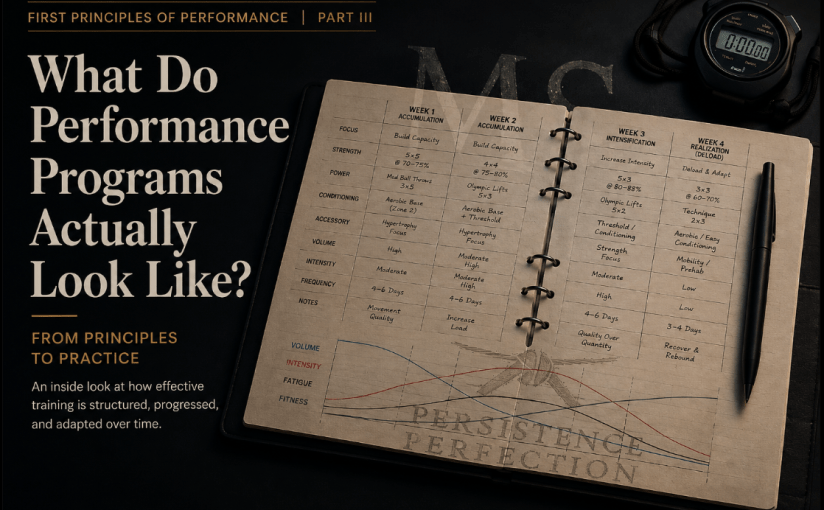
What Do Performance Programs Actually Look Like?
The same physical qualities. Different priorities. Intelligent application.
Part I, we dismantled the myth.
Part II explained the physiology.
Part III shows how to construct the program.

The Central Thesis
Programming is not the indiscriminate accumulation of desirable exercises. It is the deliberate allocation of finite adaptive resources.
Every athlete would benefit from being stronger, more muscular, more powerful, better conditioned, more mobile, and more resilient. The problem is that no one can maximize every quality simultaneously.
A sound program therefore asks:
- What must be developed?
- What must be maintained?
- What may be temporarily deprioritized and for how long?
- What forms of training deliver the greatest benefit with the least conflicting fatigue?
That’s where the individual disciplines separate.
The Framework
Before discussing specific populations, let’s discuss a common framework that can apply to anyone.
The Primary Objective
The primary objective determines what receives the athlete’s best energy, highest-quality practice, and largest recovery allocation.
- General physical preparedness (GPP): broad competence without narrow specialization
- Tactical readiness: resembles GPP but carries a different standard. Failure is not an option
- Olympic Weightlifting: technical power, speed, athleticism, superior flexibility + stability at end ranges of motion, and maximal strength
- CrossFit: develop broad competitive capacity across the 10 general physical skills and also have “home run” ability in several of those skills
- Bodybuilding: hypertrophy, size, and muscular symmetry
- Healthy aging and Wellness: preservation of strength, power, muscle, mobility, and cardiorespiratory fitness
Developing Secondary qualities
Secondary qualities support the principal objective but must not compete excessively with it.
For example:
- An Olympic weightlifter needs aerobic fitness for recovery and general wellness, but not the capacity to run a marathon.
- A bodybuilder needs conditioning, but not enough aerobic volume to take away from building muscle.
- A tactical athlete needs strength, but not at the expense of sharpness of movement, the ability to endure, and engage and disarm enemy combatants, i.e. maintain occupational durability.
- A more mature adult needs to build and/or maintain muscle mass, but also enough power, balance, coordination, flexibility, and aerobic capacity to remain independent.
Establishing the minimum effective dose
Not every quality requires maximal training volume. Some qualities can be developed with relatively little work. Others can be maintained with substantially less work than was required to build them.
This allows a coach to place most resources toward the current priority while preserving other capacities.
Control competing fatigue
The interference problem is not merely molecular. It is mechanical, neurological, metabolic, and logistical.
Two sessions may theoretically coexist but still conflict because they stress:
- The same musculature
- The same joints and connective tissues
- The same energy systems
- The same neurological resources
- The athlete’s limited sleep, time, and nutrition
This is why modality, sequence, volume, and timing matter.
Sequence the training week intelligently
The highest-priority, highest-skill, and highest-velocity work should generally occur when the athlete is freshest.
A useful hierarchy is:
- Technical and explosive work
- Heavy strength work
- Hypertrophy or accessory work
- Conditioning
- Supplemental mobility and tissue restoration
That order can change according to the sport, but it gives us a sound starting point.
How the application changes
CrossFit: developing breadth without creating chaos
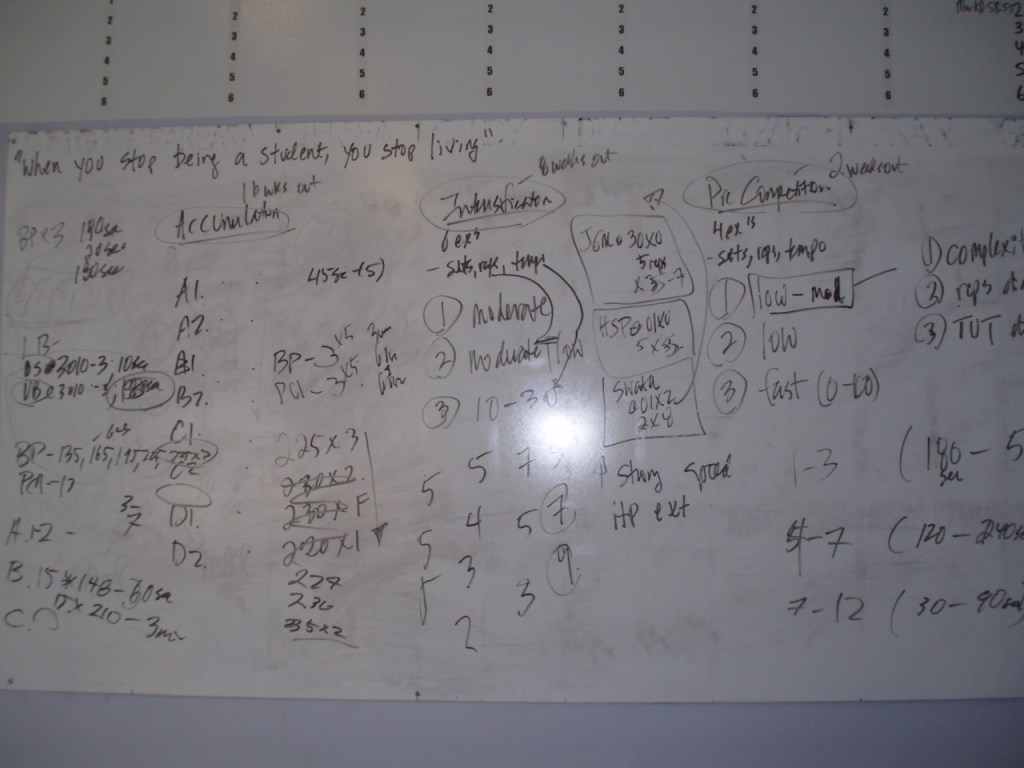
CrossFit presents one of the hardest programming problems because nearly every physical quality matters.
Why does CrossFit usually present a problem for most coaches? We begin with the 10 general physical skills. They are cardiovascular/respiratory endurance, stamina, strength, flexibility, power, coordination, agility, balance, and accuracy.
- Cardiovascular/respiratory endurance – The ability of the body’s systems to gather, process, and deliver oxygen
- Stamina – The ability of body systems to process, deliver, store, and utilize energy
- Strength – The ability of a muscular unit, or combination of muscular units, to apply force
- Flexibility – the ability to maximize the range of motion at a given joint
- Power – The ability of a muscular unit, or combination of muscular units, to apply maximum force in minimum time
- Speed – The ability to minimize the cycle time of a repeated movement
- Coordination – The ability to combine several distinct movement patterns into a singular distinct movement
- Agility – The ability to minimize transition time from one movement pattern to another
- Balance – The ability to control the placement of the body’s center of gravity in relation to its support base
- Accuracy – The ability to control movement in any given direction or at a given intensity”
So, a competitive CrossFit athlete requires:
- Maximal and relative strength
- Olympic lifting proficiency
- Gymnastics skill
- Aerobic capacity
- Anaerobic power
- Muscular endurance
- Movement efficiency
- Fatigue resistance
- Rapid recovery between efforts, et cetera
The danger is confusing variety with randomness.
A well-designed CrossFit program should not simply expose the athlete to more movements and more suffering. It should develop identifiable qualities in a logical sequence.
Primary considerations
Strength and skill must be developed and then protected.
Heavy lifting, technical precision/near perfection in the Olympic lifts, and advanced gymnastic skill should not routinely be performed after unnecessary fatigue.
Conditioning requires structure.
The athlete needs distinct exposures to:
- Low-intensity aerobic development
- Threshold or tempo work
- Short glycolytic intervals
- Sprint interval training
- Mixed-modal competition pieces
Not every metcon should destroy the athlete.
Some sessions should develop pace, transitions, breathing control, or movement economy without producing maximal fatigue.
The interference effect is managed through planning.
Heavy squats should not be surrounded by repeated high-volume running, jumping, and cycling sessions unless that fatigue is intentional.
CrossFit programming should develop the unknown and unknowable by building deep, transferable capacities, not by making every day unknowable to the coach.
Hypertrophy: condition the athlete without stealing from growth
For hypertrophy, the principal objective is clear:
Accumulate sufficient high-quality resistance-training volume to stimulate muscle growth, then recover from it.
Cardiovascular training should improve health, work capacity, and recovery without degrading lifting performance.
Best applications
- Zone 2 bike/row/ski, jogging if you can maintain zone 2, or other similar cardiac demand work
- MAP training or what I call “CrossFit aerobics”
- Short tempo intervals
- Carefully dosed sprint work
- Sleds, carries, or machines that reduce eccentric loading
- Conditioning performed after lifting or in separate sessions
Primary constraints
The bodybuilder or hypertrophy-focused lifter must manage:
- Total lower-body fatigue
- Caloric expenditure
- Joint stress
- Session duration
- Interference with progressive overload
The appropriate amount depends on the athlete’s training age, caloric intake, exercise selection, and recovery.
The practical rule is straightforward:
Conditioning should leave the athlete better prepared to train, not chronically less capable of producing force and volume.
Bodybuilding: hypertrophy with greater specialization

Bodybuilding and general hypertrophy training overlap, but bodybuilding adds several constraints:
- Muscular symmetry
- Proportional development
- High local training volume
- Fatigue management across many isolation exercises
- Contest preparation and caloric restriction
- Preservation of muscle during fat loss
Cardio becomes more prominent during contest preparation, but recovery resources simultaneously decline.
That makes modality selection especially important.
Low-impact cardio often becomes preferable because it increases energy expenditure without imposing excessive eccentric loading or soreness. As calories fall, the athlete must also avoid the common mistake of increasing cardio aggressively while maintaining all previous lifting volume.
Bodybuilding programming is therefore an exercise in resource preservation:
- Retain muscular tension
- Preserve strength where possible
- Manage fatigue
- Increase energy expenditure gradually
- Avoid turning every session into a test of willpower
The same physiology applies. The context changes.
General Physical Preparedness: build the widest useful base
GPP is not preparation for nothing. It is preparation for many possible things.
The objective is broad physical competence:
- Reasonable strength
- Useful muscle mass
- Aerobic fitness
- Anaerobic capacity
- Mobility
- Coordination
- Power
- Durability
A GPP program should avoid the extremes of narrow specialization.
The athlete does not need:
- Powerlifting-level maximal strength
- Marathon-level endurance
- Bodybuilding-level weekly muscle volume
- Elite Olympic lifting technique
But the athlete benefits from meaningful development in all of them.
A balanced GPP week might include:
- Two or three strength sessions
- One power or sprint exposure
- Two aerobic sessions
- One higher-intensity conditioning session
- Carries, sleds, jumps, throws, crawling, or climbing
- Regular movement-quality work
This is where first principles matter most. GPP should create optionality: the ability to enter a more specialized phase without beginning from zero.
Tactical readiness. The real unknown and unknowable.

Tactical readiness resembles GPP but carries a different standard. Failure is not an option.
The tactical athlete may need to:
- Sprint – short, medium, and long distance, under load, taking and returning fire
- Climb – 15 – 30 ft. ropes for multiple reps
- Fight – from striking, to grappling, to weapons defense and disarming skill, and all must work under possible extreme fatigue
- Drag or carry another person, possibly multiple people
- Move large loads, long distance, and quickly
- Operate for hours
- Recover quickly
- Make innumerable decisions under fatigue
- Repeat near perfect efforts without warning
That’s the minimum standard and it requires far more than “being strong” or being “in shape” ever can.
The old saying is, the novice practices the movements so they don’t get them wrong. The professional has practiced them so often they can’t get them wrong.
Programming priorities
- Relative and absolute strength
- Loaded movement capacity
- Grip and trunk endurance
- Aerobic base
- Martial Proficiency
- Repeated sprint ability
- Anaerobic endurance
- Power and rate of force development
- Durability under imperfect, and often austere, conditions
- Recovery between multiple, unpredictable efforts
The program must also preserve technical and occupational skills. Fitness should support marksmanship, defensive tactics, movement, communication, and decision-making rather than degrading them through constant exhaustion.
The “unknown and unknowable” should be addressed by building robust capacities and occasionally testing their integration.
It should not justify random training. Uncertainty in the mission does not require uncertainty in the program. That should be one of the article’s anchor lines.
Olympic weightlifting: develop strength, speed, power, technical skill, and force production

Olympic weightlifting is a highly technical, speed-strength, and power output sport.
Its primary qualities are:
- Technical proficiency
- Explosive strength
- Maximal strength
- Speed-strength
- Superior positional mobility
- Well-developed neuromuscular adaptation
Conditioning is useful, but it must remain subordinate to performance in the snatch and the clean and jerk.
Productive conditioning
- Low-intensity aerobic work
- Short cyclical intervals
- Sled work, carries, et cetera
- Limited sprint exposures whether it’s running, rowing, bike erg assault bike, or ski erg
- General body weight flow/movement and recovery work
Common programming error
A weightlifter can become so conditioned that the conditioning begins to impair the quality of technical practice, squatting, pulling, and recovery.
Conversely, poor aerobic fitness can reduce training density and the ability to recover between sets and sessions.
The goal is not maximal endurance.
It is sufficient conditioning to support greater quantities of high-quality weightlifting.
Healthy aging: train what age attempts to take away
Healthy aging may be the most important application because nearly every major physical quality declines without deliberate training.
The program should preserve:
- Muscle mass
- Maximal strength
- Power
- Bone density
- Aerobic capacity
- Balance
- Coordination
- Mobility
- Confidence in movement
Power deserves particular emphasis because it often declines faster than maximal strength and is essential for preventing falls, climbing stairs, catching oneself, and moving quickly when necessary.
A complete healthy-aging program should therefore include:
- Progressive resistance training
- Safe explosive intent or power training
- Zone 2 aerobic work
- Some higher-intensity aerobic exposure
- Balance and unilateral movement
- Carries and gait work
- Mobility sufficient for daily function
- Practice getting down to and up from the floor
The objective is not merely extending lifespan.
It is preserving capability across the lifespan.
The 70-year-old and the competitive athlete are not performing identical workouts, but the underlying qualities remain the same. Load, velocity, complexity, volume, and risk are adjusted to the individual.
Again: different in degree, not in kind.

The comparative model
| Population | Primary Emphasis | Supporting Conditioning | Main Interference Risk |
| CrossFit | Broad competitive capacity | Full spectrum | Excessive mixed fatigue and inadequate specialization |
| Hypertrophy | Muscle growth | Low-impact aerobic and concise intervals | Reduced lifting quality and recovery |
| Bodybuilding | Muscular size, symmetry, leanness | Progressive low-impact cardio | Energy deficit plus excessive total volume |
| GPP | Broad competence | Balanced aerobic and anaerobic work | Randomness without measurable progression |
| Tactical | Durable performance under uncertainty | Aerobic base, loaded work, repeated efforts | Fitness fatigue degrading occupational skill |
| Olympic weightlifting | Skill, power, maximal strength | Minimal effective conditioning dose | Loss of speed, freshness, and technical quality |
| Healthy aging | Capability and independence | Aerobic base plus selected intensity | Underloading, excessive caution, and lack of power work |
The deeper lesson
This third article should not merely contain seven sample programs. It should teach the reader how to reason.
The reader should finish understanding that programming is a process of adjusting several variables:
- Priority
- Frequency
- Intensity
- Volume
- Modality
- Sequence
- Recovery
- Specificity
The exercises are not the program. The allocation of stress is the program.
That is how we prevent the article from becoming a collection of templates that readers blindly copy. We can include sample weekly structures, but each one should demonstrate the principle behind the arrangement.
The barbell, a bike, the rower, a sled, the track, or a pull-up bar are not competing philosophies. They are tools. Their value depends on the problem they are being used to solve.
A bodybuilder, Olympic weightlifter, tactical professional, CrossFit athlete, and older adult all require strength, endurance, power, movement competency, and resilience. The needs vary in application, not in kind.
Good programming does not ask which quality is universally best. It asks which quality matters most right now, how much of the others must be developed or preserved, and how they can coexist without obscuring the primary objective.
Programming is not the science of writing workouts. It is the art of organizing adaptation. As always, the principles remain constant. The application is the art and that’s what real coaching is all about


 Matt Shannon, Security Pro