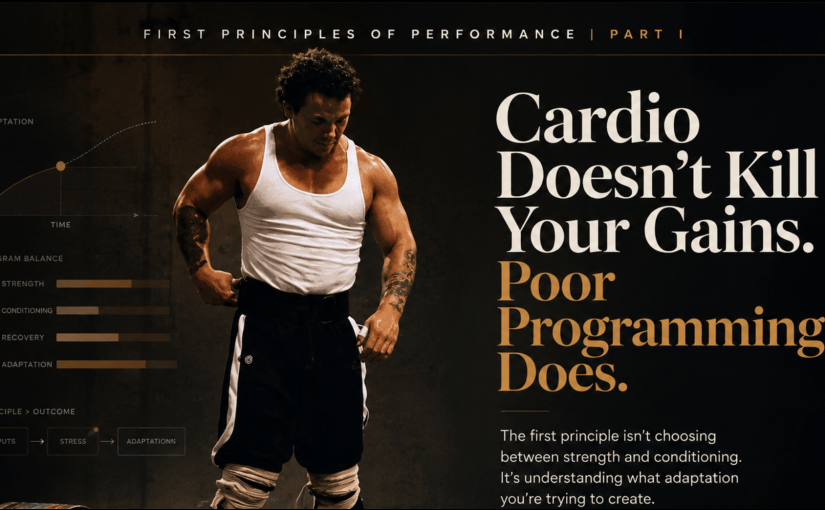
Cardio Doesn’t Kill Your Gains. Poor Programming Does.
“The first principle isn’t choosing between strength and conditioning. It’s understanding what adaptation you’re trying to create.”

For decades, one of the most persistent myths in strength training has been deceptively simple:
“If you want to build muscle, avoid cardio.”
It sounds reasonable. After all, endurance athletes tend to be lean, while bodybuilders are muscular. Somewhere along the way, many people concluded that cardiovascular training and muscle growth must exist at opposite ends of the same spectrum.
Like most fitness myths, there’s a grain of truth buried beneath a mountain of oversimplification.
Can excessive endurance training interfere with maximal hypertrophy? Yes.
Can intelligently programmed cardiovascular training improve your health, enhance your recovery, increase your work capacity, and have little meaningful effect on muscle growth?
Also yes. The difference isn’t cardio. It’s programming
The Wrong Question
People often ask, “How much cardio can I do without losing muscle?” It’s the wrong question. The better question is: What adaptation am I trying to produce?
Every training session asks your body to solve a problem. Heavy squats ask it to produce more force. Tempo intervals ask it to become more efficient at clearing lactate.
Sprints demand explosive power. Long easy efforts improve aerobic efficiency.
These aren’t competing identities. They’re simply different physiological adaptations. Understanding that distinction changes everything.
First, Let’s Define “Cardio”
One reason this discussion becomes so confusing is because we use the word cardio as though it’s a type of exercise.
It isn’t. It’s a physiological demand.
Your cardiovascular system doesn’t know whether you’re running, rowing, cycling, carrying sandbags, or performing twenty-rep squats. It only knows that your muscles require oxygen, nutrients, and energy.
Think about workouts like:
– The Standard (Grace – 30 clean and jerks at 135/95, 30 ring muscle ups, Isabel – 30 snatches at 135/95)
– Heavy sled pushes
– Oly complexes of 5 reps or more
– 2k row for time
– 5k run
– Fran
– 20 rep max back squat
– Murph
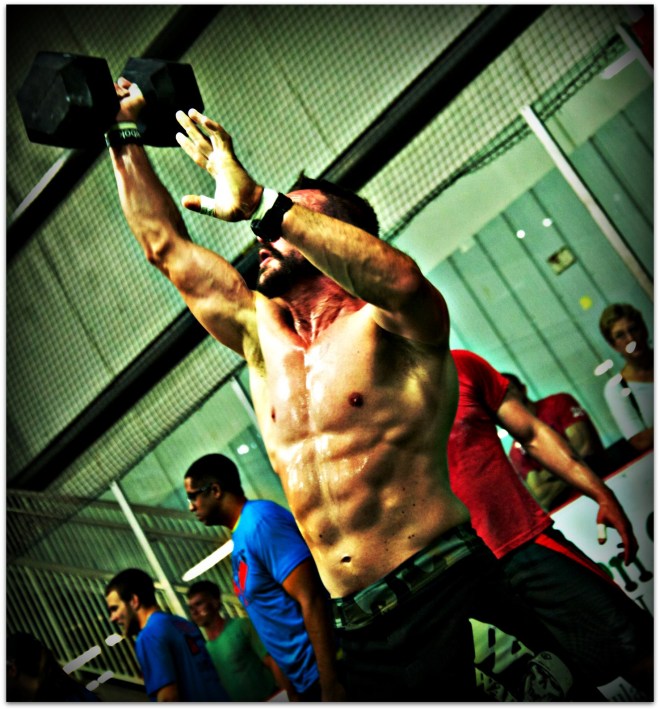
Nobody finishes those wondering whether their cardiovascular system was challenged. Weight training can absolutely become cardiovascular training depending on how it’s programmed.
Intensity.
Density.
Rest intervals.
Exercise selection.
Volume.
These variables determine the cardiovascular demand, not whether you’re holding a barbell or running shoes. The conversation isn’t “weights versus cardio.”
It never was.
Where the Myth Came From
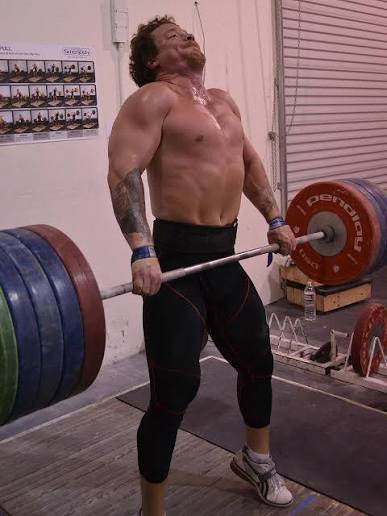
The concern isn’t entirely imaginary.
Researchers have long studied what’s known as the interference effect, the observation that combining endurance and resistance training can, under certain conditions, reduce some strength and hypertrophy adaptations compared with resistance training alone.
Notice the language. Can. Under certain conditions.
Not: Always. Those conditions matter.
A competitive marathon runner performing sixty miles each week while trying to maximize leg hypertrophy faces a very different challenge than someone lifting four days a week while adding two thirty-minute conditioning sessions.
Those are not the same training problems. Yet they’re often discussed as though they are.
What Actually Interferes?
For most lifters, muscle isn’t lost because they jogged. It’s lost because recovery becomes the limiting factor.
Poor programming often looks like this:
Heavy lower-body lifting followed immediately by long-distance running.
High-volume conditioning layered on top of already excessive lifting volume.
Poor sleep.
Insufficient calories.
Inadequate protein intake.
Eventually something has to give.
Trying to train near maximally, whether it’s loading or intensity, 4-6 days per week.
If training continually exceeds your ability to recover, progress slows—not because cardio is inherently bad, but because the total stress exceeds your adaptive capacity.
The Research Is More Encouraging Than the Internet
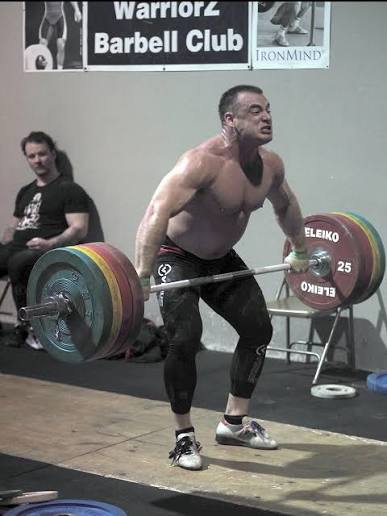
Fortunately, the research is considerably more nuanced than the internet. Much of the fear surrounding cardio comes from laboratory discussions about molecular signaling. You’ll often hear that endurance exercise activates one pathway while resistance training activates another, and that these pathways “fight” each other.
There is truth here. But physiology is rarely as binary as social media suggests.
These signals are temporary. They’re influenced by nutrition, training age, exercise selection and most important, recovery.
And they’re often localized to the tissues being trained rather than acting as a simple on-off switch across the entire body.
More importantly, when researchers look beyond the molecular biology and examine actual training outcomes, the picture becomes much less dramatic.
For the overwhelming majority of recreational lifters, and even many competitive athletes, well-designed conditioning has little meaningful effect on muscle growth.
Programming matters far more than the mere presence of cardiovascular exercise.
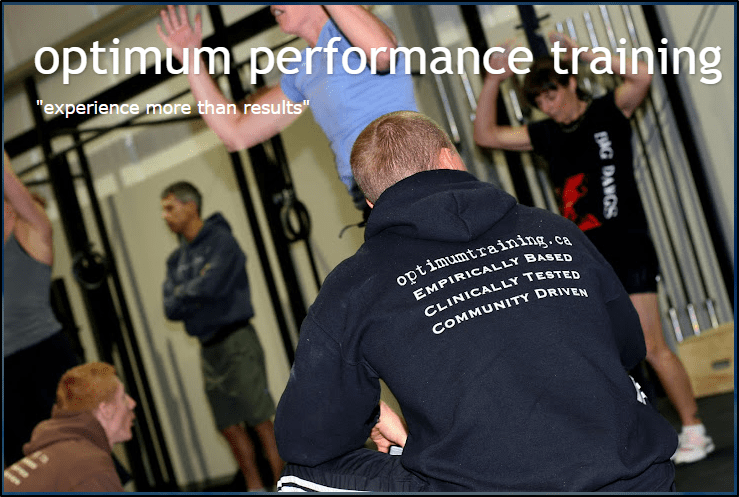
Numerous studies support the idea that cardio, when programmed intelligently, does not meaningfully hinder muscle growth. For example, a 2015 meta-analysis by Dr. Brad Schoenfeld and colleagues concluded that combining strength and cardio training results in only a negligible impact on muscle and strength gains, provided programming is sound (Schoenfeld, B.J., Ogborn, D., & Krieger, J.W., 2015, Sports Medicine).
Cardio That Supports Muscle Growth
If hypertrophy is your primary objective, conditioning should complement not compete with your lifting.
Generally speaking, it could look like the following:
- Shorter, more intense sprint work.
- Use interval-based conditioning where appropriate.
- Row.
- Cycle.
- Throw med-balls.
- Use the SkiErg.
- Carry odd objects.
- Push and pull sleds.
- Perform tempo intervals.
- Carry heavy implements.
- Include sprint interval training when recovery allows.
- Separate demanding conditioning from heavy lower-body strength sessions whenever practical.
Most importantly, keep the main thing, the main thing.
Conditioning exists to improve health, increase work capacity, and support recovery, not to leave you so fatigued that tomorrow’s strength session suffers.
Keep the Main Thing the Main Thing

The best programs are surprisingly disciplined. They know exactly what they’re trying to improve. Everything else exists to support that objective, not distract from it.
One of the greatest mistakes athletes make is assuming every session must improve every quality simultaneously.
It doesn’t. Training is about emphasis or specificity to the individual and their goals. Some phases prioritize maximal strength. Some emphasize hypertrophy, aerobic capacity gymnastic or Olympic Weightlifting skill. A skill Ive always referred to as barbell gymnastics because of how skill dependent they are.
The art of coaching isn’t teaching every quality simultaneously. It’s knowing which qualities deserve emphasis today, and which can simply be maintained until tomorrow.
That’s programming.

The First Principle
Cardio doesn’t kill your gains. Poor programming does. If your training reflects clear priorities, if recovery matches workload, if nutrition supports adaptation, if conditioning complements rather than competes with strength, then you can become stronger. You will then become stronger, healthier, and better conditioned.
Not because you avoided cardio, but because you finally stopped asking whether strength and conditioning are enemies.
They never were. They simply need a coach who understands how to make them work together.
The principles remain constant. The application is the art.
If you’re curious why all of this works, not merely what to do, we’ll step out of the weight room and into the physiology laboratory. There we’ll explore the molecular conversation taking place inside skeletal muscle every time you lift, sprint, row, or recover, and discover why the story is far more nuanced than the internet would have you believe.
References
Schoenfeld, B. J., Ogborn, D., & Krieger, J. W. (2015). Effect of concurrent aerobic and strength training on maximal strength, power, and hypertrophy in healthy adults: A systematic review and meta-analysis. Sports Medicine, 45(5), 697–708.
Wilson, J. M., Marin, P. J., Rhea, M. R., Wilson, S. M. C., Loenneke, J. P., & Anderson, J. C. (2012). Concurrent training: A meta-analysis examining interference of aerobic and resistance exercises. Journal of Strength and Conditioning Research, 26(8), 2293–2307.