First Principles of Cybersecurity: Essays on Leadership, Trust, and Organizational Maturity – Part II

First Principles of Cybersecurity Essays on Leadership, Trust, and Organizational Maturity -- MattShannonSecurityPro.com

Leadership Is a Security Control

The Environment Leaders Create Determines the Level of Security Their Organizations Achieve

Ask ten security professionals to name the most important security controls in a modern organization, and the answers will sound familiar. Multi-factor authentication. Endpoint detection and response. Network segmentation. Encryption. Vulnerability management. Security awareness training.

None of those answers is wrong. Each represents a critical layer in a mature security program.

Yet they all share a common characteristic: they are downstream of another control that receives far less attention but influences every one of them..

Leadership.

This may seem like an unusual assertion. Leadership does not appear on a network diagram. It cannot be licensed, deployed, or patched. It generates no alerts and produces no dashboard filled with metrics. Yet every meaningful security decision within an organization is ultimately shaped by leadership. Before a firewall is purchased, before a policy is written, before an employee completes awareness training, someone has already decided that security matters—or that it does not.

That decision is leadership in action.

Every Organization Is Perfectly Designed to Produce Its Security Culture

There is a saying often attributed to systems theorist W. Edwards Deming: “Every system is perfectly designed to get the results it gets.” Whether or not those were his exact words, the principle remains instructive.

Security culture is no exception.

Organizations rarely arrive at their security posture by accident. Rather, it emerges from thousands of decisions made over time. These are decisions about priorities, incentives, resources, accountability, and acceptable risk. Employees learn what truly matters not by reading policies, but by observing leadership.

If executives insist on secure practices even when they create inconvenience, employees notice.

If managers routinely ask teams to “just make it work” regardless of established procedures, employees notice that, too. Culture is not built through declarations. It is built through repetition.

Leadership determines what is repeated.

According to the 2024 Verizon Data Breach Investigations Report, over 80% of breaches involved a human element, highlighting that culture, behavior, and leadership are as critical as any technical control.

The Strongest Policies Cannot Overcome Weak Priorities.

Many organizations invest considerable effort in writing comprehensive security policies. These documents establish expectations, define responsibilities, and provide consistency across the enterprise. They are necessary.

They are also insufficient. A policy reflects what an organization says it values. Leadership reveals what it actually values.

Consider two organizations with identical password policies.

In the first, executives follow the same authentication requirements as everyone else, allocate time for security training, and treat security concerns as legitimate business discussions. In the second, executives routinely request exceptions, postpone security projects in favor of short-term operational gains, and regard cybersecurity as primarily the IT department’s responsibility.

On paper, the organizations appear identical. In practice, they are fundamentally different.

Policies establish direction and leadership establish credibility.

Employees are remarkably adept at distinguishing between the two.

Leadership Defines Acceptable Risk

One of the most misunderstood aspects of cybersecurity is the belief that the objective is to eliminate risk. It’s not. Every organization accepts risk. The question is whether those decisions are deliberate or accidental.

Leadership determines where that line is drawn. When a board approves funding for identity modernization rather than postponing the investment for another year, it is making a security decision.

When a superintendent supports temporary operational disruption to remediate a critical vulnerability rather than accepting unnecessary exposure, that is a security decision.

When an executive asks not only, “What will this cost?” but also, “What risk does this reduce?” security has become part of organizational decision-making rather than an afterthought.

Security professionals identify and communicate risk. Leadership determines which risks are acceptable.

These responsibilities are distinct, but inseparable.

Trust Is a Preventive Control

Technical controls prevent malicious activity, and leadership often prevents organizational failure.

Employees who trust their leaders report mistakes sooner. They ask questions before making assumptions. They admit uncertainty before uncertainty becomes an incident.

Conversely, organizations that punish honest mistakes often create an environment where employees hide them. The initial phishing email is rarely what causes the greatest damage.

Silence does.

Trust is therefore more than an abstract leadership quality. It is a practical security control that shortens response times, improves communication, and encourages the reporting behaviors upon which effective incident response depends.

Organizations frequently invest millions of dollars in detection technologies while overlooking one of the simplest ways to improve detection: creating an environment where people feel safe speaking up.

Technology Scales Capability. Leadership Scales Behavior.

Technology can authenticate identities, encrypt data, detect anomalies, and automate countless security functions. It can’t establish priorities, create accountability, model integrity, or build trust. Only leadership can accomplish those things.

This is why organizations with modest security budgets, but disciplined leadership often outperform organizations possessing sophisticated technologies but inconsistent governance. The difference is not the tools themselves. It is the environment in which those tools operate.

Technology amplifies capability and leadership amplifies behavior. Given enough time, behavior almost always proves to be the more influential force.

Actionable Steps for Leaders

  • Model security behaviors consistently at every level of the organization.
  • Integrate risk discussions into executive decision-making, not just technical reviews.
  • Foster a culture of psychological safety so employees feel comfortable reporting mistakes and asking questions.
  • Align security policies with actual business practices—avoid policies that are routinely bypassed.
  • Invest in both technology and leadership development to scale capability and culture in tandem.

Final Thoughts: Leadership as the First Control

It is tempting to think of cybersecurity as something managed by the security department. Firewalls belong to network engineers. Endpoint protection belongs to security analysts. Policies belong to governance teams.

Leadership belongs in every decision.

Every decision about priorities, every allocation of resources, every conversation about acceptable risk, and every example set by those entrusted to lead either strengthens or weakens the organization’s security posture.

For that reason, leadership should not be viewed merely as support for cybersecurity.

It should be recognized for what it is.

The first security control.

Key Takeaways:

  • The downstream effects of leadership shape every aspect of an organization’s security posture.
  • While policies and technology matter, leadership determines how they are valued, implemented, and, more importantly, enforced.
  • Trust and culture are practical security controls that improve incident response and reduce risk.
  • Consistent, visible prioritization of security by leaders is more influential than any single technical investment.
  • Security is ultimately a human endeavor, and its success is determined by the actions and environment set by those who lead.
  • This perspective is echoed by leading frameworks, NIST CSF and ISO 27001, which position governance and leadership at the foundation of resilient security programs.

The technologies organizations deploy may change. The threats they face certainly will. But the principle remains constant: every security program ultimately reflects the leadership that built it.

Leadership, then, is not merely support for security; it’s the foundation.

First Principles of Cybersecurity: Essays on Leadership, Trust, and Organizational Maturity – Part I

The Hidden Cost of Convenience in Cybersecurity

Why Intelligent People Circumvent Security,
and What Mature Organizations Do About It

Walk into almost any classroom in the country at the beginning of a new school year, and you’ll witness controlled chaos.

Teachers are preparing lesson plans, organizing classrooms, responding to parents, configuring technology, attending meetings, and welcoming a new group of students, all before the first bell ever rings. The pace is relentless, and every minute matters.

Now imagine walking past a cart of student Chromebooks and noticing something unexpected.

A small adhesive label with a student’s name, username, and password affixed directly to the device.

At first glance, it’s easy to criticize the practice. After all, writing credentials on the very device they’re intended to protect undermines one of the most fundamental principles of information security.

But if that’s where the conversation ends, we’ve learned very little. The more interesting question isn’t why someone ignored security.

The better question is: Why did this feel like the best solution in the first place?

That distinction matters because mature cybersecurity is not built by identifying mistakes. It is built through understanding the conditions that make those mistakes seem reasonable.

Intelligent People Rarely Choose Insecurity

One of the most persistent misconceptions in cybersecurity is the belief that policy violations emanate primarily from ignorance, carelessness, or indifference.

In reality, most people are trying to do exactly what they’ve been hired to do. Teachers are trying to teach. Nurses are trying to care for patients. Engineers are trying to deliver systems. Executives are trying to lead organizations. Their objective is not to violate policy.

Their objective is to accomplish meaningful work. When security introduces unnecessary friction into that work, people naturally begin searching for ways to reduce it. Not because they oppose security. Because they are optimizing for progress. The sticky note wasn’t malicious. It was an optimization.

Unfortunately, it optimized the wrong variable.

The Path of Least Resistance

Human beings are remarkably consistent. When presented with multiple ways to accomplish the same objective, we tend to choose the one that requires the least effort. Behavioral psychologists have studied this phenomenon for decades. Economists describe it through concepts like bounded rationality and mental effort. Engineers simply recognize it as good design.

Cybersecurity often forgets it entirely.

Organizations frequently assume that if policies are written clearly enough, people will simply follow them. Experience suggests otherwise. People generally follow the path that requires the fewest decisions, the least interruption, and the least additional effort. That’s not laziness, it’s human nature.

Every unnecessary step added to a security process becomes another opportunity for someone to find a shortcut. And shortcuts have a way of becoming habits.

The Difference Between Immature and Mature Security Programs

Immature organizations respond to incidents by writing another policy. Mature organizations ask a different question.

Why did this make sense to someone?

That question shifts the conversation from blame to design. Consider the classroom example.

Should passwords remain private? Absolutely.

Should credentials ever be attached directly to a device? Of course not. But stopping there ignores the larger lesson. Why did an experienced educator, someone strongly dedicated to their students, conclude that this was the most practical solution?

Perhaps student onboarding was cumbersome. Perhaps the process required frequent password retrieval.

Perhaps the system created more friction than necessary during one of the busiest weeks of the year. Those possibilities deserve just as much attention as the policy itself. Because good security doesn’t merely tell people what not to do. It makes the secure choice the wise choice.

Security Culture Is a Design Problem

Culture is often described as shared values or shared beliefs. In cybersecurity, culture is better measured using shared behaviors. Those behaviors are influenced less by slogans than by systems.

When secure behavior is intuitive, people adopt it naturally. When secure behavior consistently slows people down, even well-intentioned professionals begin inventing workarounds.

The problem isn’t that people prefer convenience. The problem is when convenience and security are placed in opposition to one another. Strong organizations refuse to accept that tradeoff.

Instead, they ask: “How can we design systems where the secure path is also the easiest path?”

That question signifies a profound shift in thinking. Rather than expecting people to overcome human nature, mature organizations design with human nature in mind.

Leadership Beyond Technology: Setting Security Culture by Example

This principle extends far beyond passwords. In practice, organizations sometimes hard-code credentials because rotating them seems cumbersome. Employees reuse passwords because managing dozens of unique ones is impractical without support. Executives may bypass established processes they perceive as slow, sometimes even advocating for policies they themselves neglect. These behaviors highlight how security actions, good or bad, are shaped by leadership priorities and organizational culture.

Frameworks like Zero Trust (ZT) and NIST’s Cybersecurity Framework (CSF) both emphasize the importance of aligning policies and controls with real-world workflows. For example, Zero Trust encourages the principle of ‘never trust, always verify’, but it also emphasizes minimizing user friction by making secure access seamless. Similarly, NIST CSF calls for continuous improvement and adaptation to actual business context, including user experience, as a critical part of protecting information.

A 2024 Verizon Data Breach Investigations Report found that over 80% of breaches involved a human element, whether through error, misuse, or social engineering. This underscores the need to design security with people, not just technology, in mind.

Consider the widely publicized 2023 MGM Resorts breach: attackers gained access not through a technical exploit, but by manipulating an employee via social engineering. The aftermath highlighted both the human cost of poor security design and the value of resilient, well-communicated processes. Mature organizations study such incidents to inform better system and workflow design, not just to enforce stricter rules.

None of these behaviors are unique to education. They are remarkably consistent across industries. Whether it’s healthcare, finance, manufacturing, government, or cloud engineering, it’s the same.

Technology changes, human behavior does not. This is why effective cybersecurity leaders spend as much time understanding organizational behavior, workflow design, and communication as they do learning about technology. Firewalls protect networks, encryption protects data, identity platforms protect access, and leadership shapes behavior.

And behavior, modeled first by leadership, ultimately determines whether those technologies succeed.

Designing for Reality

There is an old saying in engineering: “Don’t design for perfect conditions. Design for the conditions that are the reality.”

Cybersecurity deserves the same mindset. People work under the pressure of deadlines. And many humans are easily distracted.

They make mistakes. They focus on competing responsibilities. Expecting otherwise isn’t leadership. It’s wishful thinking. The strongest security programs acknowledge these realities and build systems that accommodate them.

Not by lowering standards. By lowering unnecessary friction. Good security accounts for human behavior. Great security aligns human behavior with enterprise intent. That is where security culture begins.

Actionable Steps for Leaders:

  • Review critical workflows for unnecessary security friction; streamline processes where possible. Invest in user-friendly identity and access management platforms that support secure, seamless authentication (e.g., password managers, SSO).
  • Regularly communicate the ‘why’ behind security policies and invite feedback from end users.
  • Model secure behaviors at the leadership level; visible adherence by executives sets cultural expectations.
  • Align technology investments with both security best practices (ZT, NIST) and the realities of day-to-day business operations.

Final Thoughts: Designing for Humans

Key Takeaways:

  • Security workarounds are rarely due to ignorance; they’re often rational responses to unnecessary friction.
  • Mature organizations design security systems that align with natural human behaviors and incentives.
  • Leadership sets the tone—when executives model secure, user-friendly practices, security culture flourishes.
  • Frameworks like Zero Trust and NIST CSF emphasize the importance of user experience and continuous improvement.
  • The most resilient organizations prioritize systems that help people succeed, not just avoid failure.

The sticky note attached to the Chromebook was never really about the sticky note. It’s an example that every decision in a security environment reflects a larger system of incentives, constraints, priorities, and, mostly, habits.

More often than not, systems fail because they ask ordinary people to behave in extraordinary ways. Technology rarely fails first. People rarely fail first. The most resilient organizations understand this. They don’t build security around an idealized version of human behavior. They build it around reality.

Because in the end, cybersecurity isn’t simply about protecting systems. It is the discipline of building systems that help people succeed. And perhaps that is the deeper lesson.

Convenience isn’t the enemy of security. Poor design is.

Or, said another way, Strong security cultures are not built by asking people to overcome human nature. They are built by knowing human nature well enough to design systems that coordinate convenience with security.

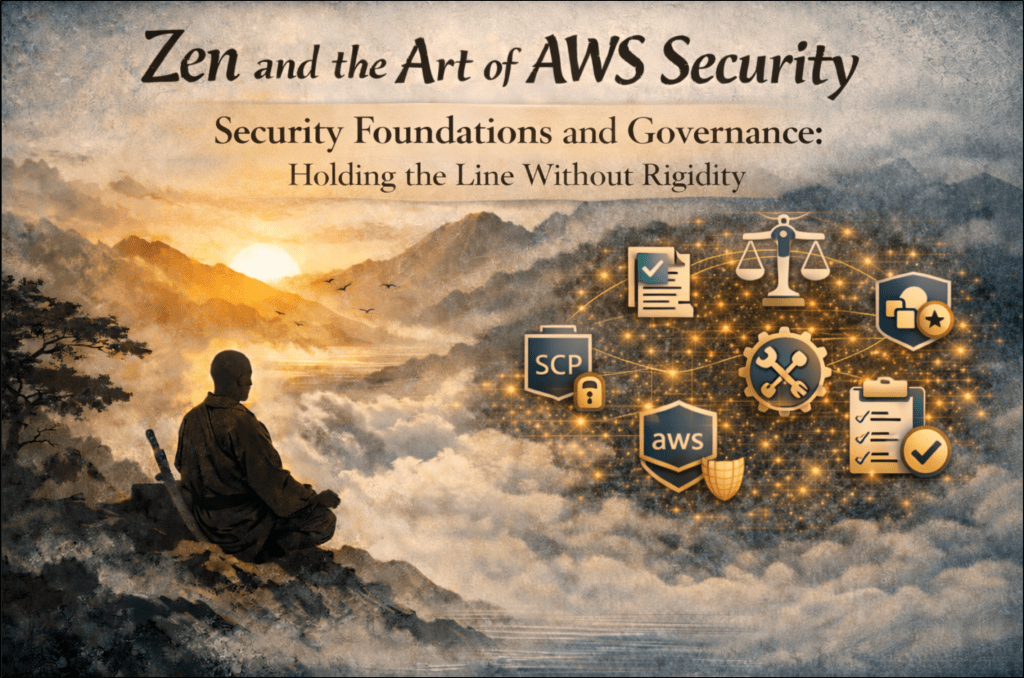
Zen and the Art of AWS Security Domain 6: Security Foundations and Governance | Holding the Line Without Rigidity


“When the structure is sound, movement becomes effortless.”

Most people expect security foundations and governance to be boring. Policy documents. Checklists. Frameworks. Meetings.

AWS, and seasoned security architects, know better.

Security Foundations and Governance are not about control. They are about alignment.

They are what allow everything else, detection, response, infrastructure, identity, and data protection, to function without friction. This is why Domain 6 exists. And why it quietly determines whether every other domain succeeds or fails.

1. What AWS Means by “Security Foundations”


AWS does not treat security foundations as a product or a service. They treat them as operating conditions.

Security foundations answer questions like:
• Who is responsible for what?
• How are decisions made?
• How do we know when something is “secure enough”?
• How do we scale security without slowing delivery?

In AWS terms, foundations are built on:

• Shared Responsibility
• Well-Architected principles
• Standardized controls
• Continuous improvement
• Clear ownership

If those are missing, everything else becomes reactive.

Key Takeaway: On the exam and in real life, assume security foundations are always present, not optional. If a question describes a scenario with ambiguous responsibility, pause and seek alignment before acting.

2. The Shared Responsibility Model: The First Gate

Every AWS security exam, especially the Security Specialty, tests one thing relentlessly: Do you understand what AWS secures…and what you must secure yourself?

    AWS is responsible for:

    • Physical data centers
    • Underlying hardware
    • The cloud infrastructure itself

    You are responsible for:

    • Identity and access
    • Network controls
    • Data protection
    • OS and application security
    • Configuration

    Governance begins the moment you clearly accept that responsibility.

    Most real-world failures, and many exam traps, happen when responsibility is blurred.

    3. Governance Is How You Scale Trust

    Governance is not about saying “no.” It’s about creating guardrails so teams can move quickly without breaking things.

      AWS governance relies on:

      • AWS Organizations
      • Service Control Policies (SCPs)
      • Account separation
      • Tagging standards
      • Centralized logging and monitoring
      • Defined escalation paths

      Exam cue: If AWS wants you to prevent risky behavior without managing individual permissions, the answer is almost always SCPs.

      Governance operates above IAM, not instead of it.

      4. Well-Architected Security Pillar: The Quiet Backbone

      The AWS Well-Architected Framework is foundational to this domain.

        The Security Pillar emphasizes:

        • Strong identity foundations
        • Traceability
        • Infrastructure protection
        • Data protection
        • Incident response

        You’ve already studied all of these.

        Domain 6 exists to show how they fit together.

        AWS wants you to think:

        • Holistically
        • Long-term
        • With trade-offs in mind

        On the exam, this shows up as:

        • “Which solution is the most scalable?”
        • “Which approach reduces operational overhead?”
        • “Which option aligns with AWS best practices?”

        Governance favors simplicity, repeatability, and clarity.

        5. Policies, Standards, and Automation

        In AWS, policy without automation is aspirational. Automation without policy is dangerous.

          Strong governance includes:

          • Infrastructure as Code (CloudFormation, Terraform)
          • Automated security checks
          • Preventive controls (SCPs, Config rules)
          • Detective controls (GuardDuty, Security Hub)
          • Corrective actions (Lambda-based remediation)

          Exam cue: If the question says, “ensure compliance continuously”, the answer involves automation, not manual review. Governance is what turns security into a system, not a on-going project.

          Top 3 Exam Gotchas: Domain 6

          1. Over-relying on IAM and neglecting the power of Service Control Policies (SCPs) for organization-wide governance.
          2. Focusing on manual reviews instead of leveraging automation for continuous compliance.3. Choosing the most restrictive answer on the exam rather than the one that balances security, cost, and operational impact.
          3. Key Takeaway: The “safe” answer is not always the correct one—look for governance and automation at scale.

          6. Risk Management: Choosing, Not Eliminating

          AWS does not expect you to eliminate all risk.

          They expect you to:

          • Identify it
          • Understand it
          • Accept, mitigate, or transfer it intentionally

          This is why governance includes:

          • Risk registers
          • Compliance mappings
          • Business context
          • Cost-awareness

          On the exam:

          The “best” answer is rarely the most restrictive one. It is the one that balances security, cost, and operational impact.

          Scenario Example: Rapid Growth, Real Governance

          In 2024, a fintech company went from 10 to 60 AWS accounts in under six months. Security needed to prevent resource creation outside of approved regions and enable GuardDuty everywhere automatically.

          Best Approach: The team used AWS Organizations to apply SCPs for region lockdown, combined with automated account bootstrapping scripts that enabled GuardDuty by default. This solution leveraged automation and organizational guardrails—demonstrating mature, real-world AWS security thinking.

          Key Takeaway: AWS rewards answers that use policy-driven, automated, and scalable solutions, exactly as in this scenario.

          7. The Martial Parallel: Structure Enables Freedom

          In martial arts, beginners see rules as limitations.

            Advanced practitioners see them as:

            • Stability
            • Efficiency
            • Freedom under pressure and much more

            A strong stance doesn’t restrict movement; it enables it. Security foundations work the same way.

            When governance is clear:

            • Teams move faster
            • Incidents resolve cleaner
            • Mistakes are contained
            • Learning compounds

            When governance is weak:

            • Everything feels urgent
            • Security becomes adversarial
            • Teams work around controls instead of with them

            8. Exam Patterns for Domain 6

            Here’s how AWS tests this domain:

            • Account-level controls → AWS Organizations + SCPs
            • Preventing risky actions globally → SCPs
            • Balancing speed and security → Guardrails, not micromanagement
            • Scaling security → Automation and standardization
            • Aligning with best practices → Well-Architected Framework

            If the question asks:

            “Which solution is easiest to manage at scale?”

            Exam cue: Choose the centralized, automated, policy-driven option.

            Final Capstone: The Six Domains as One System

            Let’s put it all together.

            Domain 1 — Detection
            See clearly. You can’t secure what you can’t observe.
            Detection creates awareness and prevents surprise.

            Domain 2 — Incident Response
            Move decisively without panic. Preparation and clarity turn chaos into choreography.

            Domain 3 — Infrastructure Security
            Shape the terrain. Segmentation, isolation, and least exposure reduce blast radius before attacks happen.

            Domain 4 — Identity and Access Management
            Decide who can act. Identity is the new perimeter. Precision here determines everything else.

            Domain 5 — Data Protection
            Guard what truly matters. Encryption, key management, and lifecycle controls protect the mission itself.

            Domain 6 — Security Foundations and Governance
            Hold the line without rigidity. Governance aligns people, process, and technology into a system that scales.

            The Quiet Truth at the Center of AWS Security

            AWS security is not about fear.
            It is not about heroics.
            It is not about locking everything down.

            It is about clarity, balance, and intention.

            The exam rewards those who:
            • Pause before reacting
            • Think in systems, not silos
            • Choose scalable solutions
            • Respect trade-offs
            • Trust structure over force

            That’s Zen. That’s architectural mastery. You’re ready.

            When you sit for the exam, remember:
            Awareness first.
            Structure second.
            Action last.

            Everything else follows naturally.

            Verification & Citations Framework | “Leave No Doubt”

            Primary AWS Sources to Reference:

            • AWS Shared Responsibility Model
            • AWS Well-Architected Framework (Security Pillar)
            • AWS Organizations Documentation
            • Service Control Policies (SCPs)
            • AWS Security Best Practices Whitepaper
            • AWS Security Specialty Exam Guide (Domain 6)

            Verification Boxes (Suggested Placement):

            • After Shared Responsibility section
            • After SCPs / Governance section
            • After Well-Architected references

            Quick Reference Checklist: Domain 6 – Security Foundations & Governance

            Key Takeaways (Scan before the exam!)

            – Shared Responsibility Model: Always clarify what AWS secures vs. what you control.

            – Use AWS Organizations and SCPs for policy-driven, organization-wide governance.

            – Automate compliance: favor Infrastructure as Code, automated checks, and auto-enablement of detective/preventive controls.

            -Lean one the AWS Well-Architected Framework forbest practice alignment.

            – Favore scalable, centralized, and policy-drive solutionsy in exam scenarios.- Always check the latest AWS documentation—services and features evolve quickly.

            Final Tip: For scenario-based questions, ask: “Is this solution scalable, automated, and centralized?” If so, it’s likely the best choice.

            Change Awareness Note:

            AWS governance services evolve regularly. Always validate SCP behavior, Organizations features, and Well-Architected guidance against current AWS documentation. For the latest on each topic, see:

            Shared Responsibility Model

            AWS Well-Architected Framework

            AWS Organizations

            Service Control Policies

            AWS Security Best Practices

            Security Specialty Exam Guide

            The Art of Cyberwar | Part XIII | The Use of Spies

            The principles:

            “Knowledge of the enemy’s dispositions can only be obtained from other men.”

            “However, spies cannot be usefully employed without a certain intuitive sagacity.”

            “Be subtle and use your spies for every kind of business.”

            “Hence, it is only the enlightened ruler and the wise general who will use the highest intelligence of the army for purposes of spying, and thereby they achieve great results.”

            The Quiet After the Fire

            After the smoke clears, the last weapon isn’t destruction; it’s knowledge. Sun Tzu closes his book here, not with conquest, but with insight. The general who knows through others, he says, wins without fighting. The one who fights without knowing spends blood buying what wisdom could have earned.

            In modern form, intelligence replaces escalation. Information, verified and interpreted, is the ultimate force multiplier.

            The Five Spies

            Sun Tzu’s framework remains elegant and practical. He identifies five types of spies, each still alive and well in today’s cyber and geopolitical landscape.

            1. Local spies = insiders, collaborators, citizens.
              • Modern analogue: human intelligence, insider threat programs, whistleblowers, or local analysts embedded in culture.
              • Lesson: you can’t know an environment without someone who breathes its air.
            2. Inward spies – the enemy’s own people who provide insight.
              • Modern analogue: defectors, double agents, internal whistleblowers, or compromised insiders in adversary organizations.
              • In cyber: infiltration of adversary forums, threat actor telemetry, or behavioral analysis of attacker TTPs.
            3. Converted spies – enemy agents who have been turned.
              • Modern analogue: captured malware turned into indicators, enemy disinformation repurposed for exposure.
              • Intelligence and counterintelligence merge – data becomes self-revealing.
            4. Doomed spies – agents sent with false information, knowing they will be sacrificed.
              • Modern analogue: honeypots, decoy networks, misinformation campaigns used to draw out adversaries.
              • Lesson: deception has cost; calculate it.
            5. Surviving spies – those who return with verified knowledge.
              • Modern analogue: analysts who gather, vet, and integrate multiple data sources to produce actual intelligence.
              • Lesson: data isn’t knowledge until it’s interpreted and fed back into strategy.

            The five together form a complete intelligence loop: gather, plant, deceive, sacrifice, verify.
            Today, we refer to this as the intelligence cycle.

            Information as the New Espionage

            We live in an age where everything and everyone collects or steals your data. Apps harvest movement. Sensors record temperature and tone. Governments build databases so vast they blur into prophecy.

            But the principle hasn’t changed: intelligence is not about having information – it’s about understanding what matters and when.

            A terabyte of telemetry means nothing without discernment. One well-placed attacker can outperform a thousand firewalls.

            Foreign Policy and the Failure of Insight

            Throughout the 20th century, U.S. foreign policy often suffered from information abundance but a lack of the ability to interpret the intelligence it had gathered.

            • Pearl Harbor: a multitude of signals existed, but interpretation failed.
            • Vietnam: metrics replaced meaning – body counts masquerading as progress.
            • Iraq WMDs: intelligence distorted to paint a specific picture rather than inform decision-making.
            • Afghanistan: decades of data existed without a clear endgame, destroyed thousands of American lives, and wasted trillions of taxpayers’ dollars.

            Each case proves Sun Tzu’s point: “If you know neither the enemy nor yourself, you will succumb in every battle.”

            Intelligence was there, but self-awareness wasn’t. Knowing isn’t only about them; it’s about seeing what you refuse to see in yourself.

            Cyber Intelligence: Seeing Without Touching

            In cybersecurity, the “spies” are telemetry, sensors, analysts, and sometimes friendly adversaries.
            Every alert, log, and anomaly is a scout’s report. But like all intelligence, its value depends on interpretation.

            • Local spies: internal logs and behavior analytics.
            • Inward spies: penetration testing, red-team operations, insider threat programs.
            • Converted spies: captured malware and attacker infrastructure repurposed for defense.
            • Doomed spies: honeypots, deception networks, and fake data seeds.
            • Surviving spies: analysts, threat-hunters, and intel-sharing alliances.

            The objective is clarity without exposure, to see everything while remaining unseen. Fire consumes, intelligence illuminates.

            The Moral Dimension of Knowing

            Intelligence work carries moral weight. Spies, human or digital, trade in trust. Sun Tzu demands that the general handle them with the highest regard: reward them generously, guard them carefully, and never waste them carelessly.

            The ethical parallel today is privacy. The line between intelligence and intrusion is measured in intent and restraint. Knowledge gathered without purpose is voyeurism. Knowledge used without reflection is manipulation.

            Sun Tzu’s ideal: learn enough to prevent war, not to justify one.

            Strategic Lessons for Leaders

            1. Listen to your scouts.
              Truth often arrives quietly, wrapped in discomfort. Leaders who dismiss dissent lose foresight.
            2. Reward information honestly.
              Transparency and gratitude feed the flow of truth; fear and ego choke it.
            3. Centralize interpretation, not collection.
              Many sensors, one mind – unified analysis, decentralized data.
            4. Balance secrecy with accountability.
              Intelligence held too tightly becomes blindness.
            5. Use information to avoid fire.
              The goal of knowledge is to make destruction unnecessary.

            From Fire to Silence

            The transition from Attack by Fire to Use of Spies is the book’s moral hinge. After escalation comes discernment; after destruction, discipline.

            Sun Tzu understood what modern states and corporations often forget: Force is crude, information is subtle – and subtlety wins the wars that power cannot.

            In cybersecurity, this is the move from reaction to anticipation. In foreign policy, it’s the evolution from aggression to diplomacy. In leadership, it’s the shift from command to comprehension.

            The best security posture isn’t dominance – it’s awareness. The most powerful army is one that rarely fights.

            Epilogue — The Quiet Art

            The Art of War ends not with blood or banners, but with silence, a stillness that comes from mastery.

            True security, like true wisdom, is invisible.
            It doesn’t announce itself.
            It doesn’t need to.

            When you know yourself and your adversary, every threat is already half-dissolved. When you act only when necessary, victory becomes maintenance rather than spectacle. And when you can learn from what moves unseen, you stop fighting the same battles over and over again.

            As Operation Aurora proved, a sophisticated cyber espionage campaign that quietly infiltrated major tech companies, the side with better intelligence rarely needs to escalate; quiet knowledge can outmaneuver brute force.

            That’s the art of cyberwar – when you know yourself and your adversary, every threat is already half-dissolved. When you act only when necessary, victory becomes maintenance rather than spectacle. And when you can learn from what moves unseen, you stop fighting the same battles over and over again.

            That is the final lesson of Sun Tzu, and of cyberwar:
            Not destruction, but understanding.
            Not conquest, but control of your own attention.
            Not escalation, but insight.

            Not noise, but silence.

            The art is not in the fight, but in the knowing. Return always to the principle: “Knowledge of the enemy’s dispositions can only be obtained from other men.”

            And, in the end, mastery is realizing you rarely need to fight at all.

            The Art of CyberWar | Part XII | Attack by Fire

            The Principle: When you use fire to attack, you must be prepared for the wind.
            — Sun Tzu

            The Nature of Fire

            Fire is decisive. It consumes, clears, and purifies, but it also spreads beyond intention. Sun Tzu treats fire as both a weapon and a warning. It can destroy an enemy’s stores, flush troops from cover, and sow panic, but he cautions that those who ignite must control the wind, or the flame will turn back.

            In today’s language: escalation is easy, judicious control is hard.

            Fire is unbridled energy without patience. It is force unbound. And every era finds its own version of it.

            The Five Fires

            Sun Tzu names five types of fire attack, each with a direct modern analogue:

            1. Burning soldiers in their camp → Disrupting people directly.
              • In cyber: targeting individual accounts, identity systems, or human processes.
              • In policy: attacking morale or legitimacy through propaganda or sanctions that hit civilians.
            2. Burning stores → Destroying logistics.
              • In cyber: supply-chain attacks, ransomware on infrastructure.
              • In statecraft: economic blockades or precision strikes on fuel, transport, or data centers.
            3. Burning baggage trains → Breaking the flow of resources.
              • In the cloud: DDoS, bandwidth throttling, or disrupting APIs that feed dependent systems.
              • In foreign policy: disrupting trade routes or financial systems to strangle supply.
            4. Burning arsenals and magazines → Targeting capability itself. A modern example: the 2014 Sony Pictures hack, in which wiper malware destroyed not only data but also the ability to operate, crippling the company’s digital arsenal and serving as a stark warning about escalation risk. Another hallmark example: Stuxnet (2010), which physically crippled Iranian centrifuges, showing that digital “fire” can leap into the physical world.
              • In digital: destroying code repositories, zero-day leaks, and wiper malware.
              • In war: targeting industrial bases, weapons stockpiles, or satellite networks.
            5. Burning the enemy’s army → Direct annihilation.
              • The catastrophic option, physical or digital scorched earth.

            Each carries the same risk Sun Tzu warned of: heat spreads.

            America’s Century of Fire
            Throughout the 20th century, U.S. foreign policy repeatedly learned and forgot this lesson.

            • WWII: strategic firebombing of Tokyo and Dresden, the atomic bombings of Hiroshima and Nagasaki, tactically decisive, highly questionable morally.
            • Vietnam: napalm, Agent Orange – the war’s imagery consumed America’s moral capital as surely as the jungle burned. Devastating to the local population and our own troops.
            • Desert Storm & Shock and Awe: firepower became performance, televised precision, hiding the longer political firestorm and over-commitment of our resources to highly specious ends.
            • Sanctions & Cyber: modern equivalents – economic or informational fire meant to distract, mislead, or coerce without bullets, still spreading collateral damage.

            Each use of fire achieved an objective, yet each left embers that smoldered for decades.

            Sun Tzu would call that victory without wisdom.

            Digital Flame

            In cyberspace, fire is code that destroys. The world learned this with Stuxnet, NotPetya, WannaCry, and countless destructive campaigns. They burned quietly, jumped borders, and torched billions in collateral damage. WannaCry (2017) swept the globe in hours, crippling hospitals, shipping, and businesses—making clear that digital fires can cause humanitarian consequences.

            Cloud fire spreads faster than any fuel; a single misconfigured credential can ignite an entire ecosystem. Because dependencies are invisible, contagion is immediate. A wiper designed for one network cripples dozens more; an exploit posted online becomes a global inferno in hours.

            Fire is the easiest attack to ignite and the hardest to contain.

            Rules for Using Fire

            Sun Tzu’s cautions translate cleanly:

            1. Control the wind. Understand the environment – network topology, public opinion, and global law. Fire turns on those who don’t map their dependencies. NotPetya (2017) began as a targeted disruption but, due to dependencies and lack of containment, rapidly spread worldwide, demonstrating why “controlling the wind” remains critical in cyber conflict.
            2. Use the right conditions. Don’t ignite in drought. If tension is already high, socially and economically, the situation will escalate.
            3. Prepare relief efforts. Have recovery plans before striking. Burn only what you can rebuild. After World War II, the Marshall Plan rebuilt war-torn Europe, demonstrating that post-conflict relief shapes both legitimacy and future stability. In 2021, the Colonial Pipeline ransomware attack forced the rapid restoration of critical infrastructure; companies with effective recovery plans minimized chaos and reputational fallout.
            4. Know the cost of smoke. Collateral damage is visibility: reputational, legal, and diplomatic.
            5. Do not rely on fire to win the war. Fire wins battles but breeds resistance.

            In short: destruction without reconstruction is self-immolation.

            Morale, Leadership, and Control

            A general’s job isn’t only to unleash power; it’s to sustain the will that wields it.
            Fire exhausts armies. Soldiers fighting amid smoke need clear purpose, rations, and rest.

            Sun Tzu demands that the commander ensure his troops are fed, disciplined, and respected so that they fight even in dire moments.

            In modern organizations, the same holds: leaders who push teams through endless “incident fire drills” without rest destroy readiness. Respect sustains endurance.

            Discipline without compassion breeds burnout; compassion without standards breeds chaos. Balance is command.

            Deception, Propaganda, and Manufactured Heat

            Every effective campaign uses perception. Propaganda creates the illusion of fire where there is none, or conceals weakness behind the smoke of strength. The ancient principle survives in every medium: shape belief, shape behavior.

            • States convince citizens of a constant threat: “War is peace. Freedom is slavery. Ignorance is strength,” and the historical manipulation line, “Who controls the past controls the future: who controls the present controls the past.”
            • Companies market vulnerability to sell security.
            • Attackers simulate breaches to force reactions.

            Fire doesn’t only burn, it solidifies and blinds. The wise strategist uses deception to conserve energy, not to irreparably manipulate trust.

            Never lose sight of this: truth is a finite resource. Burn it, and nothing grows afterward.

            Fight Only When Necessary

            War, Sun Tzu reminds us, is terrible. Mr. Lee added, “It is well that war is so terrible, or we should grow too fond of it.” That’s the heart of this chapter: the seduction of power. Fire feels decisive, satisfying, purgative. That’s why restraint is the highest discipline.

            In cybersecurity, it means choosing containment over retaliation. In policy, it means diplomacy before bombing. In leadership, it implies correction before firing squads of blame.

            Every unnecessary blaze consumes future strength.

            Calculation Before Ignition

            Fire is the last stage of calculation, not the first. The general who wins has already counted everything: fuel, wind, timing, morale, and escape.

            In modern form:

            • Map dependencies before deploying destructive countermeasures.
            • Assess public and legal consequences.
            • Coordinate allies and containment plans.
            • Pre-position humanitarian or restoration resources.

            Fire launched without calculation simply becomes arson.

            Cybersecurity Playbooks for Fire Scenarios

            1. Contain Destructive Malware (Wiper Fire)

            • Disconnect affected systems immediately.
            • Activate offline backups; rebuild from clean images.
            • Communicate fast, silence breeds rumor.
            • Forensics after containment, not before.

            2. Respond to Supply-Chain Fire

            • Freeze code releases; verify signatures.
            • Segregate affected components; rotate secrets.
            • Coordinate public disclosure and patch windows.

            3. Counter Disinformation Blaze

            • Pre-draft communications for false narratives.
            • Verify sources, issue simple factual statements.
            • Avoid panic amplification, don’t fuel the fire.

            4. Plan for Strategic Retaliation

            • Establish legal oversight for counter-operations.
            • Define thresholds: attribution confidence, proportionality, and reversibility.
            • Keep diplomatic channels open even during the heat.

            Fire is part of war, but the goal is to end fires faster than they spread.

            Ethics and Aftermath

            Fire makes headlines; rebuilding never does. Yet the moral credit of a nation, or a company, depends on what follows destruction, relief, restitution, and transparency, turning survival into legitimacy. The Marshall Plan after WWII showed that true victory is measured by the ability to restore and build anew, not just destroy. Sun Tzu closes this chapter by warning that a commander who burns recklessly endangers his own state.

            That warning scales perfectly to global networks: a destructive exploit today may torch tomorrow’s allies.

            Bridge to Chapter XIII | The Use of Spies

            Once the fire burns out, what remains is smoke, which conceals movement. Which leads us back to our opening principle: “When you use fire to attack, you must be prepared for the wind.” Next: how to “see without burning” or, the art of intelligence, deception, and misdirection on the modern battlefield. (Think Operation Fortitude, the WWII deception that enabled D-Day by fooling the enemy without a shot being fired.) Sun Tzu ends his book not with force but with intelligence. He knew that knowledge prevents the need for fire in the first place.

            “After the flames, gather information from the ashes.” The next and final lesson, The Use of Spies, is about seeing without burning, learning through observation, infiltration, and trust. Fire wins battles; intelligence prevents wars.

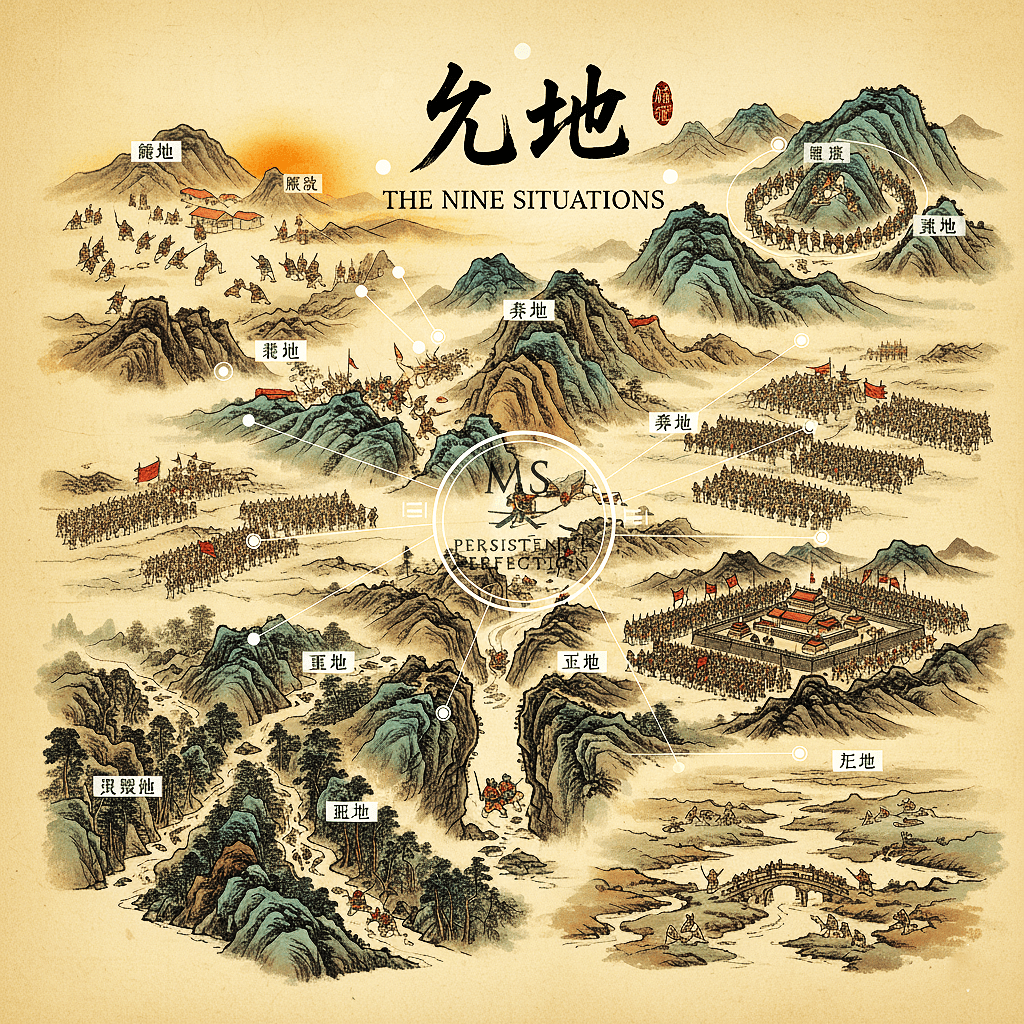
            The Art of Cyberwar | Part XI | The Nine Situations

            The principles: Begin by seizing something which your opponent holds dear; then he will be amenable to your will.

            …Concentrate your energy and hoard your strength.

            The principle on which to manage an army is to set up one standard of courage which all must reach.

            Whoever is first in the field and awaits the coming of the enemy will be fresh for the fight. – Sun Tzu

            Context and Purpose
            Sun Tzu’s Nine Situations maps the kinds of ground and circumstance a commander can face –  from favorable positions to trap-laden ground. Each situation demands a different posture: sometimes you press; sometimes you withdraw; sometimes you wait. The lesson is tactical discrimination: don’t treat every fight the same.

            In the modern world, those “situations” are organizational states: besieged systems, fleeting windows of access, deep entrenchment, overextended operations. Knowing which box you’re in changes everything you do next.

            Leadership and Morale: The Human Center
            Before tactics, a note about people. Sun Tzu insists that a general must know his soldiers. That’s not a platitude; it’s an operational fact.

            • Morale is intelligence: exhausted teams miss indicators, fail to follow playbooks, and make desperate mistakes.
            • Leadership is maintenance: rotating shifts, realistic on-call expectations, paid recovery time after incidents, and clear chains of command preserve discipline.
            • Respect plus standards: treat your people with dignity and hold them to standards. Leniency breeds sloppiness; cruelty breeds silence. Both are fatal.

            A leader who ignores morale loses the fight long before the enemy arrives. That’s as true for an infantry company as for an incident response roster.

            Deception and Perception Management
            Sun Tzu: All war is based on deception. In practice, that means shaping what the opponent and the population believe.

            • Information operations: propaganda, curated narratives, and coordinated messaging have always been instruments of power. Orwell’s line, “We have always been at war with Eastasia,” is a cautionary parable about manufactured consensus.
            • Modern analogue: in cyber, deception shows up as honeypots, false telemetry, and misinformation campaigns; in statecraft, as narratives that create vulnerability or strength where none objectively exists.
            • Ethical frame: defenders use deception for detection and deception to raise the cost for attackers (e.g., canary tokens). Democracies must guard against the weaponization of truth at home; businesses must avoid misleading stakeholders.

            Deception works because humans fill gaps with a story. Control the story; you alter the field.

            Fight Only When Necessary
            Sun Tzu and Mr. Lee agree: war is terrible; fight sparingly. The principle is simple: act only when the expected gain exceeds the cost.

            • Cost-calculation is non-negotiable: time, attention, capital, reputational risk.
            • In cyber: a public takedown, a disclosure, or active defense escalation must be measured against downtime, legal exposure, and adversary escalation risk.
            • In policy: interventions must have clear exit conditions and sustained domestic support. If you cannot sustain it, don’t start it.

            Discipline supersedes impulse.

            “If the Enemy Leaves a Door Open, Rush In” to Follow the Energy
            Sun Tzu’s pragmatic injunction to exploit openings is simple: when an opponent’s guard falls, capitalize immediately. In fighting, it’s like watching for your opponent to drop their hands or go for a spinning attack; in security, it’s a window of opportunity for decisive action.

            • Cyber example (defense): detect a lateral movement attempt and immediately isolate the segment, block the credential, and pivot forensic capture. The quicker the isolation, the smaller the blast radius.
            • Cyber example (offense/emulation): when a red-team discovers a misconfiguration, follow the chain-of-trust to map further exposures before the window closes.
            • Business/policy: when a competitor shows strategic weakness (supply disruption, PR crisis), acting quickly with a measured offer can consolidate position. But always have your logistics in place; quick gains that can’t be held are hollow.

            Following the energy multiplies the effect, but only if you’ve done the work beforehand to sustain the ground you’ve gained.

            The Nine Situations, Condensed & Modernized:

            1. Dispersive ground – you’re among your people; maintain cohesion.
              Cyber: internal incidents; prioritize comms and transparent leadership. (e.g., during the 2021 Log4Shell crisis, organizations that communicated quickly and openly with their teams contained risk more effectively.)
            2. Facile ground – easy ground, many exits; avoid traps of complacency.
              Cyber: dev/test environments misused as production; lock and audit.
            3. Contentious ground – disputed control.
              Cyber: contested supply chains; prioritize integrity of build pipelines.
            4. Open ground – mobility advantage.
              Cyber: cloud-native agility, move quickly, but instrument heavily. (Example: When a vulnerability like Heartbleed emerges, organizations that can rapidly update and redeploy cloud resources while monitoring all endpoints gain a decisive edge.)
            5. Intersecting ground – convergence of routes/partners.
              Cyber: shared services; segregate trust boundaries and enforce SLAs.
            6. Serious ground – stakes are high; commit only with full readiness.
              Cyber: critical infrastructure; assume regulation and public scrutiny.
            7. Difficult ground – constrained movement.
              Cyber: legacy stacks; carve compensating controls and minimize exposure.
            8. Hemmed-in ground (trapped) – the enemy can encircle.
              Cyber: breached islands due to vendor lock-in; prepare out-of-band recovery. (e.g., during the NotPetya outbreak, companies with alternate vendors or recovery paths minimized downtime, while others suffered prolonged outages.)
            9. Desperate ground – fight with everything; no other option.
              Cyber: blind-fire incident with full emergency playbook; declare crisis, invoke war-room, use all hands.

            Each situation requires a plan in advance, not improvisation in the heat of chaos. For those new to Sun Tzu: dispersive ground means your own territory, open ground is the public cloud, and hemmed-in ground is where your options are tightly constrained.

            Prescriptive Playbooks (Operational Guide)
            Below are short playbooks, or practical checklists, you can paste into an incident binder.

            A. Besieged System (Hemmed-in/Trapped Ground)

            • Isolate affected segments (network ACLs, VLANs).
            • Enable out-of-band admin (jump boxes, console access).
            • Invoke containment RTO/RPO playbook.
            • Engage legal & communications.
            • Stand up a dedicated recovery team; rotate shifts.
            • After action: root cause, patch, and inventory third parties.

            B. Fleeting Access (Open/Facile Ground)

            • Capture forensic snapshot immediately (memory, session tokens).
            • Harvest IOC, block indicators at perimeter.
            • Perform rapid threat hunting to see lateral movements.
            • Patch/vault credentials, revoke tokens.
            • Debrief and harden the vector.

            C. Retreat & Reconstitute (Dispersive/Retreat Scenario)

            • Execute planned fallback to secondary infrastructure.
            • Verify backups and boot from immutable images.
            • Communicate to stakeholders with controlled cadence.
            • Rebuild in clean environment; stage verification before full restore.

            D. Stronghold Defense (Steep/High Ground/Serious Ground)

            • Minimize human access; require jump hosts & MFA.
            • Immutable logging to secure audit trails.
            • Periodic red-team tests; continuous monitoring.
            • Harden supply lines: vendor SLAs, redundancy, and a tested DR plan.

            E. Rapid Exploitation (If a Door Opens)

            • Pre-authorize small rapid-response teams for exploitation windows.
            • Legal/ethics checklist signed off on in advance.
            • Capture intelligence, seal pivot paths, and convert to defense artifacts (detections, blocks).

            Each playbook starts with people: assign roles, cap on-duty hours, and rehearse quarterly.

            Final Thought: Calculation, Culture, and the Necessity of Restraint
            Sun Tzu’s closing insistence, calculate before battle, remains the core discipline. The leader who wins has already counted costs, supply, morale, and terrain. The one who loses discovers those facts mid-fight.

            That brings us back to the principles that opened this chapter:

            • Seize what the opponent holds dear: not for theater, but to create leverage and force predictable reactions.
            • Concentrate energy and hoard strength: preserve focus, avoid waste, and don’t spend force just to feel decisive.
            • Set one standard of courage: culture must hold under pressure, or your best playbooks become paper.
            • Be first in the field and wait: preparedness buys calm, and calm buys time – it’s the rarest advantage in crisis.

            In cyber and statecraft, the rule remains unchanged: prepare, preserve people, exploit opportunities, deceive judiciously, and fight only when victory is likely and sustainable. As Robert E. Lee warned, “It is well that war is so terrible, otherwise we should grow too fond of it.” So only fight when you have no other option. When you do fight, move decisively, use the force necessary to end the threat, and leave no doubt in your opponent’s mind so they will never make that mistake again.

            The Art of Cyberwar | Part X | Terrain

            The principles:

            “The natural formation of the country is the soldier’s best ally; make use of it to your advantage.”

            “When the general is weak and without authority; when his orders are not clear and distinct; when there are no fixed duties assigned to officers and men, and the ranks are formed in a slovenly haphazard manner, the result is utter disorganization.”

            “The general who advances without coveting fame and retreats without fearing disgrace, whose only thought is to protect his country and do good service for his sovereign, is the jewel of the kingdom.” — Sun Tzu

            Ground First

            Sun Tzu makes a simple demand: know the ground on which you stand.

            The proper ground turns disadvantage into leverage. The wrong ground turns strength into exposure. Terrain is not merely soil; it is topology, logistics, law, culture, and architecture. In the modern world, it includes cloud regions, compliance borders, identity planes, and network topology. Choose well, and the fight often narrows into something you can actually win.

            This is not an abstract chapter. It’s a practical one.

            If you’ve ever seen a breach unfold, you’ve witnessed terrain deciding outcomes in real time: attackers rarely “win” because they are stronger; they win because they enter through easy ground, move through poorly observed corridors, and reach valuable systems before defenders can orient.

            The defender’s job is to resist. It is to shape the ground, so the adversary’s best options become expensive, loud, or impossible.

            Types of Terrain – What They Feel Like, What They Demand

            Sun Tzu names a wide variety of ground. In practice, the terrain we face, militarily, digitally, and politically, collapses into recurring patterns: open, narrow, steep, encircled, and expansive.

            Each demands a distinct strategy. Each punishes a different kind of arrogance.

            Open Ground – Fast, visible, unforgiving

            Open ground is where you can be seen.

            In war, it is flat land with no cover: movement is easy, concealment is costly, and discipline decides whether speed becomes an advantage or panic. Detection and clean maneuvering are important because contact is constant.

            In cybersecurity, open ground is your public-facing surface area: internet-exposed services, public APIs, external portals, and remote access entry points. This is not where you want complexity. You want ruthless simplicity, fewer doors, fewer endpoints, fewer exceptions, paired with strong telemetry. Frameworks like the CIS Controls and NIST CSF explicitly prioritize inventorying and minimizing public-facing assets—making clarity and control here a universal best practice.

            Open ground is also where deception works best. Decoys, false signals, and baited paths can pull an enemy out of position. In cyber, honeypots and canary tokens do the same: they invite movement into visibility and turn curiosity into evidence.

            Real-world case: In 2021, the Microsoft Exchange Server vulnerabilities (ProxyLogon) exposed thousands of organizations’ email systems to the internet. Attackers rapidly exploited unpatched, public-facing assets—demonstrating why CIS Controls and NIST CSF stress the importance of inventory and minimizing the external attack surface.

            Open ground isn’t “unsafe.” It’s honest. It shows you what you built.

            Narrow Ground – Chokepoints, bridges, legacy stacks

            Narrow ground is where everything funnels.

            In military history, chokepoints decide battles because geometry becomes force. A smaller army can hold a larger one, not by being stronger, but by limiting the enemy’s options. Just think of the legendary last stand of Leonidas and the Battle of Thermopylae.

            In cyber and cloud, narrow ground is often the infrastructure everyone relies on and no one wants to touch: legacy integrations, VPN tunnels, identity gateways, brittle on-prem choke points, systems tied to modern workflows by thread and habit. They become bridges. Bridges become targets.

            If you harden one thing this quarter, harden your chokepoints, segment around them. Add compensating controls. Increase logging where applicable. Treat narrow terrain as sacred because when it fails, everything behind it is exposed. The MITRE ATT&CK framework’s focus on lateral movement and privilege escalation highlights why chokepoints must be secured and closely monitored.

            Mini-case: The 2021 Colonial Pipeline ransomware attack targeted a single VPN account—an overlooked chokepoint with no multi-factor authentication. This breach underscores the criticality of securing and monitoring privileged access pathways.

            Martial principles show up cleanly here. Wing Chun teaches that in close range, cutting angles and superior structure become everything. Trapping is about denying your opponent options. Narrow terrain does the same: it constrains movement and penalizes sloppy positioning.

            Steep Ground – Visibility and defensibility, limited mobility

            Steep ground is an advantage you must maintain.

            High ground offers visibility and defensive leverage, but you don’t sprint on it. Movement becomes deliberate. Once you lose it, regaining it costs more than taking it did.

            In cyber/cloud terms, the “steep ground” is where you place your crown jewels: production enclaves, privileged access vaults, critical logging pipelines, backup infrastructure, and identity governance, zones with strict access controls, immutable logs, and minimal pathways. NIST Special Publication 800-53 and CIS Controls both emphasize layered defenses and strong separation for critical assets, reinforcing the need for deliberate, hardened environments.

            These environments should feel “steep” to anyone moving through them, including your own staff. That friction is the point. Steep terrain ensures enforcement of control.

            Industry example: Major cloud providers routinely isolate customer data and management functions in highly restricted “steep ground” zones, applying controls from NIST SP 800-53 and CIS to prevent lateral movement and ensure containment if a breach occurs.

            In Jiu Jitsu, this is akin to mount or back control: you don’t rush to snatch up a submission. You stabilize, isolate, and apply pressure through position and then finish. The defender who gets impatient on steep ground usually falls off it.

            Encircled Ground – When you risk being surrounded

            Encircled terrain is where isolation becomes lethal.

            In war, encirclement breaks supply lines, erodes morale, and forces rash decisions. In cyber, encirclement often begins as “convenience” and ends as captivity: vendor dependencies, brittle third-party integrations, shadow IT no one owns, “critical” workflows held together by one person’s tribal knowledge.

            The danger is that encirclement rarely feels dramatic at first. It feels normal until you need to restore. Until a vendor is down. Until the contract becomes leverage. Until the only admin is on PTO and the incident is already in motion.

            Encircled ground demands exits: recovery paths, out-of-band access, air-gapped backups, and playbooks that restore connectivity without improvisation. CIS Control 11 and the NIST CSF Recovery Function both emphasize the importance of tested backup and recovery plans, as reliance on a single vendor or system is a strategic vulnerability.

            Recent headline: In the wake of the 2022 Okta breach, organizations that relied exclusively on one identity provider faced business continuity risks. Those with tested out-of-band recovery and contractual exit clauses, as recommended by CIS and NIST, were able to restore operations more quickly.

            If you don’t have those, you don’t have resilience. You have hope.

            Expansive Ground – Flat, wide, tempting for overreach

            Expansive terrain invites ambition. It also hides risk.

            Movement feels easy because there’s “room,” but oversight drops as the supply lines lengthen. This is how empires, and cloud estates, collapse: not from one failure, but from accumulated, ungoverned territory.

            In cyber, expansive ground is sprawl: dozens of cloud accounts, multiple providers, endless permissions, duplicated tools, integrations stacked on integrations. Sprawl isn’t evil. It’s simply unmanaged terrain.

            Expansive ground demands scalable governance: infrastructure-as-code policies, automated compliance, continuous asset inventory, and hard limits on “just one more integration.” Otherwise, you end up “owning” too many things to defend any of them properly. Both NIST CSF and the CIS Controls call for continuous asset management and automated enforcement to keep sprawl in check.

            This is where adversaries thrive, inside your noise.

            Example: Several high-profile breaches, including Capital One (2019), were linked to sprawling cloud environments where asset management and policy enforcement lagged behind rapid deployment. This highlights why NIST CSF and CIS Controls call for continuous inventory and automated governance.

            Choosing the Ground – Offense Through Selection

            A leader’s first tactical choice is where to fight. Good generals choose terrain that favors their force and punishes the enemy’s approach. That’s a decision, not a reflex.

            In cybersecurity, this is how you win before the breach: place valuable services behind hardened, observable layers and force attackers into monitored choke points. Make lateral movement steep. Make privilege escalation loud. Make time and friction the price of progress.

            In cloud architecture, it refers to trust zones and least-privilege boundaries that govern movement, much as terrain shapes an army’s movement. If an adversary wants access, they must climb and be exposed while doing it.

            In foreign policy, it means choosing diplomatic and economic levers rather than landing zones that stretch logistics and public support. Sometimes the “terrain” is public will. Sometimes it’s alliance cohesion. Sometimes it’s your economy. Burn those, and you’ve lost the campaign even if you win the first clash.

            Choosing ground is an active defense. It doesn’t surrender initiative; it shapes the enemy’s options.

            This is where martial deception becomes a strategy. A feint isn’t a lie, it’s an invitation. In Wing Chun, you draw the reach, trap the limb, clear the line, and strike at the same time. In Muay Thai, you show the jab to invite a teep to sweep the leg. In Jiu Jitsu, you offer the submission attempt you’re prepared to counter. Terrain selection works the same way: you present what looks like access, but what you built is a corridor of control.

            Leadership, Discipline, and Knowing Your Soldiers

            Sun Tzu insists a general must know his troops. That’s leadership in a sentence.

            A leader’s indecision, ego, or poor communication is as lethal as bad geography. Poor leaders over-commit, under-communicate, or ignore warnings. They treat friction as disobedience and clarity as optional. That is how organizations drift into the “slovenly haphazard” disorder Sun Tzu warns about: plenty of tools, no coherence.

            Discipline matters. Soldiers and engineers, treated with respect but held to standards, perform under pressure. Leniency breeds sloppiness; cruelty breeds silence. Both are operational risks.

            Know your teams: strengths, fatigue thresholds, and tempo. Rotate duty. Limit emergency hours. Maintain training. In cloud and cyber, this includes on-call limits, respect for sleep, post-incident retrospectives, and psychological safety to report near-misses before they become incidents.

            Morale shows up earlier than metrics. Leaders build the culture that sustains long campaigns.

            Calculation Before Battle – The Work of Winning

            Sun Tzu elevates calculation above impulse: the commander who measures many variables before engagement usually wins; the one who does not, loses.

            This calculation is methodical: map terrain, count supplies (capacity), estimate enemy options, and plan contingencies.

            In cyber, that means knowing your attack surface, understanding threat actor patterns, identifying likely pivot points, and building tested response runbooks. Rehearse, not because you expect a breach, but because you refuse to improvise under duress.

            In the cloud, this entails calculating blast radius, recovery objectives, and the cost of complexity relative to the cost of resilience. It also means choosing fewer tools and mastering them, because every new platform is a new terrain you must defend.

            In policy, it means calculating costs in treasure, trust, and time. Private-sector analogs are attention, capital, and brand.

            Winning is the product of preparation. You cannot improvise a viable posture in a crisis.

            Specific Strategies by Terrain – Practical Moves

            • Open ground: prioritize speed and detection; keep public assets to a minimum; deploy decoys and canaries; monitor aggressively. (CIS Controls 1, 7; NIST CSF Identify & Protect).
            • Narrow ground: enforce access controls and logging; funnel traffic through audited gateways; validate identity aggressively. (MITRE ATT&CK, NIST CSF Detect)
            • Steep ground: design immutable environments and strict separation; place critical controls in high-ground enclaves with minimal human pathways. (NIST SP 800-53, CIS Control 13)
            • Encircled ground: ensure out-of-band recovery, air-gapped backups, manual admin paths; maintain contractual exit clauses with vendors. (NIST CSF Recovery, CIS Control 11)
            • Expansive ground: prune and consolidate; adopt infrastructure-as-code policies and automated compliance; set hard limits on new integrations. (CIS Control 1, NIST CSF Asset Management)

            Every choice reduces the opponent’s options and preserves the defender’s leverage. In practice, aligning terrain strategies with proven frameworks isn’t bureaucracy; it’s how you translate doctrine into daily operations.

            Parallels: Rome, Corporations, and Nations

            Rome didn’t fail because it was weak; it failed because it could no longer pay for its expansion. The pattern repeats: a leader mistakes reach for control, stretches supply lines, and forgets the home base.

            In business, over-expansion without integration kills cash flow and culture. In policy, interventions without sustainable objectives are hollow support. In cyber, growth without governance turns territory into liability.

            The remedy is the same: select advantageous ground, keep logistics tight, and honor the limits of what you can sustain.

            Closing: Ground, People, Calculation

            Terrain teaches humility. It forces honesty about supply lines, political will, and human limits. Leaders must select ground that fits their forces, know their people well enough to deploy them without breaking them, and calculate relentlessly before contact. The best strategy isn’t the loudest; it’s the one most rigorously mapped to the ground and standards that define your domain.

            Sun Tzu’s point is blunt: the general who prepares wins because he has already made many small victories before the first clash. The rest simply discover, too late, what the ground beneath them already knew.

            The Next Step: Situations Reveal the Ground

            Sun Tzu ends this chapter the way a good fighter ends an exchange: not with noise, but with control.

            Terrain is not merely where you fight; it is what the fight allows. It determines which tactics are available, which movements are costly, and which victories are possible without incurring blood, bandwidth, or morale costs. The wise commander doesn’t “try harder” on bad ground. He changes the angle, changes the conditions, and shapes the enemy’s options.

            Muay Thai does it with ring craft: take space, cut off exits, force exchanges where your strikes land cleanly. Jiu Jitsu does it with: position, then control, then submission, and sometimes with a ruthless setup: allowing the opponent to chase the submission you expected, only to counter when they overextend.

            Terrain works the same way. Choose it well, and you’re not only defending but shaping the enemy’s approach until their “attack” becomes the opening you built the environment to reveal.

            That leads us directly back to the principles that opened this chapter:

            “The natural formation of the country is the soldier’s best ally; make use of it to your advantage.” Because once you understand the ground, you stop fighting the fight the enemy wants, and start forcing the battle they cannot win.

            And when leadership is weak, orders are unclear, and duties are unfixed, the result is exactly what Sun Tzu promised: utter disorganization, not because the enemy was brilliant, but because the ground exposed what was already unstable.

            The highest standard remains unchanged: the general who advances without vanity and retreats without fear, whose only thought is to protect his people and do good service, is the jewel of the kingdom.

            Bridge to Part XI – The Nine Situations

            Terrain teaches you what is possible. The Nine Situations teaches you what to do when possibility collapses into reality, when you’re advancing, retreating, encircled, trapped, deep in enemy ground, or approaching decisive contact.

            It is a doctrine of movement under pressure: acting in accordance with circumstances without losing coherence.

            You’ve learned how to read the ground.
            Next, you’ll learn how to fight on it.
            Security Without the Pessimism | Capstone: The Human Architecture of Resilience

            There’s a moment in every incident, and in every life, when things go sideways.
            An urgent alert comes in at 2 a.m.
            The phone buzzes with something you didn’t want to see.
            The room suddenly feels smaller.
            Your pulse skyrockets ahead of your ability to reason.

            That’s the pivot point.

            Not the breach, not the threat actor, not the malware strain. The moment your mind decides whether to rush, freeze, or breathe.

            And if the past two decades in cybersecurity have taught us anything, it’s this: The most overlooked control isn’t technical at all — it’s the ability to think clearly under pressure.

            You can build the best firewall on earth, layer your identity stack, and lock down every endpoint within reach. But if the wrong person panics at the wrong moment? Your architecture won’t crumble, but your response will.

            And the irony is that the same pattern shows up everywhere.
            In the gym.
            In martial arts.
            In American foreign policy across multiple generations.
            In corporate culture.
            In our personal lives.

            Technology changes. Tools evolve.
            But human behavior remains the battlefield.

            This capstone is about that battlefield, the one beneath all the dashboards and diagrams.
            The human architecture of resilience.

            Not fear.
            Not pessimism.
            Not endless warnings.
            Just clarity, culture, awareness, and depth.

            I. The Calm Before the Click: Thinking Clearly Under Pressure

            Cybersecurity professionals often discuss “root cause.”
            The CVE.
            The misconfig.
            The missing patch.
            The malicious link.

            But if you trace incidents far enough back, you rarely find a purely technical failure.
            You find someone who was tired.
            Someone who rushed.
            Someone is overloaded with tasks, tabs, or alerts.
            Someone who clicked before the mind caught up.

            Attackers have known this longer than we have.
            Social engineering is, at its core, the psychological equivalent of an ambush.
            It doesn’t rely on brilliance — it relies on rhythm.
            Interrupt someone’s rhythm, and you can make them do almost anything.

            History played the same game long before phishing emails existed.

            During WWI, the U.S. population had no appetite for a European conflict until the Committee on Public Information mastered message engineering on a national scale.

            During Vietnam, selective narratives were used to anchor the Gulf of Tonkin resolution, one of the clearest examples of how urgency overrides discernment.

            After 9/11, emotional exhaustion and fear gave the green light to decisions that would shape two decades of conflict, including the push toward Iraq in 2003 on intelligence the government already knew was questionable at best.

            The pattern is timeless: pressure → perception drops → people accept what they would normally question.

            In cybersecurity, that’s the moment a breach begins. Not when the payload deploys, but the moment someone stops breathing long enough to see clearly.

            Martial arts teach this early: when your structure collapses, so does your mind. The fight is rarely won by the strongest, but by the one who stays calm.

            Cybersecurity isn’t so different. We need quieter minds, not louder alarms. Consider the Apollo 13 mission: when an oxygen tank exploded in space, it wasn’t advanced technology alone that saved the crew—it was the unwavering composure, clear communication, and problem-solving focus of both astronauts and mission control. Their story remains a testament to the power of preparation, training, and the human spirit under pressure.

            Psychological research supports this need for balance: the Yerkes-Dodson Law demonstrates that while a certain level of stress can sharpen performance, too much leads to mistakes and paralysis. It’s not the loudest alarms or the highest stress that produce the best outcomes, but the ability to operate with steady focus under pressure.

            II. Security Isn’t a Toolset. It’s a Culture.

            This is the part vendors never put in their brochures.
            Tools matter, of course they do, but they’re not the foundation.
            If a team’s culture is fractured, fearful, or fatigued, the best tool becomes another dashboard no one trusts.

            A culture of security is built on three traits: Curiosity. Communication. Psychological safety.

            Curiosity is the click buffer. It’s the pause before the action. It’s the “does this feel right?” instinct that catches what technology misses.

            Communication is the force multiplier. If people don’t feel comfortable asking questions, you don’t have a security program; you have a façade. The worst breaches happen in organizations where employees believe that reporting something suspicious will get them punished.

            Psychological safety is the foundation beneath it all. You cannot build defense through fear.
            If people feel judged, they go silent. And silence is where threat actors win.

            Across American history, the same dynamic appears at scale. Governments that relied on controlling the narrative rather than fostering transparency created long-term instability.
            Nations that punished dissent instead of listening to it made poorer decisions, walked into unnecessary conflicts, or ignored early warnings because no one felt safe raising them.

            In cybersecurity, the equivalent is leadership that says: “If you click a bad link, come to us immediately, you’re part of the solution, not the problem.”

            Culture isn’t a policy. Culture is what happens when no one is watching.

            III. The Invisible Threat: Complacency

            Complacency is the enemy that feels like a friend. It arrives quietly. It shows up after long stretches of “nothing happened.” It hides behind phrases like:

            • “We’ve never had an incident.”
            • “We’ve always done it this way.”
            • “Our tools would catch that.”

            Every major breach you can name—SolarWinds, Equifax, Colonial Pipeline—roots itself in complacency somewhere: A missed update. An over-trusted vendor. An assumption that the environment was safer than it actually was. The 2013 Target data breach is a sobering example: multiple security alarms were triggered, but critical warnings were overlooked amidst noise and unclear processes. The failure wasn’t just technical—it was cultural and human. True resilience is built not on more tools, but on clear communication, shared responsibility, and organizational discipline.

            There’s a parallel here, too, in public psychology. Before WWI, the U.S. believed oceans protected it.

            Before the Vietnam War, we believed that superior technology guaranteed strategic clarity.
            Before 9/11, we believed asymmetrical warfare couldn’t reach our shores.
            Before the Iraq invasion, many believed intelligence agencies couldn’t be wrong.

            Every time, familiarity dulled skepticism. Certainty replaced awareness.

            Threat actors exploit the same weakness in cybersecurity: When we stop questioning our own assumptions, we hand them the keys.

            But the solution isn’t paranoia. It’s presence—the discipline to stay aware without fear, engaged without burning out, and to use quiet periods to strengthen fundamentals rather than relax them.

            Martial artists call this “maintaining the white belt mentality.” It’s the idea that no matter how skilled you become, your awareness must remain humble. The strike you don’t see coming isn’t the strongest; it’s the one you assumed wouldn’t land.

            IV. Defense in Depth Begins With Humans in Depth

            Defense in depth is usually presented as a diagram: Layers. Controls. Policies. Logging. Detection.

            But the deepest layer is always the human beings behind the console.

            Humans who communicate clearly under pressure.
            Humans who don’t panic.
            Humans who collaborate instead of silo.
            Humans who maintain integrity even when no one is watching.

            You can’t automate those traits.
            You can only cultivate them.

            A resilient team has depth:
            Depth of character.
            Depth of discipline.
            Depth of humility.
            Depth of trust.

            Leadership plays a massive role here.
            A leader who panics creates a cascading failure.
            A leader who hides incidents creates blind spots.
            A leader who blames creates avoidance.

            But a leader who stays calm?
            A leader who listens?
            A leader who respects the intelligence of their team?

            That kind of leadership becomes its own security layer, the kind attackers can’t penetrate.

            Martial philosophy applies here beautifully:
            The master doesn’t fight everything.
            The master knows when not to fight.
            The master conserves energy, maintains structure, and remains sufficiently present to move precisely when needed.

            That’s cybersecurity at its best. Not a flurry of tools or panic-driven responses. But steady awareness, grounded action, and a team that trusts itself. The response to the Stuxnet worm demonstrated the power of multidisciplinary collaboration: security researchers, government agencies, and private-sector teams worked together to analyze, share intelligence, and adapt rapidly. Their coordinated effort underscores that no single individual or technology has all the answers—resilience is a collective achievement.

            V. The Four Pillars of Real Resilience

            Looking back across this entire series, four fundamentals keep appearing.

            1. Calm

            The ability to breathe before acting. Security begins in the mind, not the machine.

            2. Culture

            Tools help. Culture protects. Culture catches what software can’t.

            3. Awareness

            Not paranoia, presence. The discipline to question, verify, and stay awake to the world around you.

            4. Depth

            Technical depth is valuable. Human depth is irreplaceable. Depth fuels resilience in every domain: networks, clouds, teams, and nations.

            These aren’t pessimistic ideas. These are empowering ideas. They’re principles that make security feel less like fear and more like clarity.

            Threat actors depend on confusion. They depend on fatigue. They depend on people who doubt their instincts.

            A calm mind. A strong culture. A present awareness. A deep team.

            That’s how you win. Not loudly, but with consistency.

            VI. Final Thought: Security Is a Human Practice Before It’s a Technical One

            If there’s a thesis to Security Without the Pessimism, it’s this: Security isn’t something we bolt onto systems. It’s something we build into ourselves.

            The work isn’t glamorous or cinematic. It’s often quiet, slow, and unrecognized. But it matters, because every decision and moment of awareness contributes to something bigger than any one of us, a culture of resilience.

            So here’s the takeaway: You don’t need pessimism to stay secure. You just need presence. You need clarity and people who care enough to pause, communicate, and stay humble.

            That’s the foundation of a safer digital world, built one calm, aware, disciplined human at a time.

            Security Without the Pessimism: Cyber Hygiene, The Daily Routine You Actually Need

            The Myth of the “Security Checklist”

            If you believed every cybersecurity headline, you’d think staying safe online takes a PhD, three apps, and a daily ritual in front of your firewall.

            The security industry profits from this complexity. Vendors want you to believe that protection requires their latest tool, their proprietary solution, their 27-step implementation guide. More complexity means more products to sell.

            But real security doesn’t look like that. It’s not about chasing every threat or memorizing every acronym. It’s about simple, repeatable habits. It’s the digital version of brushing your teeth.

            Here’s the truth they don’t want you to hear: You don’t need to do everything. You just need to do the right things, consistently.

            That’s cyber hygiene. And it’s boring on purpose.

            The Habits That Actually Matter

            Most people already know the broad strokes: use strong passwords, update software, don’t click weird links.

            But here’s what actually moves the needle:

            • Multi-Factor Authentication (MFA). Still, the single best defense against credential theft.
            • Software updates. Patches close the doors that attackers love to walk through.
            • Password managers. Better one secure vault than 20 weak logins.
            • Backups. One local, one in the cloud, test them once in a while.
            • Device lock and encryption. Lost phones shouldn’t equal lost data.

            That’s it. No mystery. No 27-step plan. Just a few habits that, when done daily, make 95% of attacks irrelevant.

            In 2017, Equifax was breached because they didn’t patch a known vulnerability for two months. 147 million records compromised. The fix? A software update they already knew about. That’s not sophisticated hacking, that’s skipped hygiene at a catastrophic scale.

            The basics aren’t basic because they’re easy to remember. They’re basic because when you skip them, everything else fails.

            Why We Skip Simple Stuff

            It’s not that people don’t know what to do. It’s that security doesn’t feel urgent until it’s too late.

            You don’t see or feel the benefits of good hygiene, but you definitely avoid the pain of neglect. No one cheers when you floss. But everyone will notice that broccoli in your teeth if you don’t.

            But there’s more to it than just invisible benefits. Three psychological forces work against cyber hygiene:

            Optimism bias. “It won’t happen to me” is a powerful drug. You read about breaches happening to other people, other companies, other industries. Your brain quietly files those stories under “someone else’s problem.” Until it isn’t.

            Decision fatigue. You have 47 accounts, each with different password requirements, different MFA setups, and different update schedules. The sheer volume of security decisions creates paralysis. So you do nothing, or you take shortcuts, the same password everywhere, “remind me later” on every update.

            The invisible threat problem. You can see a locked door. You can’t see a botnet probing your network. Physical security has visual feedback like locks, gates, cameras. Digital security is abstract until the moment it fails catastrophically. And by then, it’s too late.

            Cyber hygiene fails for the same reason flossing does: it’s easy to skip, hard to see the benefit, and the consequences feel distant. But unlike cavities, breaches don’t announce themselves with pain. They’re silent, patient, and devastating.

            The trick is to make it small enough that you’ll actually do it, and easy enough that you won’t skip it.

            Where Good Intentions Break Down

            Even security-conscious folks sometimes miss the basics. Not because they’re careless, but because these gaps accumulate slowly, invisibly:

            Outdated hardware. That router you set up five years ago? It stopped receiving security patches three years ago. Old devices become permanent vulnerabilities.

            Shadow data. Files saved “temporarily” on random drives, USB sticks, or that personal Dropbox you forgot you created. Every copy is another attack surface.

            Forgotten accounts. That forum you joined in 2014. That trial subscription you never canceled. Dormant logins are open doors with your email and password sitting in some leaked database.

            Public Wi-Fi comfort. You use a VPN at the airport but not at the coffee shop. Inconsistent protection is predictable behavior and attackers love predictability.

            You don’t have to fix everything today. Just start closing one gap at a time. Audit your accounts quarterly. Replace hardware that can’t be updated. Consolidate your data.

            Security isn’t perfection. It’s progress. And progress happens one boring habit at a time.

            Think of it this way: cyber hygiene is like compound interest, make small deposits now, get massive protection later. Skip the deposits, and you’re borrowing against a future breach.

            Make Security Boring (That’s the Point)

            The goal isn’t to turn security into a project, it’s to make it routine. Boring. Automatic. The kind of thing you do without thinking, like locking your car.

            Here’s a weekly checklist that actually sticks:

            • Monday: Check updates and patches. Five minutes. Coffee in hand. Start the week secure.
            • Wednesday: Backup your files. Set it, forget it, verify it works.
            • Friday: Review new apps or accounts, prune what you don’t use. Close the week by closing gaps.

            That’s 10 minutes a week. Three touchpoints. No drama. No heroics.

            If you can manage that, you’re already ahead of most organizations. Not because you’re doing something extraordinary because you’re doing something sustainable.

            Security should be quiet. The less you think about it, the better it’s working. The moment it becomes a production, it becomes optional.

            Culture Over Blame, Turning Awareness Into Habit

            People don’t need more fear. They need better routines.

            I’ve seen teams transform their security posture not through mandates, but through modeling. One security lead I worked with started every Monday standup by sharing what he patched over the weekend, not as a flex, just as routine. Within a month, the team was comparing notes on password managers and backup strategies. Security became a shared practice, not a compliance checkbox.

            Encourage coworkers, friends, or family to treat digital hygiene like health hygiene, it’s a shared standard, not a personal burden. When one person in a household sets up MFA, others notice. When a team lead mentions their weekly backup routine, it normalizes the behavior.

            When leaders model small, consistent habits, teams follow. Security doesn’t start in policy documents; it begins in daily rhythm. And rhythm spreads.

            Make it normal. Make it boring. Make it easy.

            Final Thought

            Cyber hygiene isn’t glamorous, but it’s the backbone of every good security posture.
            You don’t need to understand encryption or chase every breach headline.
            You just need to do the basics, on time, every time.

            The security industry wants you to believe protection is complicated because complexity sells. But the truth is simpler and cheaper: consistent habits beat expensive tools every time.

            Prevention doesn’t shout. It just works.

            That’s not pessimism, that’s just daily discipline. And it’s boring, and effective, on purpose.

            Security Without the Pessimism: The VPN Comfort Myth

            The Digital Blanket We All Love

            Few tools in cybersecurity inspire more misplaced comfort than the VPN.

            We picture it as an invisibility cloak or a tunnel of safety where no one can see us, track us, or touch our data. Turn it on, and suddenly you’re “secure.”

            That feeling of control is powerful, especially in a world that never stops reminding you how unsafe the internet supposedly is.

            But here’s the quiet truth: a VPN protects you from some things, not from everything.
            It’s a tool, not a shield.

            What VPNs Actually Do

            At its core, a VPN (Virtual Private Network) encrypts your internet traffic and routes it through a secure server. It hides your IP address and protects your data from casual snooping, especially on public Wi-Fi.

            That’s useful, but not magic.

            VPNs do not:

            • Protect you from phishing or malware
            • Stop you from logging into fake sites
            • Prevent data collection once you’re signed in somewhere

            If your VPN provider keeps logs or has weak security, your trust shifts from the ISP to them.

            So yes, a VPN helps. But only if you understand where its power ends.

            Safety Theater for the Digital Age

            VPNs scratch a deep psychological itch: the need to feel safe, even when we can’t verify it.

            They’re the digital equivalent of locking your front door but leaving the windows open, a visible act that soothes anxiety without addressing every risk.

            That invincibility leads many to take more risks online. This risk compensation means perceived safety can spark riskier behavior.

            Real security isn’t about hiding. It’s about awareness.

            Where Comfort Becomes Complacency

            The most significant problems with VPN use aren’t technical; they’re behavioral.

            • Blind trust in providers. Some “free” VPNs monetize your data rather than protect it.
            • Performance trade-offs. Slower speeds lead people to disable it, often forgetting to turn it back on.
            • Assumed anonymity. Logging into your personal accounts still links behavior to identity.
            • Neglected basics. Users skip updates or MFA because “I’ve got a VPN.”

            The tool becomes a crutch, and that comfort can cost you more than the subscription.

            Layer, Don’t Lean

            A VPN should be part of a layered defense, not its foundation.

            Here’s how to use it wisely:

            • Choose providers with no-log policies and independent audits
            • Keep software updated. VPNs rely on encryption protocols that age fast
            • Use MFA everywhere. A VPN won’t save a stolen password
            • Understand context. VPNs are best for travel, remote work, and untrusted networks — not daily browsing at home

            Security isn’t about hiding behind one tool. It’s about stacking the right ones.

            Culture Over Blame — Moving Past Security Myths

            The VPN story mirrors how we approach most security advice: quick fixes over long habits.

            Instead of mocking people for misunderstanding what VPNs do, we can use that comfort as a bridge: “Good start. Now let’s talk about the rest.”

            Awareness grows when education feels empowering rather than condescending. The goal isn’t to shame people for feeling safe; it’s to help them feel safe for the right reasons.

            Final Thought

            A VPN isn’t a vault; it’s just a smaller door to the same big house. Use it, respect it, but don’t mistake a single layer for complete protection.

            Real protection isn’t invisible. It’s intentional. That’s not pessimism, that’s just good sense.