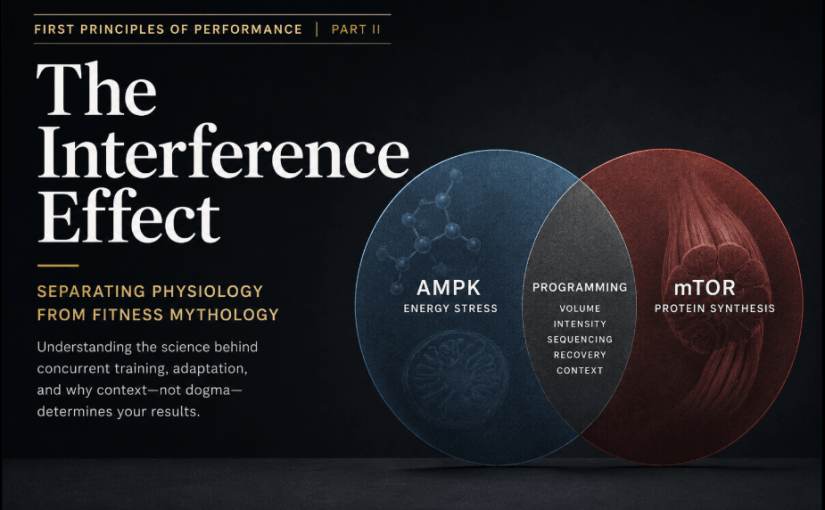
The Interference Effect: Separating Physiology from Fitness Mythology

“Understanding what works is valuable. Understanding why it works changes the way you think forever.”
In the previous article, Cardio Doesn’t Kill Your Gains. Poor Programming Does, we challenged one of the most persistent myths in strength and conditioning.
The conclusion was straightforward.
Cardiovascular training does not inherently prevent muscle growth. Rather, poorly designed training, excessive volume, inadequate recovery, insufficient nutrition, and conflicting priorities, is what most often limits progress.
For the overwhelming majority of lifters, the question isn’t whether they should perform cardiovascular training. The question is how to integrate it intelligently into a well-designed program.
That practical advice is enough for most people.
But for coaches, athletes, and those who simply enjoy understanding why the body behaves the way it does, there is a much deeper story waiting beneath the surface.
That story begins inside a single muscle cell.
The Conversation Inside the Cell
Every training session asks your body a question.
Heavy squats ask: Can you produce more force?
A sprint interval asks: Can you generate enormous amounts of energy very quickly?
A thirty-minute Zone 2 session asks: Can you become more efficient?
Your muscles answer each of these questions by activating different signaling pathways that regulate adaptation.
These pathways are often portrayed as opposing armies locked in constant battle. One builds muscle. The other builds endurance. One must win while the other loses. It’s an appealing narrative. It’s also an oversimplification because biology is rarely that binary.
Meet the Two Most Famous Molecules in Exercise Physiology
If you’ve spent any time reading about muscle growth or endurance training, you’ve almost certainly encountered two acronyms:
AMPK
and
mTOR.
They’re frequently described as rivals. While that’s directionally true, the relationship is considerably more nuanced than the internet often suggests.
AMPK functions as the cell’s energy sensor. Whenever energy availability begins to decline, as happens during prolonged or demanding exercise, AMPK becomes activated.
Its job is straightforward and that’s to restore energy balance.
It encourages the body to become more metabolically efficient, increase glucose uptake, enhance fat oxidation, and promote mitochondrial adaptations that improve endurance over time.
mTOR serves a different purpose.
Rather than conserving energy, mTOR responds to mechanical tension, amino acid availability, particularly leucine, and adequate cellular energy by promoting protein synthesis, tissue repair, and muscle growth.
One pathway asks,
“How do we survive this demand?”
The other asks,
“How do we become stronger for the next one?”
Both are essential an neither is the enemy.
Where the Myth Begins
Here’s where decades of misunderstanding started. Researchers discovered that AMPK can suppress certain components of the mTOR pathway.
That finding quickly evolved into a popular conclusion:
“Cardio turns on AMPK.
AMPK turns off mTOR.
Therefore cardio kills muscle growth.”
Simple but also wrong, or at least incomplete. Because physiology almost never operates like a light switch.
Biology Prefers Dimmers Over Switches
One of the most overlooked aspects of exercise physiology is time. AMPK responds rapidly to energetic stress. During demanding exercise, it rises quickly.
Then, once the exercise ends and energy balance begins to recover, AMPK activity declines just as rapidly, often within minutes to a few hours.
mTOR behaves differently.
Following resistance training, especially when combined with adequate protein intake, mTOR signaling can remain elevated for many hours and, in some cases, more than a day as muscle protein synthesis continues.
These aren’t two permanent states competing for dominance. They’re temporary responses to changing physiological demands. Your body constantly adjusts which pathway receives greater emphasis based on what it needs at that moment.
Location Matters
Another misconception is that these pathways somehow control the entire body equally at all times. They don’t. Many signaling responses are remarkably localized.
The muscle fibers performing repeated contractions experience different metabolic demands than surrounding tissues. The cardiovascular system responds differently than skeletal muscle. The liver behaves differently than adipose tissue.
Even within skeletal muscle, fiber type influences adaptation. The body isn’t issuing a single command. It’s conducting an orchestra. Different sections play different parts. Together they produce adaptation.
The Body Doesn’t Choose Between Building and Improving
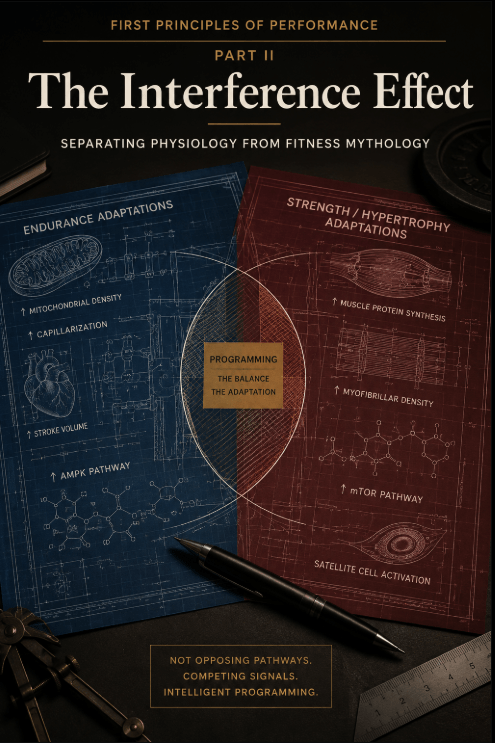
Perhaps the most fascinating aspect of this entire discussion is that AMPK and mTOR are not always mutually exclusive. Under certain physiological conditions, aspects of both pathways can be active simultaneously. Cells routinely remove damaged proteins while synthesizing new ones.
Energy availability can improve while structural remodeling occurs. Recovery itself is an ongoing process of destruction and regeneration. Our physiology isn’t designed around choosing one adaptation. It’s designed around balancing competing demands with extraordinary precision.
What the Research Shows
This is where molecular biology meets coaching.
When researchers move beyond isolated signaling pathways and study actual athletes over weeks and months, the dramatic interference many people fear becomes surprisingly difficult to reproduce outside very high volumes of endurance training.
Concurrent training research consistently demonstrates that the magnitude of the interference effect depends on factors such as:
- Total endurance volume
- Exercise modality
- Session timing
- Recovery
- Nutritional status
- Training experience
- Overall programming
In other words, the molecular biology doesn’t invalidate the conclusions from the previous article, it explains them.
Recent research confirms that the so-called “interference effect” is real, but its magnitude depends on how training is programmed. For example, a 2016 study by Jones et al. found that, while concurrent training can slightly reduce strength gains compared to strength training alone, the effect is modest and can be minimized with thoughtful sequencing and recovery (Jones et al., 2016).
Why Running Sometimes Differs from Cycling
One particularly interesting finding is that not all endurance training produces the same interference.
High-volume running often creates greater reductions in hypertrophy than cycling or rowing.
Why?
Part of the explanation likely lies in mechanical loading. Running introduces thousands of eccentric foot strikes that generate additional muscular damage and recovery demands.
Cycling and rowing produce far less eccentric stress while still developing robust cardiovascular adaptations. The heart doesn’t particularly care how you elevate its workload.
Your joints and muscles often do. For athletes prioritizing hypertrophy, choosing lower-impact conditioning modalities can preserve more recovery capacity for strength training.
The First Principle
Understanding physiology should never replace good coaching.
It should explain it. The interference effect is real. But it is conditional, contextual, and frequently exaggerated. Most athletes don’t need to fear cardiovascular training. They need to respect recovery.
They need to understand adaptation. And above all, they need to remember that physiology doesn’t reward extremes. It rewards appropriate stress followed by appropriate recovery. That’s how stronger muscles are built. That’s how better cardiovascular systems are developed.
And that’s how thoughtful programming transforms isolated workouts into long-term performance.
Closing Thoughts
Perhaps the greatest lesson from the interference effect has nothing to do with AMPK or mTOR. It is a reminder that biology rarely conforms to the tidy, binary explanations we often prefer.
Strength or endurance. Cardio or muscle. Building or recovering. These are useful categories for conversation, but they are poor descriptions of how the human body actually functions. Our physiology is not governed by absolutes. It is governed by balance, adaptation, and context.
The best coaches understand this instinctively. Science simply helps explain why.
Next time we’ll discuss what performance programs actually look like. They’re the same physical qualities, simply applied with different priorities.
As always, the principles remain the same. The art is in the application of that knowledge.
References
Jones, T. W., Howatson, G., Russell, M., French, D. N., & Thomas, K. (2016). Performance and physiological differences between concurrent training and strength training. European Journal of Applied Physiology, 116(3), 665-678.

 Matt Shannon, Security Pro