The Art of Cyberwar | Part IX | The Army on the March

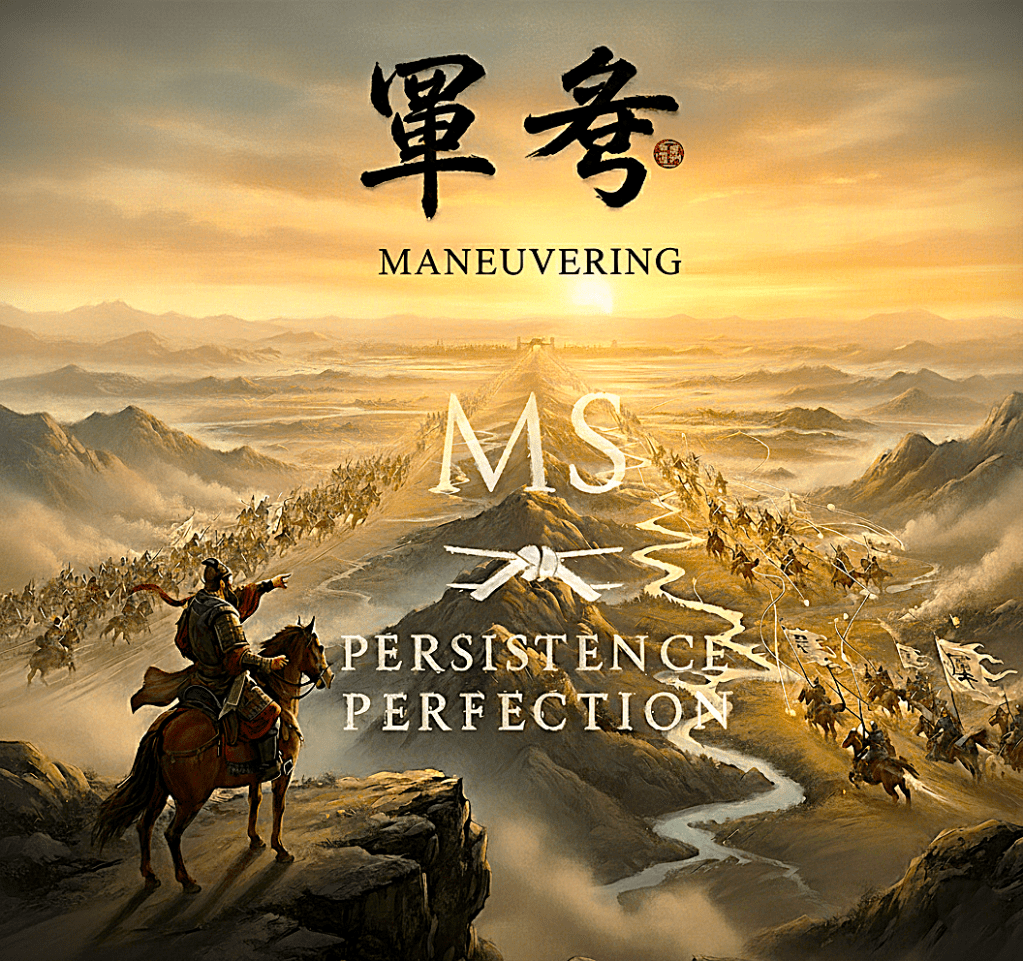
“The Army on the March” — Illustrated for The Art of Cyberwar, Part IX. This artwork evokes the visual language of classical Chinese scroll painting, capturing the essence of Sun Tzu’s Chapter IX with striking thematic fidelity. The scene unfolds in layers across a sweeping golden landscape: tightly ordered battalions march along mountain paths, supply barges cross a winding river, and distant formations assemble beneath the rising sun. Each element reflects the logistical burden, psychological tension, and environmental dependence that define an army deep into foreign territory.
At the foreground, a lone commander on horseback surveys the terrain, flanked by advisors whose varied stances suggest counsel, observation, and caution. His elevated vantage mirrors Sun Tzu’s emphasis on awareness — the practice of reading fatigue, momentum, and environmental signals before they harden into irreversible consequences. The river crossing, perilous and slow, symbolizes the fragility of overextension; the distant city, shimmering beyond the horizon, represents both ambition and the looming threat of exhaustion.
The overall composition blends serenity with strain, grandeur with vulnerability. In doing so, it transforms ancient military wisdom into a timeless reminder for modern strategists: every march requires vigilance, and every expansion carries its cost.

The Principle:

“When you leave your own country behind, and take your army across neighboring territory, you find yourself in a position of dependence on others. There you must watch for signs of strain.”— Sun Tzu

The Signs Before the Fall

Sun Tzu’s ninth chapter is about perception.

Here he shifts from action to awareness. It’s about how a commander reads fatigue, imbalance, and internal decay before they destroy an army from within.

This is not simply a lesson in combat, but more importantly, it’s a lesson in foresight. This is a crucial distinction that often separates a near-flawless victory from a crushing defeat.

Because every empire, every enterprise, every cyber defense effort eventually faces the same drift:

  • expansion that outruns understanding
  • momentum that hides exhaustion
  • ambition that blinds leadership
  • reach that exceeds resources

Armies break this way.
Companies implode this way.
Nations lose coherence this way.

In martial arts, this is the moment a fighter looks powerful, but their footwork is mis-aligned, the subtle tell of hand movement, the delayed return to guard, or the half-beat of hesitation that usually precedes success but this time leads to being hit.

Sun Tzu teaches us: if you can’t read the signs, you can’t survive the march.

Overreach: The Eternal Temptation

History loves proving this point.

Rome’s legions stretched from Britain to Mesopotamia until it could no longer feed its own frontiers. Britain built an empire “over all seas,” only to watch its overstretched supply lines rot from within.

The United States, victorious after World War II, constructed a global presence so vast that presence itself began replacing purpose.

Sun Tzu warned: The longer the march, the more fragile the army becomes.

Modern America has been marching for generations, militarily, economically, digitally, and each expansion has carried both pride and price.

Corporations experience the same decay. Cloud ecosystems suffer it even faster. What begins as strength, scale, reach, integration, becomes fragility when maintenance exceeds cost-tolerance.

In martial arts, overreach is the fighter who throws too many power shots, chasing a knockout rather than reading the opponent. They exhaust themselves long before the opponent is even breathing heavily.

Strength without pacing is just a longer route to collapse.

The Weight of Infinite Reach

In cybersecurity, overreach becomes complexity collapse.

Each new department adopts a new tool. Each executive demands a new dashboard. Each vendor promises a universal cure.

Suddenly:

  • no one sees the whole system
  • logs pile up unread
  • alerts become background noise
  • integrations multiply into untraceable webs
  • dependencies form faster than they can be understood

What once felt powerful becomes paralyzing.

Foreign policy suffers the same rhythm on a grander scale.

WWI.
WWII.
The Cold War.
Korea.
Vietnam.
Bosnia
Iraq.
Afghanistan.

Each began with a clean, confident objective. Most devolved into attrition, mission creep, and moral fatigue. It can confidently be argued that mission creep began with WWI, but that’s a conversation for another time.

Sun Tzu would summarize it simply: When the troops are weary and the purpose uncertain, the general has already lost.

In BJJ, this is the fighter who scrambles nonstop, burning energy on transitions without securing position. Sometimes, not even needing to scramble or change position, but hasn’t trained long enough to even know that.

In boxing, it’s the puncher throwing combinations without footwork. The fighter simply stands in place, wondering why his punches never land.

In Kali, it’s the practitioner who commits too aggressively, losing awareness of angles and openings.

The march becomes too long.
The lines become too thin.
And collapse becomes inevitable.

Business: The Corporate Empire Syndrome

Businesses suffer the same fate as empires.

Growth attracts attention. Attention fuels pressure to expand. Expansion becomes compulsive.

Suddenly, the company is chasing:

  • ten markets
  • ten products
  • ten strategies
  • ten “high-priority” initiatives

Each of these demanding its own “army.”

The parallels to national instability are perfect:

  • Expansion without integration
  • Strategy scaling faster than understanding.
  • Leaders mistaking size for stability.

Eventually, the weight becomes unsustainable.

The company can no longer “feed the army.”
Costs rise.
Culture cracks.
Purpose fades.

What killed Rome wasn’t the final battle; it was the slow erosion of balance across its territory.

Most businesses die the same way, and so do most digital ecosystems.

In Wing Chun, this is the collapse of structure, the moment you can see a fighter trying to do too much, forgetting the centerline, being everywhere except where they need to be.

Overreach is always invisible until it isn’t.

The Modern March: Cyber Empires and Digital Fatigue

Our networks are the new empires.

Every integration is a border.
Every API is a supply line.
Every vendor is an ally whose failure becomes your crisis, and you can never plan for when that crisis comes.

Cloud architecture multiplied this exponentially.

Organizations now live everywhere and nowhere at once.

Sun Tzu’s image of an army dependent on supply lines maps perfectly to modern digital infrastructure:

  • Multi-cloud systems
  • SaaS sprawl
  • CI/CD pipelines with invisible dependencies
  • Third-party integrations with inherited vulnerabilities

When visibility fades, risk multiplies. When dependencies become opaque, consequences become catastrophic.

A company that cannot trace its supply chain of code is like an army that has lost its map.

One outage.
One breach.
One geopolitical tremor.

And the entire formation can buckle.

We call this “scalability.”
Sun Tzu would call it: Marching too far from home.

Reading the Dust Clouds

Sun Tzu taught his officers to read subtle signs:

  • dust patterns revealing troop movement
  • birds startled into flight
  • soldiers’ voices around the fire
  • the speed of camp construction
  • the tone of marching feet

Modern versions of those signs are just as revealing:

  • Escalating ‘critical’ alerts no one addresses
  • Morale fading under constant pressure
  • Defensive posture maintained through inertia
  • Strategies repeated because they worked once, not because they work now
  • Partners showing hesitation before they show defection

In WWI, the Lusitania offered one of the clearest “dust clouds” in modern history.

Germany declared unrestricted submarine warfare. British intelligence knew passenger liners were targets. The Lusitania was warned. The U.S. was warned. Even the ship’s cargo, which included munitions, made it a predictable target.

Yet the warnings were dismissed.
The signs were clear.
The perception failed.

And America’s reaction, too, was predictable; a “neutral nation” was pushed closer to war by a tragedy entirely foreseeable. Some might argue that certain American politicians sought to force the US into the war. Again, that’s a discussion for another time.

Sun Tzu’s maxim remains timeless: The first to lose perception always loses position.

The Cost of Endless Motion

Overextension rarely appears dramatic at first.

It looks like success:

  • revenue rising
  • troops advancing
  • dashboards expanding
  • integrations multiplying

Then the consequences arise:

  • fatigue
  • erosion
  • misalignment
  • burnout
  • doubt

You begin fighting just to justify how far you’ve marched.

In cybersecurity, this is the company chasing every vulnerability without fixing their architecture.

In foreign policy, it’s the nation fighting endless “small wars” that collectively cost more than stability ever would.

In boxing, it’s the fighter who keeps moving forward until they walk into exhaustion, not a punch.

In Kali, it’s the flow practitioner who adds complexity until their movement becomes noise rather than intent.

Sun Tzu warned: An army that has marched a thousand li must rest before battle.

Modern systems rarely rest. We only measure uptime, not wisdom.

Restraint as Renewal

The answer isn’t retreat, it’s an informed, measured rhythm.

Knowing when to:

  • advance
  • consolidate
  • recover
  • regroup
  • reconsider the terrain

Strategic restraint is not weakness. It is self-preservation.

Rome could have lasted longer by fortifying fewer borders. Corporations could thrive longer by protecting focus instead of chasing scale. Nations could endure longer by strengthening their homeland defenses before ever wasting a single dime projecting power abroad.

Sun Tzu’s art was never about conquest. It was about sustainability.

Victory without stability is just defeat on layaway.

Awareness in Motion

Awareness is the antidote to overreach.

It requires honest measurement:

  • what’s working
  • what’s weakening
  • what’s cracking
  • what’s already lost

It requires humility: no army, business, or nation can move indefinitely without rest.

In cybersecurity, awareness is visibility.
In leadership, it’s listening.
In foreign policy, it’s simply remembering.

Awareness doesn’t stop momentum. It calibrates it.

It’s the half-beat between breaths that keeps the system alive.

Bridge to Chapter X | Terrain

Sun Tzu ends this chapter by looking outward again.

Once you’ve learned to read fatigue, imbalance, and decay within, the next step is to read the environment beyond.

The internal determines how you survive the external.

Which returns us to the opening principle: When you leave your own country behind…you find yourself in a position of dependence on others.

An army on the march teaches us to see ourselves. Chapter X Terrain teaches us to read the world:

  • its obstacles
  • its openings
  • its deception
  • its opportunities
  • its traps

Awareness of self means little without awareness of landscape. That’s where the next battle begins.

The Art of Cyberwar | Part VIII | Variation in Tactics

The principle: “There are not more than five musical notes, yet the combinations of these five give rise to more melodies than can ever be heard.” — Sun Tzu

Adaptation Over Assumption

In Maneuvering, we learned the art of movement and how to turn posture into progress. Now Sun Tzu takes the next step: variation.

Variation is the discipline of adaptation. Not improvisation for its own sake. It’s controlled flexibility and fluidity; the kind that keeps a force alive while in motion.

Sun Tzu’s warning is ruthless: Predictability is the slow death of strategy. Every organization that wins too long risks repeating itself.

Every CISO, every architect, every nation-state faces the same danger: When your patterns stabilize, your adversary’s job gets easier.

Attackers study rhythm.
They hunt repetition.
They exploit formula.

What you repeat becomes your weakness.

Static Defenses, Dynamic Threats

In cybersecurity, repetition feels like discipline:

  • the same checklists
  • the same daily, weekly or quarterly assessments
  • the same scanning cadence
  • the same unchanged playbooks

It feels stable but it’s stagnation dressed as process.

Meanwhile attackers evolve hourly.

Their payloads morph.
Their lures update.
Their timing adapts to human fatigue cycles.

They don’t overpower blue teamers; they systematically outlearn them.

Sun Tzu’s guidance, “alter your plans according to circumstances,” isn’t merely poetic.

It’s operational doctrine. Security isn’t a system. Security is a cycle.

  • Every breach teaches.
  • Every false alarm reveals.
  • Every routine day hides patterns waiting to be broken.

The teams that adapt fastest aren’t the biggest.

They’re the most fluid and adaptable.

Variation is awareness in motion.

Red Teams, Blue Teams, and the Dance of Adaptation

Variation is the heartbeat of adversarial testing. Red teams live in uncertainty: improvisation, deception, broken rhythm. Blue teams train in structure: detection, containment, resilience.

A mature organization doesn’t let them exist as siloed tribes. It merges them into purple teaming, where the creativity of offense and the rigor of defense evolve together.

  • Red exposes blind spots.
  • Blue turns discovery into discipline.
  • Together they adapt.

This is the martial logic of sparring:

  • Wing Chun’s angle changes, where the same attack comes from different entries vs simply straight lines.
  • Muay Thai’s broken rhythm, where timing destroys expectation.
  • BJJ’s transition → position → submission sequence, where variation becomes game, set, match.

Each engagement becomes rehearsal for reality. You’re not preparing for yesterday’s threat. You’re learning from tomorrow’s rehearsal. That’s Sun Tzu’s Variation: adaptation as preparation.

Cloud Security: Adaptation as Architecture

Cloud environments shift constantly:

  • APIs update
  • services deprecate
  • compliance rules revise
  • identity models evolve
  • integrations multiply

Static thinking is fatal in a fluid system. Cloud security is variation embodied.

Infrastructure-as-code lets architecture evolve at speed. Automation turns intent into consistent action, but without visibility, variation becomes drift.

Sun Tzu’s metaphor of water fits perfectly: Water adapts to its container yet always seeks its level.

Cloud engineers do the same:

  • change with the environment, without losing alignment
  • allow flexibility, without losing control
  • evolve configurations, without losing accountability

Adaptation is necessary. Principles are non-negotiable.

Foreign Policy and the Trap of Predictability

Nations decay when their doctrine ossifies.

The American foreign policy establishment has often fallen into this trap over and over again:

  • Cold War containment repeated even after the context changed.
  • counterinsurgency tactics applied to environments that defied them
  • interventions driven by reflex rather than awareness

Vietnam: A doctrine built for conventional warfare in Europe applied to guerrilla conflict in jungle terrain. The U.S. measured success through body counts and attrition, while the enemy measured it through will and time. Same playbook, wrong war. Predictable escalation met adaptive resistance.

Afghanistan: Twenty years of rotating commanders, each bringing their own tactical variation, but all operating under the same strategic assumption—that nation-building through military presence could succeed where it had failed for empires before. The tactics changed every 18 months with each new general. The doctrine never did. The enemy simply waited.

Iraq 2003: Intelligence assumptions treated as certainties. A swift conventional victory followed by the assumption that democratic institutions could be installed through force. When insurgency emerged, the U.S. applied a counterinsurgency doctrine designed for different conflicts. By the time adaptation occurred (the Surge), years of predictable responses had already created the conditions for ISIS.

But perhaps the most revealing pattern is the rhetorical one: every emerging threat becomes “the new Hitler,” every conflict the next World War II.

  • Saddam Hussein was Hitler.
  • Gaddafi was Hitler.
  • Milosevic was Hitler.
  • Assad was Hitler.

The framing never changes. The enemy is always being Chamberlain in 1939 and being “appeasers of Hitler.” The infantile argument is always to stave off the newest existential threat to humanity. This isn’t strategy, it’s intellectual predictability masquerading as moral rectitude and always sticking by the banal cliche “never again,” whether is really applies or not.

World War II was a unique conflict: a mechanized, industrial-scale war between nation-states with clear battle lines, total mobilization, and, foolishly, unconditional surrender as the objective. Applying that framework to insurgencies, civil wars, and regional conflicts doesn’t just fail tactically, it reveals a dangerous inability to see the situation as it actually is.

The Hitler analogy serves a purpose: it short-circuits debate, frames inaction as appeasement, and makes intervention seem inevitable. But it’s also the ultimate form of strategic predictability. When every threat is Hitler, every response becomes World War II, and variation dies.

Variation in statecraft means reading each situation fresh, not recycling last decade’s doctrine into a new century, and certainly not recycling a doctrine from 80 years ago. In each case, tactical adjustments happened but strategic doctrine remained rigid. That’s the opposite of Sun Tzu’s teaching: vary tactics, never principles. These conflicts varied neither.

The Global War on Terror: The Ultimate Failure of Variation

And then there’s the final, most damning example of strategic predictability: Ahmed al-Sharaa, originally known as Abu Mohammed al-Jolani, who once led al-Qaeda’s Al-Nusra Front or Jabhat al-Nusra in Syria and spent years detained by U.S. forces as a terrorist in Iraq, was welcomed to the White House in November 2025 by President Trump.

He once had a $10 million U.S. bounty on his head. He founded al-Nusra Front, al-Qaeda’s Syrian branch. Now he’s a partner in the Global War on Terror.

This isn’t adaptation. This is strategic incoherence dressed as pragmatism.

Twenty-four years after 9/11, after trillions spent, after Afghanistan and Iraq, after “we don’t negotiate with terrorists” became doctrine, the United States now supports the former head of the very organization we invaded multiple countries to destroy.

The justification? He helps combat ISIS. The same ISIS that emerged from the predictable chaos of the Iraq War. The same conflict where al-Sharaa himself fought as a leading al-Qaeda member against U.S. forces.

This is what happens when doctrine ossifies while reality shifts. When every threat is framed through the same lens (“the new Hitler”), when every intervention follows the same playbook, when strategic thinking atrophies into bureaucratic reflex you end up shaking hands with yesterday’s enemy because you can’t recognize that your framework has failed.

Sun Tzu’s warning rings clear: predictability invites exploitation. The GWOT’s predictable responses—invasion, occupation, counterinsurgency, withdrawal created a cycle that adversaries learned to exploit.

They adapted. We repeated.

And now, the former al-Qaeda commander who once fought U.S. forces receives a hero’s welcome at the seat of American power. Not because the threat changed. Because we ran out of variations on the same failed strategy.

Predictability in diplomacy invites miscalculation.
Predictability in force posture invites escalation.
Predictability in cyber deterrence invites probing.

Again, as an example, at the extreme end of predictability lies Pearl Harbor.

Japan didn’t strike out of pure ambition; it struck because the U.S. cut off:

  • 90% of its oil
  • vital steel
  • food
  • rubber
  • machinery
  • industrial materials

A nation deprived of resources enters what Sun Tzu called death ground, the place where maneuver becomes inevitable.

  • Predictable embargo.
  • Predictable deterioration.
  • Predictable desperation.
  • Predictable strike.

Sun Tzu understood the principle: the more rigid your doctrine, the more your opponent will shift. Nations, like networks, must evolve, or decay through repetition.

Variation Without Confusion

Adaptability is not inconsistent. Sun Tzu warned that blind variation, change for its own sake,
creates disorder.

The rule is simple: Vary your tactics. Never vary your principles.

In cybersecurity, the principles are visibility, trust, and accountability.
In cloud architecture, they are governance and clarity.
In foreign policy, they are restraint and realism.

Change how you respond.
Never change why you respond.

That’s how variation becomes strength rather than noise.

Modern Lessons in Motion

Across every domain, the real art lies in learning faster than you decay:

  • In cybersecurity, adapt playbooks to every alert, not just every quarter.
  • In cloud: treat configuration as a living organism, not a static diagram.
  • In diplomacy: update doctrine before circumstances force your hand.

Predictability invites attack.
Curiosity creates resilience.

Sun Tzu didn’t worship flexibility. He prized awareness in motion, responsiveness guided by principle.

That is how you survive modern complexity: move → learn → realign → repeat.

That’s variation.

From Variation to Awareness

Variation teaches movement. The next lesson teaches perception.

In Chapter IX, The Army on the March, Sun Tzu turns to the signals that guide a force in motion,  how to read the terrain, sense morale, detect fatigue, and recognize when momentum turns into danger.

If Variation in Tactics is about adapting to survive, The Army on the March is about understanding the signs that tell you whether your adaptation is working.

Bringing us full circle to our opening principle: “There are not more than five musical notes, yet the combinations of these five give rise to more melodies than can ever be heard.”

In our next installment, we’ll discuss perception and reality in networks, in nations, in martial skill, and most critically, in ourselves.

The Art of Cyberwar | Part VII | Maneuvering

Chapter VII’s artwork conveys the essence of Sun Tzu’s Maneuvering with clarity and grandeur. A lone commander surveys a vast, unfolding landscape of troops in motion, symbolizing disciplined rhythm rather than frantic pace. The terrain’s natural flow mirrors the movement of cloud-age systems, and the light breaking across the valley evokes strategic awareness dawning before action. It is a rare blend of historical resonance and modern metaphor, a visual philosophy.

Movement After Position

The Principle: “We may take it then that an army without its baggage-train is lost; without provisions it is lost; without bases of supply it is lost.” — Sun Tzu

The Art of Coordinated Movement

A cybersecurity team detects a breach at 2 AM. They have the skills, the tools, and the authority to act. But without coordination, that capability becomes chaos, analysts duplicating work, containment efforts conflicting, and communication breaking down. By dawn, the advantage is gone.

In February 1943, American forces faced German tanks at Kasserine Pass in North Africa. They had the weapons, the numbers, the training. What they lacked was coordination between units and effective air-ground communication. The result? The first major American defeat of WWII was not due to a lack of capability, but to failure to maneuver as a unified force.

Fifteen months later, those same American forces learned the lesson. On June 6, 1944, D-Day coordinated 12 nations, over 7,000 vessels, and 160,000 troops across five beaches in a single operation. Not because they suddenly acquired better weapons, but because they mastered maneuvering. Kasserine Pass taught them that capability without coordination is chaos. Normandy proved that coordination transforms capability into victory.

Eighty years later, the battlefield is digital, but the lesson remains the same.

Sun Tzu called this the difference between movement and maneuvering.

Maneuvering is the discipline of transforming positional advantage into progress without depleting resources. Though movement may appear straightforward (advance, pivot, respond), it demands careful coordination. Without coordination, movement breeds confusion and disorder, undermining any initial advantage.

In Brazilian Jiu-Jitsu, there’s a fundamental principle: position before submission. A novice rushes for the choke. A master secures the proper position, seeks control, applies the proper pressure, isolates the arm, and then the finish is there for the taking. The submission becomes inevitable because the position made it so.

Maneuvering works the same way: structured movement from an established position. Not frenetic action. Coordinated, calculated movement in advance.

Whether in military operations, government, or cybersecurity, the true challenge lies in maintaining momentum while preserving balance. Effective teams favor structured, intentional movement, not just speed.

This is the heart of maneuvering: composure, intent, and clarity. Act from principle, not anxiety.

The Maneuvering Decision Matrix

Sun Tzu understood that effective maneuvering requires reading the moment, knowing when to accelerate, when to pause, and when to let the environment dictate pace.

Modern leaders need the same discernment:

When to Accelerate:

  • The advantage is clear and actionable.
  • Resources are sufficient.
  • Team alignment is strong.
  • Opponent is vulnerable

When to Pause:

  • Visibility is degraded
  • Fatigue is setting in across the team.
  • Purpose has become uncertain.
  • Information remains incomplete

When to Let Environment Dictate:

  • The opponent is making mistakes.
  • Terrain is shifting faster than you can control
  • Patience offers a strategic advantage.
  • Reactive movement would expose weakness.

This isn’t indecision. It’s tactical discipline. The fighter who controls tempo controls the outcome.

Tempo and Terrain

In both war and cybersecurity, timing determines outcomes more than sheer speed. When to act matters more than how quickly you act.

Sun Tzu cautioned that armies advancing too rapidly become fatigued, while those moving too slowly forfeit initiative. Balance requires understanding rhythm, discerning when to accelerate, when to pause, and when to let the environment set the pace.

Today, that terrain is digital.

The modern battlefield consists of networks, cloud environments, and global systems. Effective cybersecurity professionals study the digital landscape to move with intent, not to avoid movement altogether.

In the cloud era, terrain isn’t geography, it’s architecture.

Latency, visibility, and complexity shape what’s possible. The most secure organizations extend beyond perimeter defense by developing a comprehensive understanding of their operational landscape. They design systems where quick tactical movements don’t create strategic vulnerabilities.

The Cyber Battlefield: Coordination Over Chaos

In cybersecurity, effective maneuvering means more than quick patching or immediate responses. It requires aligning teams, especially during high-pressure situations.

  • Incident response represents maneuvering under pressure: containment, communication, and recovery.
  • Threat intelligence involves maneuvering through uncertainty—transforming fragmented information into actionable insights without prematurely acting on incomplete data.
  • Automation functions as the logistical backbone, the supply chain supporting frontline operations. When automation fails, even highly skilled analysts face burnout.

Many security operations centers (SOCs) miss this point. Constant urgency and nonstop action may seem productive, but endless motion risks exhaustion and reduced effectiveness.

Authentic maneuvering is characterized by calm, control, deliberation, and focus.

  • Wing Chun’s centerline theory offers a simple, direct, economical model. SOC analysts don’t need fifty tools—they need the right three, automated properly, with clear escalation paths. Economy of force.
  • The central point: when your playbook drives decisions, you maneuver. When alerts drive decisions, you react.

Cloud Mobility: The Terrain in Flux

The shift to cloud computing redefined what “maneuvering” means. In the old world, servers stayed put. Now, data, workloads, and identities move across providers, borders, and legal frameworks.

In this environment, organizational strength comes not from rigidly restricting movement, but from orchestrating secure and transparent operations.

Cloud maneuvering looks like:

  • Workloads shifting across regions without breaking compliance
  • Data flowing securely through APIs without leaving blind spots
  • Teams pivoting incident response playbooks across hybrid environments in real time

Cloud environments reward planning for motion. Organizations win by designing for agile, secure movement, not by resisting change.

In 2023, a Fortune 500 company’s cloud migration stalled not because of technical limitations, but because their security team designed for a static perimeter. When workloads needed to shift regions for compliance, every move required manual review.

Organizations that assume static conditions are at a disadvantage.

This aligns with the martial principle of flow: Rigid fighters’ break. Rigid systems break faster.

Foreign Policy and the Cost of Motion

Nations, too, confuse movement with progress. America’s 20th-century record is full of lessons in tempo and fatigue.

But no example better illustrates the danger of resource-driven maneuvering than what led to the attack on Pearl Harbor.

The Pearl Harbor Lesson: When Resources Force Your Hand

Japan’s attack wasn’t born from ambition, it was forced by logistics. The U.S., Britain, and the Dutch enforced the ABCD embargo, cutting off:

  • Oil
  • Rice
  • Steel
  • Rubber
  • Machine parts

Japan imported 90% of its oil. Cut off from fuel, it faced two choices: fight or run out of energy and food entirely.

Sun Tzu wrote: “Throw your men into death ground, and they will fight.”

Japan was placed on death ground by resource denial. Their maneuver, the attack itself, was coordinated brilliantly. Six aircraft carriers, 353 aircraft, precise timing across multiple strike waves.

Tactically, it was masterful.

But strategically? Admiral Yamamoto knew: “I fear all we have done is awaken a sleeping giant.”

A lingering question remains: was America truly sleeping? WWI had concluded only 20 years earlier. Before WWII, WWI was considered the deadliest war in human history, earning the moniker “The Great War” for its immense scale and death toll of approximately 20 million lives. Its unprecedented destruction set it apart from previous conflicts. So, America was hardly asleep. Back to Pearl Harbor.

The lesson isn’t about the attack’s execution. It’s about what happens when maneuvering is dictated by desperation rather than position. When resources force your hand, even perfect coordination can’t save you.

Sun Tzu’s calculus applies: survival-driven movement, no matter how well-executed, is still reactive. And reactive maneuvering rarely wins wars.

The United States later encountered similar challenges in Vietnam, Iraq, and Afghanistan, where rapid action outpaced strategic learning. Momentum itself became a compelling but hazardous force.

Diplomacy is maneuvering in another realm.

In contrast, contemporary policy frequently equates reaction with strategy, prompting responses to every crisis even when restraint or delay might prove more advantageous.

Sun Tzu’s wisdom cuts through centuries: “If you know neither the terrain nor the season, you march to fatigue, not to victory.”

The Logistics of Cyber Power

For cybersecurity professionals, logistics consists not of physical supplies, but of bandwidth, personnel, and operational clarity.

Sustained operations aren’t feasible if systems are overburdened, personnel remain on constant alert, and every issue is treated as critical.

Good logistics in cyberspace means disciplined prioritization:

  • Which assets are mission-critical?
  • Which alerts deserve escalation?
  • What response cadence prevents burnout?

Sun Tzu would call this “feeding the army.” In today’s language, it’s resource stewardship.

An effective CISO ensures security professionals maintain resilience and don’t become exhausted before adversaries lose their resolve.

The data shows progress. Organizations took an average of 241 days to identify and contain breaches in 2025, down from 287 days in 2021. Not because threats got easier, but because purple-teamers got better at coordinated response. They learned to maneuver.

Maneuvering the Human Factor

The most challenging aspect of coordination isn’t the technical infrastructure; it’s the human element. While individuals contribute creativity, they also introduce unpredictability.

The numbers confirm what practitioners already know: 88% of cybersecurity breaches are caused by human error. Not zero-days. Not sophisticated malware. Human mistakes. The technology isn’t the weak link—the coordination of people using that technology is.

Sun Tzu understood morale as a weapon system. He coordinated hearts and minds before he coordinated units.

The same applies to martial arts and security culture.

  • In Muay Thai, they call it ring generalship, the fighter who controls space controls pace. The same applies to security teams. Leaders who set tempo, who decide when to press and when to absorb pressure, create the conditions for team effectiveness.
  • The most effective cybersecurity teams operate like jazz ensembles, distributed but synchronized. Training, communication, and trust are the modern equivalents of morale.

This is modern maneuvering: achieving precision in movement without relying solely on hierarchical control.

The Risk of Endless Marching

Sun Tzu cautioned that armies remaining in the field for extended periods experience internal decline. This phenomenon appears today as burnout, alert fatigue, and continuous red team exercises that fail to produce lasting improvements.

Organizations that never rest eventually turn on themselves. This applies equally to companies and nations.

Movement should support strategic objectives, not substitute for them. Effective leadership requires recognizing when to pause, regroup, and restore organizational strength.

Without periodic rest, strength deteriorates into strain, and resilience devolves into attrition.

The Bridge to Variation

The final lesson of maneuvering emphasizes humility: movement does not constitute mastery; it serves as its test.

Any army, individual, or system that acquires the ability to move must subsequently develop adaptability: the capacity to alter rhythm, diversify tactics, and confound adversaries who anticipate predictability.

Leading us back to the initial principle: “We may take it then that an army without its baggage-train is lost; without provisions it is lost; without bases of supply it is lost.”

Maneuvering determines survival. Variation determines victory.

But first, you must learn to move without falling apart. Master coordination before you attempt improvisation. Secure your supply lines before you advance.

Because, as Sun Tzu understood, an army that moves with discipline can adapt. An army that moves with chaos can only collapse. The next chapter explores variation, but only those who’ve mastered maneuvering will recognize when to use it.

The Art of Cyberwar, Part V | Energy | The Use of Force

the art of cyberwar part V energy and the use of force. matt shannon cloud security.

The principles:
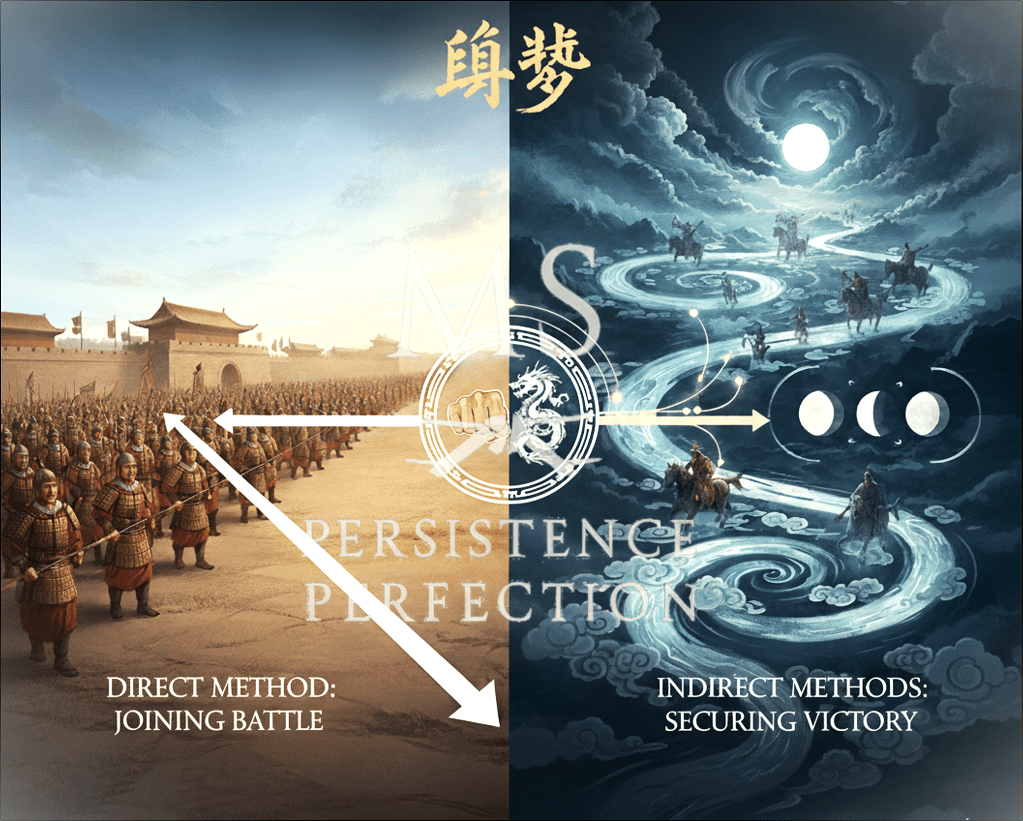
In all fighting, the direct method may be used for joining battle, but indirect methods will be needed in order to secure victory.

Indirect tactics, efficiently applied, are inexhaustible as Heaven and Earth, unending as the flow of rivers and streams; like the sun and moon, they end only to begin anew; like the four seasons, they pass away to return once more.

The Power of Controlled Motion

Sun Tzu’s fifth chapter deals with energy, not as brute strength, but as direct application of force.

He warned that a commander must know when to cultivate and store power and when to release it. Misapplied use of Energy burns itself out. However, when energy is focused, it bends the world to its will.

It’s an idea that translates effortlessly to today’s digital battlefield. Nations, like networks, often fail not because of a lack of capability, but because of a lack of control.

True mastery isn’t in how much force you can deploy. It’s in knowing how little you need to. It’s akin to the idea that, sure, you can kill a fly with a hammer, but is it the most effective tool at your disposal?

The Cost of Unchecked Energy

American Diplomatic and Military History is full of examples of lawmakers mistaking our capacity for clarity.

In Korea, overwhelming U.S. power pushed back North Korean forces, only to overextend toward China’s border and trigger an entirely new front. And thus, we have burdened ourselves with maintaining the “38th parallel” ever since.

In Vietnam, energy became inertia, force applied endlessly without definition, draining political and moral capital alike. If only the “peacemakers” at the Treaty of Versailles had let Ho Chi Minh deliver his speech on the Rights of Man, perhaps there would have been no quagmire in Southeast Asia to begin with. A guerrilla war that would take nearly 60,000 American lives and lead to what became known as the “Vietnam Syndrome.”

In Iraq, “shock and awe” demonstrated that a singular “tactical victory” can be swift, while a strategic victory remains elusive. Notwithstanding the entire list of false pretenses that led to the invasion of Iraq to begin with.

Each conflict began with a belief in momentum and ended with war fatigue. Demonstrating once again, force without direction always collapses under its own weight.

The lesson isn’t that force is wrong; it’s that force, when misapplied and unguided, becomes self-consuming. Power is not infinite. Neither is attention, money, or public trust.

The Cyber Equivalent: Sprawl and Burnout

Organizations repeat these same mistakes in digital form.

A breach occurs, and the reflex is to rush to acquire new tools, policies, and budgets, thereby triggering a cyberwar “surge.”

New dashboards, new alert monitoring, and new vendors lead to a surge in activity, while clarity plummets.

This is cyber energy without strategy, effort disconnected from insight.

As Sun Tzu also said: Amid the turmoil and tumult of battle, there may be seeming disorder and yet no real disorder at all; amid confusion and chaos, your array may be without head or tail, yet it will be proof against defeat.

Teams exhaust themselves chasing incidents instead of patterns. Leaders demand constant escalation, not realizing that perpetual crisis is its own vulnerability.

The result mirrors the national trap: motion is mistaken for genuine progress. The ability to endure is mistaken for endurance.

Energy as Rhythm, Not Frenzy

Sun Tzu described two forms of force:

  • Normal energy — the steady discipline that sustains the fight.
  • Extraordinary energy — the precise, unexpected burst that wins it.

In cybersecurity, the equivalent is security posture and precision in the application of policies.

Normal energy is the quiet work of patching, monitoring, and awareness training. Extraordinary energy is the calm, swift, and accurate incident response that turns chaos into closure.

Both are needed. But one cannot exist without the other. A team that never rests has no energy left to strike when it matters most.

It’s the same in martial arts.

In Wing Chun:
Normal energy = quality structure and energy sensitivity.
Extraordinary energy = the skill to deliver a singular, intercepting strike that ends the exchange.

Muay Thai:
Normal energy = footwork, guard, pacing.
Extraordinary energy = the slashing elbow, a stabbing teep, or perfectly placed knee.

BJJ:
Normal training energy = position, pressure, framing.
Extraordinary training energy = the ability to feel a submission triggered by feeling the opponent’s mistake. Or in Mandarin it’s an old idea called Wu Wei, or effortless action. Meaning, I don’t present the opportunity to attack; the enemy presents it to me, like water finding a leak in the dam.

A Security Team that never rests has no energy left for anything extraordinary.

Good CISOs, like good generals, good fighters, and good grapplers, understand rhythm. They know when to conserve strength so that action, when it comes, is clean and effective.

As Master Tzu also knew, “When he utilises combined energy, his fighting men become as it were like unto rolling logs or stones.” Leading to, … “the energy developed by good fighting men is as the momentum of a round stone rolled down a mountain thousands of feet in height. So important is the subject of energy.

Diplomacy and the Misuse of Force

In diplomacy, the same physics apply. The U.S. has often wielded immense power but uneven patience.

Moments like the Marshall Plan and the Cuban Missile Crisis demonstrated the value of precision, employing limited force, clear objectives, and a proportional response.

But elsewhere, the misapplication of force became diplomatic impotence on full display. Prolonged occupations and open-ended interventions constantly drain strategic reserves of will and trust.

Every drone strike, every unconstitutional data collection program, every new cyber warfare doctrine carries a similar risk: that power’s convenience will overshadow its consequence.

The Taoist counterpoint from Lao Tzu still resonates to this day:

“He who knows when to stop never finds himself in trouble.”

Knowing when not to act is the highest use of force. It’s the difference between control and compulsion.

The Lesson for Cyber Strategy

A strong digital defense isn’t constant action, it’s intelligent action.

Practical translation:

  • Automate the repeatable.
  • Escalate only with context.
  • Protect attention as aggressively as data.
  • Reserve extraordinary effort for extraordinary situations.

Energy mismanaged becomes sprawl. Energy focused becomes resilience.

It’s never the size of the arsenal. It’s the precision of the response.

Momentum and the Myth of Constant Action

Modern life rewards constant motion, refresh, respond, and reply.
In cybersecurity and foreign policy alike, stillness feels dangerous to the untrained mind.

But strategy lives in the pause between movements. Quality fighting skills are always more effective when you can strike on the half-beat, a fundamental separator on the mats, and on digital and physical battlefields.

Force has a short half-life. When it’s used endlessly, it decays quickly and fades into the ether. When it’s reserved for the right moment, it changes everything.

A breach contained quietly is often a bigger victory than a public takedown.
A crisis de-escalated without violence often preserves more stability than any show of strength.

Knowing When to “Flow With the Go”

As one of the greatest living legends in Brazilian Jiu-Jitsu, Rickson Gracie once said, “In Jiu Jitsu we flow with the go.”

Meaning:

  • don’t fight force with tension
  • stay aware but not trapped by focus
  • stay smooth and adaptive
  • flow with the opponent’s energy
  • let well-trained instinct and structure guide you

That metaphor fits the digital era perfectly. The best blue or purple teamers, like the best leaders, don’t fight the current; they learn to read it and swim with it, not against it.

Lao Tzu would say that “the soft overcomes the hard,” not through weakness but adaptability. Force channeled through awareness is stronger than force spent in anger.

In warfare and cybersecurity alike, energy is a currency. Spend it recklessly and you’ll be empty when it matters. Spend it wisely and you’ll be leading on the battlefield.

Final Reflection

Knowing how to use force is knowing its limits.
Sun Tzu and Lao Tzu shared the same truth from opposite angles:
Power must be balanced by patience.
Energy must be stored as much as it is spent.

History punishes those who forget this. So does network and security architecture.

The art isn’t in using force; it’s in knowing when the situation calls for little, none, or overwhelming force.

That’s not mysticism. That’s strategic maintenance. And it’s as accurate in security architecture as it is on the battlefield.

All of these lessons point us directly back to our opening principles: “In all fighting, the direct method may be used for joining battle, but indirect methods will be needed to secure victory.” And, “Indirect tactics, efficiently applied, are inexhaustible as Heaven and Earth, unending as the flow of rivers and streams; like the sun and moon, they end only to begin anew; like the four seasons, they pass away to return once more.

The wise strategist learns to move the same way.

Fuel to Perform: The Athlete’s Edge in Everyday Eating

If you show up on the mats, under the barbell, or work hard to refine your gymnastic skills with any kind of serious intent, you’re not just training. You’re preparing and refining, often asking your body to do more than the day before. In our world, what you eat becomes the difference between a “good session” and a “great session,” and between strategic recovery and systemic breakdown. It’s the small details that separate showing up from showing out!

Let’s skip the noise and get tactical: how do semi-competitive athletes or serious recreational competitors fuel performance when life’s messy—work, travel, kids, and tired mornings? Let’s make it real.

The Big Picture

Research shows nutrient timing matters, especially around workouts. The ISSN says, “Purposeful ingestion of nutrients at various times throughout the day” (source) supports strength, power, body composition, and performance.

But for your average serious athlete? The “anabolic window” isn’t a specific, narrow window where you must cram in a meal. That “window” is basically as wide as a garage door. You don’t need perfect timing; it’s about being prepared at the right time.

Three Fuel Strategies That Work

1. Pre-training Anchor Meal
Eat something 60-90 minutes before your session: a moderate amount of carbs, lean protein, and a lighter amount of fat. Example: oatmeal with banana + a scoop of whey or Greek yogurt. Why? You’re topping off glycogen and priming your engine. If you train early and can’t eat, choose a liquid option: an easy-to-digest protein and carb-balanced smoothie.

2. In Training Mini Feeding (When It’s Longer or More Intense)
If your session lasts more than 60 minutes or you’re doing back-to-back days, plan a quick carb hit mid-session (30–60g) and hydrate thoroughly. Why? To prevent an energy crash during your training and help protect your neurologic control.

3. Post Training Recovery Meal
Hit carbs + protein within 1–2 hours after intense work. Aim for a carb-to-protein ratio of roughly 3:1 to 4:1. Why? To replenish muscle glycogen, repair muscle, and prepare for your next session. Example: 4-6oz chicken breast, 1/2 sweet potato, 1 cup of roasted veggies drizzled with garlic-infused olive oil + 1 banana + 1 tbsp peanut butter.

How to adjust for workload (without going neurotic)

• Light day/skill day: Reduce carbs by ~20–30% and keep protein moderate.
• Heavy day/max effort session: Increase carbs by 10–20%, keep protein steady.
• Rest day: Keep protein consistent, reduce carbs/fats based on hunger, not fear.

You don’t need daily macro spreadsheets. Just know your baseline, use a fuel strategy, and build awareness. This gets easier each week and with every rep.

matt shannon glory days of crossfit


Notes from the Field

I’ve watched CrossFit athletes and tactical team members burn themselves out because they consistently skipped their pre-session carbs or failed to track and meet their protein intake for 2 or 3 consecutive days. When your training really matters, you have to treat eating like it’s a part-time job. I’ve run a meal prep business, coached fighters, been a fighter, and lived and trained overseas. I know that life because I’ve lived and breathed it for years. Fueling with purpose is fundamental.

Super Simple Action Steps You Can Take This Week

Pick one heavy training day and one rest/light day. Write down your usual food. For the heavy day, increase pre- and post-training carbs. On a rest day, maintain a steady protein intake and reduce carbohydrates by approximately 20%. Have a pre-workout anchor meal 60 minutes before a session. Note your energy, focus, and performance.

Log your post-training recovery meal within 2 hours after a session—get your carb and protein hit. Track how you feel the next day.

The key takeaways: Fuel consistently, match carbs to your workload, prioritize recovery, and make eating part of your training routine.

Train. Eat. Recover. Repeat.

If you’re training to lead from the front, fuel like someone already ahead of the pack.

The Art of Cyberwar | Part I | The Illusion of Truth

The principle:
All warfare is based on deception. —Sun Tzu

In warfare, there’s a certain irony in how often truth becomes a casualty before the first shot is ever fired. As an American, that line from The Art of War has always carried extra weight. Our history is full of moments when deception wasn’t just a tactic on the battlefield; it was the spark that lit the fuse.

From the smoke and mirrors of the Spanish-American War to the Gulf of Tonkin and the blurred motives of the Gulf Wars and the Global War on Terrorism, we’ve seen how perception shapes permission. Wars don’t always start because one side is stronger; they start because one story feels true enough to believe.

And since “All warfare is based on deception,” Sun Tzu went on to say:

When you’re able to attack, you must appear unable. When using our forces, we must seem inactive. When we are near, we must make the enemy believe we are far away. When we’re far away, we must make him believe we are nearby.

We must hold out bait to entice the enemy and then crush him. If he is superior in strength, evade him. If your opponent is overconfident in nature, seek to provoke him. Pretend to be weak, so that he may grow arrogant and attack when he otherwise wouldn’t. Attack him where he is unprepared, appear where you are not expected. If he is trying to take rest and recover, give him no rest. If his forces are united, divide them.

The general who loses a battle has made only a few calculations beforehand. Thus, many calculations lead to victory, and making only a few calculations ensures defeat. By paying attention to these points, I can foresee who is likely to win or lose.

Deception as Strategy

The principles articulated by Sun Tzu extend beyond the battlefield to broader strategic contexts. His observations highlight the value of misdirection for leaders and strategists. The objective is not to create disorder, but to control perception and attention. In both conventional warfare and digital security, success frequently depends on understanding the adversary’s perception of reality. This principle underpins the effectiveness and prevalence of social engineering tactics.

Contemporary deception strategies have shifted focus from traditional military maneuvers to achieving information dominance. Modern tools include manipulated narratives, deepfakes, phishing campaigns, propaganda, and misinformation. These methods target cognitive processes rather than physical harm. Once individuals accept misinformation as truth, further manipulation becomes significantly easier. The Committee on Public Information, the United States’ World War I propaganda agency, exemplifies institutionalized information control.

Cybersecurity’s Ethical Deception

In cybersecurity, deception is employed with the intent to enhance defense mechanisms. Techniques such as honeypots attract attackers, sandbox environments facilitate malware analysis, and red team exercises simulate adversarial tactics to maintain robust security postures.

In this context, deception functions as a defensive measure rather than an offensive tool. It is utilized to identify vulnerabilities rather than to exploit them. The underlying principle that can mislead a nation may, when applied ethically, serve to protect it. The distinction lies in the intent: defense and awareness as opposed to manipulation and illusion.

Both approaches depend on psychological insight and require strategic foresight. However, only defensive deception is fundamentally grounded in ethical integrity.

The Martial Mirror

Martial artists understand deception in its purest, most physical form. A feint isn’t a lie, it’s a question. In Wing Chun, they’re called “asking hands.” You draw your opponent’s attention, focus and/or movement one way to reveal where they’re vulnerable. The best fighters aren’t those who hide, but those who read intent faster than it’s shown. It’s why attacks on the halfbeat are so effective. But, that’s a lesson for another time.

Cybersecurity employs similar principles. Confrontation is not always optimal; instead, threats are redirected, absorbed, or neutralized preemptively. The discipline emphasizes anticipating patterns before they fully emerge, rather than merely reacting. This approach is often described as the art of fighting without fighting.

The Modern Maxim

“Deception reveals more than it hides, it shows what we most want others to believe.”

In this context, each act of deception simultaneously reveals underlying motives, strategies, and tactics.

For those responsible for safeguarding systems, individuals, or factual accuracy, the task often begins where clarity diminishes. The primary challenge is not to eliminate deception entirely, but to recognize and understand it without compromising ethical standards.

The initial action in any conflict, whether digital, physical, or psychological, is seldom a direct attack; it is often the creation of a narrative to tell. The essential responsibility is to accurately identify threats based on objective analysis, rather than relying solely on presented information. Illustrating the everlasting importance of learning the principle of this story: All warfare is based on deception.

Progress Isn’t Linear, in Martial Arts or Cybersecurity

musashi

The Myth of Linear Progress

We often imagine progress as, although slow, always moving upward. Reality is less predictable.

  1. Perfection Bias
    We assume improvement should always feel smooth. However, mastery, in both martial arts and cybersecurity, is a jagged path. The dips are where the depth develops.
  2. The Comparison Trap
    We see others’ highlight reels, the black belt breaking boards, or the company posting its “zero vulnerabilities” report, and mistake it for constant progress. Behind every clean result lies a mess of mistakes, patches, and failed tests.
  3. Forgetting That Setbacks Build Strength
    Regression often signals deeper adaptation in progress. In training, it’s when you refine mechanics. In security, it’s when you reinforce foundations.

Why Steps Back Matter

Plateaus and regressions aren’t detours; they’re checkpoints. They test persistence. Anyone can stay motivated when everything goes as planned; resilience forms when it doesn’t.

They reveal gaps in fundamentals. A failed pen test or misconfigured IAM or conditional access policy highlights what needs real attention. They build humility and precision. Overconfidence blinds; setbacks sharpen focus.

On the mats and in the SOC, mastery isn’t about avoiding mistakes, it’s about learning faster from them.

New Deadlift PR: 234kg/515lbs for a Double

Another beautiful day in the country

Physical training for the day:

A1. Incline curls 10, 10, 10, 10 – :03 second lowering/eccentric load; rest 0
A2. Seated hammer curls 20, 20, 20, 20; rest 0
A3. Standard EZ bar curl 20, 20, 20, 20; rest 2mins
B1. Bench dips 20 x 3; rest 0
B2. Banded press downs 20, 20, 20; rest 0 – pause for two deep nasal breaths at the top of every 5th rep
B3. Triceps push-ups max effort/push to failure; rest 2mins
C1. EZ bar close grip curls 15, 15, 15; rest 0 – try to stay at the same weight for all 3 movements
C2. EZ bar drag curls 15, 15, 15; rest 0
C3. EZ bar overhead triceps exts. 20, 20, 20; rest 1
+
7 n 7 for 7
7 Hang power cleans & push press
7 walk out burpees without the pushup

On Monday I accepted an offer to begin teaching, part-time, for Chegg/Thinkful.com in their Cyber Security program. I’m really looking forward to helping the next wave of cyber sec professionals. It’ll be another great way to help keep up with current trends, continue to reinforce the fundamentals, and also share past and present experiences with a wide swath of new IT pros. Who knows, before long I just might be able to start posting videos of training and teaching again.

Current affairs:

The bravest are surely those who have the clearest vision of what is before them, glory and danger alike, and yet notwithstanding, go out to meet it.

Peter Onuf’s Jefferson & Reclaiming 1619

Pelosi & Congress Claims Sovereign Immunity in Federal Court to Keep January 6 Videos and Emails Secret

Hawks Smear War Opponents Again by Ted Galen Carpenter

Putin Wants His Own Monroe Doctrine by Patrick J. Buchanan

Rep after Rep — Easy Day

Don’t no rep me

When I first wrote this, I wasn’t chasing promotions or algorithms. I was just trying to keep showing up to train, to learn, to get a little better each day. Back then, “rep after rep” was more than a training mantra. It was a way to stay grounded when progress felt invisible.

The hardest part wasn’t physical. It was the repetition, the daily grind that felt endless. Whether I was refining form under the barbell or troubleshooting code that refused to run, the challenge was the same: staying patient when nothing seemed to move forward.

Some days you make the lift. Some days the lift makes you. But the point is always to come back tomorrow.

At some point, I stopped expecting each session, physical or mental, to feel like a breakthrough. The breakthrough was the habit itself. The more I showed up, the more the process began to reveal patterns: what worked, what didn’t, and how small adjustments compound over time.

In strength and in cybersecurity, consistency is the quiet multiplier. Each drill, each review, each run-through, one more rep toward mastery.

That same mindset carries through everything I do now — training teams, hardening systems, or writing content. I don’t chase perfect outcomes anymore. I look for steady iterations. A little tighter form. A cleaner line of code. A stronger policy.

That’s how resilience is built, not simply through intensity, but through consistency.

Progress doesn’t shout. It stacks. And one day, you realize the work that used to test you has become the warm-up.

Training for the day:

7 mins of:

7 Banded Sumos

7 Banded bodyweight squats w/moderate band

7 Calf raises

+

A. Back Squat 10, 10,10,10; rest 2/2:30 – 10 RM-ish

B1. Heels elevated air squats x 10 x 3; rest :10

B2. RDL w/an empty bar, sweep away — lumbar focus x 15 x 3; rest 1

C. SL RDL stability, unloaded x 10 x 3; — 5 per leg; rest 1

+

10min alt EMOM:

20 Step-ups – 10 per

15 push-ups

Martial skill work — 5 x 5 min rounds of Z2-Z4 striking, upper push/pull bodyweight movements in trapping/grappling range, and take down defense/sprawling/working underhook escapes et cetera.

Today in my world of Linux and pentesting I worked on building out an Active Directory Lab and worked on the initial attack vectors when attacking an AD based system. Things like LLMNR Poisoning, Capturing NTLMv2 Hashes with Responder, Password Cracking with Hashcat, LLMNR Poisoning Defense, SMB Relay Attacks, Discovering Hosts with SMB Signing Disabled, Start SMB Relay Attack Defenses, & Gaining Shell Access.

Current affairs:

We Got Him (Again, and Again, and Again): On the Latest ISIS Takedown In a Long Line of American Military Actions by Andrew Bacevich

Virginia Supreme Court throws out challenge to Youngkin mask order

Bombshell Proof The ATTACK On Joe Rogan Is Politically Funded! This Is Deeper Than Spotify!

Boom: Rumble offers Joe Rogan $100M to leave Spotify…

And of course, the twat waffle who is Jonah Goldberg, is returning to his roots.

水滸傳
The Outlaws of the Marsh