

In the early days of CrossFit, the prevailing training methodology was simple: work until you drop, ignore the burning in your lungs, and let sheer grit carry you across the finish line. If you blew up mid-workout, you simply weren’t tough enough.
Today, the sport has evolved. Elite coaches and athletes see the human body not as a sledgehammer swung mindlessly, but as an intricate thermodynamic engine. In high-intensity functional fitness, going “unbroken” is no longer viewed as a universal badge of honor; often, it is a sign of poor physiological intelligence. See the Theoretical Hierarchy Of Development from the 2002 CrossFit Journal article, What is Fitness?
To build an engine that’s nearly impossible to redline, you must understand, respect, and systematically train five deeply interdependent physiological systems, while navigating the hidden biomechanical bottlenecks that govern human performance. Neglect even one, and it can sabotage the others.
1. VO2 Max: The Engine’s Ceiling

The Science
VO2 Max is the absolute maximum volume of oxygen your body can consume, transport, and use per minute during intense exercise. It dictates the upper structural limit, the literal displacement, of your cardiorespiratory engine.
The CrossFit Application & Limitations
In CrossFit, your VO2 Max establishes your recovery rate between high-power movements or intervals. Imagine executing a heavy set of thrusters. Your body incurs a massive, immediate oxygen debt. If you possess a high VO2 Max, your cardiorespiratory system can clear that debt rapidly, lowering your heart rate and readying your muscles to pick up the next barbell. If your ceiling is low, your pacing will collapse as you stand over the bar gasping for air, waiting for your system to catch up.
Overcoming the Limitation
Your genetic profile limits your absolute VO2 Max, but many athletes fail to maximize it because they confuse generic “metcons” with true high-intensity interval training (HIIT). To expand the stroke volume of the heart, you must accumulate time spent right at your peak heart rate.
The Workout Protocol: Upgrading your Engine
- The Format: 4 x 4 minute intervals at the sweet spot of 85-95% of max HR with 4 Minutes of complete rest. Also known as Norwegian Intervals which were designed maximize VO₂ and heart efficiency.
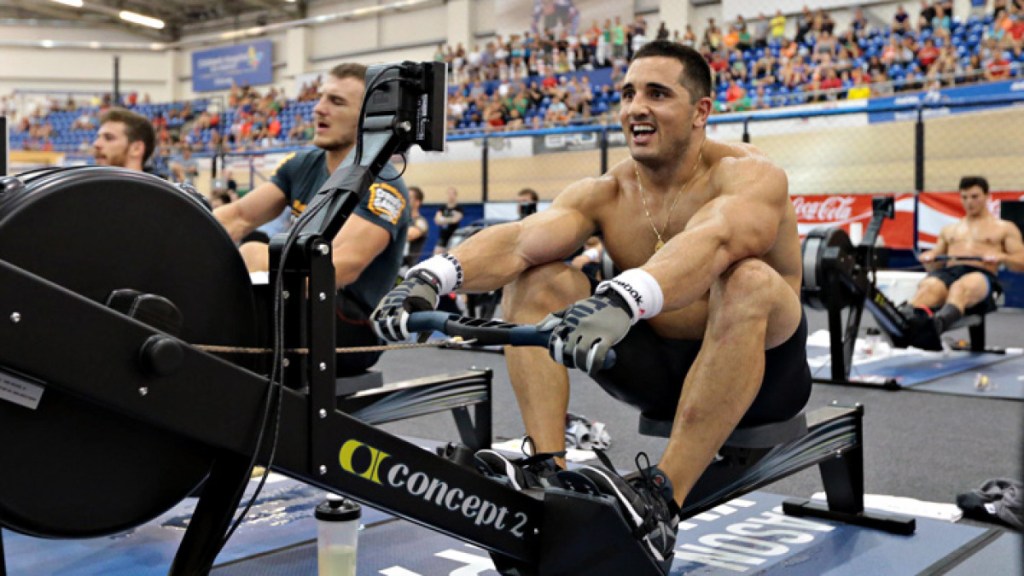
- The Execution: Utilize a cyclical modality like rowing or an Echo bike. This must be a true 9/10 effort where you hit and maintain your peak heart rate for the final 2 minutes of every working interval. The 1:1 rest ratio is mandatory to allow your system to reset so you can hit the next round with equal intensity.
2. Aerobic Capacity: Build the Size of Your Gas Tank
The Science
While VO2 Max defines your physiological ceiling, Aerobic Capacity determines how much of that ceiling you can sustain over time. It depends heavily on peripheral adaptations such as mitochondrial content, capillarization, oxidative enzyme activity, and metabolic economy. Sustained aerobic training also improves the ability to deliver and use oxygen at a given workload. Also review training techniques to improve endurance exercise performance.
The CrossFit Application & Limitations
Aerobic capacity operates as the “metabolic vacuum cleaner” of your body. During long workouts like Murph or a 20-minute mixed-modal AMRAP, the oxidative system increasingly contributes to ATP production, helps oxidize lactate through the lactate shuttle, and allows you to sustain work without relying as heavily on higher-cost anaerobic pathways.
The common limitation here is the “one-gear athlete”: someone who can sprint like a rocket for three minutes but completely falls apart by minute ten because they lack the aerobic machinery to sustain output, recover between efforts, and maintain metabolic stability as fatigue accumulates.
Overcoming the Limitation
One of the most effective ways to expand the fuel tank is through regular low-intensity steady-state work, commonly referred to as Zone 2. The purpose is to accumulate meaningful aerobic volume at an intensity low enough to remain sustainable and repeatable without creating excessive fatigue.
The Workout Protocol: The Low-Gear Flush
- The Format: 30, 45, 60, and eventually even 90 minutes of continuous movement. This can be performed as a single modality or as carefully selected mixed-modal work
- The Execution: Row, ski, jog, bike, or use low-complexity mixed-modal MAP 10-style training. Exercise selection should remain simple enough that local muscular fatigue does not become the limiter. Work at an intensity just below your first ventilatory/lactate threshold. For most recreational athletes, the easiest practical check is the talk test: you should be able to carry on a continuous conversation without gasping.
The goal isn’t to chase fatigue. It’s to accumulate high-quality aerobic work that supports mitochondrial adaptation, capillarization, improved oxygen delivery and utilization, and better recovery between harder efforts.
The Intent
The intent is to build aerobic durability, not simply burn calories or “get some cardio in.”
You are trying to improve the athlete’s ability to:
- sustain a greater percentage of VO2 max;
- produce ATP aerobically for longer;
- recover more quickly between harder bouts;
- rely less heavily on glycolytic contribution at a given workload;
- and accumulate training volume without adding substantial recovery cost.
The Expected outcome
Athletes should gradually see:
same pace/power with lower HR and lower perceived effort
or:
same HR/perceived effort with higher sustainable pace or power
They should also recover faster between rounds and movements, maintain steadier pacing deeper into longer metcons, and experience less of the “three minutes great, ten minutes dead” pattern.
That is the adaptation you want.
3. The Lactate Threshold: The Boundary Line
The Science
The Lactate Threshold (LT) is the exact exercise intensity at which blood lactate accumulates faster than your body can clear it. Once you cross this line, hydrogen ions flood the muscle tissue, acidity skyrockets, and rapid muscular failure can happen more easily. Also worthy of note is that contemporary physiology treats lactate production as associated with, and in some contexts helpful in managing, proton accumulation rather than being the acid-producing villain it was once considered.
The CrossFit Application & Limitations
CrossFit workouts are systematically designed to force you over your LT. When your forearms freeze up on pull-ups, or your legs turn to lead on wall balls, you have crossed the line. The limitation isn’t necessarily that elite athletes don’t produce lactate; it’s that they have trained their bodies to work right on the razor’s edge of their threshold (often at 85–90% of their max heart rate) without tipping over into a catastrophic redline.
Overcoming the Limitation
To push your threshold higher, you must spend extended intervals, over time, at or just below that uncomfortable boundary line, helping you adapt to buffer acidity more efficiently.
The Workout Protocol: Threshold Repeaters
- The Format: 3 Rounds of 10 Minutes on, 3 Minutes Active Recovery.
- The Execution: On an Assault Bike, Echo Bike, or rower, maintain a pace that feels “comfortably hard.” Your breathing should be deep and rhythmic, but you should not be gasping. The goal is to keep output relatively consistent across all three intervals. If your pace drops sharply from round to round, you went out too hard. Back off slightly and hold the line.
4. Rate Pressure Product (RPP): The Myocardial Tax

The Science
Rate Pressure Product (RPP) is calculated as Heart Rate × Systolic Blood Pressure. It is the premier clinical index used to measure the actual physical workload and oxygen demand placed directly on the muscle walls of your heart (myocardial oxygen consumption) NCBI Myocardial Strain.
The CrossFit Application & Limitations
In standard cardio like running, RPP climbs smoothly and predictably. In CrossFit, RPP spikes violently. When you perform high-rep, moderately heavy lifting (like clean & jerks, thrusters, or deadlifts), your contracting muscles physically compress your local blood vessels. This is called muscular occlusion. To force blood past these squeezed vessels, your blood pressure skyrockets. Combined with an elevated heart rate, your heart faces an extreme workload. This sudden “myocardial tax” explains why a short lifting metcon can leave you far more exhausted and lightheaded than a long run.
Overcoming the Limitation
You cannot bypass the physics of muscular occlusion, but you can manipulate your execution mechanics to give your heart and local capillary beds micro-breaks.
The Workout Protocol: Building The Tactical Single

- The Format: For Time: 20 Squat Cleans at 75% of your 1RM.
- The Execution: As many of you already know, it’s best not to do touch-and-go reps at this weight. Instead, perform steady singles ~every :10-:12. Also, always use the hook grip. Utilizing the hook grip locks the hand mechanically to the bar vs holding on to it. This drastically reduces the active muscle contraction required by your forearm and wrist flexors during the pull. Also, the exact moment you stand fully, with the hips and knees reaching full extension, drop the bar. Dropping the bar and releasing the grip unlocks the muscular occlusion, causing an immediate burst of fresh, oxygenated blood (reactive hyperemia) that flushes out trapped hydrogen ions, drops peripheral vascular resistance, and can lower peak RPP stress.
5. Cardiovascular Drift: The Pacer’s Enemy
The Science
Cardiovascular Drift (CV Drift) is the phenomenon in which heart rate gradually rises over the course of prolonged exercise even though power output, speed, or physical intensity remains constant (Wikipedia’s Cardiovascular Drift Analysis).
The CrossFit Application & Limitations
As you sweat during a long, hot workout, plasma volume can fall and stroke volume can decrease. As stroke volume falls, heart rate rises in an attempt to maintain cardiovascular output and sustain the same workload.
The limitation here is a pacing trap: if you pace a 30-minute workout (or 60 minute workout) purely by how your muscles feel in the first five minutes, cardiovascular drift can progressively increase the relative cardiovascular cost of that same pace, eventually pushing you toward or beyond a sustainable threshold and causing a late-workout collapse.
Overcoming the Limitation
Defeating cardio drift requires a combination of situation-specific hydration and active, conscious down-regulation of your nervous system during transitions.
The Workout Protocol: Murph Drift Prevention

The Format: 3 Rounds
2–3 Minutes of controlled running at a predetermined, repeatable pace
1–2 Rounds of Cindy
5 Pull-ups
10 Push-ups
15 Air Squats
1 Minute walking recovery while deliberately relaxing the hands, shoulders, and jaw and regaining controlled breathing
2–3 Minutes on the BikeErg at a predetermined, repeatable split or wattage
1–2 Rounds of Cindy
1 Minute walking recovery with the same down-regulation focus
The full session should initially fall somewhere around 30 minutes.
Scaling the Prescription
For newer athletes, begin with one round of Cindy after each monostructural effort. Across three rounds, that produces six total rounds of Cindy:
- 30 Pull-ups
- 60 Push-ups
- 90 Air Squats
That’s enough volume to provide meaningful exposure to the movements without allowing local muscular endurance to overwhelm the cardiovascular purpose of the session.
For experienced recreational CrossFit athletes who already tolerate gymnastics volume well, two rounds of Cindy is entirely appropriate. Across the session, that produces twelve total rounds:
- 60 Pull-ups
- 120 Push-ups
- 180 Air Squats
The determining factor is not whether the athlete can complete the higher volume. It is whether they can complete it while preserving full range of motion, movement integrity, and the intended pacing stimulus.
If the pull-ups deteriorate, the push-ups become half reps, or the squats lose depth simply to keep moving, the athlete has changed the limitation being trained. Local muscular failure has taken over the session.
Scale before that happens. Scaling does not diminish the work. Poor repetitions do.
The Execution
The monostructural pieces should be performed at a fixed, repeatable external workload, not by chasing a predetermined heart rate.
For example:
- Run at the same pace each round.
- Hold the same BikeErg wattage or split each round.
Then observe what happens to heart rate. If the athlete runs the same pace at 138 bpm during the first round, 148 bpm during the second, and 158 bpm during the third, cardiovascular drift is becoming visible.
The goal over time is not necessarily a lower heart rate at every moment. The goal is a smaller rise in heart rate while maintaining the same external work.
Several weeks later, the same athlete might produce:
138, 143, and then 148 bpm at the same running pace, same BikeErg output, and same bodyweight volume. That’s a measurable improvement.
Why the Walking Recovery Matters
The one minute walking intervals are not designed to make the workout easy. They teach the athlete to actively manage transitions rather than allowing every transition to become another uncontrolled effort.
Walk. Drop the hands. Relax the shoulders and jaw. Regain control of the breathing pattern. Then begin the next piece deliberately rather than sprinting blindly into it.
This creates repeated opportunities to practice controlling unnecessary sympathetic escalation while maintaining enough movement to keep the cardiovascular system engaged.
The athlete is learning to recover while still working. That matters in Murph, but it also matters in almost every other CrossFit workout.
Progressing the Session
Progress the workout gradually rather than simply making everything harder at once.
A simple progression might look like:
Week 1: 3 rounds with 2-minute monostructural efforts and 1 round of Cindy per station.
Week 2: Increase the run and BikeErg pieces to 3 minutes.
Week 3: Maintain duration but slightly increase the prescribed pace or power.
Week 4: For athletes demonstrating excellent movement quality and recovery, introduce a second round of Cindy at beginning or the end.
Later progressions may include longer total duration, warmer environmental conditions, and eventually a weight vest. But these progressions only happen after the athlete can maintain full range of motion and consistent pacing without the workout deteriorating into survival.
The goal is not to manufacture suffering. The goal is to build an athlete who can sustain increasingly demanding work while controlling the cardiovascular cost.
The Expected Outcome
With consistent exposure, the athlete should begin to demonstrate:
- less heart-rate drift at the same running pace or BikeErg output
- faster recovery during transitions
- improved ability to maintain breathing control under accumulating fatigue
- greater consistency from the first round to the last
- improved tolerance of mixed-modal work without premature redlining
- better preservation of pull-up, push-up, and squat mechanics late in the session
- and ultimately, improved performance when those qualities are tested in longer workouts such as Murph
Murph then becomes what it should be: the expression of the capacity you developed in training, not the only place you ever practice it.
And no matter what, DO NOT cheat the reps. Do legitimate pullups, pushups, and squats. Don’t wear the vest if you can’t do the FULL ROM on every rep. Scaling does NOT diminish the work you’re doing. No one cares if you scaled the workout, everyone cares if you cheated.

A Note on System Interdependency: The Multi-Pillar Bleed-Over
While it is helpful to categorize your engine into five distinct pillars for diagnostic purposes, the human body does not operate in isolated, clinical buckets. In the human machine, a breakdown in one pillar triggers a catastrophic domino effect across multiple systems simultaneously.
Consider how easily the boundaries blur mid-workout:
If your Aerobic Capacity (Pillar 2) is weak, your body cannot efficiently clear metabolic waste. This forces you to cross your Lactate Threshold (Pillar 3) much earlier in the workout than expected. The moment you cross that threshold, your breathing becomes rapid and shallow to buffer the rising blood acidity. This frantic breathing pattern spikes your autonomic panic response and drives your heart rate up.
That spiked heart rate, combined with the heavy muscle occlusion of a lifting movement, sends your Rate Pressure Product (Pillar 4) into the red zone. Worse, the heat generated by this systemic panic accelerates sweat loss, triggering early Cardiovascular Drift (Pillar 5) and forcing you to hit your absolute VO2 Max ceiling (Pillar 1) just to maintain a basic walking pace.
You aren’t managing five separate systems; you are balancing a web. A leak in one corner of the engine will inevitably drown the rest.
For the Beginner: Avoid Learning the Hard Way
Every veteran athlete you see executing smooth, steady singles with a calm expression has a graveyard of workouts behind them where they blew up, choked on their own pace, and ended up flat on their back questioning their life choices.
As a beginner, your mind loves to learn lessons the hard way. When a coach gives you a pacing strategy, your ego will whisper, “You feel great, go faster, go unbroken.”

To bypass years of unnecessary metabolic suffering, write these three rules in your training diary of wherever you keep mission-critical information:
- Intensity is an Asset, Not a Strategy: Blind toughness is a finite resource. If you redline your engine in the first two minutes of a ten-minute workout, no amount of mental toughness will override the biochemistry of acidic muscle tissue.
- Pacing is the True Secret Sauce: Pacing isn’t about moving slowly; it’s about defending your thresholds. Your goal should be to move at a speed that allows you to finish the final minute of a workout at the exact same intensity (or faster) than your first minute.
- Trust the Coach’s Intent: If a coach tells you a workout should take 8 minutes, and you pick a weight that forces you to take 20 minutes, you didn’t get a better workout, you completely missed the intended physiological stimulus. You trained a different energy system entirely.
Listen to the mapmakers. The coaches and veteran athletes who came before you ran full speed into the physiological walls so you wouldn’t have to. Respect the biology, master your pacing, use the mechanical shortcuts like the hook grip, and turn your engine into a finely tuned, unstoppable machine.

The Hidden Nuances of Elite Performance
To transition fully from a standard textbook understanding of physiology to the reality of competitive sports, athletes must master two final unwritten variables:
Nuance 1: The Biomechanical Shunt – Postural Occlusion
Most people assume muscle occlusion only happens because you are lifting heavy weights. They forget about the physiological tax of changing your body’s physical position under gravity. When you transition rapidly from a horizontal position to a vertical position (like jumping up from a burpee to perform a thruster, or dropping off a pull-up bar into a heavy deadlift), your cardiovascular system has to violently shift blood pressure dynamics to prevent blood pooling in your lower extremities. Your heart has to contract significantly harder to maintain stroke volume, causing an immediate, artificial spike in your RPP.
- The Fix: Athletes shouldn’t just pace the reps; they must pace the transitions. Taking a deliberate pause at the top of a burpee, 3-5 seconds, before grabbing the barbell allows the vascular system to normalize pressure, preventing an autonomic panic surge.
Nuance 2: The CO₂ Tolerance Deficit – The Brain’s Panic Button
Athletes often mistake a gasping, redlined feeling for a lack of oxygen. In reality, the human brain rarely panics because of low oxygen; it panics because of a buildup of carbon dioxide (CO₂). When your muscles burn, they produce hydrogen ions, which your blood buffers by turning them into CO₂. Your brain’s respiratory center detects this rising CO₂ and triggers a frantic, survival-driven command to breathe faster. If an athlete has a low tolerance for CO₂, they begin hyperventilating prematurely. This shallow, rapid breathing increases anatomical “dead space” in the airways, accelerates Cardiovascular Drift, and causes the brain’s Central Governor (model/theory) to pull the emergency brake.
- The Fix: This explains why elite CrossFit athletes are increasingly turning to respiratory muscle training behind the scenes to optimize their engines (The Barbell Spin). Renowned coaches use these methods to elevate baseline conditioning. Targeted Inspiratory Muscle Training (IMT), using isolated breathing-resistance tools (like the O2 Trainer), acts as a legal cheat code. They do not just mechanically thicken and strengthen the diaphragm muscle to prevent it from “stealing” blood from your limbs via the respiratory metaboreflex (PMC Respiratory Metaboreflex). They force your nervous system to tolerate higher intracellular pressures and controlled CO₂ accumulation without triggering a psychological panic response (Isocapnic BWB Strength Features).
Quick Reference: Assessing and Addressing Each Limiter
• VO2 Max: Assess with all-out, short interval efforts (e.g., 4-min max effort test). Improve with high-intensity intervals at peak heart rate and full recovery.
• Aerobic Capacity: Assess with sustained efforts (e.g., 60-min continuous movement). Improve with consistent Zone 2, low-intensity steady-state work.
• Lactate Threshold: Assess with pace/effort you can hold for 20–40 minutes before sharp muscular fatigue. Improve with threshold repeat intervals at a “comfortably hard” pace.
• Rate Pressure Product: Assess with moderate-load, high-rep lifting under fatigue. Improve by managing rest, using hook grip, and breaking up reps to reduce occlusion.
- Cardiovascular Drift: Assess by monitoring heart rate in long, hot workouts for upward drift. Improve with hydration, conscious down-regulation, and transition protocols.
- For all limiters, log workouts and physiological responses to identify which system fails first during high-intensity sessions.
Glossary for Novices
• VO2 Max: The maximum amount of oxygen your body can use during intense exercise.
• Aerobic Capacity: How long you can sustain exercise using oxygen efficiently.
• Lactate Threshold: The intensity where your body starts accumulating fatigue-causing byproducts faster than it can clear them.
• Rate Pressure Product: A measure of how hard your heart is working (heart rate × blood pressure).
• Cardiovascular Drift: When your heart rate rises during long workouts even if you’re not working harder.
• Muscular Occlusion: When working muscles temporarily restrict blood flow because they’re contracting.
• Angiogenesis: The process of growing new blood vessels.
• Reactive Hyperemia: The rush of blood that occurs when a muscle relaxes after being contracted.
• Central Governor: The brain’s way of limiting effort to protect you from harm.
• Zone 2: A training intensity where you can carry on a conversation easily, usually 60–70% of your maximum heart rate.
Refer to this glossary as you read, and use the quick reference section to help guide athlete assessments and target training interventions.

