Fat Isn’t Evil: It’s Essential

Picking up from where we left off last week — we’ve already dismantled the myths around protein and carbohydrates, now it’s time to put the final macronutrient into proper context.

In Week 3, we covered nutrient timing and why eating with intention matters. In Week 4, we cleared the air around carbs, showing they’re a necessary tool for fueling performance, not something to fear.

This week, we’re doing the same with fat, one of the most demonized and misunderstood components of the human diet.

Why This Matters:

Most people trying to ‘eat healthy’ unknowingly sabotage their energy, focus, and results by fearing fat. Understanding the truth lets you make smarter, less stressful choices in and out of the gym.

The Problem: Fat Got Blamed for What Sugar (and Sedentary Living) Did

The war on fat started in the 1970s and 80s, pushing people toward fat-free everything, from cookies to frozen dinners. What happened next?
• Obesity skyrocketed.
• Type 2 diabetes surged.
• People got sicker, not healthier.

Why? Because removing fat didn’t remove the problem. It just made food more processed, more sugary, and less satisfying.

Question:

Ever skip the avocado on your salad because you thought it was ‘too fattening’, then ended up hungry an hour later? Now, youre beginning to pick up what I’m puttin’ down.

What Fat Actually Does in the Body

Fat isn’t the enemy. It’s a required nutrient for:
• Hormone production (testosterone, estrogen, cortisol)
• Brain health and cognition
• Joint lubrication and recovery
• Fat-soluble vitamin absorption (A, D, E, and K)
• Cellular structure (yes, your cells are literally built from it)

But here’s the key: fat is fuel for low-intensity output and recovery, not high-performance explosive training. That’s where carbs step in.

Quick Fat Facts:

• Unsaturated fats (olive oil, nuts, avocado, fatty fish) support heart and brain health.

Saturated fats (animal fats, butter, coconut oil) are fine in moderation, especially from whole foods.

• Trans fats (partially hydrogenated oils) are in a different league; avoid them entirely. They wreak havoc on cholesterol and inflammation.

You need both fat and carbs, but at the right doses for the right goals.

Data Point:

Fat slows gastric emptying, helping you feel fuller for longer—a secret weapon against late-night snacking (British Journal of Nutrition, 2021).

Why “Healthy Fats” Doesn’t Mean “Unlimited Fats”

Yes, olive oil, avocado, nuts, and salmon are great, but overconsumption is still overconsumption.

Fat is energy-dense.
• 1 gram of fat = 9 calories
• That’s more than double protein or carbs (4 calories per gram)

So while you need it, you don’t need as much as you might think, especially if you’re already fueling with protein and carbs.

Most Common Fat Mistake:

Dousing salads, veggies, or “healthy” bowls with extra oil or nuts. Even good fats add up fast, so measure, don’t guess.

What This Looks Like in Practice

Swap:

Instead of fat-free salad dressing (loaded with sugar), use olive oil and vinegar for flavor, better absorption of nutrients, and longer-lasting energy.

Here’s how to build smart, balanced fat intake into your day:

Add a thumb-sized portion of fat to your main meals (nuts, oil, nut butter, avocado)
Don’t dump oil or butter onto every dish “for health;” it adds up fast
Keep fats lighter pre-workout, so digestion doesn’t slow you down
Post-workout, prioritize protein + carbs, not a heavy fat load
Evening meals can include more fats to help slow digestion and promote satiety

You don’t need to avoid fat, you need to respect it.

Visual Analogy:

Think of fat as the steady-burning logs on a campfire versus using pine needles: the dry pine needles can get the fire going, but don’t last. The logs are for warmth that lasts all night.

Now that we’ve set the record straight, here’s how to use fat like an anti-hero: deliberately, strategically, and never just because the label says “healthy.”

Action Challenge

For the next 3 days:
• Track how much fat you’re eating (rough estimate is fine)
• Identify where it’s coming from (meals vs snacks vs sauces/oils)
• Adjust one meal per day to intentionally include a measured fat source (e.g., 1 tbsp olive oil, 1/4 avocado, or 10 almonds)

You’ll start to see how easily fat sneaks in and how powerful it can be when used deliberately.

Coach’s Corner

• Fat is a recovery nutrient, not a performance one.
• Don’t go to war with it, just don’t treat it like a free-for-all either.
• Balance is your ally. Fat has its place, use it like a tool, not a reward.

Suggested Reading

“Deep Nutrition” by Dr. Cate Shanahan
A sharp breakdown of how traditional diets used fats well, and how we can reclaim that without getting lost in the noise.

Real-World Headline:

In 2024, a major study published in JAMA found that replacing just 5% of calories from saturated to unsaturated fat was associated with a significant reduction in cardiovascular risk. (Source: JAMA, April 2024)

Science Insight:

Regular consumption of omega-3 fatty acids (found in fatty fish, chia, and flaxseed) is associated with improved heart health and reduced inflammation, according to the American Heart Association (2023).

Quick Fact:

Contrary to old myths, moderate whole-egg consumption does not increase heart disease risk for most people (Harvard School of Public Health, 2022).

Key Takeaway: Your hormones, brain, and cells are built from fats. Don’t fear them, but definitely manage them.

Key Anti-Hero Move: Use fat on your terms, not the food industry’s. Portion is power.

Empowerment Challenge:

What’s one fat source you’ll add back this week? Try it, track it, and notice the difference. Anti-heroes don’t just read, they act.

What’s Coming Next

You’ve now got a full picture of the big three macros, but how do you put them together? In Week 6, we’ll map out what a real-world performance meal looks like, and how to adjust it for your goals, whether that’s training, leaning out, or staying sharp at work.

In Defense of Carbs: Energy, Recovery, and the Science You Need

Most people fear carbs because they’ve been sold the idea that carbs equal fat gain. But for anyone who trains, thinks deeply, or recovers with intent, carbs aren’t optional; they’re essential.

This isn’t about eating gummy bears or Pop-Tarts and calling it “fuel.” It’s about understanding the physiological role of carbohydrates and using them to enhance output, mood, muscle retention, and recovery.

Let’s break it down.

1. Carbs = Performance

Glycogen (stored carbs) is your muscle’s preferred fuel during strength training, sparring, sprints, or any high-output effort. Without enough:

  • Strength drops
  • Endurance tanks
  • Motor control falters

Carbs refill that tank. Fewer reps and less intensity? That’s not a motivation problem; it might be a glycogen one. There’s a term known as “bonking” in a workout. To “bonk” in a workout is to reach the functional depletion of glycogen, brought on by exercise. In other words, it’s the condition in which your muscles run out of fuel, with profound effects on performance and well-being. And how do you avoid it? Adequate carbohydrate fueling for your level of performance.

Science Sidebar: When you eat carbs, insulin helps shuttle glucose into muscle cells to refill glycogen. This is why carbs matter most around activity, not when you’re sedentary. Research shows that athletes and active individuals who time carbs around exercise have better performance and recovery (Burke et al., 2011).

2. Carbs = Cognitive Clarity

Your brain runs on glucose. Low-carb fog is real. It shows up in several ways, such as decision fatigue, irritability, difficulty focusing, and a short attention span. Yes, ketones can serve as a backup fuel, but they’re not the most efficient during high-stress or high-focus days.

Carbs sharpen cognition, boost mood, and reduce stress response.

3. Carbs = Recovery and Muscle Retention

Carbs after training:

  • Restore depleted glycogen
  • Support protein synthesis
  • Lower post-training cortisol

They’re also “protein-sparing,” meaning your body doesn’t need to break down muscle for energy.

4. Carbs = Hormonal Stability

Low-carb diets for too long can suppress:

  • Thyroid output (especially T3)
  • Leptin (your satiety and metabolic rate signal)
  • Sleep quality and parasympathetic recovery

Especially for athletes, hard trainers, or people under high stress, this is a deal-breaker.

5. Carbs = Better Sleep

Moderate carbs in the evening:

  • Support serotonin → melatonin conversion
  • Lower cortisol
  • Help shift the body into parasympathetic mode.

Sleep: Carbs help lower cortisol levels and promote relaxation. Carbs also help raise serotonin, a neurotransmitter that supports relaxation and sleep. It’s one reason why a small carb snack before bed can improve sleep quality for some people. This is why low-carb diets can sometimes disrupt sleep.

Pro tip: Avoid eating after 8:00 PM. If you must have something, keep it light and digestible:

  • 1 banana
  • 1 scoop whey
  • 1 Fairlife 26g protein shake
  • Optional: 1 tbsp PB2

That’s ~350 kcal – just enough to support recovery without interrupting your sleep cycle.

The Real Issue Isn’t Carbs, It’s Unstructured Eating

People don’t “gain fat” from potatoes. They gain fat from:

  • Chronic snacking
  • Emotional eating
  • Under-fueling during the day and overeating at night

Carbs are fine; reactivity and randomness aren’t.

Coach’s Notes: Carb needs vary from person to person; listen to your body and adjust based on your activity, stress, and recovery.

  • Start with structure, not restriction.
  • Place carbs around output: morning, post-training, early dinner.
  • Observe how your sleep and recovery improve when you fuel with intention.

As silly as it may sound, a palm-sized portion of rice, potatoes, or fruit is a good place to start if you don’t want to count grams. Use your hand as a guide for portions.

Bonus tip: Carbs that are high in fiber, like fruit, potatoes, and whole grains, not only support performance, but also feed your gut microbiome, helping with digestion and immunity. And just in case you need a reminder, any fruit or vegetable is a carbohydrate source. Some are better than others, but the key is to eat the ones you like vs. trying to force yourself to eat anything you don’t like.

Suggested Reading:

Good Calories, Bad Calories – Gary Taubes
A well-researched, critical look at nutritional dogma and food myths, especially around carbs and fat.

Myth: Carbs make you fat. Truth: Excess calories, not carbs, drive weight gain.

Carbs don’t kill gains; they help sustain them. Used wisely, they improve output, cognition, mood, sleep, and recovery. However, as with any caloric intake, excess leads to consuming more calories than you burn, i.e., a caloric surplus = “weight gain.”

Action Challenge:

Track your carb intake for 3 days, but not just the grams. Track when and why you ate when you did:

  • Was it training-related?
  • Emotional?
  • Habitual?
  • Based on energy need?

Awareness creates clarity, and clarity can help drive consistency.

Next Week: You’ve dialed in protein and carbs. Now we’ll cover the most misunderstood macronutrient of all: fats.

How to use them for satiety, hormones, and cognitive support without overdoing it.

Does Nutrient Timing Matter? Yes, But Not the Way You Think

Stop obsessing over windows. Start building systems.

If you train hard, care about body composition, and want real-world energy, you’ve probably heard people say:

“You have to eat protein within 30 minutes of lifting.”
“Don’t eat carbs after 8 PM.”
“Fasting boosts growth hormone, just train fasted.”
“Breakfast is optional if your willpower is high enough.”

None of this is completely wrong, but none of them is 100% valid or effective for all, so don’t waste any mental space on them and focus on what’s been proven to work over decades.

Let’s cut through the BS.

The Truth About Nutrient Timing

Nutrient timing can matter, but it’s not the magic some claim, and it’s not completely useless like others claim.

It doesn’t override your daily totals. But it does influence:

  • How well you train.
  • How fast you recover.
  • How consistent is your energy, mood, and hunger?

Here’s the simplified hierarchy:

  1. Daily intake = most important
  2. Meal timing = performance lever
  3. Meal composition = precision tool
  4. Supplement timing = tiny bonus

Myth: If you miss the post-workout window, your workout is wasted.
Fact: Muscle protein synthesis remains elevated for hours; what matters most is your overall daily intake and rhythm.

Science Sidebar: Why does timing matter? Protein synthesis is elevated for several hours after training, so spacing protein throughout the day maximizes muscle repair. Carbohydrates around workouts help refill glycogen and lower stress hormones like cortisol.

What You Need to Know

1. Protein Timing

Protein intake is about distribution, not hitting a “window.”

Aim for:

  • 25–40g of protein per meal
  • Every 3–5 hours
  • Starting within 1–2 hours of waking
  • Ending within 2 hours post-training

Even distribution improves muscle protein synthesis, recovery, and satiety. Research shows that even protein distribution (every 3–5 hours) is linked to greater muscle protein synthesis and recovery (Areta et al., 2013).

2. Carbohydrate Timing

Carbs are fuel, especially around training.

Pre-workout: 30–60g (1–2 hours prior)
Post-workout: 30–60g + protein (within 1–2 hours)

This replenishes glycogen, blunts cortisol, and enhances recovery.
It’s not “dirty.” It’s just useful.

3. Fat Timing

Fat slows digestion. That’s helpful during the day but not ideal around training.

Keep fat moderate pre-workout. Go higher-fat during lower-carb meals later in the day.

Fat: It’s less about timing, more about portion. Eating a high-fat meal before training can slow digestion and make some people feel sluggish. Experiment with your pre-workout meals to find what feels best.

Generally: moderate fat at main meals, lower fat pre/post-workout.

Example Timing Strategy (Strength Training Day)

When I started having a balanced meal within 90 minutes of training, my recovery and afternoon energy noticeably improved.

  • 8:00 AM: 3 eggs, oats, berries (protein + carbs + fat)
  • 12:00 PM: Chicken, veggies, avocado (protein + carbs + fat)
  • 3:00 PM: Pre-workout shake 1 scoop whey + 50g carbs from a fruit source
  • 5:00 PM: Train
  • 6:30 PM: Post-workout, beef and sweet potato + Kerry gold butter (protein + carbs + fat)
  • 730/8 PM: Greek yogurt + whey or casein and a handful of nuts

Total protein: ~180-200g
Balanced carbs, front-loaded around training
Fats used to stabilize energy later

Action Challenge:

Pick one meal to move closer to your training time and one post-workout meal to optimize.

Your goal:

  • Protein: 30g
  • Carbs: 30–50g
  • Minimal fat
  • Eaten within 1–2 hours of finishing your workout

Coach’s Corner:

  • Don’t try to “hack” your metabolism with clever meal timing.
  • Build rhythm that supports your output.
  • Use timing to reduce stress, not increase it.

Suggested Reading:

“Nutrient Timing: The Future of Sports Nutrition by Ivy & Portman
A classic foundation on how timing influences performance and recovery. A bit dated, but still useful.

Key Takeaway:

Nutrient timing isn’t magic; it’s just another way to support what matters most: consistency and recovery.

Timing isn’t a rulebook. It’s a framework. Daily totals matter most, but if you train hard, timing helps you show up stronger, recover faster, and stay more consistent.

Next Week: The Carbohydrate Question

Once your daily intake is dialed in and you start thinking about timing, the next question always comes up:

“Do carbs still matter? Or should I be avoiding them?”

That’s where we’re headed next. In Week 4, we’ll break down the truth about carbs. Not hype. Not fear. Just what they actually do, and how to use them to train, recover, and function better in daily life.

New Year’s Day: The Moment Between Who You Were and Who You’re Becoming

There’s a quiet, almost sacred moment in the days around the New Year, a pause between what’s behind you and what’s ahead.

A moment when the noise drops, the pace slows, and you can finally hear yourself think.

This is the place where growth actually happens. Not in the fireworks, not in resolutions shouted into the void, but in the stillness where you decide, honestly and without ego, who you want to be in the year ahead.

Before we talk about goals, habits, or protocols, take one breath and look back at the year you lived.

Not with judgment. With gratitude.

You made it through things you didn’t plan for and didn’t ask for.
You showed up on days when the last thing you wanted was responsibility.
You trained when you were tired, worked when you were stretched thin, and grew in ways you didn’t see happening in real time.

You earned wisdom this year, through effort, mistakes, repetition, and resilience.

Before stepping forward, be sure to honor what got you here.

What the Old Year Teaches Us (If We Let It)

Every year leaves you with lessons, most of which don’t announce themselves loudly:

  • You learned what drains you and what restores you.
  • You learned who adds to your life and who subtracts from it.
  • You learned which habits pull you closer to the person you want to be, and which ones drag you away.
  • You learned exactly how strong you can be when you don’t have a choice.

And if the year felt heavy? Good. Heaviness can teach, build, and help you reveal what’s real.

Gratitude doesn’t erase difficulty, but it can help you reframe it.

The Catalyst: Where Reflection Meets Action

Reflection is where wisdom is found. Action is where progress is made.

And New Year’s Day is the catalyst between the two, the moment you get to carry forward everything that served you and release everything that didn’t.

The turning of the calendar doesn’t magically transform you. It simply provides a precise date to keep measuring from.

It’s not a “new version” of yourself, just a more consistent one.

The New Year Activation Protocol

Your blueprint for the next 30, 60, and 90 days. These are the habits that actually move the needle.

These aren’t resolutions. They’re behaviors and behaviors build identity.

No more, “New year, new me!” Nonsense.

1. Choose Your Anchor Habit

Start with one non-negotiable daily action you can sustain even on your busiest days:

  • 20-minute walk
  • Protein at every meal
  • 10 minutes of mobility
  • 15 minutes of reading each night before bed
  • One short lift session – make it 10-20 minutes to help get the ball rolling if you have to

Your anchor habit becomes the spine of your discipline.

2. Clarity Over Motivation

Motivation is a spark, but sparks fade fast. Discipline and clarity are your compass.

Define your goals in behaviors, not wishes:

No: “I want to lose weight.”
Yes: “I’m hitting my protein target daily.”

No: “I want to get healthier.”
Yes: “I’m sleeping 7-8 hours per night (and make the necessary changes to make it happen)  and 15-20 minute walk daily. ”

Specific. Measurable. Repeatable.

3. Identity-Based Goals

Willpower is unreliable. Discipline is consistent.

Decide:

“I am someone who trains.”
“I am someone who eats with intention.”
“I am someone who gets up when life knocks me down.”

Then act in alignment, chasing persistence, not perfection.

4. Protein, Hydration, Sleep – the Unbreakable Trio

Forget New Year fads. These three change everything:

  • 30–40g protein per meal
  • 2–3L water per day
  • A sleep routine (sleep hygiene) that doesn’t involve doom scrolling – think reading…a book, that’s not on your phone!

These give you strength, recovery, mental clarity, emotional bandwidth, and energy.

5. The Rhythm → Not the Rush

Don’t sprint into January. Build a rhythm you can maintain into February, March, and beyond.

Your goal isn’t intensity, it’s consistency. Next thing you know it will be January of 2027.

Why This Year Will Be Different

Because this year, you’re not chasing perfection. You’re choosing persistence and consistency in your decision-making.

You’re not rewriting or “redefining” yourself, you’re simply refining yourself. You’re not waiting to feel ready. You’re starting *now* with small, steady, confident decisions.

This is the year you build momentum quietly, relentlessly, and intentionally.

And by the time you look up, you’ll be further along than you expected, not because you changed who you are, but because you committed to who you’re becoming.

Final Note – person to person

You don’t owe the world a reinvention this year. You owe yourself consistency.

Be thankful to yourself for showing up.
Be thankful to yourself for putting in the effort.
Be thankful to yourself for your strength, discipline, humor, humility, and humanity.

On the Lunar calendar, this is the Year of the Fire Horse. In Chinese tradition, the Fire Horse isn’t about luck or superstition; it’s about momentum. It’s about energy that moves forward on its own. Strong, independent, and restless in a good way. The kind of year that rewards people who are relentlessly moving forward and who enjoy the process.

So don’t rush. Just keep moving with a purpose. Do the work that matters to you. Build your momentum quietly and simply let it compound.

Keep fueling your fire and honoring your desires. May this New Year be steady and strong, full of the kind of momentum you earn, protect, and carry with you everywhere you go.

Happy New Year, my friend. Let’s make it count.

And remember: at midnight, open the back door to release the old year and whatever hardships came with it. Then open the front door to welcome the new year in, inviting luck, health, and fresh starts.

And be sure to wish your neighbors Athbhliain faoi mhaise duit!

Onward and Upward!

The 5 Biggest Meal Prep Myths and What Actually Works for Real People

Meal prep gets talked about so much these days, you’d swear it’s a personality trait. It’s always rigid, joyless, and maybe just a little smug. But the truth is, prepping food isn’t about discipline for its own sake. It’s about simplifying the week so you can think less about logistics, saving money, and staving off adverse health effects, and more about living your life.

While you’ll often see phrases like “may help” or “might improve” online, real data and everyday experience show what actually works. Here’s what makes a real difference for people like us.

Myth #1: “Meal prep means eating the same thing every day.”

Reality: Meal prep doesn’t mean you have to eat chicken and rice every day until you’re sick of them. The real goal is to make healthy choices easy and convenient.

Try prepping ingredients instead of full meals. Grill or roast some proteins, cook a few types of carbs, and chop up veggies. Then, mix and match them throughout the week—maybe smoked salmon over greens one day, steak and rice another, or yogurt with fruit when you need something quick.

What “the science” says: Research from the International Journal of Behavioral Nutrition and Physical Activity found that people who plan their meals tend to have more diverse diets — not less. It’s the planning that makes variety possible, not spontaneity.

Myth #2: “Prepping takes too much time.”

Reality: Spending a few hours on Sunday or Saturday can save you from stressful evenings all week. Even just washing produce, boiling rice, or portioning fruit ahead of time can make your weekdays much easier.
And it’s not just about time. People who spend even 30–60 minutes a day preparing food eat more vegetables and fruit (University of Washington research, 2014).

The time’s going somewhere either way, you can spend it prepping intentionally, or you can spend it waiting in drive-thrus.

Myth #3: “Meal prep is only for people trying to lose weight.”

Reality: That idea is just a marketing myth. Meal prep isn’t only for losing weight. It helps you avoid making poor choices when you’re hungry and supports your long-term health.

Sure, portion control helps. But more importantly, prep stabilizes your energy and makes fueling performance automatic. Whether you’re lifting, coding, or commuting, your brain and body both need steady inputs.

Home-prepped meals consistently come in lower in sodium and saturated fat, not because they’re “diet food,” but because you’re in charge of the ingredients.

You’re not dieting; you’re planning to succeed, not to fail. When in doubt, always rely on PPP, proper prior planning, and it’ll save you in countless scenarios.

Myth #4: “It’s cheaper to just grab takeout.”

Reality: The numbers don’t lie. Data from the American Journal of Preventive Medicine shows that people who cook at home spend significantly less on food than those who eat out. Prepping helps you shop with purpose, so you buy only what you need. You waste less food and make your ingredients go further.

Pro tip: Using convenience items still counts as meal prep. Things like pre-washed greens, frozen veggies, frozen fruits, or rotisserie chicken can make things easier. Being efficient is smart, not cheating.

Myth #5: “Healthy meal prep means going ‘Paleo,’ ‘keto,’ or you’re “cutting carbs.”

Reality: Restrictive eating styles burn people out. The goal is consistency, not purity. You don’t have to eliminate carbs, especially if you train. Always remember, persistence over perfection.

Your brain and body work best with carbs. Foods like fruits, vegetables, potatoes, and white rice help you perform and recover, especially if you’re working out.

Coach’s Note: We eat well today for optimal performance tomorrow.
Coach’s Note:
We eat well today for optimal performance tomorrow.

Whether your training is on the mats, in the gym, or at your desk, food is fuel, not a moral test.

The Bottom Line

Meal prep isn’t about being perfect, it’s about being consistent. It’s a simple way to get back your energy, time, and control in a world full of distractions. Eat well, keep your plans simple, and stick with what works.

Progress comes from following through, not from always trying something new.

Forty Point Two

3, 2, 1 get some!

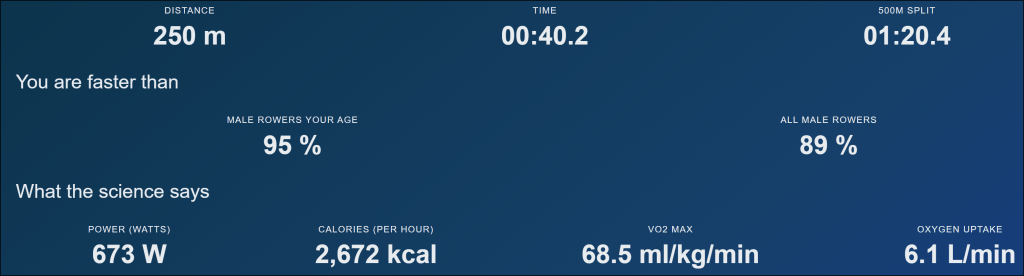
Five weeks ago, I pulled a 41.3-second 250 meter row. Today, I hit 40.2. Just over a second faster.

Most wouldn’t notice the difference, but if you’ve ever chased improvement in anything, lifting, rowing, writing, or career-related, you know what that second really means.

It’s not one test. It’s everything between the test and the retest.

Early mornings. Late nights. Lifting after focusing on a screen all day, securing cloud configs, writing incident reports, and drafting security policies. Endless meetings, collaborating with stakeholders, or staying disciplined enough to meal prep when convenience is whispering your name.

The first test showed where I was. The weeks that followed demonstrated what I was willing to do to get a little bit better every day.

That one second didn’t come from luck. It came from honesty. From taking stock of where my form slipped when fatigue hit, where breathing got shallow, where my leg drive gave too early, and where comfort started whispering, “Hey man, you’ve done enough.”

It came from the same place real growth always hides: the re-tests, not the first runs. Every domain follows the same law: test, learn, refine, retest. That’s how systems harden. That’s how people do, too.

The next time you test something, whether it’s a lift, a sprint, IAM permissions, or a personal limit, remember this: progress rarely looks dramatic as it happens. It might seem minor, but the one second I cut over five weeks shows the value of steady effort. Others might have said, “Hey man, that 41.3 is pretty damn good for a man your age.” For me, that will never be enough.

What “the science” says:

  • Power output was 673 Watts
  • VO2 Max is 68.5 ml/kg/min
  • Faster than 95% of male rowers your age
  • 89% faster than all male rowers

No matter what, 41.3 → 40.2 is proof that attention to detail and small improvements over time are earned, never issued, and that’s the real story.

Strength & Resilience: Why Chaos Is the Real Teacher

henry rollins matt shannon cloud security
The Iron Never Lies — Henry Rollins

Discipline Over Flash: 30 Strict Pull-Ups for Time

Most workouts have a loophole. If you know how to do them, you can kip and be done in less than a minute. Most dudes who do “pull-ups” cheat the range of motion like it’s a professional sport by never fully extending at the bottom, and/OR do NOT get their chins over the bar. But, every now and then, rules will strip everything away and reveal the raw truth.

That’s the point of this challenge: 30 strict pull-ups for time.

The rules are simple but tough:

  • Must be done in sets of 5 or 10 only. No singles, no doubles, and no kipping (this time).
  • NO half a$$ Pete Hegseth or RKF, Jr. reps.
  • Full extension at the bottom. Elbows locked out every time.
  • Chin over the bar at the top. No “almost” reps. No, “I was so close that time.”
  • Discipline over ego.

My time? Watch and see.

But the question you might be asking is, “Why Does This Even Matter?”

This is more than a physical test; it’s a mindset test, like the pressure faced in cybersecurity, leadership, or life.

Here’s what the workout teaches:

  1. Constraints Make You Stronger
    Without the rule of “5 or more reps per set,” you’d see people game the system: 30 singles, done easily, no challenge. But rules force focus. They push you past your comfort zone and into real growth.

Cloud security works on the same principle as the pull-up challenge: doing things the hard, correct way leads to lasting results. In cloud security, if you make permissions too loose or skip essential controls, it seems easier—just like doing easier pull-ups. But real security comes from applying restrictions such as least privilege, multi-factor authentication, and segmentation. These are to security what strict form is to strength: they are challenging but essential for durability.

2. Form Is Discipline
Locking out every rep is about integrity. Cutting corners in training leads to cutting corners under stress.

Cyber pros know the drill: if you skip patch cycles, code reviews, or alerts, you won’t suddenly excel in a crisis—you will perform only as well as your training prepared you. The point is: in emergencies, people don’t ‘rise to the occasion’; they revert to their standard preparedness.

3. Speed Comes From Structure
Strict pull-ups in just over 2 minutes require planning: strict adherence to set sizes, rest, and when to push or hold back.

Incident response follows the same principle: structured speed is essential. Success comes from following practiced processes, not from last-minute effort.

4. Resilience Beats Flash
Nobody remembers the person who did 20 kipping pull-ups that looked good on Instagram but didn’t count in this instance. The athletes who succeed in the gym or in life are those who can perform strict reps under pressure, year after year.

Resilience isn’t glamorous. It’s strict adherence to form and standards. Reps stacked and basics drilled.

Closing Thoughts

Thirty strict pull-ups for time really isn’t about the number. It’s about the mindset: constraints, no ego, and the discipline not to go again sooner than you can complete at least another set of 5, along with persistence under pressure.

The lessons extend beyond workouts. Whether you’re securing cloud environments, writing policies, or leading teams, following real constraints, practicing discipline, and building resilience are as vital as adhering to strict form in your pull-ups when required.

Constraints can make you sharper. Discipline makes you stronger. Resilience makes you unbreakable.

Persistence Beats Perfection

Chasing perfection can be tempting. It makes us believe that if we get everything exactly right, like following a flawless training plan or a perfect patch cycle, we’ll be safe from risks or mistakes. But perfection is fragile. One mistake or setback, and it falls apart. That’s when persistence matters most.

Persistence, on the other hand, is unbreakable and endures where perfection falters.

Anyone who’s trained in martial arts or strength sports knows some days you set PRs, some days you don’t. Some days you win; other days, you learn. The outcome of a single session doesn’t matter; what counts is that you keep showing up.

Cybersecurity runs on the same principle. Rather than expecting flawless results, it relies on the daily commitment, running scans, monitoring logs, and applying updates, which builds resilience over time.

Why Perfection Fails

  • Unrealistic expectations: Nobody patches everything at once. Expecting to do so leads to burnout.
  • Procrastination: Waiting until you can do it “perfectly” means it never gets done.
  • Fragility: Perfection breaks under stress; persistence adapts.

Why Persistence Wins

  • Consistency compounds. One small patch today, another tomorrow, adds up to systemic strength.
  • Resilience under pressure. When incidents occur, teams that have developed daily habits respond more quickly.
  • Adaptability. Persistence isn’t rigid; it bends, adjusts, and continues forward.

The Martial Arts Parallel

Martial artists don’t achieve mastery through perfection. They drill basics until instinctive, spar, fail, and adapt. Each session is about persistence; the discipline of returning to the mat, working on strikes, footwork, counter-wrestling, etc, etc.

Cybersecurity professionals must do the same. Drill, repeat, refine, and drill some more. That way, when the attacks come, your persistence in training wins the day.

Closing Thought:
Persistence, not perfection, is the key to success. Perfection is unattainable, persistence ensures progress, and tangible results.

Fueling Your Cybersecurity: How To Eat Right for Cyber Success

Cybersecurity incidents don’t care how well you slept or ate. They happen anytime. If your body feels slow, your mind will too.

That’s why nutrition isn’t just about physique or gym numbers. It’s about resilience.

A strong body fuels a sharp mind, which makes you a stronger IT professional.

Before jumping in, you might ask: how do you build nutrition habits that fuel performance, even under pressure? Let’s break it down with these five rules:

Rule #1: Always Eat Protein First

If there’s one macro nutrient that changes everything, it’s protein. Most people under-eat it, even those who train.

  • Why it matters: Protein saves muscle, keeps you full longer, and helps your body burn more calories.
  • Aim for .75 to 1g per pound of lean or target body weight. Spread it across meals: eggs at breakfast, chicken or beef at lunch, fish at dinner, or a shake if needed.

Think of protein like a system update: without it, your body gradually weakens until you notice it, and by then it’s too late.

Carbs, like protein, provide 4 calories per gram.

Carbs get demonized needlessly. If you train hard, they’re your gas pedal—not optional.

  • Performance: Carbs fuel high-intensity efforts (CrossFit, sprints, heavy lifts). They refill glycogen so your “engine” doesn’t sputter.
  • Focus: Complex carbs—including all fruits, vegetables, and grains like rice—keep blood sugar steady. That means steady energy and fewer crashes.

The key isn’t cutting carbs. What matters is eating quality carbs at the right times.

  • Hard training days? Eat more.
  • Recovery days? Dial it back a bit.

Rule #3: Fats – The Slow-Burn Energy Source

Fats do not give quick energy like carbs, but they help you last longer. Fats are essential for hormone production, brain function, and recovery.

  • Prioritize avocados, nuts, olive oil, walnut oil, and sesame oil, as well as grass-fed, wild-caught and free-range meats.

Most people do well with 20–30% of their calories from fat. That’s enough for health but not too much.

Rule #4: Hydration = Cognitive Uptime

Mild dehydration tanks focus faster than hunger. For IT pros, that’s dangerous.

  • Target: ½ gallon per day minimum.
  • Use electrolytes during long training or extended incident calls.

Think of hydration as uptime. Skip it, and your system crashes.

Rule #5: Structure Beats Willpower, Every Time

No one does well by guessing. Like securing a system, lasting results come from discipline and routine.

  • Meal prep → Simple, repeatable meals built ahead of time.
  • Macro targets: track for a few weeks until you get the feel.
  • Boundaries: Sleep, fuel, and downtime are mandatory security controls.

The goal is not perfection; it’s persistence. Remember, chasing perfection can actually slow your progress. Aim for 80 to 90 percent consistency for the best results.

Closing Thoughts

Nutrition is about training, discipline, and resilience, and it all starts with each meal.

Forget fad diets, quick fixes, and guilt. Focus on what helps you daily: sufficient protein, good carbs, healthy fats, water, and sticking to a plan that eliminates guesswork.

Anyone with a strong body and sharp mind doesn’t just survive the grind; they thrive in it.

Soon, I’ll show you how to build simple, sustainable meal prep systems. You can protect your body and mind just like you protect your network: with structure and planning.