The very best of the of B-sides
Category: virginia
Dispatches from The Blue Ridge
Dispatches from the Blue Ridge
Slow enough to remind you that time still belongs to the mountains.
Song credit: Singing Song by Mipso
How to Improve Your Deadlift for Olympic Weightlifting
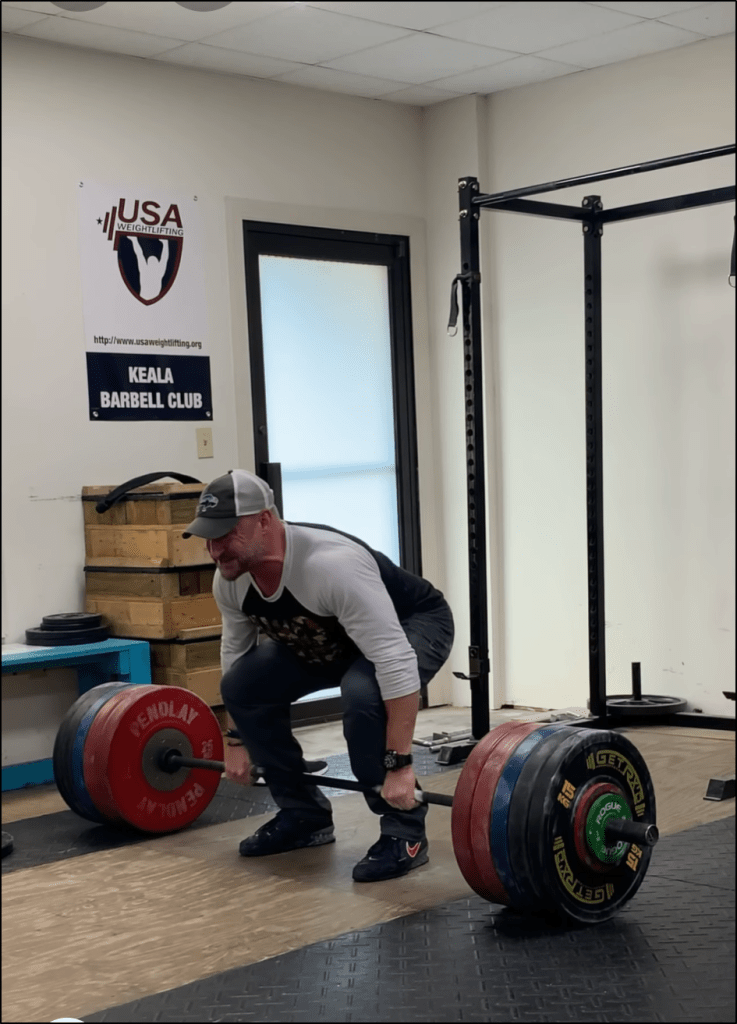
The deadlift is a foundational exercise in Olympic weightlifting, crucial for developing overall strength, maximum power, and athletic performance. Improving your deadlift can enhance your performance in the clean and jerk, snatch, and other compound lifts. Below you’ll find detailed strategies to enhance your deadlift, focusing on technique, strength training, range of motion work, and basic recovery strategies.
1. Perfect Your Technique — the main point here is this exercise will only help improve your lifts if it looks like the the first pull of the lifts. We are emphasizing the clean variation of the deadlift not the traditional deadlift.
Technique is paramount in the deadlift. Proper movement pattern not only reduces the risk of injury but also maximizes strength gains where it matters most. Here’s a more detailed breakdown of the essential components of deadlift technique:
Foot Positioning:
Stance: From the start, use your pulling position in the clean and/or snatch as reference. Like the conventional deadlift though be sure not to begin with your feet too narrow or too wide. My starting position varies slightly but should almost always be EXACTLY the same. Stand with your feet hip/shoulder-width apart, ensuring your toes are pointing slightly outward. How much your toes point out will determined by your hip structure genetically and your over mobility or lack-there-of. No matter where you begin, you want it to a habitual and it be a position to allow for a stable base and optimal leverage during the 1st pull, i.e. the deadlift portion of the movement.
Setup: Place the barbell over the mid-foot, close to your shins. This minimizes helps prevent the bar from traveling forward off the ground and helps keep it from getting out of position in any other portion of the lift. Even though some of you are not martial artists always remember this phrase — position before submission. This means make sure you put/keep the bar in the correct position throughout the movement so you can have MAXimal control over the bar throughout the movement.
Grip: There’s only one and that’s the hook grip. get used to it early and make it habitual.
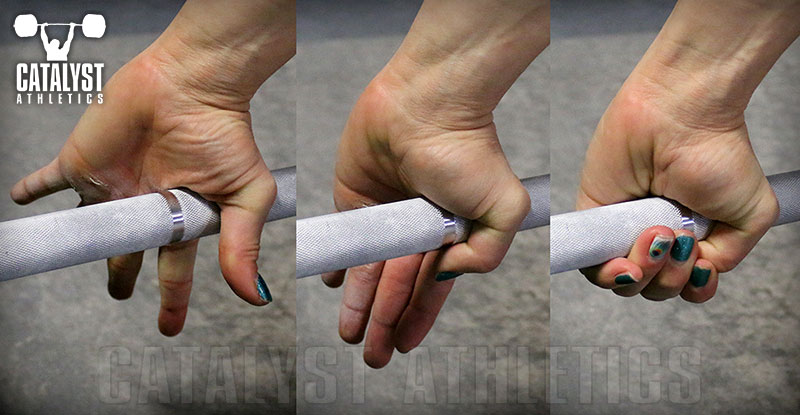
Hook Grip: Thumb is wrapped around the bar and secured by the fingers. This grip is more secure but can be uncomfortable initially.
Bar Path:
Proximity: Keep the barbell close to your body throughout the lift. The bar should travel in a straight line from the ground to the lockout position. This minimizes the distance the bar travels and reduces the strain on your lower back.
Hips and Back:
Starting Position: Begin with your hips lower than in a conventional deadlift, and your torso more upright. This engages your legs more effectively and helps you get used to using your legs to DRIVE the earth away.
Spine Position: Maintain a neutral spine throughout the lift. Avoid rounding your back to prevent injuries. Engage your core to stabilize your spine.
Pulling Motion:
Initial Lift: Drive through your WHOLE FOOT, extending your hips and knees simultaneously. Your shoulders should be slightly in front of the bar at the start.
Engagement: Engage your lats to keep the bar close to your body and prevent it from drifting forward.
Lockout: Fully extend your hips and knees at the top of the lift, ensuring your shoulders are back and your chest is up.
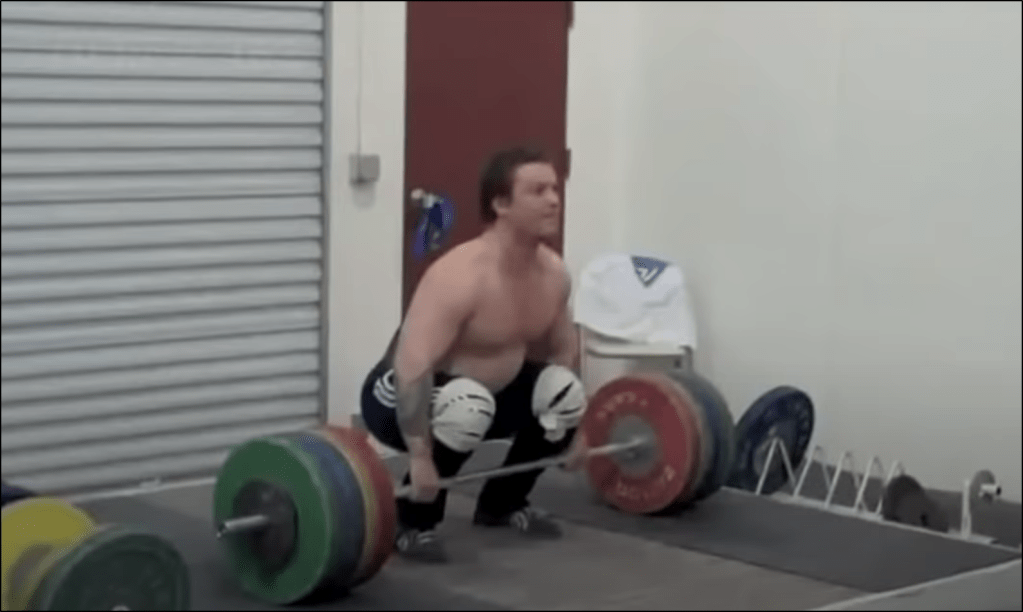
2. Build Strength with Accessory Exercises
Incorporate accessory exercises to target the muscles involved in the deadlift. These exercises help to build strength and address any weaknesses:
Romanian Deadlifts: AKA SLDL, Stiff-Legged Deadlift, Top-Down Deadlift
Execution: Stand in your snatch or clean pulling stance with a clean grip on the bar. Set your back in the same extension you use to pull the snatch and clean and brace your trunk forcefully.
Hinge at the hip while bending the knees very slightly to bring the bar as far down the legs as possible without losing any back extension. Actively keep the bar as close to the legs as possible throughout the motion.
Stay balanced evenly over the whole foot rather than pushing the hips back more than necessary and shifting to the heels. This will limit how much weight you can handle, but it will make the exercise more effective by increasing the force on the hips and back while reinforcing the balance we want in the snatch and clean, as well as strengthening the back and shoulders’ ability to keep the bar close to the body.
Stay braced tightly so as you change directions at the bottom, you don’t allow any softening of the back extension.
If you’re mobile enough to get the plates to the floor with perfect back extension, still stop just short of touching—the changing of direction without compromising back extension is an important element of the exercise.
Benefits: Focuses on the hamstrings and glutes, improving the posterior chain strength essential for a powerful deadlift.
Execution: The good morning is a posterior chain strength exercise that emphasizes isometric back extension strength.
Place the bar on the back as you would for a back squat. You can use either your squat or pulling stance depending on which you want to focus on.
Brace the trunk forcefully with the lower back neutral or slightly more extended and the upper back flattened as much as possible.
Bend the knees very slightly as you hinge at the hips as far as you’re able without losing back extension. Bend forward at a controlled speed, and recover at a natural to quick speed.
Maintain whole foot balance or shift slightly more to the heels, but keep the whole foot in contact with the floor.
Don’t allow your back to soften as you change direction in the bottom to stand again—resisting that force with a rigid trunk is a primary element of the exercise.
The knees can be bent more to shift more of the work to the glutes than the hamstrings, or can be locked straight to maximize hamstring emphasis.
Benefits: Strengthens the lower back, glutes, and hamstrings, promoting better hip hinge mechanics.
Pendlay Rows: AKA Bent-over row, bent forward row, barbell row
Execution: The bent row is a basic but effective upper body pulling exercise that strengthens the upper back, shoulders and arms.
Hold the bar with a clean-width grip, brace your trunk in the same position you would when pulling from the floor, and hinge forward at the hips while bending the knees to bring your trunk just above horizontal, letting the bar hang at arms’ length close to the legs.
Pull the bar to the abdomen, squeezing your shoulder blades back together and forcefully extending the upper back at the top of each rep. Lower the bar to full elbow extension without losing your braced back position.
Notes
The bent row can be performed strictly with a controlled tempo, or with a little body English to put some speed on the bar and then reach the trunk into the bar at the top of the row. The angle of the trunk can also be varied depending on the desired effect, from horizontal to closer to 45-degrees—the higher the angle, the more heavily it can be loaded, but the smaller the range of motion.
Benefits: Develops mid-back strength, crucial for maintaining proper bar path and posture during the deadlift.
Execution: Fix the ankles in a glute-ham bench or similar adjusted to place the pad on the upper thighs. Bend at the hip and back to hang straight down from the hip—back relaxed and trunk hanging vertically.
Extend the hip and back together to bring yourself up to an extended position above horizontal in which the entire back, including the upper back, is extended completely and the glutes are forcefully contracted. Lift your head up at the top to reinforce upper back extension.
For unweighted back extensions, placing the hands behind the head is recommended to help encourage better extension of the upper back. For weighted back extensions, hold the weight in the form of a barbell or dumbbell behind the neck to ensure better resistance and better reinforce that upper back extension.
Notes
Technically, this execution is combined back and hip extension. Back extension can be isolated by fixing the hips in place with the glutes and flexing and extending only along the spine. This can be assisted by relocating the fulcrum or pad of the bench closer to the hips.
Trunk Work: Copenhagen Plank, Chinese Plank (add weight if/when you can) Russian Twists: Leg Raises: Lying Leg Raises. For the Copenhagen & Chinese planks think doing 3-5 sets of 1min resting 1-2 mins between for all of the others think 3-4 set of 15-25 reps per exercise and also resting 1-2 mins between sets.
Additional Strength Building Exercises
Execution: Stand on a platform to increase the range of motion. Perform the deadlift as usual.
Benefits: Increases strength off the floor by emphasizing the initial pull.
Execution: Place the barbell on blocks or mats to elevate it. Perform the deadlift from this elevated position.
Benefits: Focuses on the lockout phase, improving strength in the upper portion of the lift.
Execution: Use a wide grip, similar to a snatch. Perform the deadlift with this grip.
Benefits: Enhances upper back and grip strength and increases the range of motion.
3. Focus on strength in your end ranges of motion not simply “mobility” or being “flexible”
Mobility and flexibility are vital for performing a safe and effective deadlift and overall quality of your movement pattern(s). Think of and possibly implement these movements into your mobility/ROM work exercises into your routine:
Hips: Perform hip flexor stretches, pigeon pose, and hip circles to improve hip flexibility.
For your hamstrings think of using using dynamic and static stretching to enhance hamstring flexibility, allowing for better hip hinge movement. Things like poor man’s GHR, Frankensteins, Hamstring sweeps, and so on.
Ankle Mobility: Incorporate ankle plantar and dorsiflexion exercises to ensure you can maintain proper foot positioning and balance. Worst case scenario just do a couple of slow, controlled bodyweight double and single calf raise to get your calves and ankle complex warm/fired up and ready to lift!
Thoracic Mobility: Here really focus on getting the support structure of your t-spine loose and work on what you need to get yourself closer and closer to the best starting position you can achieve.
Here’s a great exercise The Barbell Physio just dropped on their IG page:
4. Implement Progressive Overload
Progressive overload is essential for continuous improvement. Gradually increase the weight you lift, the number of repetitions, or the volume of your training sessions to challenge your muscles and stimulate growth. Here’s how to effectively implement progressive overload:
Linear Progression: Increase the weight lifted in small, consistent increments/percentages each week.
Volume Training: Add more sets and reps to your routine, focusing on maintaining proper form.
Tempo Variations: Incorporating tempo with your lifts, primarily slow eccentrics (lowering phase), to increase time under tension and build strength are of paramount importance. Using slow tempos also help you feel the muscles you use to do the lifts, and can be the greatest tool you’ll be exposed to help you master the positions of the lifts.
5. Last, and certainly not least, prioritize Recovery
Recovery is just as important as training itself. Proper recovery ensures that your muscles repair and grow stronger, and reduces the rick of injury.
Key recovery strategies include:
NUMBER ONE! Adequate Sleep: Aim for 8-9 hours of sleep per night to support muscle recovery and overall health.
Nutrition: As one famous fitness influencer one said — you can only piss in the gas tank for so long and expect elite performance. So, be sure to quality proteins, healthy fats, and lots of fruits and vegetables. Consider post-workout nutrition/protein shakes if you struggle to meet your daily macros to aid muscle repair. But, first and foremost, be sure you are focusing on eating whole foods vs supplementing with any kind of shakes. Yes, use them when necessary but only when necessary.
Hydration: Stay well-hydrated to maintain muscle function and performance.
Active Recovery: Engage in low-intensity activities such as walking, jogging, rowing, swimming or any sort of quality mixed modal training to help promote blood flow and muscle recovery.
Improving your Olympic weightlifting deadlift requires a comprehensive approach that includes perfecting your technique, incorporating accessory exercises, focusing on mobility, implementing progressive overload, and prioritizing recovery. By consistently applying these strategies, you will build the strength, power, and resilience needed to excel in your deadlift and overall Olympic weightlifting performance. Remember, progress takes time and dedication, so stay patient and committed to your training regimen. More importantly, deadlifting feels cool because you can move a lot of weight but don’t forget to actually do the lifts!
Until next time…
CompTIA Pentest+ and the CEH exam in the works + some fitness follies
Well, well, well, the world has changed a lot since my last post. Definitely have a lot of irons in the fire as the old saying goes. Currently working on the PenTest+ certification from CompTIA. I’ll be following that up with the CEH exam. Between those two certs I’ll be working on and getting the ISACA’s Cybersecurity Audit Certificate. 2024 is shaping up to be another great year!
Hit a new deadlift PR at 521/237
Another beautiful day in the country

Physical training for the day:
A1. Incline curls 10, 10, 10, 10 – :03 second lowering/eccentric load; rest 0
A2. Seated hammer curls 20, 20, 20, 20; rest 0
A3. Standard EZ bar curl 20, 20, 20, 20; rest 2mins
B1. Bench dips 20 x 3; rest 0
B2. Banded press downs 20, 20, 20; rest 0 – pause for two deep nasal breaths at the top of every 5th rep
B3. Triceps push-ups max effort/push to failure; rest 2mins
C1. EZ bar close grip curls 15, 15, 15; rest 0 – try to stay at the same weight for all 3 movements
C2. EZ bar drag curls 15, 15, 15; rest 0
C3. EZ bar overhead triceps exts. 20, 20, 20; rest 1
+
7 n 7 for 7
7 Hang power cleans & push press
7 walk out burpees without the pushup

On Monday I accepted an offer to begin teaching, part-time, for Chegg/Thinkful.com in their Cyber Security program. I’m really looking forward to helping the next wave of cyber sec professionals. It’ll be another great way to help keep up with current trends, continue to reinforce the fundamentals, and also share past and present experiences with a wide swath of new IT pros. Who knows, before long I just might be able to start posting videos of training and teaching again.
Current affairs:

Peter Onuf’s Jefferson & Reclaiming 1619
Hawks Smear War Opponents Again by Ted Galen Carpenter
Putin Wants His Own Monroe Doctrine by Patrick J. Buchanan
Rep after Rep — Easy Day
When I first wrote this, I wasn’t chasing promotions or algorithms. I was just trying to keep showing up to train, to learn, to get a little better each day. Back then, “rep after rep” was more than a training mantra. It was a way to stay grounded when progress felt invisible.
The hardest part wasn’t physical. It was the repetition, the daily grind that felt endless. Whether I was refining form under the barbell or troubleshooting code that refused to run, the challenge was the same: staying patient when nothing seemed to move forward.
Some days you make the lift. Some days the lift makes you. But the point is always to come back tomorrow.
At some point, I stopped expecting each session, physical or mental, to feel like a breakthrough. The breakthrough was the habit itself. The more I showed up, the more the process began to reveal patterns: what worked, what didn’t, and how small adjustments compound over time.
In strength and in cybersecurity, consistency is the quiet multiplier. Each drill, each review, each run-through, one more rep toward mastery.
That same mindset carries through everything I do now — training teams, hardening systems, or writing content. I don’t chase perfect outcomes anymore. I look for steady iterations. A little tighter form. A cleaner line of code. A stronger policy.
That’s how resilience is built, not simply through intensity, but through consistency.
Progress doesn’t shout. It stacks. And one day, you realize the work that used to test you has become the warm-up.
Training for the day:
7 mins of:
7 Banded Sumos
7 Banded bodyweight squats w/moderate band
7 Calf raises
+
A. Back Squat 10, 10,10,10; rest 2/2:30 – 10 RM-ish
B1. Heels elevated air squats x 10 x 3; rest :10
B2. RDL w/an empty bar, sweep away — lumbar focus x 15 x 3; rest 1
C. SL RDL stability, unloaded x 10 x 3; — 5 per leg; rest 1
+
10min alt EMOM:
20 Step-ups – 10 per
15 push-ups
Martial skill work — 5 x 5 min rounds of Z2-Z4 striking, upper push/pull bodyweight movements in trapping/grappling range, and take down defense/sprawling/working underhook escapes et cetera.
Today in my world of Linux and pentesting I worked on building out an Active Directory Lab and worked on the initial attack vectors when attacking an AD based system. Things like LLMNR Poisoning, Capturing NTLMv2 Hashes with Responder, Password Cracking with Hashcat, LLMNR Poisoning Defense, SMB Relay Attacks, Discovering Hosts with SMB Signing Disabled, Start SMB Relay Attack Defenses, & Gaining Shell Access.
Current affairs:
We Got Him (Again, and Again, and Again): On the Latest ISIS Takedown In a Long Line of American Military Actions by Andrew Bacevich
Virginia Supreme Court throws out challenge to Youngkin mask order
Bombshell Proof The ATTACK On Joe Rogan Is Politically Funded! This Is Deeper Than Spotify!
Boom: Rumble offers Joe Rogan $100M to leave Spotify…
And of course, the twat waffle who is Jonah Goldberg, is returning to his roots.

Keep moving dirt
Training:
A1. Seated Arnold rotations x 20, 20, 20; rest :30
A2. Banded triceps press down 20, 20, 20; rest 1
B1. SA DB row x 10-12 reps x 3; @31X1 on the first 5 reps rest :10 secs b/t arms
B2. Snatch grip BTN press w/an empty bar x 15 x 3; rest 1
C1. Assisted pullups using barbell and feet in pullup cage x 6-8 x 3; rest :0
C2. DB push press 15, 15, 15; rest 1
D1. DB shrugs 30, 30, 30, 30; rest :30
D2. Banded upright row 25, 25, 25, 25; rest 90
5 sets of :30secs of work/:30 secs of rest
:30secs KBS – 2pd.
:30secs rest
:30 secs pushups
:30secs rest
:30 secs DB RDL – 55/h
:30secs rest
:30secs 24” box step-ups
:30secs rest
Today’s professional training covered Linux User Accounts and Groups along with Managing File Ownership and Permission. Then in network penetration we covered privilege using Sudo + about hour of training over at tryhackme.
Current Affairs:
The Media Outlets Demanding Joe Rogan’s Removal from Spotify Spread Far More Disinformation
Today in Syria 13 people killed, including six children and four women, during a SF pre-dawn raid targeting ISIS leader Abu Ibrahim al-Hashimi al-Qurayshi.
Johns Hopkins Study: Lockdowns Only Reduce Mortality by 0.2 Percent – good thing they didn’t announce this study on Rogan’s show.
Trudeau’s lies about Freedom Convoy/Canadian truckers show he’s just gaslighting the everyday working man
CORONAVIRUS — Majority of Canadians Now Want COVID Rules to End After Trucker Revolt — Massive 15 point swing in sentiment suggests trucker are not “fringe minority.”
Training 1 DEC 2021
Today’s purification ritual
A1. Strict press 10, 10, 10, 10; rest 0
A2. Ys & Ts 10 & 10 x 4; rest 2
B1. Heavy laterals 15, 15, 15, 15; rest 0
B2. DB Shrugs 15, 15, 15, 15; rest 2
C1. Rear delt flies 15, 15, 15, 15; rest 0
C2. Anterior raises 15, 15, 15, 15; rest 0
C3. Banded upright rows 15 x 4; rest 2
+
E2MOM for 10 mins
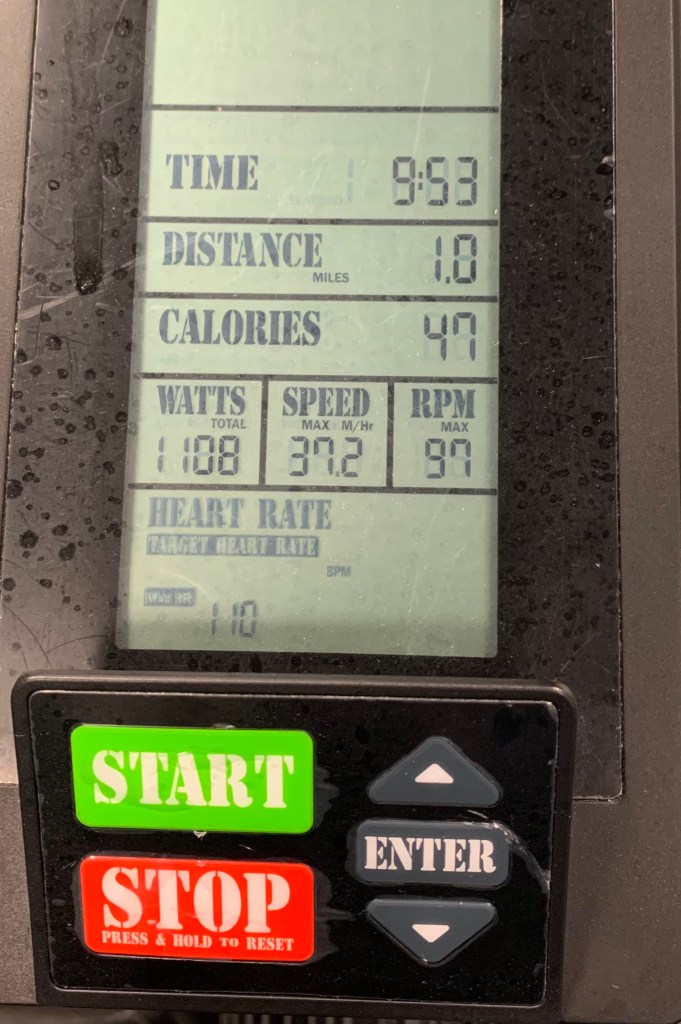
:10 second SPRINT
1:50 rest off the bike
covered a mile in :50 seconds – almost yacked. solid work again today.
Today’s purification ritual

10 minutes of movement prep then…
4 sets:
250m row
20 push-ups
20 KBS
20 Hammer curls
20 Russian twists
20 back exts
-Rest 3
 Matt Shannon, Security Pro