Grammarly sent me a little “you might have a problem” email earlier this week.
Apparently, I’ve written over 900,000 words in the last five weeks. They claim it’s more than 99% of users, with more unique words than 99% of them too. I don’t know how that’s true, but I definitely have been writing a lot lately. I had no idea it was even close to that much.
It’s both kind of cool and kind of hilarious. Why? Because it wasn’t part of a strategy, a streak, or even a goal. It just came from putting in the writing reps. One sentence, one section, and one page at a time.
I’d love to say it’s all poetry and brilliance. But it’s hardly that. It’s been mostly retelling of long hours coaching, martial and security strategies and the kind of sentences that get rewritten three or four times before they sound right.
Still, I’ll take it.
Some of it’s for the book. Some of its old stories I’m finally writing down. Some of it’s heart-wrenching, some of it’s about training, traveling, coaching, fighting, or just trying to make sense of the thoughts that appear between deadlifts, dog walks, deep in the mountains or just walking into the office.
It reminded me of something George Washington once said:
“To be prepared for war is one of the most effective means of preserving peace.”
Sometimes the work is the preparation. And sometimes the work is the peace. Not trying to be prolific, just consistent.
Keeping the standard high, even when no one’s watching.
So, here’s to showing up, stringing some stories together, and hoping at least a few of them land where they’re supposed to.
The principles: “In war, let your great object be victory, not lengthy campaigns”…because “There is no instance of a country having benefited from prolonged warfare.” — Sun Tzu, The Art of War, Chapter II
Historical precedent demonstrates that nations failing to adapt are often used as cautionary examples. Despite significant resources, the United States has not yet overcome this strategic challenge.
From Vietnam to Afghanistan, the United States has exemplified Sun Tzu’s warning by conflating endurance with strength and persistence with strategy. When military presence supersedes the objective of victory, campaigns extend beyond their intended purpose, resulting in significant human and material costs.
The Illusion of Victory
Following President George H. W. Bush’s declaration on March 1, 1991, that the United States had overcome the ‘Vietnam syndrome,’ national sentiment was celebratory. The Gulf War was conducted rapidly and with precision, widely broadcast as evidence of renewed national confidence. The conclusion of the Cold War was perceived as a triumph for democratic governance.
However, this perceived redemption represented a recurrence of previous strategic errors. The primary lesson of Vietnam—the futility of engaging in conflict without a defined objective—remained unheeded. Demonstrating rapid military success led to neglect of the risks associated with protracted engagements lacking clear victory conditions or exit strategies.
In subsequent decades, this hubris manifested in new conflicts. The invasions of Iraq and Afghanistan were initially framed as missions of defense and liberation, but evolved into prolonged operations characterized by strategic inertia. Between January 1968 and January 2022, the United States expended approximately $41 trillion on regime-change wars, supporting unstable governments, and reconstructing nations without explicit local consent.
When the conflict concluded in Kabul in August 2021, the resulting images closely resembled those from Saigon in 1975: helicopters evacuating personnel, abandonment of allied partners, and governmental collapse returning control to the previously ousted regime.
Two wars. Two generations. One unlearned truth:
“Contributing to maintain an army at a distance causes the people to be impoverished.”
The resulting impoverishment extended beyond material losses to include diminished clarity, discipline, and strategic purpose.
The Cost of Long Wars
Sun Tzu recognized that prolonged conflict leads to internal deterioration. Geographic and temporal distance not only depletes resources but also impairs strategic perception.
Extended campaigns obscure strategic objectives and make it difficult to define victory when mere survival becomes the primary focus.
This confusion often results in a detrimental shift from strategic planning to operational maintenance.
The Cyber Parallel
A similar pattern is evident in contemporary cybersecurity. Prolonged defensive operations manifest as alert fatigue, excessive expenditures, and staff burnout. Continuous patching, monitoring, and incident response create an environment of persistent engagement. While terminology evolves, the underlying strategic mindset remains unchanged.
Cybersecurity teams often become engaged in repetitive activities, addressing recurring issues through marginally varied approaches without achieving lasting resolution.
This situation represents the cybersecurity equivalent of protracted military engagements, often referred to as ‘forever wars.’ Effective leaders, including Chief Information Security Officers (CISOs), recognize the importance of strategic restraint.
It is neither feasible nor advisable to attempt to defend all assets indiscriminately. The primary objective is not comprehensive awareness but rather targeted precision.
Security efforts should prioritize critical assets and aim to resolve threats efficiently rather than sustain ongoing conflict.
“The leader of armies is the arbiter of the people’s fate.”
Within organizational contexts, this leadership role may be assumed by a security architect, team leader, or any individual responsible for directing security resources. The fundamental responsibility remains the protection of the enterprise.
Victory Over Attrition
The primary cost of protracted conflicts, whether conventional or digital, is cumulative exhaustion. Achieving victory requires recognizing the appropriate moment to cease operations, consolidate gains, conduct assessments, and facilitate recovery.
Regardless of the domain, whether physical or digital, conflicts that lack a definitive conclusion cannot be considered genuine victories.
Once again, highlighting the timeless nature and importance of imbibing this story’s principles: “In war, let your great object be victory, not lengthy campaigns…” because “There is no instance of a country having benefited from prolonged warfare.“
In cybersecurity, we get excited about new technologies like AI, zero trust, and quantum encryption. But ask any practitioner what quietly stops the most breaches day to day? It’s still MFA.
Multi-Factor Authentication may not be exciting. It can slow people down and sometimes feels awkward. Even so, it remains one of the best ways to stop credential theft, which is the most common way attackers get into any network.
Why MFA Matters
• Passwords are weak. People reuse them across accounts, attackers buy them on the dark web, and “123456” still shows up in breach data. • Phishing is effective. Users still click links and enter credentials. MFA blocks stolen passwords from being enough. • Attacks are automated. Bots hammer login pages at scale. MFA breaks that automation by forcing a second factor.
Despite everything we know, MFA is still the easiest and most effective step in cyber defense. It often makes the difference between stopping an incident and having to respond to one.
The Pushback Problem
When we first rolled out MFA our district, the resistance was loud.
“It’s annoying.” “It slows us down.” “We don’t have time for that.” “Why do I need this if I’m just checking email?”
At first, security changes can feel like a big hassle for everyone, whether you’re a teacher, technician, or leader. But a few seconds of extra effort can save us from days or even weeks of problems.
To make sure everyone accepted MFA, we took our time and built support step by step:
• Continuous staff education. Regular updates explained the “why” behind MFA, not just the “how.” • Knowledge-base articles gave our help desk a clear playbook, no scrambling when someone was locked out or confused. • Anticipating questions became part of the rollout strategy. From custodians logging into shared workstations to the superintendent approving district-wide communications, everyone got personalized guidance.
We kept the message clear: MFA is not a burden. It’s part of how we protect our entire staff and precious student PII, and PHI data. We aways have to remain FERPA, COPPA, CIPA, and PPRA compliant.
Over time, the complaints faded. Now, using MFA is second nature. It’s simply part of our routine.
The Fix
• Enforce MFA on all critical systems. • Use phishing-resistant methods (authenticator apps, hardware keys) and worst-case scenario SMS. • Train users that a few extra seconds of friction is the cost of resilience.
The Parallel
Using MFA is similar to wrapping your hands before boxing. It might seem tedious when you’re just getting started, but it protects you. If you skip it once, you might be fine, but skip it again, and you risk real trouble.
Security, like weightlifting, CrossFit, martial arts or meal prep it works best when the basics become instinct.
Again, MFA is boring. But, it’s also one of the most powerful shields you have.
The principle: All warfare is based on deception. —Sun Tzu
In warfare, there’s a certain irony in how often truth becomes a casualty before the first shot is ever fired. As an American, that line from The Art of War has always carried extra weight. Our history is full of moments when deception wasn’t just a tactic on the battlefield; it was the spark that lit the fuse.
From the smoke and mirrors of the Spanish-American War to the Gulf of Tonkin and the blurred motives of the Gulf Wars and the Global War on Terrorism, we’ve seen how perception shapes permission. Wars don’t always start because one side is stronger; they start because one story feels true enough to believe.
And since “All warfare is based on deception,” Sun Tzu went on to say:
When you’re able to attack, you must appear unable. When using our forces, we must seem inactive. When we are near, we must make the enemy believe we are far away. When we’re far away, we must make him believe we are nearby.
We must hold out bait to entice the enemy and then crush him. If he is superior in strength, evade him. If your opponent is overconfident in nature, seek to provoke him. Pretend to be weak, so that he may grow arrogant and attack when he otherwise wouldn’t. Attack him where he is unprepared, appear where you are not expected. If he is trying to take rest and recover, give him no rest. If his forces are united, divide them.
The general who loses a battle has made only a few calculations beforehand. Thus, many calculations lead to victory, and making only a few calculations ensures defeat. By paying attention to these points, I can foresee who is likely to win or lose.
Deception as Strategy
The principles articulated by Sun Tzu extend beyond the battlefield to broader strategic contexts. His observations highlight the value of misdirection for leaders and strategists. The objective is not to create disorder, but to control perception and attention. In both conventional warfare and digital security, success frequently depends on understanding the adversary’s perception of reality. This principle underpins the effectiveness and prevalence of social engineering tactics.
Contemporary deception strategies have shifted focus from traditional military maneuvers to achieving information dominance. Modern tools include manipulated narratives, deepfakes, phishing campaigns, propaganda, and misinformation. These methods target cognitive processes rather than physical harm. Once individuals accept misinformation as truth, further manipulation becomes significantly easier. The Committee on Public Information, the United States’ World War I propaganda agency, exemplifies institutionalized information control.
Cybersecurity’s Ethical Deception
In cybersecurity, deception is employed with the intent to enhance defense mechanisms. Techniques such as honeypots attract attackers, sandbox environments facilitate malware analysis, and red team exercises simulate adversarial tactics to maintain robust security postures.
In this context, deception functions as a defensive measure rather than an offensive tool. It is utilized to identify vulnerabilities rather than to exploit them. The underlying principle that can mislead a nation may, when applied ethically, serve to protect it. The distinction lies in the intent: defense and awareness as opposed to manipulation and illusion.
Both approaches depend on psychological insight and require strategic foresight. However, only defensive deception is fundamentally grounded in ethical integrity.
The Martial Mirror
Martial artists understand deception in its purest, most physical form. A feint isn’t a lie, it’s a question. In Wing Chun, they’re called “asking hands.” You draw your opponent’s attention, focus and/or movement one way to reveal where they’re vulnerable. The best fighters aren’t those who hide, but those who read intent faster than it’s shown. It’s why attacks on the halfbeat are so effective. But, that’s a lesson for another time.
Cybersecurity employs similar principles. Confrontation is not always optimal; instead, threats are redirected, absorbed, or neutralized preemptively. The discipline emphasizes anticipating patterns before they fully emerge, rather than merely reacting. This approach is often described as the art of fighting without fighting.
The Modern Maxim
“Deception reveals more than it hides, it shows what we most want others to believe.”
In this context, each act of deception simultaneously reveals underlying motives, strategies, and tactics.
For those responsible for safeguarding systems, individuals, or factual accuracy, the task often begins where clarity diminishes. The primary challenge is not to eliminate deception entirely, but to recognize and understand it without compromising ethical standards.
The initial action in any conflict, whether digital, physical, or psychological, is seldom a direct attack; it is often the creation of a narrative to tell. The essential responsibility is to accurately identify threats based on objective analysis, rather than relying solely on presented information. Illustrating the everlasting importance of learning the principle of this story:All warfare is based on deception.
Progress isn’t linear. Martial artists learn this the hard way. One day you nail a three punch combo finished with a clavicle crushing elbow; the next, you stumble over the same movement combination you were hitting regularly just a couple days before. Some weeks, you level up quickly, while others days you’ll hit stumbling blocks. Always approach your wins and losses with the same humility.
Cybersecurity follows the same rhythm. Just as martial artists face setbacks, security professionals experience their own ups and downs. You patch systems, close vulnerabilities, and tighten configurations. Then a new zero-day vulnerability emerges, or an audit reveals previously unaddressed blind spots. It feels like sliding backward.
That slide isn’t a failure, it’s where progress truly forms.
The Myth of Linear Progress
We often imagine progress as, although slow, always moving upward. Reality is less predictable.
Perfection Bias We assume improvement should always feel smooth. However, mastery, in both martial arts and cybersecurity, is a jagged path. The dips are where the depth develops.
The Comparison Trap We see others’ highlight reels, the black belt breaking boards, or the company posting its “zero vulnerabilities” report, and mistake it for constant progress. Behind every clean result lies a mess of mistakes, patches, and failed tests.
Forgetting That Setbacks Build Strength Regression often signals deeper adaptation in progress. In training, it’s when you refine mechanics. In security, it’s when you reinforce foundations.
Why Steps Back Matter
Plateaus and regressions aren’t detours; they’re checkpoints. They test persistence. Anyone can stay motivated when everything goes as planned; resilience forms when it doesn’t.
They reveal gaps in fundamentals. A failed pen test or misconfigured IAM or conditional access policy highlights what needs real attention. They build humility and precision. Overconfidence blinds; setbacks sharpen focus.
On the mats and in the SOC, mastery isn’t about avoiding mistakes, it’s about learning faster from them.
The Cybersecurity Parallel
You don’t know what you don’t know so every incident teaches you something you didn’t know you needed to learn. Every vulnerability scan reveals details you may have overlooked. It isn’t failure. It’s your system adapting, like a martial artist’s mind & body.
A martial artist doesn’t quit after a rough sparring session. They analyze what went wrong, refine their techniques, and return smarter & stronger. Security teams should do the same. A missed vulnerability isn’t a defeat; it’s a mirror. It can show you where your technique slipped & where to tighten your counter-offensive skills.
From the Mats to the Data Center
Both disciplines thrive on discipline, reflection, and repitition:
Training drills = Routine audits. Each repetition builds muscle memory for fighters and for security teams.
Pad work and shadow boxing = Playbooks and runbooks. Practicing in controlled settings builds confidence under pressure.
Sparring = Incident Response sims. You can’t simulate chaos perfectly, but you can train to be calm, and respond correctly, in chaos. That’s why you just keep training and doing reps over and over because each time your partner responds differently but you’re learning to respond with the correct technique every time.
Every repetition, every submission attempt, every punch, every kick, or incident response builds competence and confidence. Every CVE update, OWASP update or vulnerability scan creates visibility and awareness.
The Real Skill of a Black Belt: The Ability to Adapt and Overcome
In martial arts, the belt color doesn’t make you untouchable; it signifies you’ve learned and adapted more than others. In cybersecurity, it’s the same. The strongest organizations aren’t flawless; they’re mobile, agile and when necessary, hostile.
Adaptation beats perfection. Reflection beats reaction. Resilience beats your comfort zone. So the next time your scan lights up with new vulnerabilities or your red team exposes a blind spot, don’t get discouraged. It’s just another training session.
Final Thought
Progress, whether in close range combat or in your code, isn’t about avoiding setbacks. It’s about showing up again after them. The real win isn’t being unbreakable, it’s being unshakable.
Keep patching. Keep learning. Keep moving. Progress isn’t linear, but staying adaptive always drives you forward. Or, as it was once famously said, “Be water my friend.”
Chasing perfection can be tempting. It makes us believe that if we get everything exactly right, like following a flawless training plan or a perfect patch cycle, we’ll be safe from risks or mistakes. But perfection is fragile. One mistake or setback, and it falls apart. That’s when persistence matters most.
Persistence, on the other hand, is unbreakable and endures where perfection falters.
Anyone who’s trained in martial arts or strength sports knows some days you set PRs, some days you don’t. Some days you win; other days, you learn. The outcome of a single session doesn’t matter; what counts is that you keep showing up.
Cybersecurity runs on the same principle. Rather than expecting flawless results, it relies on the daily commitment, running scans, monitoring logs, and applying updates, which builds resilience over time.
Why Perfection Fails
Unrealistic expectations: Nobody patches everything at once. Expecting to do so leads to burnout.
Procrastination: Waiting until you can do it “perfectly” means it never gets done.
Fragility: Perfection breaks under stress; persistence adapts.
Why Persistence Wins
Consistency compounds. One small patch today, another tomorrow, adds up to systemic strength.
Resilience under pressure. When incidents occur, teams that have developed daily habits respond more quickly.
Adaptability. Persistence isn’t rigid; it bends, adjusts, and continues forward.
The Martial Arts Parallel
Martial artists don’t achieve mastery through perfection. They drill basics until instinctive, spar, fail, and adapt. Each session is about persistence; the discipline of returning to the mat, working on strikes, footwork, counter-wrestling, etc, etc.
Cybersecurity professionals must do the same. Drill, repeat, refine, and drill some more. That way, when the attacks come, your persistence in training wins the day.
Closing Thought: Persistence, not perfection, is the key to success. Perfection is unattainable, persistence ensures progress, and tangible results.
When most people think about cybersecurity, they picture glowing screens, rapid typing, “hacking” and maybe a hoodie or two. What they don’t picture is chalk & barbells, sprint intervals, sparring mats or even walking.
But here’s the truth: the body and the mind aren’t separate operating systems. They have a symbiotic relationship. The stronger one becomes, the more resilient the other gets. And in a field like cybersecurity, where pressure is high, hours are unpredictable, and the stakes have real-life impact, that resilience makes all the difference.
Stress Management
No breach ever times itself for your convenience. Alerts fire off at 2 a.m whether youre trying to sleep or not. It doesn’t matter if your judgment is foggy and your nerves are already frayed. Mistakes made in those moments don’t just cost hours, they can cost you and your clients millions.
Physical training is rehearsal for that kind of pressure. Every time you push your heart rate into the red zone, whether it’s during a sprint, a lift, or a round of sparring, you’re training your nervous system to stay sharp and composed. You’ve practiced breathing through discomfort. You’ve felt the panic rising and learned not to flinch.
That calm under physical stress translates directly into composure under digital fire.
Discipline & Consistency
You don’t get strong by lifting once a month. You don’t become a skilled defender by reading one book or passing one certification.
Strength and security are both built on repetition. Small daily habits, squats and deadlifts, daily log reviews, routine key rotations and hardwired discipline.
Discipline isn’t glamorous. Nobody applauds your Tuesday-night study session or your Sunday meal prep. But that quiet consistency is what separates those who dabble from those who attain mastery.
Recovery Matters
Burnout wrecks the mind. Overtraining wrecks the body. And yet in both the gym and SOC, too many people wear exhaustion like a badge of honor.
The best of the best know better. They respect recovery. They take deload weeks. They do their best to sleep 8 hours a night. They understand that stress plus rest equals growth. Without rest, stress is just destruction.
Security pros need the same rhythm. Downtime, sleep, and boundaries. They’re not luxuries, they’re daily essentials. A fried analyst is a liability, not a hero.
Confidence Under Pressure
Just like any APT or other malicious actor, the iron doesn’t care how you feel today. The sparring partner doesn’t care if you’re tired. They test you anyway. No matter how tired you are that day, the weight still weighs the same.
That pressure teaches confidence. You must feel what it’s like to fail a lift, get winded mid-round, or be pushed beyond what you thought you could handle to know that you can. Only then you’ll learn you can stay composed, reset, and respond decisively.
That kind of grounded confidence is exactly what’s needed in the middle of a high-stakes incident response, defending your infrastructure under scrutiny, or having to brief leadership with incomplete information. It’s not bravado, it’s composure forged under fire.
The Long Game
Neither training nor cybersecurity has a finish line. You’re never “done.”
Martial arts teach that a black belt isn’t an end state, it’s proof that you’ve mastered the basics and are ready to start again at a higher level. Security works the same way. Every new CVE, every new framework, every new technology is another layer, not the final one.
The goal isn’t perfection, it’s persistence. The discipline to keep showing up, stacking reps, and sharpening your resilience over time is what it takes.
Closing Thoughts
A strong body fuels a sharp mind. A sharp mind makes a stronger defender. Separate them, and you limit yourself. Train both, and you’ll be prepared for whatever comes your way — whether it’s on the mat, under the bar, or in the middle of a 2 a.m. incident call.
Next up, I’ll dive into practical ways to sharpen your eating habits — how to drop body fat, boost metabolic health, and fuel both physical and mental performance.
The hallmark of good martial arts training isn’t punching, kicking, grappling or strategy, per se. What they’re really about is mastery of the basics over time through discipline and repetition. At a certain point you attain virtuosity in all of your movements. What is virtuosity? It was once famously described as, “performing the common uncommonly well.” What that means is you repeat and practice the basics for so long they become instinctual or habitual. Cloud security functions on the same principles.
Here’s what the dojo has to teach the data center:
Stance = Identity & Access Management (IAM) Every fight starts on the feet/with a good stance. Get your footwork wrong, and you’re off balance before anything even happens. In the cloud, IAM is your stance. Sloppy permissions or overextended access? You’re already being taken down.
*Fix: Always apply the principle of least privilege. Review access on a regular cadence and thus lock-in a solid foundation.
Defense = Network Segmentation Your guard protects you before the strike ever comes. In cloud environments, segmentation is your guard. Break systems into zones so one hit doesn’t take down the whole body.
*Fix: Use VPCs, VLANs, subnets, NACLs and security groups like a strong guard.
Drills = Patching & Updatesto View Protection as an Automated Process Most folks hate endless drilling — until the day they save you. Patching helps in the same way. Repetition keeps you sharp and keeps vulnerabilities from stacking up.
*Fix: Automate updates. Drill patch cycles until they’re habit.
Sparring = Tabletop ExercisesandIncident Response Sparring helps to teach how to deploy your offense, avoid being hit, how to take a punch if one lands and helps you adapt, and respond under fire. Incident response does the same. If you never practice, the first real strike will knock you flat.
Fix: Run tabletop exercises and red-team drills so your team isn’t surprised when it counts.
Black Belt = Resilience The belt, in and of itself, doesn’t mean you know everything. It means you’ve mastered the basics so well you can adapt to whatever’s thrown your way. That’s resilience in the cloud: strong architecture, backups, monitoring, and a mindset of continuous improvement.
*Fix: Architect for failure. Test recovery. Expect the unexpected.
Closing Thoughts Martial artists don’t rise to the occasion, they sink to the level of their training. Cloud security is no different. Drill the basics, protection your vital points of attack, accept the associated risks of some less protected areas, and keep your stance fluid, flexible and grounded. Then , when any attacks come, you won’t just survive, you’ll be ready to win before the attack is even launched. And that my friends, is the supreme art of war.
There’s a moment most people don’t talk about when they post their certifications, it’s that part where you stare at the screen, waiting for the result to load, rehearsing how you’ll feel either way.
That was me, after months of studying, rewrites, retakes, and nights when the last thing I wanted to see was another port, protocol, or payload.
I’d already passed the CompTIA trifecta, A+, Network+, Security+, and each one felt like a step forward. But PenTest+ was different. It wasn’t just about memorization. It forced me to think like an adversary, to build a structured approach out of controlled chaos. It was humbling.
There were setbacks. Long hours after long workdays. Missed weekends. That quiet voice that says, maybe this one’s just too much right now.
But that’s where persistence replaces motivation. I tell my students and training partners the same thing I remind myself: motivation gets you started, discipline keeps you moving.
When that “Pass” finally appeared on the screen, it wasn’t triumph, it was relief. And gratitude. Because every failed scan, every misconfigured lab, every late-night tracing network maps, they built the competence that makes the win real.
The truth is, no certification on its own changes who you are. The process does. The grind does. The decision to sit back down after the first, second, or third setback does.
In cybersecurity, as in martial arts, you don’t earn a belt to prove you’re done. You earn it because you’ve decided you’re not done yet.
And that lesson, more than any flag on a résumé, is what makes the next challenge possible.
The deadlift is a foundational exercise in Olympic weightlifting, crucial for developing overall strength, maximum power, and athletic performance. Improving your deadlift can enhance your performance in the clean and jerk, snatch, and other compound lifts. Below you’ll find detailed strategies to enhance your deadlift, focusing on technique, strength training, range of motion work, and basic recovery strategies.
1. Perfect Your Technique — the main point here is this exercise will only help improve your lifts if it looks like the the first pull of the lifts. We are emphasizing the clean variation of the deadlift not the traditional deadlift.
Technique is paramount in the deadlift. Proper movement pattern not only reduces the risk of injury but also maximizes strength gains where it matters most. Here’s a more detailed breakdown of the essential components of deadlift technique:
Foot Positioning:
Stance: From the start, use your pulling position in the clean and/or snatch as reference. Like the conventional deadlift though be sure not to begin with your feet too narrow or too wide. My starting position varies slightly but should almost always be EXACTLY the same. Stand with your feet hip/shoulder-width apart, ensuring your toes are pointing slightly outward. How much your toes point out will determined by your hip structure genetically and your over mobility or lack-there-of. No matter where you begin, you want it to a habitual and it be a position to allow for a stable base and optimal leverage during the 1st pull, i.e. the deadlift portion of the movement.
Setup: Place the barbell over the mid-foot, close to your shins. This minimizes helps prevent the bar from traveling forward off the ground and helps keep it from getting out of position in any other portion of the lift. Even though some of you are not martial artists always remember this phrase — position before submission. This means make sure you put/keep the bar in the correct position throughout the movement so you can have MAXimal control over the bar throughout the movement.
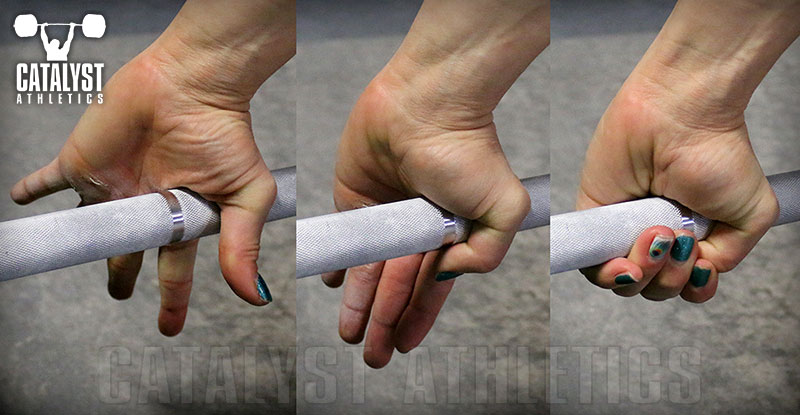
Grip: There’s only one and that’s the hook grip. get used to it early and make it habitual.
Hook Grip: Thumb is wrapped around the bar and secured by the fingers. This grip is more secure but can be uncomfortable initially.
Bar Path:
Proximity: Keep the barbell close to your body throughout the lift. The bar should travel in a straight line from the ground to the lockout position. This minimizes the distance the bar travels and reduces the strain on your lower back.
Hips and Back:
Starting Position: Begin with your hips lower than in a conventional deadlift, and your torso more upright. This engages your legs more effectively and helps you get used to using your legs to DRIVE the earth away.
Spine Position: Maintain a neutral spine throughout the lift. Avoid rounding your back to prevent injuries. Engage your core to stabilize your spine.
Pulling Motion:
Initial Lift: Drive through your WHOLE FOOT, extending your hips and knees simultaneously. Your shoulders should be slightly in front of the bar at the start.
Engagement: Engage your lats to keep the bar close to your body and prevent it from drifting forward.
Lockout: Fully extend your hips and knees at the top of the lift, ensuring your shoulders are back and your chest is up.
2. Build Strength with Accessory Exercises
Incorporate accessory exercises to target the muscles involved in the deadlift. These exercises help to build strength and address any weaknesses:
Execution: Stand in your snatch or clean pulling stance with a clean grip on the bar. Set your back in the same extension you use to pull the snatch and clean and brace your trunk forcefully.
Hinge at the hip while bending the knees very slightly to bring the bar as far down the legs as possible without losing any back extension. Actively keep the bar as close to the legs as possible throughout the motion.
Stay balanced evenly over the whole foot rather than pushing the hips back more than necessary and shifting to the heels. This will limit how much weight you can handle, but it will make the exercise more effective by increasing the force on the hips and back while reinforcing the balance we want in the snatch and clean, as well as strengthening the back and shoulders’ ability to keep the bar close to the body.
Stay braced tightly so as you change directions at the bottom, you don’t allow any softening of the back extension.
If you’re mobile enough to get the plates to the floor with perfect back extension, still stop just short of touching—the changing of direction without compromising back extension is an important element of the exercise.
Benefits: Focuses on the hamstrings and glutes, improving the posterior chain strength essential for a powerful deadlift.
Execution: The good morning is a posterior chain strength exercise that emphasizes isometric back extension strength.
Place the bar on the back as you would for a back squat. You can use either your squat or pulling stance depending on which you want to focus on.
Brace the trunk forcefully with the lower back neutral or slightly more extended and the upper back flattened as much as possible.
Bend the knees very slightly as you hinge at the hips as far as you’re able without losing back extension. Bend forward at a controlled speed, and recover at a natural to quick speed.
Maintain whole foot balance or shift slightly more to the heels, but keep the whole foot in contact with the floor.
Don’t allow your back to soften as you change direction in the bottom to stand again—resisting that force with a rigid trunk is a primary element of the exercise.
The knees can be bent more to shift more of the work to the glutes than the hamstrings, or can be locked straight to maximize hamstring emphasis.
Benefits: Strengthens the lower back, glutes, and hamstrings, promoting better hip hinge mechanics.
Pendlay Rows: AKA Bent-over row, bent forward row, barbell row
Execution: The bent row is a basic but effective upper body pulling exercise that strengthens the upper back, shoulders and arms.
Hold the bar with a clean-width grip, brace your trunk in the same position you would when pulling from the floor, and hinge forward at the hips while bending the knees to bring your trunk just above horizontal, letting the bar hang at arms’ length close to the legs.
Pull the bar to the abdomen, squeezing your shoulder blades back together and forcefully extending the upper back at the top of each rep. Lower the bar to full elbow extension without losing your braced back position.
Notes The bent row can be performed strictly with a controlled tempo, or with a little body English to put some speed on the bar and then reach the trunk into the bar at the top of the row. The angle of the trunk can also be varied depending on the desired effect, from horizontal to closer to 45-degrees—the higher the angle, the more heavily it can be loaded, but the smaller the range of motion.
Benefits: Develops mid-back strength, crucial for maintaining proper bar path and posture during the deadlift.
Execution: Fix the ankles in a glute-ham bench or similar adjusted to place the pad on the upper thighs. Bend at the hip and back to hang straight down from the hip—back relaxed and trunk hanging vertically.
Extend the hip and back together to bring yourself up to an extended position above horizontal in which the entire back, including the upper back, is extended completely and the glutes are forcefully contracted. Lift your head up at the top to reinforce upper back extension.
For unweighted back extensions, placing the hands behind the head is recommended to help encourage better extension of the upper back. For weighted back extensions, hold the weight in the form of a barbell or dumbbell behind the neck to ensure better resistance and better reinforce that upper back extension.
Notes Technically, this execution is combined back and hip extension. Back extension can be isolated by fixing the hips in place with the glutes and flexing and extending only along the spine. This can be assisted by relocating the fulcrum or pad of the bench closer to the hips.
Trunk Work: Copenhagen Plank, Chinese Plank (add weight if/when you can) Russian Twists: Leg Raises: Lying Leg Raises. For the Copenhagen & Chinese planks think doing 3-5 sets of 1min resting 1-2 mins between for all of the others think 3-4 set of 15-25 reps per exercise and also resting 1-2 mins between sets.
Execution: Use a wide grip, similar to a snatch. Perform the deadlift with this grip.
Benefits: Enhances upper back and grip strength and increases the range of motion.
3. Focus on strength in your end ranges of motion not simply “mobility” or being “flexible”
Mobility and flexibility are vital for performing a safe and effective deadlift and overall quality of your movement pattern(s). Think of and possibly implement these movements into your mobility/ROM work exercises into your routine:
Hips: Perform hip flexor stretches, pigeon pose, and hip circles to improve hip flexibility.
For your hamstrings think of using using dynamic and static stretching to enhance hamstring flexibility, allowing for better hip hinge movement. Things like poor man’s GHR, Frankensteins, Hamstring sweeps, and so on.
Ankle Mobility: Incorporate ankle plantar and dorsiflexion exercises to ensure you can maintain proper foot positioning and balance. Worst case scenario just do a couple of slow, controlled bodyweight double and single calf raise to get your calves and ankle complex warm/fired up and ready to lift!
Thoracic Mobility: Here really focus on getting the support structure of your t-spine loose and work on what you need to get yourself closer and closer to the best starting position you can achieve.
Here’s a great exercise The Barbell Physio just dropped on their IG page:
Progressive overload is essential for continuous improvement. Gradually increase the weight you lift, the number of repetitions, or the volume of your training sessions to challenge your muscles and stimulate growth. Here’s how to effectively implement progressive overload:
Linear Progression: Increase the weight lifted in small, consistent increments/percentages each week.
Volume Training: Add more sets and reps to your routine, focusing on maintaining proper form.
Tempo Variations: Incorporating tempo with your lifts, primarily slow eccentrics (lowering phase), to increase time under tension and build strength are of paramount importance. Using slow tempos also help you feel the muscles you use to do the lifts, and can be the greatest tool you’ll be exposed to help you master the positions of the lifts.
5. Last, and certainly not least, prioritize Recovery
Recovery is just as important as training itself. Proper recovery ensures that your muscles repair and grow stronger, and reduces the rick of injury.
Key recovery strategies include:
NUMBER ONE! Adequate Sleep: Aim for 8-9 hours of sleep per night to support muscle recovery and overall health.
Nutrition: As one famous fitness influencer one said — you can only piss in the gas tank for so long and expect elite performance. So, be sure to quality proteins, healthy fats, and lots of fruits and vegetables. Consider post-workout nutrition/protein shakes if you struggle to meet your daily macros to aid muscle repair. But, first and foremost, be sure you are focusing on eating whole foods vs supplementing with any kind of shakes. Yes, use them when necessary but only when necessary.
Hydration: Stay well-hydrated to maintain muscle function and performance.
Active Recovery: Engage in low-intensity activities such as walking, jogging, rowing, swimming or any sort of quality mixed modal training to help promote blood flow and muscle recovery.
Improving your Olympic weightlifting deadlift requires a comprehensive approach that includes perfecting your technique, incorporating accessory exercises, focusing on mobility, implementing progressive overload, and prioritizing recovery. By consistently applying these strategies, you will build the strength, power, and resilience needed to excel in your deadlift and overall Olympic weightlifting performance. Remember, progress takes time and dedication, so stay patient and committed to your training regimen. More importantly, deadlifting feels cool because you can move a lot of weight but don’t forget to actually do the lifts!







 Matt Shannon, Security Pro