Fat Isn’t Evil: It’s Essential

Picking up from where we left off last week — we’ve already dismantled the myths around protein and carbohydrates, now it’s time to put the final macronutrient into proper context.

In Week 3, we covered nutrient timing and why eating with intention matters. In Week 4, we cleared the air around carbs, showing they’re a necessary tool for fueling performance, not something to fear.

This week, we’re doing the same with fat, one of the most demonized and misunderstood components of the human diet.

Why This Matters:

Most people trying to ‘eat healthy’ unknowingly sabotage their energy, focus, and results by fearing fat. Understanding the truth lets you make smarter, less stressful choices in and out of the gym.

The Problem: Fat Got Blamed for What Sugar (and Sedentary Living) Did

The war on fat started in the 1970s and 80s, pushing people toward fat-free everything, from cookies to frozen dinners. What happened next?
• Obesity skyrocketed.
• Type 2 diabetes surged.
• People got sicker, not healthier.

Why? Because removing fat didn’t remove the problem. It just made food more processed, more sugary, and less satisfying.

Question:

Ever skip the avocado on your salad because you thought it was ‘too fattening’, then ended up hungry an hour later? Now, youre beginning to pick up what I’m puttin’ down.

What Fat Actually Does in the Body

Fat isn’t the enemy. It’s a required nutrient for:
• Hormone production (testosterone, estrogen, cortisol)
• Brain health and cognition
• Joint lubrication and recovery
• Fat-soluble vitamin absorption (A, D, E, and K)
• Cellular structure (yes, your cells are literally built from it)

But here’s the key: fat is fuel for low-intensity output and recovery, not high-performance explosive training. That’s where carbs step in.

Quick Fat Facts:

• Unsaturated fats (olive oil, nuts, avocado, fatty fish) support heart and brain health.

Saturated fats (animal fats, butter, coconut oil) are fine in moderation, especially from whole foods.

• Trans fats (partially hydrogenated oils) are in a different league; avoid them entirely. They wreak havoc on cholesterol and inflammation.

You need both fat and carbs, but at the right doses for the right goals.

Data Point:

Fat slows gastric emptying, helping you feel fuller for longer—a secret weapon against late-night snacking (British Journal of Nutrition, 2021).

Why “Healthy Fats” Doesn’t Mean “Unlimited Fats”

Yes, olive oil, avocado, nuts, and salmon are great, but overconsumption is still overconsumption.

Fat is energy-dense.
• 1 gram of fat = 9 calories
• That’s more than double protein or carbs (4 calories per gram)

So while you need it, you don’t need as much as you might think, especially if you’re already fueling with protein and carbs.

Most Common Fat Mistake:

Dousing salads, veggies, or “healthy” bowls with extra oil or nuts. Even good fats add up fast, so measure, don’t guess.

What This Looks Like in Practice

Swap:

Instead of fat-free salad dressing (loaded with sugar), use olive oil and vinegar for flavor, better absorption of nutrients, and longer-lasting energy.

Here’s how to build smart, balanced fat intake into your day:

Add a thumb-sized portion of fat to your main meals (nuts, oil, nut butter, avocado)
Don’t dump oil or butter onto every dish “for health;” it adds up fast
Keep fats lighter pre-workout, so digestion doesn’t slow you down
Post-workout, prioritize protein + carbs, not a heavy fat load
Evening meals can include more fats to help slow digestion and promote satiety

You don’t need to avoid fat, you need to respect it.

Visual Analogy:

Think of fat as the steady-burning logs on a campfire versus using pine needles: the dry pine needles can get the fire going, but don’t last. The logs are for warmth that lasts all night.

Now that we’ve set the record straight, here’s how to use fat like an anti-hero: deliberately, strategically, and never just because the label says “healthy.”

Action Challenge

For the next 3 days:
• Track how much fat you’re eating (rough estimate is fine)
• Identify where it’s coming from (meals vs snacks vs sauces/oils)
• Adjust one meal per day to intentionally include a measured fat source (e.g., 1 tbsp olive oil, 1/4 avocado, or 10 almonds)

You’ll start to see how easily fat sneaks in and how powerful it can be when used deliberately.

Coach’s Corner

• Fat is a recovery nutrient, not a performance one.
• Don’t go to war with it, just don’t treat it like a free-for-all either.
• Balance is your ally. Fat has its place, use it like a tool, not a reward.

Suggested Reading

“Deep Nutrition” by Dr. Cate Shanahan
A sharp breakdown of how traditional diets used fats well, and how we can reclaim that without getting lost in the noise.

Real-World Headline:

In 2024, a major study published in JAMA found that replacing just 5% of calories from saturated to unsaturated fat was associated with a significant reduction in cardiovascular risk. (Source: JAMA, April 2024)

Science Insight:

Regular consumption of omega-3 fatty acids (found in fatty fish, chia, and flaxseed) is associated with improved heart health and reduced inflammation, according to the American Heart Association (2023).

Quick Fact:

Contrary to old myths, moderate whole-egg consumption does not increase heart disease risk for most people (Harvard School of Public Health, 2022).

Key Takeaway: Your hormones, brain, and cells are built from fats. Don’t fear them, but definitely manage them.

Key Anti-Hero Move: Use fat on your terms, not the food industry’s. Portion is power.

Empowerment Challenge:

What’s one fat source you’ll add back this week? Try it, track it, and notice the difference. Anti-heroes don’t just read, they act.

What’s Coming Next

You’ve now got a full picture of the big three macros, but how do you put them together? In Week 6, we’ll map out what a real-world performance meal looks like, and how to adjust it for your goals, whether that’s training, leaning out, or staying sharp at work.
Does Nutrient Timing Matter? Yes, But Not the Way You Think

Stop obsessing over windows. Start building systems.

If you train hard, care about body composition, and want real-world energy, you’ve probably heard people say:

“You have to eat protein within 30 minutes of lifting.”
“Don’t eat carbs after 8 PM.”
“Fasting boosts growth hormone, just train fasted.”
“Breakfast is optional if your willpower is high enough.”

None of this is completely wrong, but none of them is 100% valid or effective for all, so don’t waste any mental space on them and focus on what’s been proven to work over decades.

Let’s cut through the BS.

The Truth About Nutrient Timing

Nutrient timing can matter, but it’s not the magic some claim, and it’s not completely useless like others claim.

It doesn’t override your daily totals. But it does influence:

  • How well you train.
  • How fast you recover.
  • How consistent is your energy, mood, and hunger?

Here’s the simplified hierarchy:

  1. Daily intake = most important
  2. Meal timing = performance lever
  3. Meal composition = precision tool
  4. Supplement timing = tiny bonus

Myth: If you miss the post-workout window, your workout is wasted.
Fact: Muscle protein synthesis remains elevated for hours; what matters most is your overall daily intake and rhythm.

Science Sidebar: Why does timing matter? Protein synthesis is elevated for several hours after training, so spacing protein throughout the day maximizes muscle repair. Carbohydrates around workouts help refill glycogen and lower stress hormones like cortisol.

What You Need to Know

1. Protein Timing

Protein intake is about distribution, not hitting a “window.”

Aim for:

  • 25–40g of protein per meal
  • Every 3–5 hours
  • Starting within 1–2 hours of waking
  • Ending within 2 hours post-training

Even distribution improves muscle protein synthesis, recovery, and satiety. Research shows that even protein distribution (every 3–5 hours) is linked to greater muscle protein synthesis and recovery (Areta et al., 2013).

2. Carbohydrate Timing

Carbs are fuel, especially around training.

Pre-workout: 30–60g (1–2 hours prior)
Post-workout: 30–60g + protein (within 1–2 hours)

This replenishes glycogen, blunts cortisol, and enhances recovery.
It’s not “dirty.” It’s just useful.

3. Fat Timing

Fat slows digestion. That’s helpful during the day but not ideal around training.

Keep fat moderate pre-workout. Go higher-fat during lower-carb meals later in the day.

Fat: It’s less about timing, more about portion. Eating a high-fat meal before training can slow digestion and make some people feel sluggish. Experiment with your pre-workout meals to find what feels best.

Generally: moderate fat at main meals, lower fat pre/post-workout.

Example Timing Strategy (Strength Training Day)

When I started having a balanced meal within 90 minutes of training, my recovery and afternoon energy noticeably improved.

  • 8:00 AM: 3 eggs, oats, berries (protein + carbs + fat)
  • 12:00 PM: Chicken, veggies, avocado (protein + carbs + fat)
  • 3:00 PM: Pre-workout shake 1 scoop whey + 50g carbs from a fruit source
  • 5:00 PM: Train
  • 6:30 PM: Post-workout, beef and sweet potato + Kerry gold butter (protein + carbs + fat)
  • 730/8 PM: Greek yogurt + whey or casein and a handful of nuts

Total protein: ~180-200g
Balanced carbs, front-loaded around training
Fats used to stabilize energy later

Action Challenge:

Pick one meal to move closer to your training time and one post-workout meal to optimize.

Your goal:

  • Protein: 30g
  • Carbs: 30–50g
  • Minimal fat
  • Eaten within 1–2 hours of finishing your workout

Coach’s Corner:

  • Don’t try to “hack” your metabolism with clever meal timing.
  • Build rhythm that supports your output.
  • Use timing to reduce stress, not increase it.

Suggested Reading:

“Nutrient Timing: The Future of Sports Nutrition by Ivy & Portman
A classic foundation on how timing influences performance and recovery. A bit dated, but still useful.

Key Takeaway:

Nutrient timing isn’t magic; it’s just another way to support what matters most: consistency and recovery.

Timing isn’t a rulebook. It’s a framework. Daily totals matter most, but if you train hard, timing helps you show up stronger, recover faster, and stay more consistent.

Next Week: The Carbohydrate Question

Once your daily intake is dialed in and you start thinking about timing, the next question always comes up:

“Do carbs still matter? Or should I be avoiding them?”

That’s where we’re headed next. In Week 4, we’ll break down the truth about carbs. Not hype. Not fear. Just what they actually do, and how to use them to train, recover, and function better in daily life.

BCAAs Are Overrated — Here’s What to Do Instead

There was a time when tossing a neon scoop of BCAAs into your shaker cup felt like a secret code, like a sign that you were truly “dialed in.” Fast forward a few years, and the science is pretty blunt: if you’re already eating enough high-quality protein, those branched-chain amino acids aren’t doing much besides lightening your wallet.

Let’s break it down.

1. You’re Already Getting Plenty

BCAAs (leucine, isoleucine, valine) are just three of the nine essential amino acids your body needs to repair and build muscle. They’re naturally found in every solid protein source: meat, fish, eggs, dairy, and even plants. In fact, most whole protein sources already contain the 2-3 grams of leucine per meal needed to maximize muscle protein synthesis, making isolated BCAA supplements redundant.

If you eat real food and hit roughly 1.6–2.2 grams of protein per kilogram of body weight, you’re already covered. Studies keep confirming it: supplementing with BCAAs doesn’t outperform simply consuming complete protein. Here’s why: muscle protein synthesis requires all nine essential amino acids to activate mTOR signaling, the metabolic pathway that triggers muscle growth. BCAAs alone can’t complete the job. Without the full amino acid lineup, your body can’t finish the muscle-building process.

Unless your diet is severely lacking protein, that fancy powder isn’t rescuing anything.

2. Pop Culture Made It Cool — But Not Useful

Let’s be honest: a lot of this stuck around because of marketing and muscle culture. The fitness industry turned hydration into a brand identity with bright colors, bold claims, and goofy influencers sipping between sets like it’s rocket fuel.

It looks serious. It feels like doing something extra. But feeling busy isn’t the same as being productive. In truth, most BCAA use today is psychological, the ritual of “recovery in a cup” more than any measurable physiological edge.

Field note: I’ve worked with hundreds of lifters and athletes and not one of them ever turned a corner in strength, body comp, or recovery because they added BCAAs. But I’ve seen countless athletes break plateaus when they fixed their sleep schedule, added 20 grams of protein to breakfast, or simply trained with more consistency. The wins come from the boring fundamentals, not the colorful supplements.

3. The Paleo/Keto Twist

Here’s where a lot of people overcomplicate it.

If you’re following Paleo or keto and already eating quality animal protein, steak, tuna, salmon, eggs, you’re getting plenty of BCAAs naturally. The supplement is redundant.

But here’s the real issue: many low-carb folks turn to BCAAs because they’re afraid strategic carbs will derail their progress. They won’t. If you’re training hard two or three times a week, your muscles need readily available fuel. Natural carb sources like fruit, bananas, berries, oranges, apples, et cetera, around your training window will do more for performance and recovery than any BCAA powder.

That’s not breaking Paleo. That’s being smart. And it’s cheaper than another tub of supplements.

4. When Supplements Actually Make Sense

To be fair, there are scenarios where amino acid supplementation has merit but even then, BCAAs aren’t your best option.

If you’re training fasted (early morning workouts before you can eat), recovering from an injury where whole food intake is compromised, or genuinely struggling to meet your protein needs through diet alone, a full EAA supplement or quality whey protein makes far more sense than BCAAs.

Why? They deliver the complete amino acid profile your body needs to rebuild tissue and trigger muscle protein synthesis, not just the marketing-friendly three. You’re getting the full toolkit, not just a hammer.

Otherwise? Eat real food, train with purpose, sleep hard, repeat. Oh, and if you’re a vegan or vegetarian, you will need to use supplements to meet your BCAA and EAA needs, but that’s a story for another time.

The Takeaway

Most people sipping BCAAs are already getting what they need from their plate.

The supplement industry thrives on making simple things feel complicated. They profit when you believe that food alone isn’t enough—that you need their powders, their timing protocols, their proprietary blends to unlock results.

But the truth is simpler and cheaper: eat quality protein, train consistently, sleep well, and your body will handle the rest. The fundamentals work. They’ve always worked. And no neon powder changes that.

Save your money for real food, a good night’s sleep, or maybe a new pair of shoes for the trail. If you’re eating enough quality protein, you’re already doing what BCAAs promise — only better, and for less.

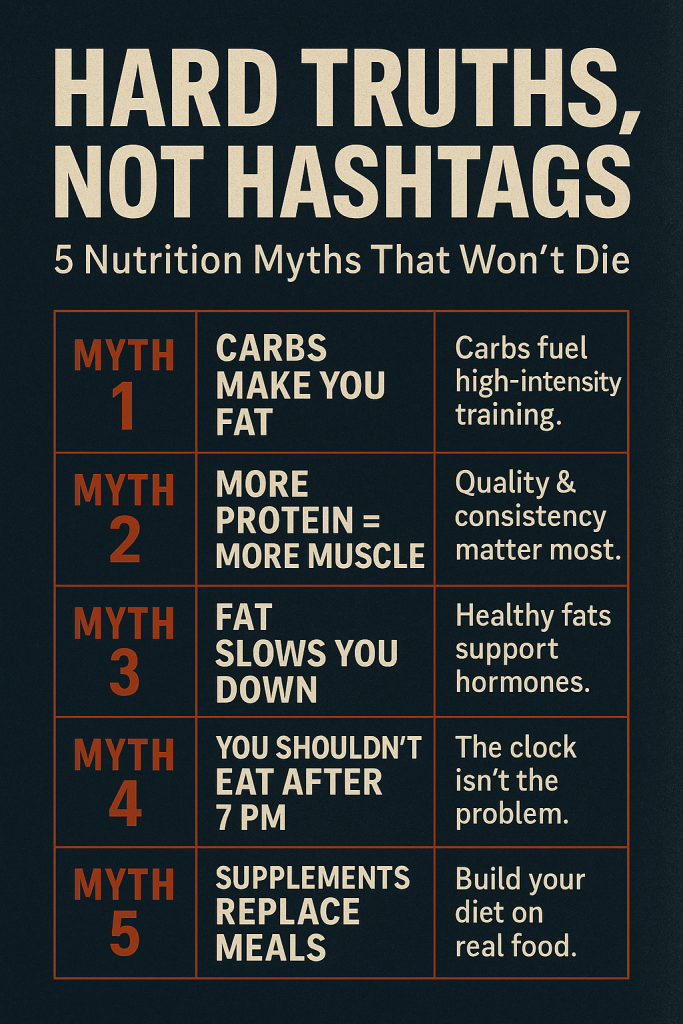
Hard Truths, Not Hashtags: 5 Nutrition Myths That Won’t Die

When you’ve trained on the mats, coached clients through cleans, kettlebell swings, and meal prep execution, and watched everyday athletes chase their performance goals, you start to see the myths vs reality.

The claims that sound sexy.

Some strategies seem fresh and innovative.

And there are promises that seem too good to be true and usually are.

Here are five of the most persistent nutrition myths that still persist in fitness culture to this day. These myths can hold back your progress, make your habits harder, and limit your performance.

Let’s put these myths to rest.

Myth 1: Carbs Make You Fat, So Avoid Them
The belief that carbohydrates are always “bad” is one of the oldest myths in fitness. Over time, people started to think of “carbs” as just donuts and soda, forgetting that fruits, vegetables, rice, and oats are also carbohydrates.

Carbohydrates are your body’s preferred fuel source for high-intensity movement. In sprinting, lifting, grappling, and EMOMs. When you cut carbs too aggressively, especially around training, you’re cutting the fuel that keeps the engine running and ready for its highest performance.

Of course, someone who doesn’t move much and eats 400 grams of sugary carbs every day will gain fat. But if you’re an athlete training 4 to 6 times a week and still avoiding fruit, you’re likely to struggle with recovery, mental clarity, and performance.

Carbs are not the problem. The real issues are poor timing, portion sizes, and choosing the wrong sources. It’s important to know the difference.

Myth 2: More Protein Equals More Muscle
It’s easy to think of protein as a magic solution for building muscle. But the idea that you can just drink more shakes and automatically grow isn’t true. Your body can only use a certain amount of protein at a time, and anything extra just adds calories.

If your training lacks volume, intensity, or progression, no amount of protein will magically build muscle. If your sleep is poor, your recovery window is compromised. And if your stress is off the charts, you’ll break down more than you build.

Think of protein as a critical piece of the puzzle, but not the only one. Focus on consistent daily intake (spread across meals), quality sources (whole food > processed powders), and real recovery habits. You don’t get stronger just by eating. You get stronger by absorbing nutrients after solid training and real rest.

Myth 3: Fat Slows You Down, Avoid It
Fat was blamed during the low-fat trends of the 1980s and 1990s, and some people still avoid it. Even now, many choose “fat-free” salad dressing and worry that eating an avocado will hurt their progress.

The truth is, healthy fats are needed for hormone production, joint health, cell repair, and brain function. Athletes who avoid fat for too long often have trouble sleeping, joint pain, low libido, or hormone problems.

You don’t have to add butter to your coffee or eat only bacon to benefit from fat. But if you’re training hard and still eating like it’s the 1990s, you’re missing out on better performance.

Balance your macronutrients to build a strong foundation.

Myth 4: You Shouldn’t Eat After 7 PM
This one sticks around like gym chalk on a black shirt. The belief is: eating late = fat gain. But what the science actually says is this: calorie balance, nutrient timing, and daily movement matter far more than the clock.

If you train in the evening, work a night shift, or just eat dinner late, you’re not hurting your progress. It’s your routine. The real problem is eating junk food late at night, snacking without thinking, stress-eating, or skipping meals earlier.

For athletes, skipping a meal after training just because it’s late can lead to poor recovery and insufficient sleep. Your body doesn’t track time; it just needs the right fuel.

Myth 5: Supplements Replace Meals
Supplements have become a billion-dollar industry promising shortcuts. But the truth? They’re called supplements for a reason. They supplement a well-rounded diet. They don’t replace one.

If your diet isn’t steady, you don’t drink enough water, and your sleep is poor, no supplement will fix your performance.

Whey protein is fine when you’re on the go. Electrolytes help when training volume is high. But if you’re leaning on powders, bars, or mystery potions more than you’re eating real food? You’re missing the point.

Eating real food leads to real results. Supplements are optional, but hard work, recovery, and whole foods are essential.

Bonus Myth That Needs to Be Busted Once and For All

You Need BCAAs to Build Muscle and Recover
Branched-chain amino acids (BCAAs) have been marketed like magic, drink this neon liquid, build more muscle, recover faster, dominate your workouts. But if you’re eating enough complete protein daily (think eggs, meat, fish, dairy, or quality whey), you’re already getting all the BCAAs your body needs.

The truth is, BCAAs are only three out of nine essential amino acids, and they don’t work alone. Building and repairing muscle needs all of them. Taking BCAAs instead of full protein is like bringing only a few bricks to a construction site and expecting to build a whole building.

This myth sticks around because supplement companies make a lot of money from BCAAs. They’re cheap to produce, easy to flavor, and simple to market to people who want quick fixes or think more is always better. Unless you train for hours without eating or have a very low protein diet, BCAAs aren’t necessary.

The bottom line: If you get enough protein each day, you don’t need BCAAs. Save your money and enjoy a good meal instead.

Why This Actually Matters
I’ve been in boardrooms, meal prep kitchens, and war rooms. I’ve been a fighter and sat across from fighters who measure life in rounds, and clients who measure progress in PRs.

The pattern is always the same:
Myths confuse, limit, and delay growth. But once you break your nutrition down into simple truths, reality & function over fad, you become harder to fool, harder to distract, harder to derail.

Field Notes: Your Mission This Week
Pick one myth above you’re still believing. Write it down. Then spend 10 minutes challenging it with real information.
Swap one habit: Still avoiding carbs around workouts? Try a simple “safe” carb on a heavy day. Watch how recovery and hunger change.
Track one metric: Not the scale. Maybe energy, sleep, or workout quality. Let that be your barometer, not guilt.
Talk it out: Share one busted myth with someone—client, teammate, or partner. Watch the shift when you trade confusion for clarity.

Nutrition is more than just eating. It’s about being ready for training, workouts, and daily life with the right fuel to help you succeed, not hold you back.

No More Macro Mayhem: How to Hit Your Numbers Without Losing Your Mind

After years of lifting, training, and meeting real-life performance demands, you realize your nutrition plan shouldn’t feel like another workout. But for many people, it turns into a tracking obsession, a spreadsheet habit, or a source of stress or anxiety every time you eat.

Let’s change that.

Why macros matter, but not how you think.

Macronutrients (protein, carbs, and fats) are the foundation of performance. They help your muscles rebuild, maintain hormonal balance, and support the overall recovery process. But knowing about them doesn’t mean you have to let them control you.

As the saying goes, precision doesn’t mean perfection. It means having a system. If you want to train hard and stay healthy for years, your nutrition shouldn’t wear you out mentally. It should feel natural, not like a burden.

Three Rules to Keep It Simple and Consistent

  1. In the Beginning, Pick Your Baseline and Repeat It
    Select one meal, either breakfast or lunch, that aligns with your nutrition goals and fits your daily routine. Use the same amount of protein, carbohydrates, and fat each time. If keeping it simple helps, don’t worry about making it exciting. Simple meals build structure, and structure leads to consistency.

    This meal becomes your anchor, helping you stay on track. After week one, you can start making small changes to keep your meals interesting while still keeping things simple.
  2. When Portioning, Simply Use Visual Portion Anchors
    Instead of chasing macros with a food scale, use your hands as portion tools:
    • Protein = palm of your hand
    • Carbs = cupped hand
    • Fats = thumb or small handful

      This method works for everyone from tactical athletes to Olympic weightlifters and CrossFit competitors. It’s not about being exact with every number. It’s about enjoying your food and reaching your goals by being consistent and making steady progress each day.
  3. Make Tweaks with Purpose, Not Panic
    Most people make changes too soon out of worry. Try not to do that. If your training feels off or you’re hungrier than usual outside of workout times, make minor adjustments instead: add +5% protein. +10% carbs. Be sure you’re consuming the bulk of your carbs around your training window.

    Here’s a bonus tip: Start by keeping notes. Each week, look back, notice any patterns, and make changes with confidence. Being consistent and clear is better than chasing new trends or getting distracted by outside opinions.

What Gets In the Way

Let’s be honest: people don’t miss their macros because they’re lazy. It happens because life gets busy, maybe you didn’t sleep well, your kids are sick, your workout got delayed, or work meetings piled up.

That’s why I follow a simple rule: plan your meals for the life you really have, not the one you wish you could organize. If your plan falls apart when things get unpredictable, it needs to be stronger. Don’t stress—just adapt and keep going.

That’s where coaching and real-world experience make the difference.

The Coach’s Corner

I’ve seen this happen with everyone I’ve coached—military members, athletes, and in my own nutrition journey, even while running a Paleo meal prep business. I always try to share these ideas and show people how to cook good food that supports real performance. The athletes who succeed over time don’t eat perfectly; they eat well and stay consistent. They build habits, rely on routines, and make their food work for them.

This Week’s Action Plan

  • Anchor a meal: Pick one go-to meal that hits your macros and repeat it 4–5 days this week.
  • Use your hands: Apply the visual anchor method to every other meal.
  • Track with context: Pick one training day and one rest day to log. How did you feel? What did you eat? Did it support recovery?
  • If necessary, adjust just one thing next week based on performance, energy, or hunger cues.

Final Word

This is about fueling your performance without burning out. Your training needs clarity, and your life needs structure. Eating well and hitting your macros shouldn’t feel like a burden. It can be the steady, powerful engine that keeps everything running smoothly in the background.

Try these strategies and let your nutrition support your best work, both in the gym and in your daily life.