Fat Isn’t Evil: It’s Essential

Picking up from where we left off last week — we’ve already dismantled the myths around protein and carbohydrates, now it’s time to put the final macronutrient into proper context.

In Week 3, we covered nutrient timing and why eating with intention matters. In Week 4, we cleared the air around carbs, showing they’re a necessary tool for fueling performance, not something to fear.

This week, we’re doing the same with fat, one of the most demonized and misunderstood components of the human diet.

Why This Matters:

Most people trying to ‘eat healthy’ unknowingly sabotage their energy, focus, and results by fearing fat. Understanding the truth lets you make smarter, less stressful choices in and out of the gym.

The Problem: Fat Got Blamed for What Sugar (and Sedentary Living) Did

The war on fat started in the 1970s and 80s, pushing people toward fat-free everything, from cookies to frozen dinners. What happened next?
• Obesity skyrocketed.
• Type 2 diabetes surged.
• People got sicker, not healthier.

Why? Because removing fat didn’t remove the problem. It just made food more processed, more sugary, and less satisfying.

Question:

Ever skip the avocado on your salad because you thought it was ‘too fattening’, then ended up hungry an hour later? Now, youre beginning to pick up what I’m puttin’ down.

What Fat Actually Does in the Body

Fat isn’t the enemy. It’s a required nutrient for:
• Hormone production (testosterone, estrogen, cortisol)
• Brain health and cognition
• Joint lubrication and recovery
• Fat-soluble vitamin absorption (A, D, E, and K)
• Cellular structure (yes, your cells are literally built from it)

But here’s the key: fat is fuel for low-intensity output and recovery, not high-performance explosive training. That’s where carbs step in.

Quick Fat Facts:

• Unsaturated fats (olive oil, nuts, avocado, fatty fish) support heart and brain health.

Saturated fats (animal fats, butter, coconut oil) are fine in moderation, especially from whole foods.

• Trans fats (partially hydrogenated oils) are in a different league; avoid them entirely. They wreak havoc on cholesterol and inflammation.

You need both fat and carbs, but at the right doses for the right goals.

Data Point:

Fat slows gastric emptying, helping you feel fuller for longer—a secret weapon against late-night snacking (British Journal of Nutrition, 2021).

Why “Healthy Fats” Doesn’t Mean “Unlimited Fats”

Yes, olive oil, avocado, nuts, and salmon are great, but overconsumption is still overconsumption.

Fat is energy-dense.
• 1 gram of fat = 9 calories
• That’s more than double protein or carbs (4 calories per gram)

So while you need it, you don’t need as much as you might think, especially if you’re already fueling with protein and carbs.

Most Common Fat Mistake:

Dousing salads, veggies, or “healthy” bowls with extra oil or nuts. Even good fats add up fast, so measure, don’t guess.

What This Looks Like in Practice

Swap:

Instead of fat-free salad dressing (loaded with sugar), use olive oil and vinegar for flavor, better absorption of nutrients, and longer-lasting energy.

Here’s how to build smart, balanced fat intake into your day:

Add a thumb-sized portion of fat to your main meals (nuts, oil, nut butter, avocado)
Don’t dump oil or butter onto every dish “for health;” it adds up fast
Keep fats lighter pre-workout, so digestion doesn’t slow you down
Post-workout, prioritize protein + carbs, not a heavy fat load
Evening meals can include more fats to help slow digestion and promote satiety

You don’t need to avoid fat, you need to respect it.

Visual Analogy:

Think of fat as the steady-burning logs on a campfire versus using pine needles: the dry pine needles can get the fire going, but don’t last. The logs are for warmth that lasts all night.

Now that we’ve set the record straight, here’s how to use fat like an anti-hero: deliberately, strategically, and never just because the label says “healthy.”

Action Challenge

For the next 3 days:
• Track how much fat you’re eating (rough estimate is fine)
• Identify where it’s coming from (meals vs snacks vs sauces/oils)
• Adjust one meal per day to intentionally include a measured fat source (e.g., 1 tbsp olive oil, 1/4 avocado, or 10 almonds)

You’ll start to see how easily fat sneaks in and how powerful it can be when used deliberately.

Coach’s Corner

• Fat is a recovery nutrient, not a performance one.
• Don’t go to war with it, just don’t treat it like a free-for-all either.
• Balance is your ally. Fat has its place, use it like a tool, not a reward.

Suggested Reading

“Deep Nutrition” by Dr. Cate Shanahan
A sharp breakdown of how traditional diets used fats well, and how we can reclaim that without getting lost in the noise.

Real-World Headline:

In 2024, a major study published in JAMA found that replacing just 5% of calories from saturated to unsaturated fat was associated with a significant reduction in cardiovascular risk. (Source: JAMA, April 2024)

Science Insight:

Regular consumption of omega-3 fatty acids (found in fatty fish, chia, and flaxseed) is associated with improved heart health and reduced inflammation, according to the American Heart Association (2023).

Quick Fact:

Contrary to old myths, moderate whole-egg consumption does not increase heart disease risk for most people (Harvard School of Public Health, 2022).

Key Takeaway: Your hormones, brain, and cells are built from fats. Don’t fear them, but definitely manage them.

Key Anti-Hero Move: Use fat on your terms, not the food industry’s. Portion is power.

Empowerment Challenge:

What’s one fat source you’ll add back this week? Try it, track it, and notice the difference. Anti-heroes don’t just read, they act.

What’s Coming Next

You’ve now got a full picture of the big three macros, but how do you put them together? In Week 6, we’ll map out what a real-world performance meal looks like, and how to adjust it for your goals, whether that’s training, leaning out, or staying sharp at work.

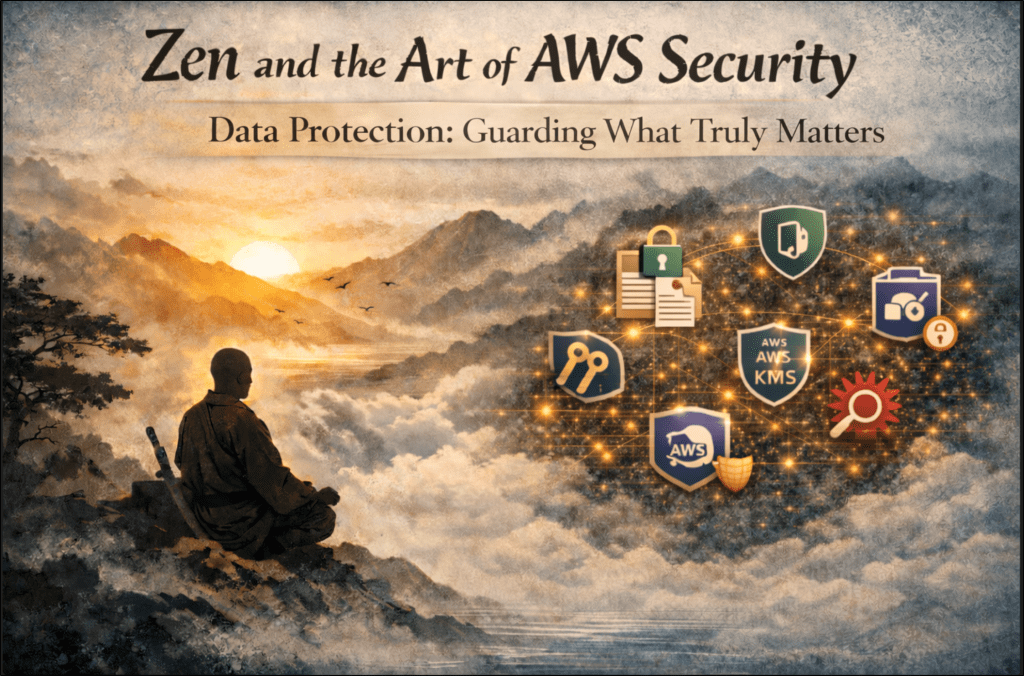
Zen and the Art of AWS Security Domain 5: Data Protection | Guarding What Truly Matters

There is an old saying that fits data protection perfectly:

“You don’t simply protect what you value. You protect what you cannot afford to lose.”

In AWS, data is that thing.

Not compute.
Not networking.
Not even identity.

Those exist to serve data.

This is why AWS treats data protection not as a single control, but as a layered discipline spanning encryption, access, durability, lifecycle management, and governance.

And this is why the exam tests how you think about protecting data, not just which checkbox you tick.

Why Data Protection Is Its Own Domain

Data protection answers one core question:

If everything else fails, what survives?

A secure AWS environment assumes:

  • credentials can be compromised
  • networks can be misconfigured
  • workloads can be attacked

Data protection is what prevents those failures from becoming irreversible losses.

On the exam, this domain tests whether you understand:

  • where data lives
  • how it is encrypted
  • who can access it
  • how it is recovered
  • and how its exposure is prevented by design

AWS’s Data Protection Philosophy

AWS data protection follows five principles:

  1. Encrypt everything, everywhere
  2. Control access separately from storage
  3. Assume data will move
  4. Protect backups as carefully as production
  5. Make exposure detectable, not silent

If your answer aligns with these principles, you are almost always on the right path.

Core Data Protection Controls (Exam-Critical)

Encryption at Rest, The Default, Not the Feature

AWS expects encryption at rest by default.

Services commonly tested:

  • S3
  • EBS
  • RDS/Aurora
  • DynamoDB
  • EFS
  • Redshift

Correct exam answers almost always include:

  • SSE-KMS (not SSE-S3 unless explicitly stated)
  • customer-managed CMKs for sensitive workloads
  • key rotation enabled

Exam mental model: If the data matters, AWS wants KMS involved. Exam mental model: If you see “KMS” think encryption and key management. If you see “SSE-S3” think storage-level encryption. If you see “Macie” think S3/PII monitoring—especially for sensitive data exposure. If you see “Secrets Manager” think credential lifecycle and rotation—never hardcode secrets.

Encryption in Transit is a Non-Negotiable

Encryption in transit protects data while it moves.

Look for:

  • TLS for ALBs/NLBs
  • HTTPS for APIs
  • encrypted database connections
  • mutual TLS in higher-security scenarios

If the question mentions:

  • “data in transit”
  • “between services”
  • “across VPCs or accounts”

Encryption in transit is required.

AWS Key Management Service (KMS) | Control, Not Convenience

KMS is not “just encryption.”

It provides:

  • key policies (resource-based)
  • IAM integration
  • auditability via CloudTrail
  • centralized control
  • automatic rotation (for CMKs)

On the exam:

  • KMS = security
  • service-managed keys = convenience

If the scenario mentions compliance, separation of duties, or auditability → choose KMS.

Secrets Management | Never Hardcode Trust

AWS expects secrets to be:

  • rotated
  • auditable
  • centrally managed

Primary services:

  • AWS Secrets Manager
  • SSM Parameter Store (SecureString)

Exam preference:

  • Secrets Manager for rotation-heavy use cases
  • Parameter Store for simpler workloads

If credentials appear in:

  • code
  • AMIs
  • user data
  • config files

That is a deliberate trap.

Amazon Macie | Data Awareness

Macie detects:

  • sensitive data in S3
  • PII exposure
  • unintended public access
  • anomalous access patterns

If the question includes:

  • “PII”
  • “sensitive data discovery”
  • “S3 data exposure”

Macie is the correct answer.

Backups & Durability | Security’s Quiet Backbone

AWS treats backups as security artifacts.

Correct patterns include:

  • AWS Backup
  • cross-region backups
  • cross-account backups
  • immutable backups (where applicable)
  • restricted restore permissions

If ransomware or deletion is mentioned: Backups + restricted access are mandatory.

High-Yield Exam Patterns

  • Encryption everywhere → KMS
  • Sensitive S3 data → Macie
  • Credentials → Secrets Manager
  • Compliance → customer-managed CMKs
  • Backups → cross-account, encrypted
  • Exposure prevention → least privilege + monitoring

These patterns answer a large percentage of Domain 5 questions.

The Philosophical Layer: What Data Protection Really Is

Data protection is not paranoia. It is respect.

Respect for:

  • the people whose data you store
  • the systems that depend on it
  • the trust placed in you as a steward

In martial terms, this is guarding the centerline.

You don’t need to chase every strike to protect yourself against them. You only protect what, if lost, will end the fight.

AWS data protection works the same way:

  • encryption limits blast radius
  • access control limits misuse
  • backups ensure recovery
  • monitoring ensures visibility

This is calm, disciplined defense, not fear-driven security.

Closing: Quiet strength is the test. Not panic. Not noise. Not drama.

Data protection is rarely visible when done well.

There are no alerts.
No dashboards screaming.
No hero moments.

And yet:

  • breaches are survivable
  • incidents remain contained
  • recovery is possible
  • trust endures

On the exam, and in production environments, this domain rewards patience, clarity, and restraint.

Security without pessimism lives here. Protect the data. Everything else is replaceable. In AWS, as in life, what you protect quietly is what endures.

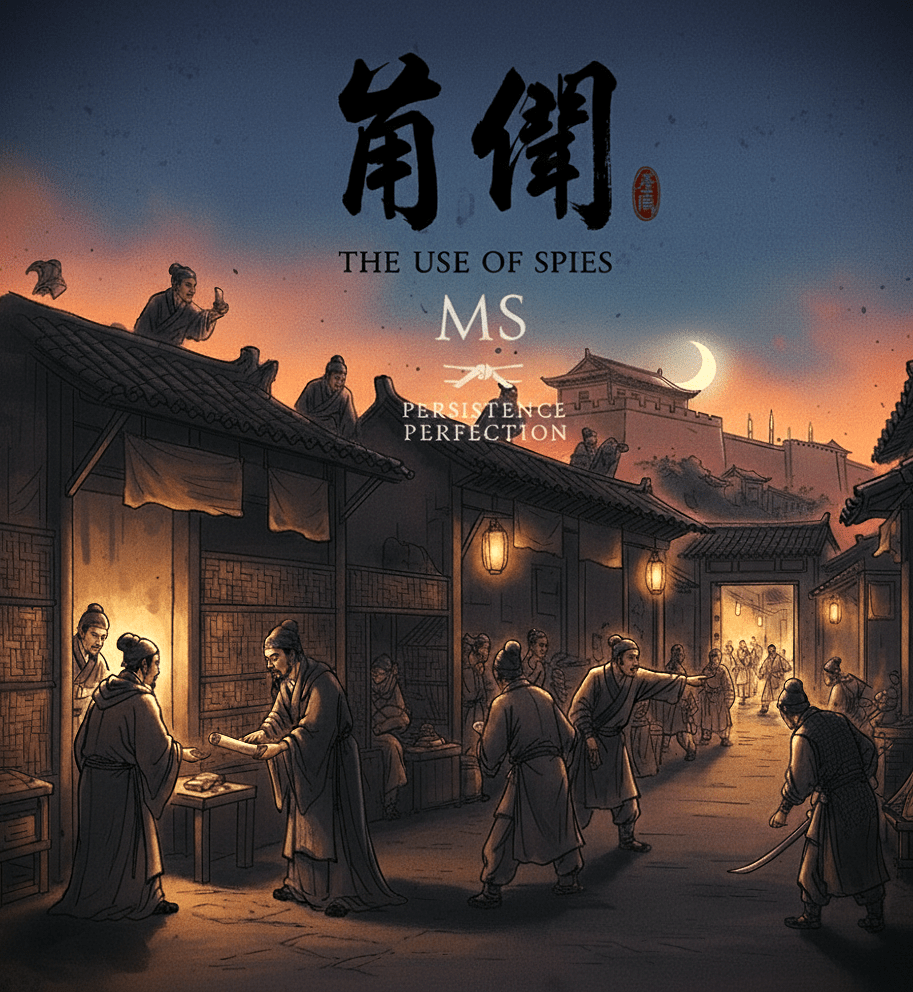
The Art of Cyberwar | Part XIII | The Use of Spies

The principles:

“Knowledge of the enemy’s dispositions can only be obtained from other men.”

“However, spies cannot be usefully employed without a certain intuitive sagacity.”

“Be subtle and use your spies for every kind of business.”

“Hence, it is only the enlightened ruler and the wise general who will use the highest intelligence of the army for purposes of spying, and thereby they achieve great results.”

The Quiet After the Fire

After the smoke clears, the last weapon isn’t destruction; it’s knowledge. Sun Tzu closes his book here, not with conquest, but with insight. The general who knows through others, he says, wins without fighting. The one who fights without knowing spends blood buying what wisdom could have earned.

In modern form, intelligence replaces escalation. Information, verified and interpreted, is the ultimate force multiplier.

The Five Spies

Sun Tzu’s framework remains elegant and practical. He identifies five types of spies, each still alive and well in today’s cyber and geopolitical landscape.

  1. Local spies = insiders, collaborators, citizens.
    • Modern analogue: human intelligence, insider threat programs, whistleblowers, or local analysts embedded in culture.
    • Lesson: you can’t know an environment without someone who breathes its air.
  2. Inward spies – the enemy’s own people who provide insight.
    • Modern analogue: defectors, double agents, internal whistleblowers, or compromised insiders in adversary organizations.
    • In cyber: infiltration of adversary forums, threat actor telemetry, or behavioral analysis of attacker TTPs.
  3. Converted spies – enemy agents who have been turned.
    • Modern analogue: captured malware turned into indicators, enemy disinformation repurposed for exposure.
    • Intelligence and counterintelligence merge – data becomes self-revealing.
  4. Doomed spies – agents sent with false information, knowing they will be sacrificed.
    • Modern analogue: honeypots, decoy networks, misinformation campaigns used to draw out adversaries.
    • Lesson: deception has cost; calculate it.
  5. Surviving spies – those who return with verified knowledge.
    • Modern analogue: analysts who gather, vet, and integrate multiple data sources to produce actual intelligence.
    • Lesson: data isn’t knowledge until it’s interpreted and fed back into strategy.

The five together form a complete intelligence loop: gather, plant, deceive, sacrifice, verify.
Today, we refer to this as the intelligence cycle.

Information as the New Espionage

We live in an age where everything and everyone collects or steals your data. Apps harvest movement. Sensors record temperature and tone. Governments build databases so vast they blur into prophecy.

But the principle hasn’t changed: intelligence is not about having information – it’s about understanding what matters and when.

A terabyte of telemetry means nothing without discernment. One well-placed attacker can outperform a thousand firewalls.

Foreign Policy and the Failure of Insight

Throughout the 20th century, U.S. foreign policy often suffered from information abundance but a lack of the ability to interpret the intelligence it had gathered.

  • Pearl Harbor: a multitude of signals existed, but interpretation failed.
  • Vietnam: metrics replaced meaning – body counts masquerading as progress.
  • Iraq WMDs: intelligence distorted to paint a specific picture rather than inform decision-making.
  • Afghanistan: decades of data existed without a clear endgame, destroyed thousands of American lives, and wasted trillions of taxpayers’ dollars.

Each case proves Sun Tzu’s point: “If you know neither the enemy nor yourself, you will succumb in every battle.”

Intelligence was there, but self-awareness wasn’t. Knowing isn’t only about them; it’s about seeing what you refuse to see in yourself.

Cyber Intelligence: Seeing Without Touching

In cybersecurity, the “spies” are telemetry, sensors, analysts, and sometimes friendly adversaries.
Every alert, log, and anomaly is a scout’s report. But like all intelligence, its value depends on interpretation.

  • Local spies: internal logs and behavior analytics.
  • Inward spies: penetration testing, red-team operations, insider threat programs.
  • Converted spies: captured malware and attacker infrastructure repurposed for defense.
  • Doomed spies: honeypots, deception networks, and fake data seeds.
  • Surviving spies: analysts, threat-hunters, and intel-sharing alliances.

The objective is clarity without exposure, to see everything while remaining unseen. Fire consumes, intelligence illuminates.

The Moral Dimension of Knowing

Intelligence work carries moral weight. Spies, human or digital, trade in trust. Sun Tzu demands that the general handle them with the highest regard: reward them generously, guard them carefully, and never waste them carelessly.

The ethical parallel today is privacy. The line between intelligence and intrusion is measured in intent and restraint. Knowledge gathered without purpose is voyeurism. Knowledge used without reflection is manipulation.

Sun Tzu’s ideal: learn enough to prevent war, not to justify one.

Strategic Lessons for Leaders

  1. Listen to your scouts.
    Truth often arrives quietly, wrapped in discomfort. Leaders who dismiss dissent lose foresight.
  2. Reward information honestly.
    Transparency and gratitude feed the flow of truth; fear and ego choke it.
  3. Centralize interpretation, not collection.
    Many sensors, one mind – unified analysis, decentralized data.
  4. Balance secrecy with accountability.
    Intelligence held too tightly becomes blindness.
  5. Use information to avoid fire.
    The goal of knowledge is to make destruction unnecessary.

From Fire to Silence

The transition from Attack by Fire to Use of Spies is the book’s moral hinge. After escalation comes discernment; after destruction, discipline.

Sun Tzu understood what modern states and corporations often forget: Force is crude, information is subtle – and subtlety wins the wars that power cannot.

In cybersecurity, this is the move from reaction to anticipation. In foreign policy, it’s the evolution from aggression to diplomacy. In leadership, it’s the shift from command to comprehension.

The best security posture isn’t dominance – it’s awareness. The most powerful army is one that rarely fights.

Epilogue — The Quiet Art

The Art of War ends not with blood or banners, but with silence, a stillness that comes from mastery.

True security, like true wisdom, is invisible.
It doesn’t announce itself.
It doesn’t need to.

When you know yourself and your adversary, every threat is already half-dissolved. When you act only when necessary, victory becomes maintenance rather than spectacle. And when you can learn from what moves unseen, you stop fighting the same battles over and over again.

As Operation Aurora proved, a sophisticated cyber espionage campaign that quietly infiltrated major tech companies, the side with better intelligence rarely needs to escalate; quiet knowledge can outmaneuver brute force.

That’s the art of cyberwar – when you know yourself and your adversary, every threat is already half-dissolved. When you act only when necessary, victory becomes maintenance rather than spectacle. And when you can learn from what moves unseen, you stop fighting the same battles over and over again.

That is the final lesson of Sun Tzu, and of cyberwar:
Not destruction, but understanding.
Not conquest, but control of your own attention.
Not escalation, but insight.

Not noise, but silence.

The art is not in the fight, but in the knowing. Return always to the principle: “Knowledge of the enemy’s dispositions can only be obtained from other men.”

And, in the end, mastery is realizing you rarely need to fight at all.

How Much Protein Do You Actually Need?

Forget hype. Here’s what science and results actually say.

Protein is the most misunderstood macronutrient in nutrition. It’s essential for more than just muscles or fitness; protein underpins your energy, brain function, and long-term health.
Most people fall into one of two groups:

  • Under-eaters, living off snacks, smoothies, and “light” meals.
  • Over-obsessors, hitting 300 grams a day and still thinking it’s not enough.

Both miss the point.

The goal isn’t to chase numbers; it’s to consistently eat enough to support muscle, recovery, cognition, and metabolic health.

Let’s walk through what actually matters and help you stop guessing.

The Real Job of Protein

Protein isn’t a magic fat burner. It’s not a cheat code. It’s a raw material, and your body needs it daily for:

  • Muscle repair and growth
  • Tendon and ligament recovery
  • Immune system function
  • Neurotransmitter production
  • Skin, hair, and tissue health

No fad diet, cleanse, or cutting phase changes that. Protein is required every day, not just “on training days.”

Think of protein as the bricks and mTOR as the foreman. Without enough bricks, the foreman can’t build or repair anything.

Trust “The Science“: Protein activates a pathway called mTOR, which acts as your body’s ‘growth command center.’ When you eat enough protein, mTOR signals your cells to repair, build muscle, and recover efficiently. Skimp on protein, and that signal never fires at full strength.

Multiple studies show that eating 25–40g of protein per meal maximizes muscle protein synthesis in adults (Morton et al., 2018). People who consistently meet their protein needs tend to retain more muscle as they age and recover faster from injuries.

Myth-busting:

Myth: “Too much protein will damage your kidneys.”

Reality: For healthy people, there’s no evidence that moderate-to-high protein intake harms kidney health. (See: National Kidney Foundation, 2017)

How Much Protein You Actually Need

Here’s what current science says, without the influencer fluff:

Sedentary0.6 – 0.8 g/lb
General Training0.8 – 1.0 g/lb
Strength / Hypertrophy1.0 – 1.2 g/lb
Cutting / Deficit1.2 – 1.4 g/lb

All ranges above are based on your target body weight, not your current weight, and definitely not your high school dream-physique weight. If you’re 180-200 pounds and lifting 3–5x/week, your target likely falls around 180–200g/day — not 300g+ and not 80g from “lean” meals and vibes. Now, depending on how much intensity you’re cranking up, you’ll have an additional need for carbohydrates, not protein.

Practical Ways to Hit Your Target

Protein isn’t just chicken breast and powder. Here’s what works for me and examples of how I actually hit my numbers every day without burning out:

Solid protein sources (per serving):

  • Chicken, turkey, smoked salmon, tuna, shrimp, beef, eggs
  • Greek yogurt, cottage cheese
  • Whey, casein, or egg white protein (smartly used, not overused)
  • Protein-forward meal replacements (e.g., a “complete” protein shake, a FairLife, RX bars, jerky only when needed/planned)

Underrated strategies:

  • Aim for 25–50g of protein per meal, instead of grazing on 10g snacks. A palm-sized portion of chicken, tofu, or fish is usually around 25g of protein—use your hand as a guide if you don’t want to count.
  • Don’t rely on just dinner to “catch up”
  • Use high-protein staples to plug into busy days (e.g. 8 oz chicken = ~50g, two scoops whey = 21-25g, ½ cup of yogurt + ½ cup of cottage cheese + 1 cup of fruit of your choice)

You don’t need a perfect plan. You need a repeatable system. A “protein-first” mindset simplifies the rest of your day.

Week Two Action Challenge:

Pick 3 protein staples that match your schedule and eat them for the next 3 days.

  • These should give you 30–40g per meal.
  • Rotate them between breakfast, lunch, dinner, or post-training
  • Make it frictionless, not fancy.

The goal: clarity, consistency, and a structure that supports your real life.

Protein isn’t just for athletes; it’s for everyone who wants to stay strong, energized, and resilient for life. Just like with your habits, it’s about building a system that makes the right choice automatic.

Coach’s Corner:

  • Protein is the most forgiving macro, but only if you get enough.
  • Hit your baseline. Track it once, then automate it.
  • Build around meals, not snacks.

Suggested Reading:

“The Protein Book” by Lyle McDonald
Dense, thorough, science-backed, and extremely useful for athletes or serious lifters.

Key Takeaway:

Protein isn’t about hitting a magic number; it’s about consistently meeting your needs so you can reach your life and training goals, whatever those are.

Once you get it right, energy balance improves, recovery speeds up, and hunger stabilizes.

Everything else becomes easier.

That’s all for this week. Let me know if this helps!

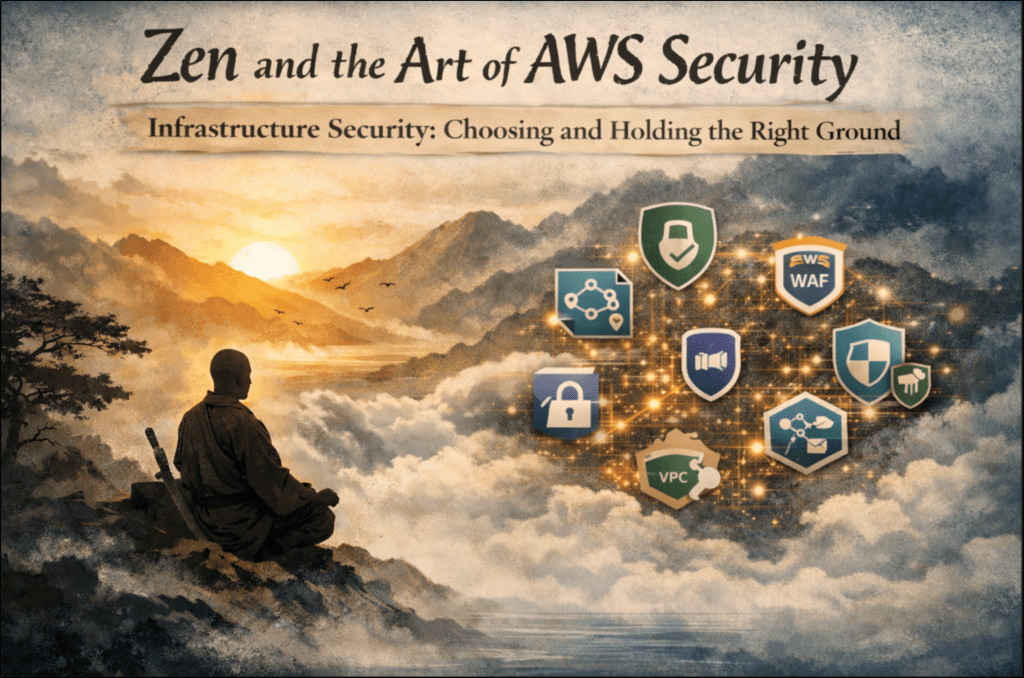
Zen and the Art of AWS Security Domain 3: Infrastructure Security | Choosing and Holding the Right Ground

There’s an old principle in strategy that applies as cleanly to cloud architecture as it does to combat: “The battle is often decided before the first move is made.”

In AWS, that decision is infrastructure security. Not firewalls alone. Not encryption alone. Not identity alone.

Infrastructure security is about where you place systems, how they connect, and what paths are intentionally left open, or closed, long before an attacker arrives.

If Detection is awareness, and Incident Response is discipline, then Infrastructure Security is terrain. And AWS cares deeply about terrain.

1. AWS’s Philosophy of Infrastructure Security

AWS assumes three things that shape every exam question in this domain:

  1. Networks are software-defined, not physical perimeters
  2. Segmentation beats fortification
  3. Blast radius matters more than absolute prevention

This is why AWS infrastructure security is built around:

  • isolation
  • segmentation
  • least connectivity
  • explicit network paths
  • and controlled exposure

If an answer choice tries to “lock everything down globally,” it’s usually wrong. AWS prefers intentional exposure over accidental openness.

2. The Core Infrastructure Security Pillars

Infrastructure security questions almost always reduce to one (or more) of these pillars:

  1. Network isolation
  2. Traffic control
  3. Private connectivity
  4. Service exposure boundaries
  5. DDoS resilience

If you can identify which pillar is being tested, the correct answer becomes obvious.

3. VPC Design: Isolation Is the Default

At the heart of AWS infrastructure security is the VPC.

Exam truth: If a resource doesn’t need to be public, it shouldn’t be.

High-yield concepts:

  • Private subnets for most workloads
  • Public subnets only for controlled ingress/egress
  • NAT Gateways for outbound-only access
  • No direct internet exposure—ever—unless required

Exam mental model: Public access is a deliberate exception, not the baseline.

4. Security Groups vs. NACLs – This Still Trips People Up

AWS loves testing this distinction.

Security Groups

  • Stateful
  • Instance-level
  • Allow rules only
  • Primary enforcement point

Network ACLs

  • Stateless
  • Subnet-level
  • Allow and deny rules
  • Coarse-grained control

Exam shortcut: If the question is about precise control, use Security Groups. If it’s about broad subnet filtering, use NACLs. If both appear as options, AWS usually wants Security Groups.

5. Controlling Traffic Paths, Not Just Blocking Traffic

Infrastructure security isn’t just about denial; it’s about routing intentionally.

Key services:

  • VPC Route Tables
  • Internet Gateways
  • NAT Gateways
  • VPC Endpoints (Gateway & Interface)

High-yield exam concept:

If AWS services should be accessed without traversing the internet, the answer is almost always: VPC Endpoints

This shows up constantly for:

  • S3
  • DynamoDB
  • KMS
  • Secrets Manager
  • Systems Manager

Mental model: Private traffic beats filtered public traffic every time.

6. Load Balancing and Exposure Control

AWS does not expect you to expose instances directly.

Instead:

  • ALB for HTTP/HTTPS
  • NLB for high-performance TCP/UDP
  • Internal load balancers for private services

Exam rule:
If traffic needs inspection or TLS termination → ALB
If performance and static IPs matter → NLB

Direct instance exposure is almost always a wrong answer.

7. DDoS Protection: Built-In, Not Bolted On

AWS assumes you will be targeted.

Infrastructure security includes:

  • AWS Shield Standard (always on)
  • AWS Shield Advanced (for high-risk workloads)
  • CloudFront + WAF for edge protection

Exam pattern: If the question involves:

  • volumetric attacks
  • Layer 7 threats
  • global availability

The answer usually includes:
CloudFront
AWS WAF
Shield

Defense through scale is a core AWS advantage.

8. The Exam Patterns That Matter

Pattern #1 Reduce Blast Radius

Choose:

  • smaller subnets
  • separate VPCs
  • multiple accounts

Over:

  • one massive flat network

Pattern #2 Prefer Private Connectivity

VPC endpoints beat:

  • public endpoints
  • IP whitelisting
  • internet gateways

Pattern #3 Use Managed Services When Possible

AWS prefers:

  • managed load balancers
  • managed DDoS protection
  • managed routing

Less custom = less risk.

9. The Martial Parallel: Choosing the Ground

In strategy, you don’t fight everywhere.

You choose:

  • narrow paths
  • defensible positions
  • terrain that limits your opponent’s options

Infrastructure security does the same thing. A flat network invites chaos. A segmented network channels behavior. Attackers aren’t always stopped; they’re contained. And containment wins.

For example, a major breach in 2019 exploited a flat network without segmentation, allowing attackers to move laterally across dozens of workloads. Had strict subnetting and NACLs been in place, the impact would have been far smaller.

10. Closing: Architecture Is the First Defense

Infrastructure security is quiet.

When it’s done right:

  • nothing dramatic happens
  • nothing breaks
  • nothing escalates

But when it’s wrong, no amount of detection or response can save you.

AWS rewards architects who:

  • think in boundaries
  • design for failure
  • assume compromise
  • and limit consequences

CIS Control 13 and NIST CSF both emphasize network segmentation and limiting exposure as foundational security practices.

A frequent pitfall is relying solely on Security Groups for segmentation, especially in environments with compliance or subnet-level boundary requirements, and overlooking the value of NACLs for coarse-grained, subnet-level protection. In layered security, redundancy is a strength. And with the VPC Reachability Analyzer, AWS now makes it easier than ever to verify and audit your network paths.

As AWS’s Well-Architected Framework advises: “Apply security at all layers.” These principles echo patterns are seen in AWS re:Invent security keynotes and in major cloud breach postmortems.

Security without pessimism continues here.

Not by building walls everywhere but by choosing the right ground and holding it calmly.

In AWS, as in strategy, victory belongs to those who shape the ground before the battle begins.

Remember, cloud security evolves quickly; architects who regularly review new AWS features and industry breach lessons maintain the sharpest edge. But for the exam, stay focused on what’s covered in the content outline provided by AWS for the exam. After you pass, you can ad lib. Until then, stay focused on the material that AWS expressly states is covered on the exam.

New Year’s Day: The Moment Between Who You Were and Who You’re Becoming

There’s a quiet, almost sacred moment in the days around the New Year, a pause between what’s behind you and what’s ahead.

A moment when the noise drops, the pace slows, and you can finally hear yourself think.

This is the place where growth actually happens. Not in the fireworks, not in resolutions shouted into the void, but in the stillness where you decide, honestly and without ego, who you want to be in the year ahead.

Before we talk about goals, habits, or protocols, take one breath and look back at the year you lived.

Not with judgment. With gratitude.

You made it through things you didn’t plan for and didn’t ask for.
You showed up on days when the last thing you wanted was responsibility.
You trained when you were tired, worked when you were stretched thin, and grew in ways you didn’t see happening in real time.

You earned wisdom this year, through effort, mistakes, repetition, and resilience.

Before stepping forward, be sure to honor what got you here.

What the Old Year Teaches Us (If We Let It)

Every year leaves you with lessons, most of which don’t announce themselves loudly:

  • You learned what drains you and what restores you.
  • You learned who adds to your life and who subtracts from it.
  • You learned which habits pull you closer to the person you want to be, and which ones drag you away.
  • You learned exactly how strong you can be when you don’t have a choice.

And if the year felt heavy? Good. Heaviness can teach, build, and help you reveal what’s real.

Gratitude doesn’t erase difficulty, but it can help you reframe it.

The Catalyst: Where Reflection Meets Action

Reflection is where wisdom is found. Action is where progress is made.

And New Year’s Day is the catalyst between the two, the moment you get to carry forward everything that served you and release everything that didn’t.

The turning of the calendar doesn’t magically transform you. It simply provides a precise date to keep measuring from.

It’s not a “new version” of yourself, just a more consistent one.

The New Year Activation Protocol

Your blueprint for the next 30, 60, and 90 days. These are the habits that actually move the needle.

These aren’t resolutions. They’re behaviors and behaviors build identity.

No more, “New year, new me!” Nonsense.

1. Choose Your Anchor Habit

Start with one non-negotiable daily action you can sustain even on your busiest days:

  • 20-minute walk
  • Protein at every meal
  • 10 minutes of mobility
  • 15 minutes of reading each night before bed
  • One short lift session – make it 10-20 minutes to help get the ball rolling if you have to

Your anchor habit becomes the spine of your discipline.

2. Clarity Over Motivation

Motivation is a spark, but sparks fade fast. Discipline and clarity are your compass.

Define your goals in behaviors, not wishes:

No: “I want to lose weight.”
Yes: “I’m hitting my protein target daily.”

No: “I want to get healthier.”
Yes: “I’m sleeping 7-8 hours per night (and make the necessary changes to make it happen)  and 15-20 minute walk daily. ”

Specific. Measurable. Repeatable.

3. Identity-Based Goals

Willpower is unreliable. Discipline is consistent.

Decide:

“I am someone who trains.”
“I am someone who eats with intention.”
“I am someone who gets up when life knocks me down.”

Then act in alignment, chasing persistence, not perfection.

4. Protein, Hydration, Sleep – the Unbreakable Trio

Forget New Year fads. These three change everything:

  • 30–40g protein per meal
  • 2–3L water per day
  • A sleep routine (sleep hygiene) that doesn’t involve doom scrolling – think reading…a book, that’s not on your phone!

These give you strength, recovery, mental clarity, emotional bandwidth, and energy.

5. The Rhythm → Not the Rush

Don’t sprint into January. Build a rhythm you can maintain into February, March, and beyond.

Your goal isn’t intensity, it’s consistency. Next thing you know it will be January of 2027.

Why This Year Will Be Different

Because this year, you’re not chasing perfection. You’re choosing persistence and consistency in your decision-making.

You’re not rewriting or “redefining” yourself, you’re simply refining yourself. You’re not waiting to feel ready. You’re starting *now* with small, steady, confident decisions.

This is the year you build momentum quietly, relentlessly, and intentionally.

And by the time you look up, you’ll be further along than you expected, not because you changed who you are, but because you committed to who you’re becoming.

Final Note – person to person

You don’t owe the world a reinvention this year. You owe yourself consistency.

Be thankful to yourself for showing up.
Be thankful to yourself for putting in the effort.
Be thankful to yourself for your strength, discipline, humor, humility, and humanity.

On the Lunar calendar, this is the Year of the Fire Horse. In Chinese tradition, the Fire Horse isn’t about luck or superstition; it’s about momentum. It’s about energy that moves forward on its own. Strong, independent, and restless in a good way. The kind of year that rewards people who are relentlessly moving forward and who enjoy the process.

So don’t rush. Just keep moving with a purpose. Do the work that matters to you. Build your momentum quietly and simply let it compound.

Keep fueling your fire and honoring your desires. May this New Year be steady and strong, full of the kind of momentum you earn, protect, and carry with you everywhere you go.

Happy New Year, my friend. Let’s make it count.

And remember: at midnight, open the back door to release the old year and whatever hardships came with it. Then open the front door to welcome the new year in, inviting luck, health, and fresh starts.

And be sure to wish your neighbors Athbhliain faoi mhaise duit!

Onward and Upward!

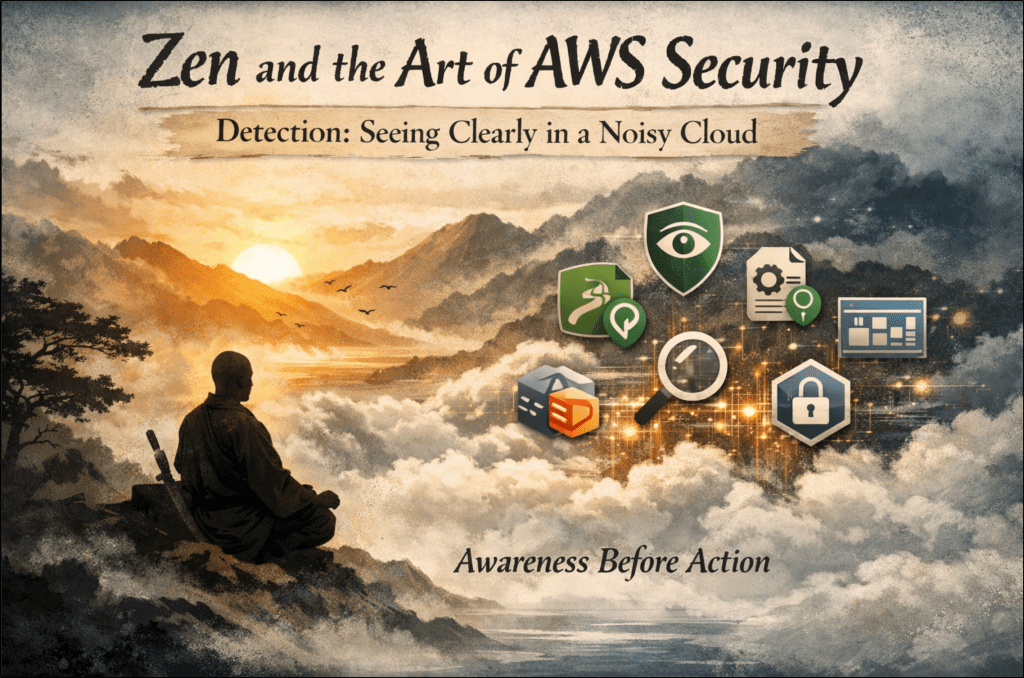
Zen and the Art of AWS Security | Domain 1 | Detection

Domain 1: Detection – Hearing and Seeing Clearly in the Cloud

There’s a saying in martial arts that applies perfectly to cloud security: “Awareness prevents more fights than strength.”

Most people think security begins with blocking, encryption, denial, and restriction. But AWS and attackers know differently. The real starting point is detection. You can’t defend what you can’t see, and you can’t respond to what you never noticed.

This is why Detection is Domain 1 on the AWS Security Specialty exam. Not because it’s the most technical topic, but because every other domain depends on it.

Identity, data protection, incident response, and infrastructure security all collapse the moment visibility disappears. In the cloud, as in combat, clarity is the highest security control.

1. AWS’s Philosophy of Detection

AWS designs detection around a core assumption: You cannot rely on perimeter security in a distributed, API-driven system.

Instead, AWS builds around three principles:

  1. Every meaningful action must generate a log. Not optional. Not “best effort.” Mandatory.
  2. Threat detection must be continuous and automated. The cloud moves faster than human reaction time.
  3. Context matters more than isolated events. A single API call means very little.
    A pattern of calls can mean everything.

The exam tests whether you understand this mindset—not whether you memorized service names.

Once you internalize the philosophy, the questions stop feeling tricky. They start feeling predictable.

2. Core Detection Services – What They Do & Why AWS Tests Them

Below is the high-value, exam-relevant, no-fluff breakdown of AWS detection services, explained the way AWS expects you to reason about them.

AWS CloudTrail – The Source of Truth, Telling You Who Did What

CloudTrail records:

  • Who made the request
  • When it occurred
  • From where
  • Against which service
  • And the result

If a question mentions API activity, auditing, investigation, or root cause, the correct answer almost always includes:

  • CloudTrail enabled
  • centralized log storage (S3)
  • encryption (SSE-KMS)
  • optional CloudTrail Insights for anomalies

Exam mental model: If you’re reconstructing events, start with CloudTrail.

Case in point: In 2019, Capital One suffered a major data breach in their AWS environment. Investigators traced the attack using CloudTrail logs, which revealed how a misconfigured firewall and stolen credentials allowed unauthorized access. This incident underscores why robust detection and logging aren’t just about passing the exam; they’re essential for real-world defense and forensic investigation.

CloudTrail isn’t just a checkbox when breaches happen; it’s often the first and last line of forensic defense.

AWS Config – The Historian Letting You Know What Changed?

Config tracks:

  • configuration changes
  • compliance drift
  • deviations from approved baselines

If the question mentions misconfiguration, continuous compliance, governance, or drift, the answer is:

  • AWS Config
  • Config Rules
  • Aggregators (for multi-account visibility)

Exam pattern callout: If a question mentions misconfiguration, compliance drift, or unexpected changes, AWS Config is usually the answer.

Exam mental model: If something shouldn’t have changed, but did, Config already knows. Config is your early warning system for risky changes, catching drift before it becomes a compromise.

Amazon GuardDuty – The Sentinel Letting You Know “If Anything Is Behaving Abnormally

GuardDuty detects:

  • anomalous IAM behavior
  • malicious API usage
  • compromised EC2 instances
  • suspicious network activity
  • data exfiltration indicators

It is:

  • agentless
  • continuously running
  • driven by AWS threat intelligence

If the question mentions anomaly, unexpected behavior, suspicious activity, or threat intel, the answer is almost always: GuardDuty

Exam pattern callout: If the question mentions anomaly detection, threat intelligence, or suspicious behavior, GuardDuty is the right choice.

Exam mental model: When AWS wants you to detect weirdness, choose GuardDuty.

GuardDuty’s findings are your heads-up display—if it’s alerting, pay attention before a minor issue becomes a major breach.

Amazon Detective – The Investigator, Tells You Why Things Happened

Detective correlates:

  • CloudTrail
  • GuardDuty
  • VPC Flow Logs

…into a graph-based model showing relationships between events.

If the question mentions:

  • root cause analysis
  • investigation
  • relationships between actions
  • tracing an incident timeline

The answer likely includes: Detective

Exam pattern callout: For root cause analysis, investigation, or connecting actions across services, Detective is the answer.

Exam mental model: GuardDuty alerts you. Detective explains it.

Detective is your investigation toolkit, connecting the dots when the story isn’t obvious from a single log or alert.

AWS IAM Access Analyzer – The Boundary Checker

Access Analyzer identifies:

  • unintended public access
  • unintended cross-account access
  • overly permissive resource policies

If the question involves:

  • S3 exposure
  • IAM trust policies
  • KMS, ECR, or EKS access
  • cross-account risk

Answer: Access Analyzer

Exam pattern callout: If the question involves S3 exposure, overly permissive policies, or cross-account access, think Access Analyzer.

Exam mental model: Resource policy exposure = Access Analyzer.

Access Analyzer is your reality check, proactively surfacing risky permissions before the wrong person finds them.

AWS Security Hub – The Fusion Center

Security Hub:

  • aggregates findings
  • normalizes severity
  • provides centralized visibility

It pulls from:

  • GuardDuty
  • Inspector
  • IAM Access Analyzer
  • Macie
  • custom sources

If the question says “centralized findings”, “single pane of glass”, or “consolidated security view”, the answer is: Security Hub

Exam pattern callout: If the question asks about centralized findings, “single pane of glass,” or consolidated security data, Security Hub is the answer.

Exam mental model: Security Hub does not detect. It collects.

Security Hub is your security operations dashboard where all findings converge for centralized action.

3. Detection Exam Patterns – These Score You Points Quickly

AWS exam writers love pattern recognition.

Memorize these:

  1. “Who did what?” → CloudTrail
  2. “Unexpected behavior” → GuardDuty
  3. “Investigate a finding” → Detective
  4. “Cross-account exposure” → Access Analyzer
  5. “Continuous compliance” → Config
  6. “Centralized visibility” → Security Hub

These patterns alone solve a large percentage of Domain 1 questions.

4. Detection Is the Art of Paying Attention

Detection is not about tools. Tools amplify awareness; they don’t replace it.

Attackers understand this. That’s why social engineering works: it hijacks attention.

Propaganda uses the same mechanism:

  • control attention
  • shape perception
  • influence behavior

Detection in AWS is the defensive inversion of that logic:

Expand awareness → clarify perception → prevent escalation.

Detection isn’t about catching bad actors. It’s about not being surprised.

In martial arts, that’s everything. If you anticipate the strike, the strike no longer matters.

5. The Martial Parallel: Awareness Before Technique

Technique without awareness is empty.

You can block perfectly, but only if you can see or feel the strike coming.

You can counter cleanly, but only if you read the motion correctly.

In AWS:

  • CloudTrail is your eyes.
  • Config is your memory.
  • GuardDuty is your instincts.
  • Detective is your reasoning.
  • Access Analyzer is your boundary sense.
  • Security Hub is your situational awareness.

Without awareness, technique becomes panic. With awareness, technique becomes effortless.

6. Closing: The Quiet Strength of Clear Insight

Detection is the least glamorous domain.

No firewalls to tune.
No keys to rotate.
No dashboards that make you feel heroic.

And yet, everything depends on it.

A well-architected detection strategy:

  • eliminates blind spots
  • accelerates incident response
  • surfaces misconfigurations early
  • strengthens identity boundaries
  • anchors governance

On the exam, clarity is the deciding factor.

Domain 1 rewards candidates who pause, breathe, and reason, rather than react.

Security without pessimism begins here:

See clearly.
Think clearly.
Move deliberately.

Obviously, the detection process isn’t paranoia. It’s awareness of what’s going on in your environment. And awareness is where security and mastery begin. Detection isn’t just an exam topic; it’s the first line of defense in every real cloud breach.

Verification & Citations Framework (Leave No Doubt)

Authoritative AWS Sources Used for The AWS Security Specialty (SCS-C03)

Domain 1 Detection:

  • AWS CloudTrail Documentation
  • Amazon GuardDuty Documentation
  • AWS Config Documentation
  • Amazon Detective Documentation
  • IAM Access Analyzer Documentation
  • AWS Security Hub Documentation

Verification Checklist:

  • Services mapped to AWS exam guide Domain 1
  • Descriptions align with AWS documentation language
  • Mental models reflect AWS exam question patterns
  • No unsupported claims or third-party assumptions

Change Awareness Note:
AWS services evolve. Always confirm current feature behavior against official AWS documentation prior to exam or implementation.
Security Without the Pessimism | Capstone: The Human Architecture of Resilience

There’s a moment in every incident, and in every life, when things go sideways.
An urgent alert comes in at 2 a.m.
The phone buzzes with something you didn’t want to see.
The room suddenly feels smaller.
Your pulse skyrockets ahead of your ability to reason.

That’s the pivot point.

Not the breach, not the threat actor, not the malware strain. The moment your mind decides whether to rush, freeze, or breathe.

And if the past two decades in cybersecurity have taught us anything, it’s this: The most overlooked control isn’t technical at all — it’s the ability to think clearly under pressure.

You can build the best firewall on earth, layer your identity stack, and lock down every endpoint within reach. But if the wrong person panics at the wrong moment? Your architecture won’t crumble, but your response will.

And the irony is that the same pattern shows up everywhere.
In the gym.
In martial arts.
In American foreign policy across multiple generations.
In corporate culture.
In our personal lives.

Technology changes. Tools evolve.
But human behavior remains the battlefield.

This capstone is about that battlefield, the one beneath all the dashboards and diagrams.
The human architecture of resilience.

Not fear.
Not pessimism.
Not endless warnings.
Just clarity, culture, awareness, and depth.

I. The Calm Before the Click: Thinking Clearly Under Pressure

Cybersecurity professionals often discuss “root cause.”
The CVE.
The misconfig.
The missing patch.
The malicious link.

But if you trace incidents far enough back, you rarely find a purely technical failure.
You find someone who was tired.
Someone who rushed.
Someone is overloaded with tasks, tabs, or alerts.
Someone who clicked before the mind caught up.

Attackers have known this longer than we have.
Social engineering is, at its core, the psychological equivalent of an ambush.
It doesn’t rely on brilliance — it relies on rhythm.
Interrupt someone’s rhythm, and you can make them do almost anything.

History played the same game long before phishing emails existed.

During WWI, the U.S. population had no appetite for a European conflict until the Committee on Public Information mastered message engineering on a national scale.

During Vietnam, selective narratives were used to anchor the Gulf of Tonkin resolution, one of the clearest examples of how urgency overrides discernment.

After 9/11, emotional exhaustion and fear gave the green light to decisions that would shape two decades of conflict, including the push toward Iraq in 2003 on intelligence the government already knew was questionable at best.

The pattern is timeless: pressure → perception drops → people accept what they would normally question.

In cybersecurity, that’s the moment a breach begins. Not when the payload deploys, but the moment someone stops breathing long enough to see clearly.

Martial arts teach this early: when your structure collapses, so does your mind. The fight is rarely won by the strongest, but by the one who stays calm.

Cybersecurity isn’t so different. We need quieter minds, not louder alarms. Consider the Apollo 13 mission: when an oxygen tank exploded in space, it wasn’t advanced technology alone that saved the crew—it was the unwavering composure, clear communication, and problem-solving focus of both astronauts and mission control. Their story remains a testament to the power of preparation, training, and the human spirit under pressure.

Psychological research supports this need for balance: the Yerkes-Dodson Law demonstrates that while a certain level of stress can sharpen performance, too much leads to mistakes and paralysis. It’s not the loudest alarms or the highest stress that produce the best outcomes, but the ability to operate with steady focus under pressure.

II. Security Isn’t a Toolset. It’s a Culture.

This is the part vendors never put in their brochures.
Tools matter, of course they do, but they’re not the foundation.
If a team’s culture is fractured, fearful, or fatigued, the best tool becomes another dashboard no one trusts.

A culture of security is built on three traits: Curiosity. Communication. Psychological safety.

Curiosity is the click buffer. It’s the pause before the action. It’s the “does this feel right?” instinct that catches what technology misses.

Communication is the force multiplier. If people don’t feel comfortable asking questions, you don’t have a security program; you have a façade. The worst breaches happen in organizations where employees believe that reporting something suspicious will get them punished.

Psychological safety is the foundation beneath it all. You cannot build defense through fear.
If people feel judged, they go silent. And silence is where threat actors win.

Across American history, the same dynamic appears at scale. Governments that relied on controlling the narrative rather than fostering transparency created long-term instability.
Nations that punished dissent instead of listening to it made poorer decisions, walked into unnecessary conflicts, or ignored early warnings because no one felt safe raising them.

In cybersecurity, the equivalent is leadership that says: “If you click a bad link, come to us immediately, you’re part of the solution, not the problem.”

Culture isn’t a policy. Culture is what happens when no one is watching.

III. The Invisible Threat: Complacency

Complacency is the enemy that feels like a friend. It arrives quietly. It shows up after long stretches of “nothing happened.” It hides behind phrases like:

  • “We’ve never had an incident.”
  • “We’ve always done it this way.”
  • “Our tools would catch that.”

Every major breach you can name—SolarWinds, Equifax, Colonial Pipeline—roots itself in complacency somewhere: A missed update. An over-trusted vendor. An assumption that the environment was safer than it actually was. The 2013 Target data breach is a sobering example: multiple security alarms were triggered, but critical warnings were overlooked amidst noise and unclear processes. The failure wasn’t just technical—it was cultural and human. True resilience is built not on more tools, but on clear communication, shared responsibility, and organizational discipline.

There’s a parallel here, too, in public psychology. Before WWI, the U.S. believed oceans protected it.

Before the Vietnam War, we believed that superior technology guaranteed strategic clarity.
Before 9/11, we believed asymmetrical warfare couldn’t reach our shores.
Before the Iraq invasion, many believed intelligence agencies couldn’t be wrong.

Every time, familiarity dulled skepticism. Certainty replaced awareness.

Threat actors exploit the same weakness in cybersecurity: When we stop questioning our own assumptions, we hand them the keys.

But the solution isn’t paranoia. It’s presence—the discipline to stay aware without fear, engaged without burning out, and to use quiet periods to strengthen fundamentals rather than relax them.

Martial artists call this “maintaining the white belt mentality.” It’s the idea that no matter how skilled you become, your awareness must remain humble. The strike you don’t see coming isn’t the strongest; it’s the one you assumed wouldn’t land.

IV. Defense in Depth Begins With Humans in Depth

Defense in depth is usually presented as a diagram: Layers. Controls. Policies. Logging. Detection.

But the deepest layer is always the human beings behind the console.

Humans who communicate clearly under pressure.
Humans who don’t panic.
Humans who collaborate instead of silo.
Humans who maintain integrity even when no one is watching.

You can’t automate those traits.
You can only cultivate them.

A resilient team has depth:
Depth of character.
Depth of discipline.
Depth of humility.
Depth of trust.

Leadership plays a massive role here.
A leader who panics creates a cascading failure.
A leader who hides incidents creates blind spots.
A leader who blames creates avoidance.

But a leader who stays calm?
A leader who listens?
A leader who respects the intelligence of their team?

That kind of leadership becomes its own security layer, the kind attackers can’t penetrate.

Martial philosophy applies here beautifully:
The master doesn’t fight everything.
The master knows when not to fight.
The master conserves energy, maintains structure, and remains sufficiently present to move precisely when needed.

That’s cybersecurity at its best. Not a flurry of tools or panic-driven responses. But steady awareness, grounded action, and a team that trusts itself. The response to the Stuxnet worm demonstrated the power of multidisciplinary collaboration: security researchers, government agencies, and private-sector teams worked together to analyze, share intelligence, and adapt rapidly. Their coordinated effort underscores that no single individual or technology has all the answers—resilience is a collective achievement.

V. The Four Pillars of Real Resilience

Looking back across this entire series, four fundamentals keep appearing.

1. Calm

The ability to breathe before acting. Security begins in the mind, not the machine.

2. Culture

Tools help. Culture protects. Culture catches what software can’t.

3. Awareness

Not paranoia, presence. The discipline to question, verify, and stay awake to the world around you.

4. Depth

Technical depth is valuable. Human depth is irreplaceable. Depth fuels resilience in every domain: networks, clouds, teams, and nations.

These aren’t pessimistic ideas. These are empowering ideas. They’re principles that make security feel less like fear and more like clarity.

Threat actors depend on confusion. They depend on fatigue. They depend on people who doubt their instincts.

A calm mind. A strong culture. A present awareness. A deep team.

That’s how you win. Not loudly, but with consistency.

VI. Final Thought: Security Is a Human Practice Before It’s a Technical One

If there’s a thesis to Security Without the Pessimism, it’s this: Security isn’t something we bolt onto systems. It’s something we build into ourselves.

The work isn’t glamorous or cinematic. It’s often quiet, slow, and unrecognized. But it matters, because every decision and moment of awareness contributes to something bigger than any one of us, a culture of resilience.

So here’s the takeaway: You don’t need pessimism to stay secure. You just need presence. You need clarity and people who care enough to pause, communicate, and stay humble.

That’s the foundation of a safer digital world, built one calm, aware, disciplined human at a time.

The Art of Cyberwar | Part IX | The Army on the March

“The Army on the March” — Illustrated for The Art of Cyberwar, Part IX. This artwork evokes the visual language of classical Chinese scroll painting, capturing the essence of Sun Tzu’s Chapter IX with striking thematic fidelity. The scene unfolds in layers across a sweeping golden landscape: tightly ordered battalions march along mountain paths, supply barges cross a winding river, and distant formations assemble beneath the rising sun. Each element reflects the logistical burden, psychological tension, and environmental dependence that define an army deep into foreign territory.
At the foreground, a lone commander on horseback surveys the terrain, flanked by advisors whose varied stances suggest counsel, observation, and caution. His elevated vantage mirrors Sun Tzu’s emphasis on awareness — the practice of reading fatigue, momentum, and environmental signals before they harden into irreversible consequences. The river crossing, perilous and slow, symbolizes the fragility of overextension; the distant city, shimmering beyond the horizon, represents both ambition and the looming threat of exhaustion.
The overall composition blends serenity with strain, grandeur with vulnerability. In doing so, it transforms ancient military wisdom into a timeless reminder for modern strategists: every march requires vigilance, and every expansion carries its cost.

The Principle:

“When you leave your own country behind, and take your army across neighboring territory, you find yourself in a position of dependence on others. There you must watch for signs of strain.”— Sun Tzu

The Signs Before the Fall

Sun Tzu’s ninth chapter is about perception.

Here he shifts from action to awareness. It’s about how a commander reads fatigue, imbalance, and internal decay before they destroy an army from within.

This is not simply a lesson in combat, but more importantly, it’s a lesson in foresight. This is a crucial distinction that often separates a near-flawless victory from a crushing defeat.

Because every empire, every enterprise, every cyber defense effort eventually faces the same drift:

  • expansion that outruns understanding
  • momentum that hides exhaustion
  • ambition that blinds leadership
  • reach that exceeds resources

Armies break this way.
Companies implode this way.
Nations lose coherence this way.

In martial arts, this is the moment a fighter looks powerful, but their footwork is mis-aligned, the subtle tell of hand movement, the delayed return to guard, or the half-beat of hesitation that usually precedes success but this time leads to being hit.

Sun Tzu teaches us: if you can’t read the signs, you can’t survive the march.

Overreach: The Eternal Temptation

History loves proving this point.

Rome’s legions stretched from Britain to Mesopotamia until it could no longer feed its own frontiers. Britain built an empire “over all seas,” only to watch its overstretched supply lines rot from within.

The United States, victorious after World War II, constructed a global presence so vast that presence itself began replacing purpose.

Sun Tzu warned: The longer the march, the more fragile the army becomes.

Modern America has been marching for generations, militarily, economically, digitally, and each expansion has carried both pride and price.

Corporations experience the same decay. Cloud ecosystems suffer it even faster. What begins as strength, scale, reach, integration, becomes fragility when maintenance exceeds cost-tolerance.

In martial arts, overreach is the fighter who throws too many power shots, chasing a knockout rather than reading the opponent. They exhaust themselves long before the opponent is even breathing heavily.

Strength without pacing is just a longer route to collapse.

The Weight of Infinite Reach

In cybersecurity, overreach becomes complexity collapse.

Each new department adopts a new tool. Each executive demands a new dashboard. Each vendor promises a universal cure.

Suddenly:

  • no one sees the whole system
  • logs pile up unread
  • alerts become background noise
  • integrations multiply into untraceable webs
  • dependencies form faster than they can be understood

What once felt powerful becomes paralyzing.

Foreign policy suffers the same rhythm on a grander scale.

WWI.
WWII.
The Cold War.
Korea.
Vietnam.
Bosnia
Iraq.
Afghanistan.

Each began with a clean, confident objective. Most devolved into attrition, mission creep, and moral fatigue. It can confidently be argued that mission creep began with WWI, but that’s a conversation for another time.

Sun Tzu would summarize it simply: When the troops are weary and the purpose uncertain, the general has already lost.

In BJJ, this is the fighter who scrambles nonstop, burning energy on transitions without securing position. Sometimes, not even needing to scramble or change position, but hasn’t trained long enough to even know that.

In boxing, it’s the puncher throwing combinations without footwork. The fighter simply stands in place, wondering why his punches never land.

In Kali, it’s the practitioner who commits too aggressively, losing awareness of angles and openings.

The march becomes too long.
The lines become too thin.
And collapse becomes inevitable.

Business: The Corporate Empire Syndrome

Businesses suffer the same fate as empires.

Growth attracts attention. Attention fuels pressure to expand. Expansion becomes compulsive.

Suddenly, the company is chasing:

  • ten markets
  • ten products
  • ten strategies
  • ten “high-priority” initiatives

Each of these demanding its own “army.”

The parallels to national instability are perfect:

  • Expansion without integration
  • Strategy scaling faster than understanding.
  • Leaders mistaking size for stability.

Eventually, the weight becomes unsustainable.

The company can no longer “feed the army.”
Costs rise.
Culture cracks.
Purpose fades.

What killed Rome wasn’t the final battle; it was the slow erosion of balance across its territory.

Most businesses die the same way, and so do most digital ecosystems.

In Wing Chun, this is the collapse of structure, the moment you can see a fighter trying to do too much, forgetting the centerline, being everywhere except where they need to be.

Overreach is always invisible until it isn’t.

The Modern March: Cyber Empires and Digital Fatigue

Our networks are the new empires.

Every integration is a border.
Every API is a supply line.
Every vendor is an ally whose failure becomes your crisis, and you can never plan for when that crisis comes.

Cloud architecture multiplied this exponentially.

Organizations now live everywhere and nowhere at once.

Sun Tzu’s image of an army dependent on supply lines maps perfectly to modern digital infrastructure:

  • Multi-cloud systems
  • SaaS sprawl
  • CI/CD pipelines with invisible dependencies
  • Third-party integrations with inherited vulnerabilities

When visibility fades, risk multiplies. When dependencies become opaque, consequences become catastrophic.

A company that cannot trace its supply chain of code is like an army that has lost its map.

One outage.
One breach.
One geopolitical tremor.

And the entire formation can buckle.

We call this “scalability.”
Sun Tzu would call it: Marching too far from home.

Reading the Dust Clouds

Sun Tzu taught his officers to read subtle signs:

  • dust patterns revealing troop movement
  • birds startled into flight
  • soldiers’ voices around the fire
  • the speed of camp construction
  • the tone of marching feet

Modern versions of those signs are just as revealing:

  • Escalating ‘critical’ alerts no one addresses
  • Morale fading under constant pressure
  • Defensive posture maintained through inertia
  • Strategies repeated because they worked once, not because they work now
  • Partners showing hesitation before they show defection

In WWI, the Lusitania offered one of the clearest “dust clouds” in modern history.

Germany declared unrestricted submarine warfare. British intelligence knew passenger liners were targets. The Lusitania was warned. The U.S. was warned. Even the ship’s cargo, which included munitions, made it a predictable target.

Yet the warnings were dismissed.
The signs were clear.
The perception failed.

And America’s reaction, too, was predictable; a “neutral nation” was pushed closer to war by a tragedy entirely foreseeable. Some might argue that certain American politicians sought to force the US into the war. Again, that’s a discussion for another time.

Sun Tzu’s maxim remains timeless: The first to lose perception always loses position.

The Cost of Endless Motion

Overextension rarely appears dramatic at first.

It looks like success:

  • revenue rising
  • troops advancing
  • dashboards expanding
  • integrations multiplying

Then the consequences arise:

  • fatigue
  • erosion
  • misalignment
  • burnout
  • doubt

You begin fighting just to justify how far you’ve marched.

In cybersecurity, this is the company chasing every vulnerability without fixing their architecture.

In foreign policy, it’s the nation fighting endless “small wars” that collectively cost more than stability ever would.

In boxing, it’s the fighter who keeps moving forward until they walk into exhaustion, not a punch.

In Kali, it’s the flow practitioner who adds complexity until their movement becomes noise rather than intent.

Sun Tzu warned: An army that has marched a thousand li must rest before battle.

Modern systems rarely rest. We only measure uptime, not wisdom.

Restraint as Renewal

The answer isn’t retreat, it’s an informed, measured rhythm.

Knowing when to:

  • advance
  • consolidate
  • recover
  • regroup
  • reconsider the terrain

Strategic restraint is not weakness. It is self-preservation.

Rome could have lasted longer by fortifying fewer borders. Corporations could thrive longer by protecting focus instead of chasing scale. Nations could endure longer by strengthening their homeland defenses before ever wasting a single dime projecting power abroad.

Sun Tzu’s art was never about conquest. It was about sustainability.

Victory without stability is just defeat on layaway.

Awareness in Motion

Awareness is the antidote to overreach.

It requires honest measurement:

  • what’s working
  • what’s weakening
  • what’s cracking
  • what’s already lost

It requires humility: no army, business, or nation can move indefinitely without rest.

In cybersecurity, awareness is visibility.
In leadership, it’s listening.
In foreign policy, it’s simply remembering.

Awareness doesn’t stop momentum. It calibrates it.

It’s the half-beat between breaths that keeps the system alive.

Bridge to Chapter X | Terrain

Sun Tzu ends this chapter by looking outward again.

Once you’ve learned to read fatigue, imbalance, and decay within, the next step is to read the environment beyond.

The internal determines how you survive the external.

Which returns us to the opening principle: When you leave your own country behind…you find yourself in a position of dependence on others.

An army on the march teaches us to see ourselves. Chapter X Terrain teaches us to read the world:

  • its obstacles
  • its openings
  • its deception
  • its opportunities
  • its traps

Awareness of self means little without awareness of landscape. That’s where the next battle begins.

Rituals and Routines: How to Stay Consistent When Life Gets Loud

There’s a reason militaries train drills, martial artists bow before stepping on the mat, and serious lifters follow the same barbell warm-ups and setups every rep: ritual anchors action.

Every time I approach the snatch or clean and jerk, my warm-up is identical. But more importantly, before each lift, my mantra is the same: strong, smooth, execute. Strong off the floor. Smooth through the transition past the knees. Execute the finish as fully and explosively as possible. That’s not superstition, it’s neurological priming.

And it’s not because rituals are magical but because they’re neurological.

Your brain craves predictability. When you repeat a behavior in the same context, you create neural pathways that make the action automatic. Decision fatigue drops. Willpower becomes irrelevant. The ritual does the thinking for you.

Routines are what you do. Rituals are what you become. And what you become is what earns you success in everything you do.

As we move into the tail end of the year, that time when holidays, social demands, stressors, and schedules swirl into chaos, it’s tempting to believe our nutrition, training, or recovery practices must go on pause.

That belief isn’t just unnecessary, it’s counterproductive.

What keeps progress intact isn’t perfection; it’s persistent, ritualized behaviors that stabilize and center the day, no matter what’s going on around you.

Build the Day on Behavioral Anchors, Not Outcomes

When people ask me how to stay consistent in “real life,” they usually mean: how do I not fall off the wagon when life gets chaotic?

The answer is simple: build it from the inside out.

Here are four anchors that form the bedrock of consistency:

  1. Movement Before Screens:
    It doesn’t have to be a full workout. But 5–10 minutes of movement (walk, stretch, bodyweight flow) before checking the phone, laptop, or email changes the tone of your entire day. Why? Because you’ve claimed the first decision. You’ve told your nervous system: I control my attention, not my inbox. That psychological win compounds throughout the day.
  2. Hydration Habit:
    A full glass of water (ideally with a pinch of sea salt and lemon if you don’t get enough salt in your diet) within 10 minutes of waking kickstarts your digestion, cognitive function, and blood pressure regulation, before that first dose of coffee.
  3. Protein-Priority Breakfast:
    Especially when life gets hectic, humans skip meals or over-rely on convenience. Anchoring your day with 30–40g of protein early (eggs/egg whites, Greek yogurt, turkey sausage, et cetera) improves neurotransmitter production and blood sugar regulation for hours. This isn’t bro-science, it’s biochemistry. Protein provides the amino acids needed for dopamine and serotonin synthesis. Skip breakfast, and you’re running on cortisol and caffeine until lunch. That’s not energy. That’s borrowed time.
  4. The 3 pm Prep Pulse:
    Set an alarm. Use it as a check-in: have I eaten enough? Do I need to prep dinner? Can I cut back on caffeine now to improve my sleep later? It’s not a full pause, just a quiet calibration. Most people crash in the afternoon because they’re reacting—grabbing sugar, slamming coffee, pushing through. The 3 pm pulse is proactive. It’s a moment to course-correct before the evening gets away from you.

None of these is radical. That’s the point.

The fitness industry profits from extremes. Thirty-day challenges. Transformation programs. Biohacking protocols that require a PhD and a trust fund. More complexity means more products to sell, more content to consume, more reasons to feel like you’re not doing enough.

But rituals win because they’re repeatable. And what’s repeatable is sustainable. And what’s sustainable is what actually changes your life.

Field Notes: Coaching in the Chaos

A few years ago, a CrossFit athlete of mine was juggling a full-time job, coaching mornings, and training for her first comp. Time was tight. Energy was tighter. She came to me overwhelmed, trying to follow a six-day training split, meal prep on Sundays, and track macros down to the gram.

“I’m doing everything right, but I feel like I’m failing,” she said.

The problem wasn’t effort. It was sustainability. So we simplified everything down to three non-negotiables:

  • Never skip breakfast (30g protein minimum)
  • Get one quality training session per day as prescribed (not six mediocre ones)
  • Set the coffee pot timer at night as a small win (and a moment of morning Zen)

That’s it. No macro tracking. No six-day splits. Just three rituals she could execute even on her worst days.

It wasn’t flashy. It was ritualized. She podiumed in her first comp three months later. Not because the rituals were magic, but because they were repeatable.

Full transparency: we also got her front squat, deadlift, and strength endurance up during that time. But here’s the thing, the PRs didn’t come from complicated programming. They came from consistent execution. Higher protein intake and quality training sessions made both the podium and the PRs possible. The rituals created the conditions for everything else to work.

Chaos Is the Test, Not the Excuse

Everyone can follow a plan when life’s calm. But performance, in sport, work, or life, is forged when conditions are not ideal.

Chaos doesn’t care about your goals. It doesn’t wait for January or “when things settle down.” Chaos is constant. Which means your rituals must be too.

The path forward isn’t motivation. It’s not willpower. It’s intentional design backed by disciplined repetition.

As the holiday season ramps up, resist the all-or-nothing mindset. Build your day on anchors, not apps. Choose a few small rituals, do them well, and repeat them until they’re part of who you are, not something you have to remember to do.

Then repeat them until you can’t get them wrong.

Consistency doesn’t come from a spreadsheet or a thirty-day challenge. It comes from rituals that show up for you when everything else is falling apart.

The reward isn’t external. It’s internal. And that’s something worth protecting.