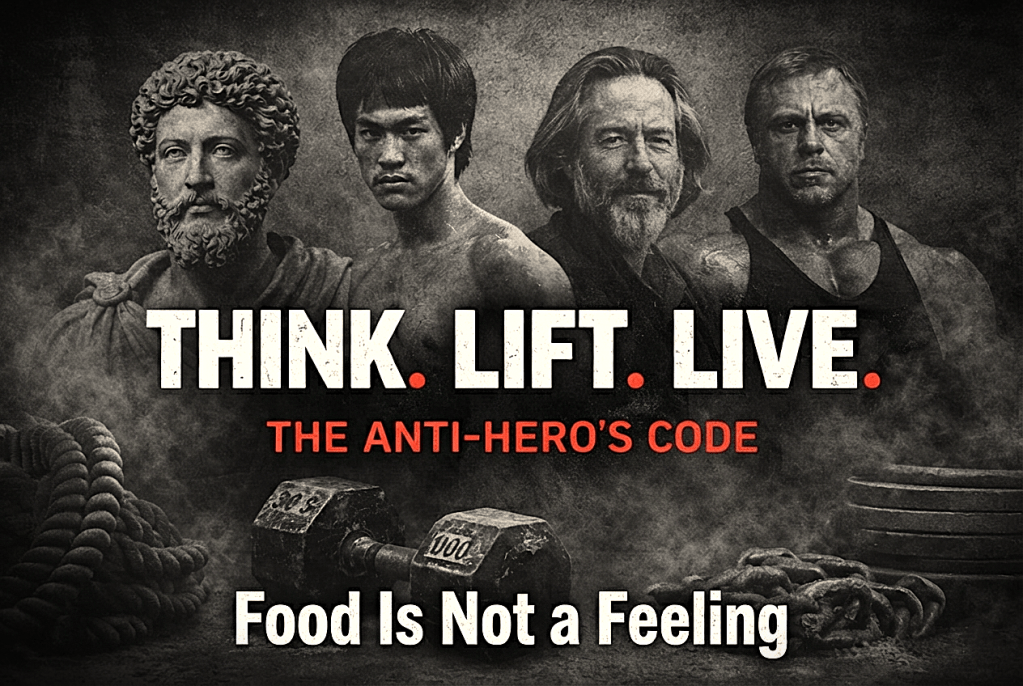
Food Is Not a Feeling: Rethinking Nutrition as a Tool for Consistency and Performance

Most people don’t have a nutrition problem; they have a perspective problem.

They’re not making poor food choices because they don’t know better. They’re making them because food has become emotional, reactive, and inconsistent. It’s comfort. It’s control or lack of it. It’s a celebration. It’s punishment. Worse still, it may be a genetic issue. And that is often the one that is least talked about. Often, almost every fitness “influencer” or goofy “guru” just tells everyone who will listen that they just need more or less of (fill in the blank). Given the particular and foundational nature of thetopic, 99% of influencers and “online fitness coaches” do their best to cram everyone into the same box.

And that’s the first thing we need to dismantle.

The Problem: Food Has Been Taught as Reward, Not Resource

We’re told from a young age that food is earned. Or to “earn your calories.” That it’s something you deserve when you’ve worked really hard, “been good,” or achieved something meaningful. Now, in some ways, that can be true, but it makes much more sense that, after all this time, we shouldn’t treat it like some sort of mood regulator.

  • Stress = snacks
  • Sadness = sugar
  • Boredom = bites
  • Hard workout = “reward meal”

But if you’re trying to feel, think, move, and live better—whether in training or just day-to-day—then food should support those goals. Emotions fluctuate, but your system for eating can remain steady.

A More Useful Lens: Food as a Support System

This isn’t about becoming robotic or clinical. It’s simply about building stability.

If you train, work, and live with intention, then food is one of your daily support tools. It’s not a treat. It’s not a cheat. It’s structure.

That means:

  • You eat when your body needs fuel.
  • You eat with an understanding of what’s coming next.
  • You repeat meals that work.
  • You build rituals around consistency, not emotion.

It’s how professionals eat. Not rigid. Not joyless. Just consistent, and you can do it, too.

What This Looks Like in Practice

We’ve covered this info a few times, but it bears repeating:

  • A consistent breakfast with protein, fiber, and hydration (not just a dose of caffeine and chaos and you’re out the door).
  • A post-workout meal that supports recovery, not emotional relief.
  • Default/backup meals when you’re too tired to think.
  • Less “what am I in the mood for?” and more “what supports what I’m doing today?”

For example, my go-to breakfast is eggs, oats, and berries. I repeat it most mornings because it works for me. Again, not robotic, just straightforward, easy to maintain, offers lots of flavor combinations, and is a simple, logical way to handle your food for the day.

You’ll find plenty of room for flexibility later. But not if you’re always reactively eating.

ACTION CHALLENGE:

Track what you eat for 3 days, but not just what, also why. Each time you eat, note what prompted it.

  • Was it hunger?
  • Boredom?
  • Social pressure?
  • Stress?
  • Fatigue?

You’ll be shocked by how often it has nothing to do with performance or physical need.

Coach’s Corner:

  • Start small. You don’t need the perfect meal plan; you need a few solid defaults.
  • Emotion is part of eating, and sometimes, comfort eating is okay. But it can’t be the foundation.
  • If your day feels chaotic, your nutrition shouldn’t add to that chaos. It should bring structure.

Suggested reading: “The Hungry Brain” by Stephan Guyenet
One of the best deep dives into the biology of eating behavior, hunger, and food decision-making.

Key takeaway: The more you can separate food from mood, and link it to your daily needs, the more empowered and consistent you’ll become, no guilt, no perfection required.

A great life = persistence > perfection.

New Year’s Day: The Moment Between Who You Were and Who You’re Becoming

There’s a quiet, almost sacred moment in the days around the New Year, a pause between what’s behind you and what’s ahead.

A moment when the noise drops, the pace slows, and you can finally hear yourself think.

This is the place where growth actually happens. Not in the fireworks, not in resolutions shouted into the void, but in the stillness where you decide, honestly and without ego, who you want to be in the year ahead.

Before we talk about goals, habits, or protocols, take one breath and look back at the year you lived.

Not with judgment. With gratitude.

You made it through things you didn’t plan for and didn’t ask for.
You showed up on days when the last thing you wanted was responsibility.
You trained when you were tired, worked when you were stretched thin, and grew in ways you didn’t see happening in real time.

You earned wisdom this year, through effort, mistakes, repetition, and resilience.

Before stepping forward, be sure to honor what got you here.

What the Old Year Teaches Us (If We Let It)

Every year leaves you with lessons, most of which don’t announce themselves loudly:

  • You learned what drains you and what restores you.
  • You learned who adds to your life and who subtracts from it.
  • You learned which habits pull you closer to the person you want to be, and which ones drag you away.
  • You learned exactly how strong you can be when you don’t have a choice.

And if the year felt heavy? Good. Heaviness can teach, build, and help you reveal what’s real.

Gratitude doesn’t erase difficulty, but it can help you reframe it.

The Catalyst: Where Reflection Meets Action

Reflection is where wisdom is found. Action is where progress is made.

And New Year’s Day is the catalyst between the two, the moment you get to carry forward everything that served you and release everything that didn’t.

The turning of the calendar doesn’t magically transform you. It simply provides a precise date to keep measuring from.

It’s not a “new version” of yourself, just a more consistent one.

The New Year Activation Protocol

Your blueprint for the next 30, 60, and 90 days. These are the habits that actually move the needle.

These aren’t resolutions. They’re behaviors and behaviors build identity.

No more, “New year, new me!” Nonsense.

1. Choose Your Anchor Habit

Start with one non-negotiable daily action you can sustain even on your busiest days:

  • 20-minute walk
  • Protein at every meal
  • 10 minutes of mobility
  • 15 minutes of reading each night before bed
  • One short lift session – make it 10-20 minutes to help get the ball rolling if you have to

Your anchor habit becomes the spine of your discipline.

2. Clarity Over Motivation

Motivation is a spark, but sparks fade fast. Discipline and clarity are your compass.

Define your goals in behaviors, not wishes:

No: “I want to lose weight.”
Yes: “I’m hitting my protein target daily.”

No: “I want to get healthier.”
Yes: “I’m sleeping 7-8 hours per night (and make the necessary changes to make it happen)  and 15-20 minute walk daily. ”

Specific. Measurable. Repeatable.

3. Identity-Based Goals

Willpower is unreliable. Discipline is consistent.

Decide:

“I am someone who trains.”
“I am someone who eats with intention.”
“I am someone who gets up when life knocks me down.”

Then act in alignment, chasing persistence, not perfection.

4. Protein, Hydration, Sleep – the Unbreakable Trio

Forget New Year fads. These three change everything:

  • 30–40g protein per meal
  • 2–3L water per day
  • A sleep routine (sleep hygiene) that doesn’t involve doom scrolling – think reading…a book, that’s not on your phone!

These give you strength, recovery, mental clarity, emotional bandwidth, and energy.

5. The Rhythm → Not the Rush

Don’t sprint into January. Build a rhythm you can maintain into February, March, and beyond.

Your goal isn’t intensity, it’s consistency. Next thing you know it will be January of 2027.

Why This Year Will Be Different

Because this year, you’re not chasing perfection. You’re choosing persistence and consistency in your decision-making.

You’re not rewriting or “redefining” yourself, you’re simply refining yourself. You’re not waiting to feel ready. You’re starting *now* with small, steady, confident decisions.

This is the year you build momentum quietly, relentlessly, and intentionally.

And by the time you look up, you’ll be further along than you expected, not because you changed who you are, but because you committed to who you’re becoming.

Final Note – person to person

You don’t owe the world a reinvention this year. You owe yourself consistency.

Be thankful to yourself for showing up.
Be thankful to yourself for putting in the effort.
Be thankful to yourself for your strength, discipline, humor, humility, and humanity.

On the Lunar calendar, this is the Year of the Fire Horse. In Chinese tradition, the Fire Horse isn’t about luck or superstition; it’s about momentum. It’s about energy that moves forward on its own. Strong, independent, and restless in a good way. The kind of year that rewards people who are relentlessly moving forward and who enjoy the process.

So don’t rush. Just keep moving with a purpose. Do the work that matters to you. Build your momentum quietly and simply let it compound.

Keep fueling your fire and honoring your desires. May this New Year be steady and strong, full of the kind of momentum you earn, protect, and carry with you everywhere you go.

Happy New Year, my friend. Let’s make it count.

And remember: at midnight, open the back door to release the old year and whatever hardships came with it. Then open the front door to welcome the new year in, inviting luck, health, and fresh starts.

And be sure to wish your neighbors Athbhliain faoi mhaise duit!

Onward and Upward!