The Art of CyberWar | Part XII | Attack by Fire

The Principle: When you use fire to attack, you must be prepared for the wind.
— Sun Tzu
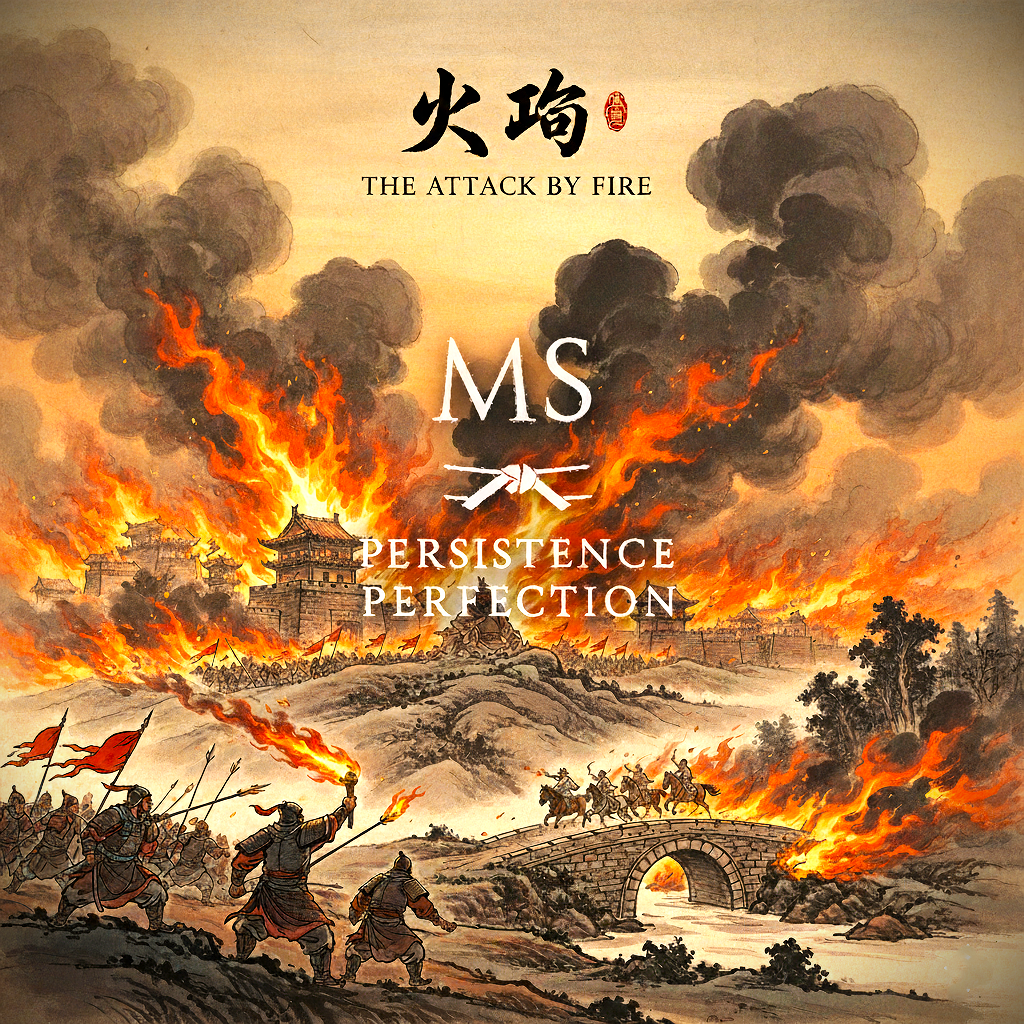
The Nature of Fire

Fire is decisive. It consumes, clears, and purifies, but it also spreads beyond intention. Sun Tzu treats fire as both a weapon and a warning. It can destroy an enemy’s stores, flush troops from cover, and sow panic, but he cautions that those who ignite must control the wind, or the flame will turn back.

In today’s language: escalation is easy, judicious control is hard.

Fire is unbridled energy without patience. It is force unbound. And every era finds its own version of it.

The Five Fires

Sun Tzu names five types of fire attack, each with a direct modern analogue:

  1. Burning soldiers in their campDisrupting people directly.
    • In cyber: targeting individual accounts, identity systems, or human processes.
    • In policy: attacking morale or legitimacy through propaganda or sanctions that hit civilians.
  2. Burning storesDestroying logistics.
    • In cyber: supply-chain attacks, ransomware on infrastructure.
    • In statecraft: economic blockades or precision strikes on fuel, transport, or data centers.
  3. Burning baggage trainsBreaking the flow of resources.
    • In the cloud: DDoS, bandwidth throttling, or disrupting APIs that feed dependent systems.
    • In foreign policy: disrupting trade routes or financial systems to strangle supply.
  4. Burning arsenals and magazinesTargeting capability itself. A modern example: the 2014 Sony Pictures hack, in which wiper malware destroyed not only data but also the ability to operate, crippling the company’s digital arsenal and serving as a stark warning about escalation risk. Another hallmark example: Stuxnet (2010), which physically crippled Iranian centrifuges, showing that digital “fire” can leap into the physical world.
    • In digital: destroying code repositories, zero-day leaks, and wiper malware.
    • In war: targeting industrial bases, weapons stockpiles, or satellite networks.
  5. Burning the enemy’s armyDirect annihilation.
    • The catastrophic option, physical or digital scorched earth.

Each carries the same risk Sun Tzu warned of: heat spreads.

America’s Century of Fire
Throughout the 20th century, U.S. foreign policy repeatedly learned and forgot this lesson.

  • WWII: strategic firebombing of Tokyo and Dresden, the atomic bombings of Hiroshima and Nagasaki, tactically decisive, highly questionable morally.
  • Vietnam: napalm, Agent Orange – the war’s imagery consumed America’s moral capital as surely as the jungle burned. Devastating to the local population and our own troops.
  • Desert Storm & Shock and Awe: firepower became performance, televised precision, hiding the longer political firestorm and over-commitment of our resources to highly specious ends.
  • Sanctions & Cyber: modern equivalents – economic or informational fire meant to distract, mislead, or coerce without bullets, still spreading collateral damage.

Each use of fire achieved an objective, yet each left embers that smoldered for decades.

Sun Tzu would call that victory without wisdom.

Digital Flame

In cyberspace, fire is code that destroys. The world learned this with Stuxnet, NotPetya, WannaCry, and countless destructive campaigns. They burned quietly, jumped borders, and torched billions in collateral damage. WannaCry (2017) swept the globe in hours, crippling hospitals, shipping, and businesses—making clear that digital fires can cause humanitarian consequences.

Cloud fire spreads faster than any fuel; a single misconfigured credential can ignite an entire ecosystem. Because dependencies are invisible, contagion is immediate. A wiper designed for one network cripples dozens more; an exploit posted online becomes a global inferno in hours.

Fire is the easiest attack to ignite and the hardest to contain.

Rules for Using Fire

Sun Tzu’s cautions translate cleanly:

  1. Control the wind. Understand the environment – network topology, public opinion, and global law. Fire turns on those who don’t map their dependencies. NotPetya (2017) began as a targeted disruption but, due to dependencies and lack of containment, rapidly spread worldwide, demonstrating why “controlling the wind” remains critical in cyber conflict.
  2. Use the right conditions. Don’t ignite in drought. If tension is already high, socially and economically, the situation will escalate.
  3. Prepare relief efforts. Have recovery plans before striking. Burn only what you can rebuild. After World War II, the Marshall Plan rebuilt war-torn Europe, demonstrating that post-conflict relief shapes both legitimacy and future stability. In 2021, the Colonial Pipeline ransomware attack forced the rapid restoration of critical infrastructure; companies with effective recovery plans minimized chaos and reputational fallout.
  4. Know the cost of smoke. Collateral damage is visibility: reputational, legal, and diplomatic.
  5. Do not rely on fire to win the war. Fire wins battles but breeds resistance.

In short: destruction without reconstruction is self-immolation.

Morale, Leadership, and Control

A general’s job isn’t only to unleash power; it’s to sustain the will that wields it.
Fire exhausts armies. Soldiers fighting amid smoke need clear purpose, rations, and rest.

Sun Tzu demands that the commander ensure his troops are fed, disciplined, and respected so that they fight even in dire moments.

In modern organizations, the same holds: leaders who push teams through endless “incident fire drills” without rest destroy readiness. Respect sustains endurance.

Discipline without compassion breeds burnout; compassion without standards breeds chaos. Balance is command.

Deception, Propaganda, and Manufactured Heat

Every effective campaign uses perception. Propaganda creates the illusion of fire where there is none, or conceals weakness behind the smoke of strength. The ancient principle survives in every medium: shape belief, shape behavior.

  • States convince citizens of a constant threat: War is peace. Freedom is slavery. Ignorance is strength,and the historical manipulation line, “Who controls the past controls the future: who controls the present controls the past.
  • Companies market vulnerability to sell security.
  • Attackers simulate breaches to force reactions.

Fire doesn’t only burn, it solidifies and blinds. The wise strategist uses deception to conserve energy, not to irreparably manipulate trust.

Never lose sight of this: truth is a finite resource. Burn it, and nothing grows afterward.

Fight Only When Necessary

War, Sun Tzu reminds us, is terrible. Mr. Lee added, “It is well that war is so terrible, or we should grow too fond of it.” That’s the heart of this chapter: the seduction of power. Fire feels decisive, satisfying, purgative. That’s why restraint is the highest discipline.

In cybersecurity, it means choosing containment over retaliation. In policy, it means diplomacy before bombing. In leadership, it implies correction before firing squads of blame.

Every unnecessary blaze consumes future strength.

Calculation Before Ignition

Fire is the last stage of calculation, not the first. The general who wins has already counted everything: fuel, wind, timing, morale, and escape.

In modern form:

  • Map dependencies before deploying destructive countermeasures.
  • Assess public and legal consequences.
  • Coordinate allies and containment plans.
  • Pre-position humanitarian or restoration resources.

Fire launched without calculation simply becomes arson.

Cybersecurity Playbooks for Fire Scenarios

1. Contain Destructive Malware (Wiper Fire)

  • Disconnect affected systems immediately.
  • Activate offline backups; rebuild from clean images.
  • Communicate fast, silence breeds rumor.
  • Forensics after containment, not before.

2. Respond to Supply-Chain Fire

  • Freeze code releases; verify signatures.
  • Segregate affected components; rotate secrets.
  • Coordinate public disclosure and patch windows.

3. Counter Disinformation Blaze

  • Pre-draft communications for false narratives.
  • Verify sources, issue simple factual statements.
  • Avoid panic amplification, don’t fuel the fire.

4. Plan for Strategic Retaliation

  • Establish legal oversight for counter-operations.
  • Define thresholds: attribution confidence, proportionality, and reversibility.
  • Keep diplomatic channels open even during the heat.

Fire is part of war, but the goal is to end fires faster than they spread.

Ethics and Aftermath

Fire makes headlines; rebuilding never does. Yet the moral credit of a nation, or a company, depends on what follows destruction, relief, restitution, and transparency, turning survival into legitimacy. The Marshall Plan after WWII showed that true victory is measured by the ability to restore and build anew, not just destroy. Sun Tzu closes this chapter by warning that a commander who burns recklessly endangers his own state.

That warning scales perfectly to global networks: a destructive exploit today may torch tomorrow’s allies.

Bridge to Chapter XIII | The Use of Spies

Once the fire burns out, what remains is smoke, which conceals movement. Which leads us back to our opening principle: “When you use fire to attack, you must be prepared for the wind.” Next: how to “see without burning” or, the art of intelligence, deception, and misdirection on the modern battlefield. (Think Operation Fortitude, the WWII deception that enabled D-Day by fooling the enemy without a shot being fired.) Sun Tzu ends his book not with force but with intelligence. He knew that knowledge prevents the need for fire in the first place.

“After the flames, gather information from the ashes.” The next and final lesson, The Use of Spies, is about seeing without burning, learning through observation, infiltration, and trust. Fire wins battles; intelligence prevents wars.
The Art of Cyberwar | Part XI | The Nine Situations

The principles: Begin by seizing something which your opponent holds dear; then he will be amenable to your will.

…Concentrate your energy and hoard your strength.

The principle on which to manage an army is to set up one standard of courage which all must reach.

Whoever is first in the field and awaits the coming of the enemy will be fresh for the fight. Sun Tzu

Context and Purpose
Sun Tzu’s Nine Situations maps the kinds of ground and circumstance a commander can face –  from favorable positions to trap-laden ground. Each situation demands a different posture: sometimes you press; sometimes you withdraw; sometimes you wait. The lesson is tactical discrimination: don’t treat every fight the same.

In the modern world, those “situations” are organizational states: besieged systems, fleeting windows of access, deep entrenchment, overextended operations. Knowing which box you’re in changes everything you do next.

Leadership and Morale: The Human Center
Before tactics, a note about people. Sun Tzu insists that a general must know his soldiers. That’s not a platitude; it’s an operational fact.

  • Morale is intelligence: exhausted teams miss indicators, fail to follow playbooks, and make desperate mistakes.
  • Leadership is maintenance: rotating shifts, realistic on-call expectations, paid recovery time after incidents, and clear chains of command preserve discipline.
  • Respect plus standards: treat your people with dignity and hold them to standards. Leniency breeds sloppiness; cruelty breeds silence. Both are fatal.

A leader who ignores morale loses the fight long before the enemy arrives. That’s as true for an infantry company as for an incident response roster.

Deception and Perception Management
Sun Tzu: All war is based on deception. In practice, that means shaping what the opponent and the population believe.

  • Information operations: propaganda, curated narratives, and coordinated messaging have always been instruments of power. Orwell’s line, “We have always been at war with Eastasia,” is a cautionary parable about manufactured consensus.
  • Modern analogue: in cyber, deception shows up as honeypots, false telemetry, and misinformation campaigns; in statecraft, as narratives that create vulnerability or strength where none objectively exists.
  • Ethical frame: defenders use deception for detection and deception to raise the cost for attackers (e.g., canary tokens). Democracies must guard against the weaponization of truth at home; businesses must avoid misleading stakeholders.

Deception works because humans fill gaps with a story. Control the story; you alter the field.

Fight Only When Necessary
Sun Tzu and Mr. Lee agree: war is terrible; fight sparingly. The principle is simple: act only when the expected gain exceeds the cost.

  • Cost-calculation is non-negotiable: time, attention, capital, reputational risk.
  • In cyber: a public takedown, a disclosure, or active defense escalation must be measured against downtime, legal exposure, and adversary escalation risk.
  • In policy: interventions must have clear exit conditions and sustained domestic support. If you cannot sustain it, don’t start it.

Discipline supersedes impulse.

“If the Enemy Leaves a Door Open, Rush In” to Follow the Energy
Sun Tzu’s pragmatic injunction to exploit openings is simple: when an opponent’s guard falls, capitalize immediately. In fighting, it’s like watching for your opponent to drop their hands or go for a spinning attack; in security, it’s a window of opportunity for decisive action.

  • Cyber example (defense): detect a lateral movement attempt and immediately isolate the segment, block the credential, and pivot forensic capture. The quicker the isolation, the smaller the blast radius.
  • Cyber example (offense/emulation): when a red-team discovers a misconfiguration, follow the chain-of-trust to map further exposures before the window closes.
  • Business/policy: when a competitor shows strategic weakness (supply disruption, PR crisis), acting quickly with a measured offer can consolidate position. But always have your logistics in place; quick gains that can’t be held are hollow.

Following the energy multiplies the effect, but only if you’ve done the work beforehand to sustain the ground you’ve gained.

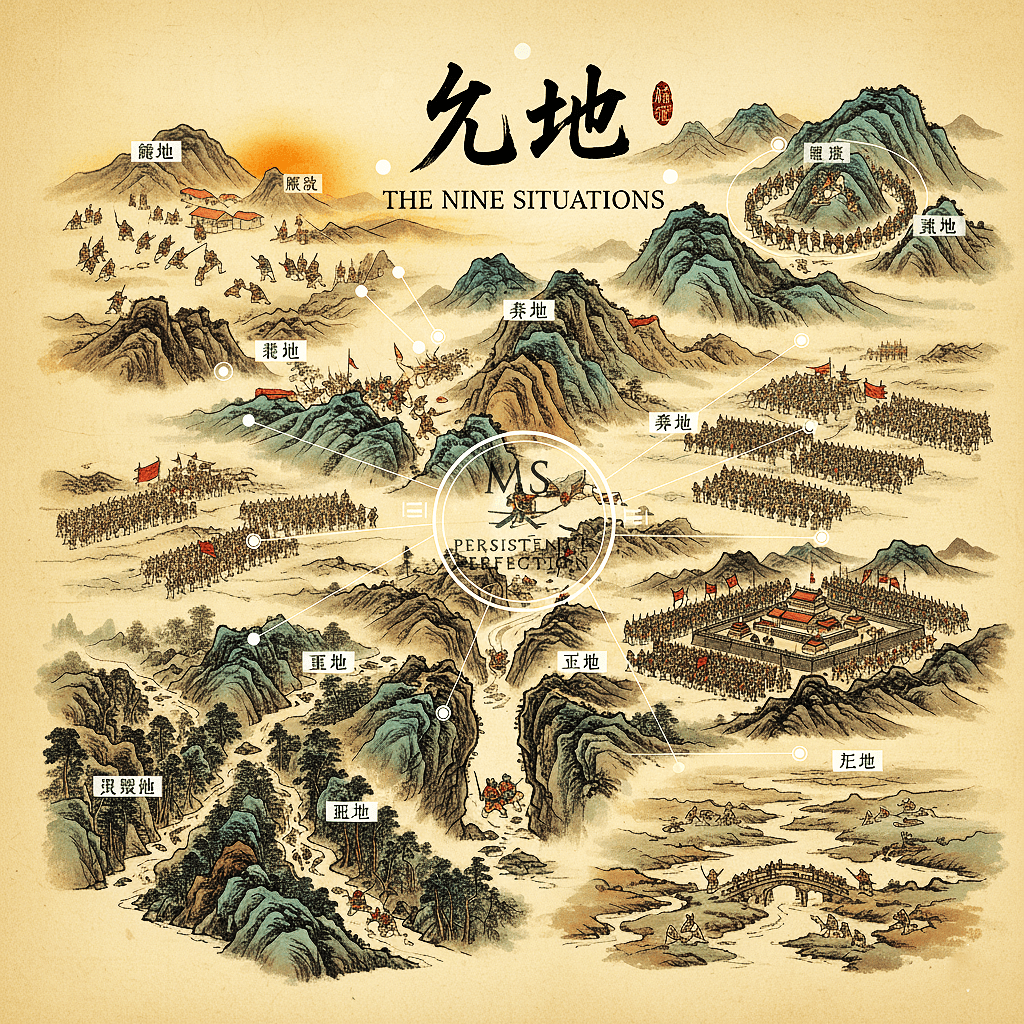
The Nine Situations, Condensed & Modernized:

  1. Dispersive ground – you’re among your people; maintain cohesion.
    Cyber: internal incidents; prioritize comms and transparent leadership. (e.g., during the 2021 Log4Shell crisis, organizations that communicated quickly and openly with their teams contained risk more effectively.)
  2. Facile ground – easy ground, many exits; avoid traps of complacency.
    Cyber: dev/test environments misused as production; lock and audit.
  3. Contentious ground – disputed control.
    Cyber: contested supply chains; prioritize integrity of build pipelines.
  4. Open ground – mobility advantage.
    Cyber: cloud-native agility, move quickly, but instrument heavily. (Example: When a vulnerability like Heartbleed emerges, organizations that can rapidly update and redeploy cloud resources while monitoring all endpoints gain a decisive edge.)
  5. Intersecting ground – convergence of routes/partners.
    Cyber: shared services; segregate trust boundaries and enforce SLAs.
  6. Serious ground – stakes are high; commit only with full readiness.
    Cyber: critical infrastructure; assume regulation and public scrutiny.
  7. Difficult ground – constrained movement.
    Cyber: legacy stacks; carve compensating controls and minimize exposure.
  8. Hemmed-in ground (trapped) – the enemy can encircle.
    Cyber: breached islands due to vendor lock-in; prepare out-of-band recovery. (e.g., during the NotPetya outbreak, companies with alternate vendors or recovery paths minimized downtime, while others suffered prolonged outages.)
  9. Desperate ground – fight with everything; no other option.
    Cyber: blind-fire incident with full emergency playbook; declare crisis, invoke war-room, use all hands.

Each situation requires a plan in advance, not improvisation in the heat of chaos. For those new to Sun Tzu: dispersive ground means your own territory, open ground is the public cloud, and hemmed-in ground is where your options are tightly constrained.

Prescriptive Playbooks (Operational Guide)
Below are short playbooks, or practical checklists, you can paste into an incident binder.

A. Besieged System (Hemmed-in/Trapped Ground)

  • Isolate affected segments (network ACLs, VLANs).
  • Enable out-of-band admin (jump boxes, console access).
  • Invoke containment RTO/RPO playbook.
  • Engage legal & communications.
  • Stand up a dedicated recovery team; rotate shifts.
  • After action: root cause, patch, and inventory third parties.

B. Fleeting Access (Open/Facile Ground)

  • Capture forensic snapshot immediately (memory, session tokens).
  • Harvest IOC, block indicators at perimeter.
  • Perform rapid threat hunting to see lateral movements.
  • Patch/vault credentials, revoke tokens.
  • Debrief and harden the vector.

C. Retreat & Reconstitute (Dispersive/Retreat Scenario)

  • Execute planned fallback to secondary infrastructure.
  • Verify backups and boot from immutable images.
  • Communicate to stakeholders with controlled cadence.
  • Rebuild in clean environment; stage verification before full restore.

D. Stronghold Defense (Steep/High Ground/Serious Ground)

  • Minimize human access; require jump hosts & MFA.
  • Immutable logging to secure audit trails.
  • Periodic red-team tests; continuous monitoring.
  • Harden supply lines: vendor SLAs, redundancy, and a tested DR plan.

E. Rapid Exploitation (If a Door Opens)

  • Pre-authorize small rapid-response teams for exploitation windows.
  • Legal/ethics checklist signed off on in advance.
  • Capture intelligence, seal pivot paths, and convert to defense artifacts (detections, blocks).

Each playbook starts with people: assign roles, cap on-duty hours, and rehearse quarterly.

Final Thought: Calculation, Culture, and the Necessity of Restraint
Sun Tzu’s closing insistence, calculate before battle, remains the core discipline. The leader who wins has already counted costs, supply, morale, and terrain. The one who loses discovers those facts mid-fight.

That brings us back to the principles that opened this chapter:

  • Seize what the opponent holds dear: not for theater, but to create leverage and force predictable reactions.
  • Concentrate energy and hoard strength: preserve focus, avoid waste, and don’t spend force just to feel decisive.
  • Set one standard of courage: culture must hold under pressure, or your best playbooks become paper.
  • Be first in the field and wait: preparedness buys calm, and calm buys time – it’s the rarest advantage in crisis.

In cyber and statecraft, the rule remains unchanged: prepare, preserve people, exploit opportunities, deceive judiciously, and fight only when victory is likely and sustainable. As Robert E. Lee warned, “It is well that war is so terrible, otherwise we should grow too fond of it.” So only fight when you have no other option. When you do fight, move decisively, use the force necessary to end the threat, and leave no doubt in your opponent’s mind so they will never make that mistake again.

The Art of Cyberwar, Part V | Energy | The Use of Force

the art of cyberwar part V energy and the use of force. matt shannon cloud security.

The principles:
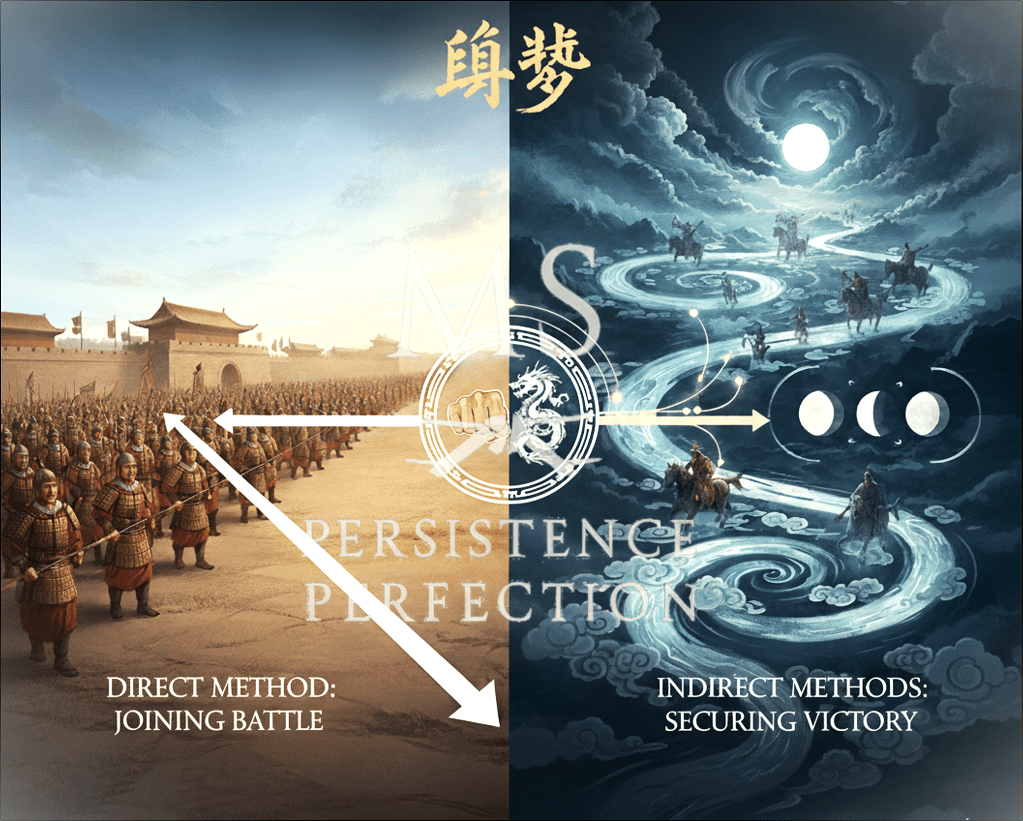
In all fighting, the direct method may be used for joining battle, but indirect methods will be needed in order to secure victory.

Indirect tactics, efficiently applied, are inexhaustible as Heaven and Earth, unending as the flow of rivers and streams; like the sun and moon, they end only to begin anew; like the four seasons, they pass away to return once more.

The Power of Controlled Motion

Sun Tzu’s fifth chapter deals with energy, not as brute strength, but as direct application of force.

He warned that a commander must know when to cultivate and store power and when to release it. Misapplied use of Energy burns itself out. However, when energy is focused, it bends the world to its will.

It’s an idea that translates effortlessly to today’s digital battlefield. Nations, like networks, often fail not because of a lack of capability, but because of a lack of control.

True mastery isn’t in how much force you can deploy. It’s in knowing how little you need to. It’s akin to the idea that, sure, you can kill a fly with a hammer, but is it the most effective tool at your disposal?

The Cost of Unchecked Energy

American Diplomatic and Military History is full of examples of lawmakers mistaking our capacity for clarity.

In Korea, overwhelming U.S. power pushed back North Korean forces, only to overextend toward China’s border and trigger an entirely new front. And thus, we have burdened ourselves with maintaining the “38th parallel” ever since.

In Vietnam, energy became inertia, force applied endlessly without definition, draining political and moral capital alike. If only the “peacemakers” at the Treaty of Versailles had let Ho Chi Minh deliver his speech on the Rights of Man, perhaps there would have been no quagmire in Southeast Asia to begin with. A guerrilla war that would take nearly 60,000 American lives and lead to what became known as the “Vietnam Syndrome.”

In Iraq, “shock and awe” demonstrated that a singular “tactical victory” can be swift, while a strategic victory remains elusive. Notwithstanding the entire list of false pretenses that led to the invasion of Iraq to begin with.

Each conflict began with a belief in momentum and ended with war fatigue. Demonstrating once again, force without direction always collapses under its own weight.

The lesson isn’t that force is wrong; it’s that force, when misapplied and unguided, becomes self-consuming. Power is not infinite. Neither is attention, money, or public trust.

The Cyber Equivalent: Sprawl and Burnout

Organizations repeat these same mistakes in digital form.

A breach occurs, and the reflex is to rush to acquire new tools, policies, and budgets, thereby triggering a cyberwar “surge.”

New dashboards, new alert monitoring, and new vendors lead to a surge in activity, while clarity plummets.

This is cyber energy without strategy, effort disconnected from insight.

As Sun Tzu also said: Amid the turmoil and tumult of battle, there may be seeming disorder and yet no real disorder at all; amid confusion and chaos, your array may be without head or tail, yet it will be proof against defeat.

Teams exhaust themselves chasing incidents instead of patterns. Leaders demand constant escalation, not realizing that perpetual crisis is its own vulnerability.

The result mirrors the national trap: motion is mistaken for genuine progress. The ability to endure is mistaken for endurance.

Energy as Rhythm, Not Frenzy

Sun Tzu described two forms of force:

  • Normal energy — the steady discipline that sustains the fight.
  • Extraordinary energy — the precise, unexpected burst that wins it.

In cybersecurity, the equivalent is security posture and precision in the application of policies.

Normal energy is the quiet work of patching, monitoring, and awareness training. Extraordinary energy is the calm, swift, and accurate incident response that turns chaos into closure.

Both are needed. But one cannot exist without the other. A team that never rests has no energy left to strike when it matters most.

It’s the same in martial arts.

In Wing Chun:
Normal energy = quality structure and energy sensitivity.
Extraordinary energy = the skill to deliver a singular, intercepting strike that ends the exchange.

Muay Thai:
Normal energy = footwork, guard, pacing.
Extraordinary energy = the slashing elbow, a stabbing teep, or perfectly placed knee.

BJJ:
Normal training energy = position, pressure, framing.
Extraordinary training energy = the ability to feel a submission triggered by feeling the opponent’s mistake. Or in Mandarin it’s an old idea called Wu Wei, or effortless action. Meaning, I don’t present the opportunity to attack; the enemy presents it to me, like water finding a leak in the dam.

A Security Team that never rests has no energy left for anything extraordinary.

Good CISOs, like good generals, good fighters, and good grapplers, understand rhythm. They know when to conserve strength so that action, when it comes, is clean and effective.

As Master Tzu also knew, “When he utilises combined energy, his fighting men become as it were like unto rolling logs or stones.” Leading to, … “the energy developed by good fighting men is as the momentum of a round stone rolled down a mountain thousands of feet in height. So important is the subject of energy.

Diplomacy and the Misuse of Force

In diplomacy, the same physics apply. The U.S. has often wielded immense power but uneven patience.

Moments like the Marshall Plan and the Cuban Missile Crisis demonstrated the value of precision, employing limited force, clear objectives, and a proportional response.

But elsewhere, the misapplication of force became diplomatic impotence on full display. Prolonged occupations and open-ended interventions constantly drain strategic reserves of will and trust.

Every drone strike, every unconstitutional data collection program, every new cyber warfare doctrine carries a similar risk: that power’s convenience will overshadow its consequence.

The Taoist counterpoint from Lao Tzu still resonates to this day:

“He who knows when to stop never finds himself in trouble.”

Knowing when not to act is the highest use of force. It’s the difference between control and compulsion.

The Lesson for Cyber Strategy

A strong digital defense isn’t constant action, it’s intelligent action.

Practical translation:

  • Automate the repeatable.
  • Escalate only with context.
  • Protect attention as aggressively as data.
  • Reserve extraordinary effort for extraordinary situations.

Energy mismanaged becomes sprawl. Energy focused becomes resilience.

It’s never the size of the arsenal. It’s the precision of the response.

Momentum and the Myth of Constant Action

Modern life rewards constant motion, refresh, respond, and reply.
In cybersecurity and foreign policy alike, stillness feels dangerous to the untrained mind.

But strategy lives in the pause between movements. Quality fighting skills are always more effective when you can strike on the half-beat, a fundamental separator on the mats, and on digital and physical battlefields.

Force has a short half-life. When it’s used endlessly, it decays quickly and fades into the ether. When it’s reserved for the right moment, it changes everything.

A breach contained quietly is often a bigger victory than a public takedown.
A crisis de-escalated without violence often preserves more stability than any show of strength.

Knowing When to “Flow With the Go”

As one of the greatest living legends in Brazilian Jiu-Jitsu, Rickson Gracie once said, “In Jiu Jitsu we flow with the go.”

Meaning:

  • don’t fight force with tension
  • stay aware but not trapped by focus
  • stay smooth and adaptive
  • flow with the opponent’s energy
  • let well-trained instinct and structure guide you

That metaphor fits the digital era perfectly. The best blue or purple teamers, like the best leaders, don’t fight the current; they learn to read it and swim with it, not against it.

Lao Tzu would say that “the soft overcomes the hard,” not through weakness but adaptability. Force channeled through awareness is stronger than force spent in anger.

In warfare and cybersecurity alike, energy is a currency. Spend it recklessly and you’ll be empty when it matters. Spend it wisely and you’ll be leading on the battlefield.

Final Reflection

Knowing how to use force is knowing its limits.
Sun Tzu and Lao Tzu shared the same truth from opposite angles:
Power must be balanced by patience.
Energy must be stored as much as it is spent.

History punishes those who forget this. So does network and security architecture.

The art isn’t in using force; it’s in knowing when the situation calls for little, none, or overwhelming force.

That’s not mysticism. That’s strategic maintenance. And it’s as accurate in security architecture as it is on the battlefield.

All of these lessons point us directly back to our opening principles: “In all fighting, the direct method may be used for joining battle, but indirect methods will be needed to secure victory.” And, “Indirect tactics, efficiently applied, are inexhaustible as Heaven and Earth, unending as the flow of rivers and streams; like the sun and moon, they end only to begin anew; like the four seasons, they pass away to return once more.

The wise strategist learns to move the same way.