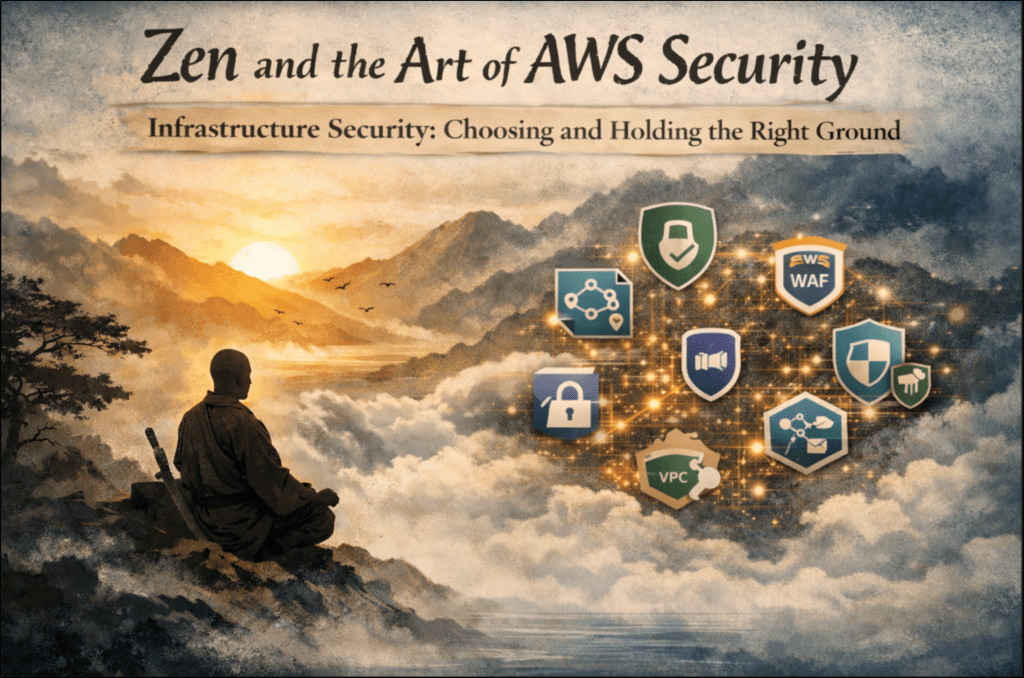
Zen and the Art of AWS Security Domain 3: Infrastructure Security | Choosing and Holding the Right Ground

There’s an old principle in strategy that applies as cleanly to cloud architecture as it does to combat: “The battle is often decided before the first move is made.”

In AWS, that decision is infrastructure security. Not firewalls alone. Not encryption alone. Not identity alone.

Infrastructure security is about where you place systems, how they connect, and what paths are intentionally left open, or closed, long before an attacker arrives.

If Detection is awareness, and Incident Response is discipline, then Infrastructure Security is terrain. And AWS cares deeply about terrain.

1. AWS’s Philosophy of Infrastructure Security

AWS assumes three things that shape every exam question in this domain:

  1. Networks are software-defined, not physical perimeters
  2. Segmentation beats fortification
  3. Blast radius matters more than absolute prevention

This is why AWS infrastructure security is built around:

  • isolation
  • segmentation
  • least connectivity
  • explicit network paths
  • and controlled exposure

If an answer choice tries to “lock everything down globally,” it’s usually wrong. AWS prefers intentional exposure over accidental openness.

2. The Core Infrastructure Security Pillars

Infrastructure security questions almost always reduce to one (or more) of these pillars:

  1. Network isolation
  2. Traffic control
  3. Private connectivity
  4. Service exposure boundaries
  5. DDoS resilience

If you can identify which pillar is being tested, the correct answer becomes obvious.

3. VPC Design: Isolation Is the Default

At the heart of AWS infrastructure security is the VPC.

Exam truth: If a resource doesn’t need to be public, it shouldn’t be.

High-yield concepts:

  • Private subnets for most workloads
  • Public subnets only for controlled ingress/egress
  • NAT Gateways for outbound-only access
  • No direct internet exposure—ever—unless required

Exam mental model: Public access is a deliberate exception, not the baseline.

4. Security Groups vs. NACLs – This Still Trips People Up

AWS loves testing this distinction.

Security Groups

  • Stateful
  • Instance-level
  • Allow rules only
  • Primary enforcement point

Network ACLs

  • Stateless
  • Subnet-level
  • Allow and deny rules
  • Coarse-grained control

Exam shortcut: If the question is about precise control, use Security Groups. If it’s about broad subnet filtering, use NACLs. If both appear as options, AWS usually wants Security Groups.

5. Controlling Traffic Paths, Not Just Blocking Traffic

Infrastructure security isn’t just about denial; it’s about routing intentionally.

Key services:

  • VPC Route Tables
  • Internet Gateways
  • NAT Gateways
  • VPC Endpoints (Gateway & Interface)

High-yield exam concept:

If AWS services should be accessed without traversing the internet, the answer is almost always: VPC Endpoints

This shows up constantly for:

  • S3
  • DynamoDB
  • KMS
  • Secrets Manager
  • Systems Manager

Mental model: Private traffic beats filtered public traffic every time.

6. Load Balancing and Exposure Control

AWS does not expect you to expose instances directly.

Instead:

  • ALB for HTTP/HTTPS
  • NLB for high-performance TCP/UDP
  • Internal load balancers for private services

Exam rule:
If traffic needs inspection or TLS termination → ALB
If performance and static IPs matter → NLB

Direct instance exposure is almost always a wrong answer.

7. DDoS Protection: Built-In, Not Bolted On

AWS assumes you will be targeted.

Infrastructure security includes:

  • AWS Shield Standard (always on)
  • AWS Shield Advanced (for high-risk workloads)
  • CloudFront + WAF for edge protection

Exam pattern: If the question involves:

  • volumetric attacks
  • Layer 7 threats
  • global availability

The answer usually includes:
CloudFront
AWS WAF
Shield

Defense through scale is a core AWS advantage.

8. The Exam Patterns That Matter

Pattern #1 Reduce Blast Radius

Choose:

  • smaller subnets
  • separate VPCs
  • multiple accounts

Over:

  • one massive flat network

Pattern #2 Prefer Private Connectivity

VPC endpoints beat:

  • public endpoints
  • IP whitelisting
  • internet gateways

Pattern #3 Use Managed Services When Possible

AWS prefers:

  • managed load balancers
  • managed DDoS protection
  • managed routing

Less custom = less risk.

9. The Martial Parallel: Choosing the Ground

In strategy, you don’t fight everywhere.

You choose:

  • narrow paths
  • defensible positions
  • terrain that limits your opponent’s options

Infrastructure security does the same thing. A flat network invites chaos. A segmented network channels behavior. Attackers aren’t always stopped; they’re contained. And containment wins.

For example, a major breach in 2019 exploited a flat network without segmentation, allowing attackers to move laterally across dozens of workloads. Had strict subnetting and NACLs been in place, the impact would have been far smaller.

10. Closing: Architecture Is the First Defense

Infrastructure security is quiet.

When it’s done right:

  • nothing dramatic happens
  • nothing breaks
  • nothing escalates

But when it’s wrong, no amount of detection or response can save you.

AWS rewards architects who:

  • think in boundaries
  • design for failure
  • assume compromise
  • and limit consequences

CIS Control 13 and NIST CSF both emphasize network segmentation and limiting exposure as foundational security practices.

A frequent pitfall is relying solely on Security Groups for segmentation, especially in environments with compliance or subnet-level boundary requirements, and overlooking the value of NACLs for coarse-grained, subnet-level protection. In layered security, redundancy is a strength. And with the VPC Reachability Analyzer, AWS now makes it easier than ever to verify and audit your network paths.

As AWS’s Well-Architected Framework advises: “Apply security at all layers.” These principles echo patterns are seen in AWS re:Invent security keynotes and in major cloud breach postmortems.

Security without pessimism continues here.

Not by building walls everywhere but by choosing the right ground and holding it calmly.

In AWS, as in strategy, victory belongs to those who shape the ground before the battle begins.

Remember, cloud security evolves quickly; architects who regularly review new AWS features and industry breach lessons maintain the sharpest edge. But for the exam, stay focused on what’s covered in the content outline provided by AWS for the exam. After you pass, you can ad lib. Until then, stay focused on the material that AWS expressly states is covered on the exam.

The Art of Cyberwar | Part IX | The Army on the March

“The Army on the March” — Illustrated for The Art of Cyberwar, Part IX. This artwork evokes the visual language of classical Chinese scroll painting, capturing the essence of Sun Tzu’s Chapter IX with striking thematic fidelity. The scene unfolds in layers across a sweeping golden landscape: tightly ordered battalions march along mountain paths, supply barges cross a winding river, and distant formations assemble beneath the rising sun. Each element reflects the logistical burden, psychological tension, and environmental dependence that define an army deep into foreign territory.
At the foreground, a lone commander on horseback surveys the terrain, flanked by advisors whose varied stances suggest counsel, observation, and caution. His elevated vantage mirrors Sun Tzu’s emphasis on awareness — the practice of reading fatigue, momentum, and environmental signals before they harden into irreversible consequences. The river crossing, perilous and slow, symbolizes the fragility of overextension; the distant city, shimmering beyond the horizon, represents both ambition and the looming threat of exhaustion.
The overall composition blends serenity with strain, grandeur with vulnerability. In doing so, it transforms ancient military wisdom into a timeless reminder for modern strategists: every march requires vigilance, and every expansion carries its cost.

The Principle:

“When you leave your own country behind, and take your army across neighboring territory, you find yourself in a position of dependence on others. There you must watch for signs of strain.”— Sun Tzu

The Signs Before the Fall

Sun Tzu’s ninth chapter is about perception.

Here he shifts from action to awareness. It’s about how a commander reads fatigue, imbalance, and internal decay before they destroy an army from within.

This is not simply a lesson in combat, but more importantly, it’s a lesson in foresight. This is a crucial distinction that often separates a near-flawless victory from a crushing defeat.

Because every empire, every enterprise, every cyber defense effort eventually faces the same drift:

  • expansion that outruns understanding
  • momentum that hides exhaustion
  • ambition that blinds leadership
  • reach that exceeds resources

Armies break this way.
Companies implode this way.
Nations lose coherence this way.

In martial arts, this is the moment a fighter looks powerful, but their footwork is mis-aligned, the subtle tell of hand movement, the delayed return to guard, or the half-beat of hesitation that usually precedes success but this time leads to being hit.

Sun Tzu teaches us: if you can’t read the signs, you can’t survive the march.

Overreach: The Eternal Temptation

History loves proving this point.

Rome’s legions stretched from Britain to Mesopotamia until it could no longer feed its own frontiers. Britain built an empire “over all seas,” only to watch its overstretched supply lines rot from within.

The United States, victorious after World War II, constructed a global presence so vast that presence itself began replacing purpose.

Sun Tzu warned: The longer the march, the more fragile the army becomes.

Modern America has been marching for generations, militarily, economically, digitally, and each expansion has carried both pride and price.

Corporations experience the same decay. Cloud ecosystems suffer it even faster. What begins as strength, scale, reach, integration, becomes fragility when maintenance exceeds cost-tolerance.

In martial arts, overreach is the fighter who throws too many power shots, chasing a knockout rather than reading the opponent. They exhaust themselves long before the opponent is even breathing heavily.

Strength without pacing is just a longer route to collapse.

The Weight of Infinite Reach

In cybersecurity, overreach becomes complexity collapse.

Each new department adopts a new tool. Each executive demands a new dashboard. Each vendor promises a universal cure.

Suddenly:

  • no one sees the whole system
  • logs pile up unread
  • alerts become background noise
  • integrations multiply into untraceable webs
  • dependencies form faster than they can be understood

What once felt powerful becomes paralyzing.

Foreign policy suffers the same rhythm on a grander scale.

WWI.
WWII.
The Cold War.
Korea.
Vietnam.
Bosnia
Iraq.
Afghanistan.

Each began with a clean, confident objective. Most devolved into attrition, mission creep, and moral fatigue. It can confidently be argued that mission creep began with WWI, but that’s a conversation for another time.

Sun Tzu would summarize it simply: When the troops are weary and the purpose uncertain, the general has already lost.

In BJJ, this is the fighter who scrambles nonstop, burning energy on transitions without securing position. Sometimes, not even needing to scramble or change position, but hasn’t trained long enough to even know that.

In boxing, it’s the puncher throwing combinations without footwork. The fighter simply stands in place, wondering why his punches never land.

In Kali, it’s the practitioner who commits too aggressively, losing awareness of angles and openings.

The march becomes too long.
The lines become too thin.
And collapse becomes inevitable.

Business: The Corporate Empire Syndrome

Businesses suffer the same fate as empires.

Growth attracts attention. Attention fuels pressure to expand. Expansion becomes compulsive.

Suddenly, the company is chasing:

  • ten markets
  • ten products
  • ten strategies
  • ten “high-priority” initiatives

Each of these demanding its own “army.”

The parallels to national instability are perfect:

  • Expansion without integration
  • Strategy scaling faster than understanding.
  • Leaders mistaking size for stability.

Eventually, the weight becomes unsustainable.

The company can no longer “feed the army.”
Costs rise.
Culture cracks.
Purpose fades.

What killed Rome wasn’t the final battle; it was the slow erosion of balance across its territory.

Most businesses die the same way, and so do most digital ecosystems.

In Wing Chun, this is the collapse of structure, the moment you can see a fighter trying to do too much, forgetting the centerline, being everywhere except where they need to be.

Overreach is always invisible until it isn’t.

The Modern March: Cyber Empires and Digital Fatigue

Our networks are the new empires.

Every integration is a border.
Every API is a supply line.
Every vendor is an ally whose failure becomes your crisis, and you can never plan for when that crisis comes.

Cloud architecture multiplied this exponentially.

Organizations now live everywhere and nowhere at once.

Sun Tzu’s image of an army dependent on supply lines maps perfectly to modern digital infrastructure:

  • Multi-cloud systems
  • SaaS sprawl
  • CI/CD pipelines with invisible dependencies
  • Third-party integrations with inherited vulnerabilities

When visibility fades, risk multiplies. When dependencies become opaque, consequences become catastrophic.

A company that cannot trace its supply chain of code is like an army that has lost its map.

One outage.
One breach.
One geopolitical tremor.

And the entire formation can buckle.

We call this “scalability.”
Sun Tzu would call it: Marching too far from home.

Reading the Dust Clouds

Sun Tzu taught his officers to read subtle signs:

  • dust patterns revealing troop movement
  • birds startled into flight
  • soldiers’ voices around the fire
  • the speed of camp construction
  • the tone of marching feet

Modern versions of those signs are just as revealing:

  • Escalating ‘critical’ alerts no one addresses
  • Morale fading under constant pressure
  • Defensive posture maintained through inertia
  • Strategies repeated because they worked once, not because they work now
  • Partners showing hesitation before they show defection

In WWI, the Lusitania offered one of the clearest “dust clouds” in modern history.

Germany declared unrestricted submarine warfare. British intelligence knew passenger liners were targets. The Lusitania was warned. The U.S. was warned. Even the ship’s cargo, which included munitions, made it a predictable target.

Yet the warnings were dismissed.
The signs were clear.
The perception failed.

And America’s reaction, too, was predictable; a “neutral nation” was pushed closer to war by a tragedy entirely foreseeable. Some might argue that certain American politicians sought to force the US into the war. Again, that’s a discussion for another time.

Sun Tzu’s maxim remains timeless: The first to lose perception always loses position.

The Cost of Endless Motion

Overextension rarely appears dramatic at first.

It looks like success:

  • revenue rising
  • troops advancing
  • dashboards expanding
  • integrations multiplying

Then the consequences arise:

  • fatigue
  • erosion
  • misalignment
  • burnout
  • doubt

You begin fighting just to justify how far you’ve marched.

In cybersecurity, this is the company chasing every vulnerability without fixing their architecture.

In foreign policy, it’s the nation fighting endless “small wars” that collectively cost more than stability ever would.

In boxing, it’s the fighter who keeps moving forward until they walk into exhaustion, not a punch.

In Kali, it’s the flow practitioner who adds complexity until their movement becomes noise rather than intent.

Sun Tzu warned: An army that has marched a thousand li must rest before battle.

Modern systems rarely rest. We only measure uptime, not wisdom.

Restraint as Renewal

The answer isn’t retreat, it’s an informed, measured rhythm.

Knowing when to:

  • advance
  • consolidate
  • recover
  • regroup
  • reconsider the terrain

Strategic restraint is not weakness. It is self-preservation.

Rome could have lasted longer by fortifying fewer borders. Corporations could thrive longer by protecting focus instead of chasing scale. Nations could endure longer by strengthening their homeland defenses before ever wasting a single dime projecting power abroad.

Sun Tzu’s art was never about conquest. It was about sustainability.

Victory without stability is just defeat on layaway.

Awareness in Motion

Awareness is the antidote to overreach.

It requires honest measurement:

  • what’s working
  • what’s weakening
  • what’s cracking
  • what’s already lost

It requires humility: no army, business, or nation can move indefinitely without rest.

In cybersecurity, awareness is visibility.
In leadership, it’s listening.
In foreign policy, it’s simply remembering.

Awareness doesn’t stop momentum. It calibrates it.

It’s the half-beat between breaths that keeps the system alive.

Bridge to Chapter X | Terrain

Sun Tzu ends this chapter by looking outward again.

Once you’ve learned to read fatigue, imbalance, and decay within, the next step is to read the environment beyond.

The internal determines how you survive the external.

Which returns us to the opening principle: When you leave your own country behind…you find yourself in a position of dependence on others.

An army on the march teaches us to see ourselves. Chapter X Terrain teaches us to read the world:

  • its obstacles
  • its openings
  • its deception
  • its opportunities
  • its traps

Awareness of self means little without awareness of landscape. That’s where the next battle begins.