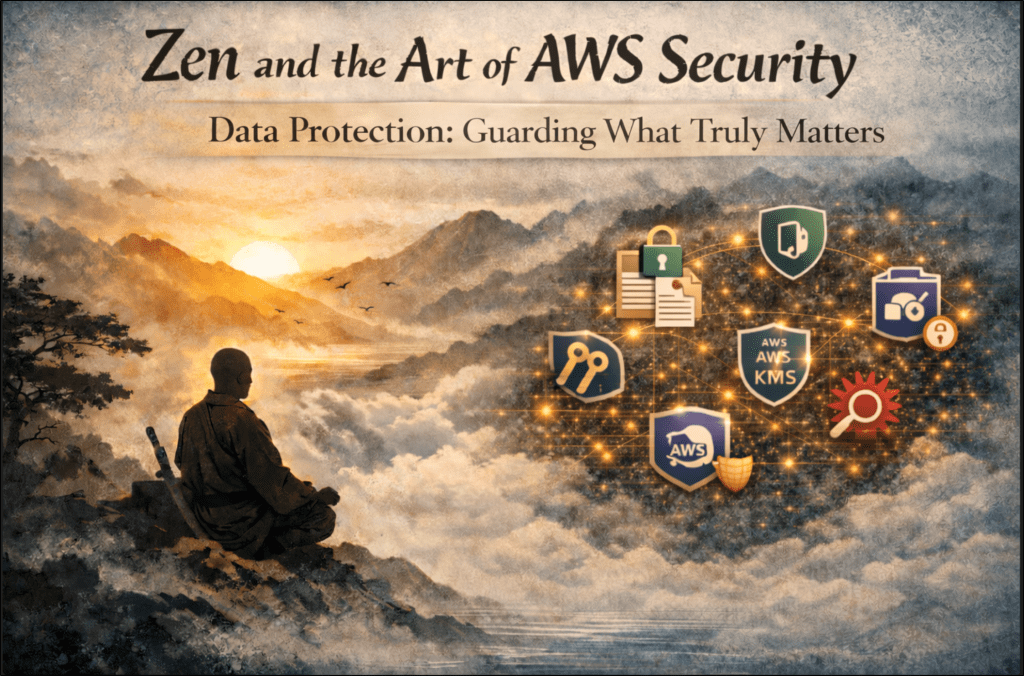
There is an old saying that fits data protection perfectly:
“You don’t simply protect what you value. You protect what you cannot afford to lose.”
In AWS, data is that thing.
Not compute.
Not networking.
Not even identity.
Those exist to serve data.
This is why AWS treats data protection not as a single control, but as a layered discipline spanning encryption, access, durability, lifecycle management, and governance.
And this is why the exam tests how you think about protecting data, not just which checkbox you tick.
Why Data Protection Is Its Own Domain
Data protection answers one core question:
If everything else fails, what survives?
A secure AWS environment assumes:
- credentials can be compromised
- networks can be misconfigured
- workloads can be attacked
Data protection is what prevents those failures from becoming irreversible losses.
On the exam, this domain tests whether you understand:
- where data lives
- how it is encrypted
- who can access it
- how it is recovered
- and how its exposure is prevented by design
AWS’s Data Protection Philosophy
AWS data protection follows five principles:
- Encrypt everything, everywhere
- Control access separately from storage
- Assume data will move
- Protect backups as carefully as production
- Make exposure detectable, not silent
If your answer aligns with these principles, you are almost always on the right path.
Core Data Protection Controls (Exam-Critical)
Encryption at Rest, The Default, Not the Feature
AWS expects encryption at rest by default.
Services commonly tested:
- S3
- EBS
- RDS/Aurora
- DynamoDB
- EFS
- Redshift
Correct exam answers almost always include:
- SSE-KMS (not SSE-S3 unless explicitly stated)
- customer-managed CMKs for sensitive workloads
- key rotation enabled
Exam mental model: If the data matters, AWS wants KMS involved. Exam mental model: If you see “KMS” think encryption and key management. If you see “SSE-S3” think storage-level encryption. If you see “Macie” think S3/PII monitoring—especially for sensitive data exposure. If you see “Secrets Manager” think credential lifecycle and rotation—never hardcode secrets.
Encryption in Transit is a Non-Negotiable
Encryption in transit protects data while it moves.
Look for:
- TLS for ALBs/NLBs
- HTTPS for APIs
- encrypted database connections
- mutual TLS in higher-security scenarios
If the question mentions:
- “data in transit”
- “between services”
- “across VPCs or accounts”
Encryption in transit is required.
AWS Key Management Service (KMS) | Control, Not Convenience
KMS is not “just encryption.”
It provides:
- key policies (resource-based)
- IAM integration
- auditability via CloudTrail
- centralized control
- automatic rotation (for CMKs)
On the exam:
- KMS = security
- service-managed keys = convenience
If the scenario mentions compliance, separation of duties, or auditability → choose KMS.
Secrets Management | Never Hardcode Trust
AWS expects secrets to be:
- rotated
- auditable
- centrally managed
Primary services:
- AWS Secrets Manager
- SSM Parameter Store (SecureString)
Exam preference:
- Secrets Manager for rotation-heavy use cases
- Parameter Store for simpler workloads
If credentials appear in:
- code
- AMIs
- user data
- config files
That is a deliberate trap.
Amazon Macie | Data Awareness
Macie detects:
- sensitive data in S3
- PII exposure
- unintended public access
- anomalous access patterns
If the question includes:
- “PII”
- “sensitive data discovery”
- “S3 data exposure”
Macie is the correct answer.
Backups & Durability | Security’s Quiet Backbone
AWS treats backups as security artifacts.
Correct patterns include:
- AWS Backup
- cross-region backups
- cross-account backups
- immutable backups (where applicable)
- restricted restore permissions
If ransomware or deletion is mentioned: Backups + restricted access are mandatory.
High-Yield Exam Patterns
- Encryption everywhere → KMS
- Sensitive S3 data → Macie
- Credentials → Secrets Manager
- Compliance → customer-managed CMKs
- Backups → cross-account, encrypted
- Exposure prevention → least privilege + monitoring
These patterns answer a large percentage of Domain 5 questions.
The Philosophical Layer: What Data Protection Really Is
Data protection is not paranoia. It is respect.
Respect for:
- the people whose data you store
- the systems that depend on it
- the trust placed in you as a steward
In martial terms, this is guarding the centerline.
You don’t need to chase every strike to protect yourself against them. You only protect what, if lost, will end the fight.
AWS data protection works the same way:
- encryption limits blast radius
- access control limits misuse
- backups ensure recovery
- monitoring ensures visibility
This is calm, disciplined defense, not fear-driven security.
Closing: Quiet strength is the test. Not panic. Not noise. Not drama.
Data protection is rarely visible when done well.
There are no alerts.
No dashboards screaming.
No hero moments.
And yet:
- breaches are survivable
- incidents remain contained
- recovery is possible
- trust endures
On the exam, and in production environments, this domain rewards patience, clarity, and restraint.
Security without pessimism lives here. Protect the data. Everything else is replaceable. In AWS, as in life, what you protect quietly is what endures.
 Matt Shannon, Security Pro