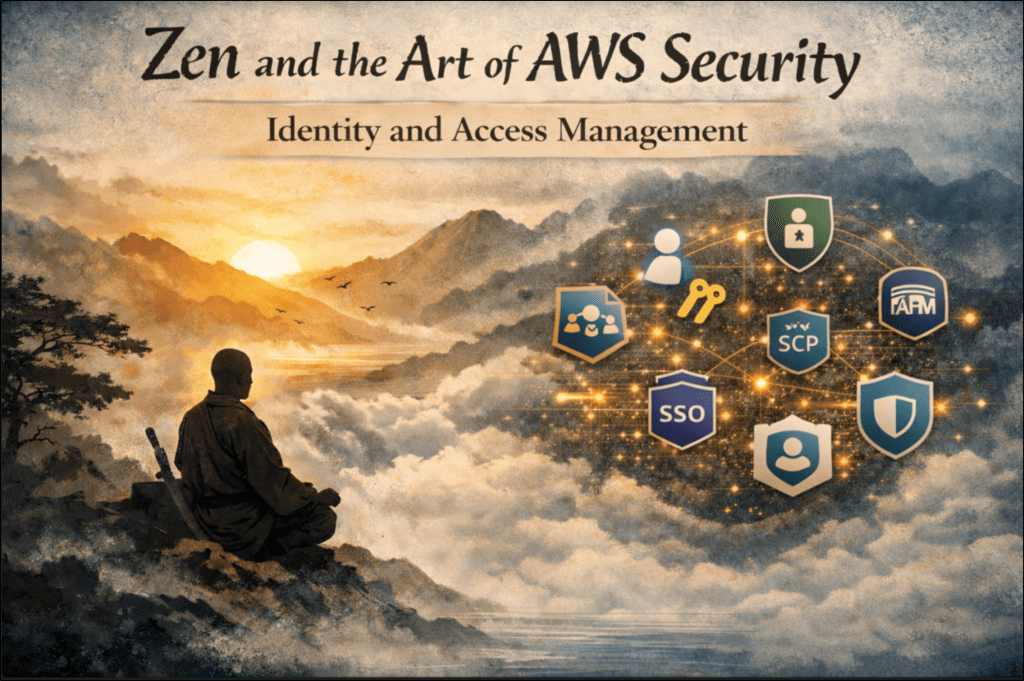
There is a principle taught early in martial disciplines:
“Position determines outcome long before the strike is thrown or submission is attempted.”
Identity and Access Management (IAM) is that principle made concrete in AWS.
Most breaches do not begin with sophisticated exploits. They begin with credentials that worked exactly as designed.
An over-permissive role. A forgotten trust relationship. A policy that was “temporary” and became permanent. For example, the 2019 Capital One breach was enabled by overly permissive roles and misconfigured permissions, allowing an attacker to move laterally and access sensitive data.
This is why Domain 4 carries the highest exam weight. Not because IAM is complicated, but because everything else depends on it.
If identity boundaries fail, encryption doesn’t matter. If access is wrong, detection only tells you what already happened. If trust is misplaced, infrastructure becomes irrelevant.
IAM is not about users. It’s about control.
And control, done well, is quiet.
1. AWS’s Philosophy of Identity
AWS operates on a core assumption:
Every request is an identity problem before it is a security problem.
There is no implicit trust. There is no “inside the network.”
There is only:
• Who is making the request
• What they are allowed to do
• Under what conditions
IAM exists to answer those questions every single time, without exception. The exam tests whether you understand this philosophy, not whether you can recite practice exam answers.
2. The IAM Mental Model (This Wins Exams)
Think of IAM as four concentric controls, not a flat permission system:
- Authentication — Who are you?
- Authorization — What are you allowed to do?
- Boundaries — What can never be exceeded?
- Conditions — Under what circumstances is access allowed?
If you read exam questions through this lens, the “best” answer becomes obvious.
3. Core IAM Building Blocks (Exam-Critical)
IAM Users and Legacy by Design
IAM users represent long-lived human identities.
AWS exam posture:
• Avoid when possible
• Prefer federation
• If used → MFA required
Exam takeaway: If the question involves humans, AWS prefers federated access, not IAM users.
IAM Roles Are The Center of Gravity
Roles are temporary, assumable identities.
They are used for:
• AWS services accessing AWS services
• Cross-account access
• Federated users
• Least-privilege design
Roles eliminate long-lived credentials.
Exam mental model: If access is temporary, automated, or cross-account → IAM Role.
Policies — Permissions, Not People
Policies define what can be done.
Three types matter on the exam:
• Identity-based policies
• Resource-based policies
• Permission boundaries
AWS evaluates permissions as:
Explicit deny → Allow → Default deny
No exceptions.
Exam trap: More permissions is never the right answer. More precise permissions always are.
Permission Boundaries: Where’s the Ceiling?
Boundaries define the maximum possible permissions, regardless of attached policies.
Used heavily in:
• Delegated administration
• CI/CD pipelines
• Guardrails for developers
Exam mental model: If the question mentions “limit what a role could ever do” → Permission Boundary.
Service Control Policies (SCPs) The Absolute Wall
SCPs operate at the AWS Organizations level.
They do not grant access. They only restrict.
If an SCP denies an action, nothing below it can override that denial.
Exam mental model: If the question involves organizational guardrails → SCPs.
4. Federation: AWS’s Preferred Human Access Model
AWS strongly prefers identity federation:
• SAML 2.0
• OIDC
• IAM Identity Center (SSO)
Benefits:
• Centralized identity lifecycle
• No long-lived AWS credentials
• Enforced MFA
• Conditional access
Exam signal phrases:
• “Corporate directory”
• “Single sign-on”
• “Temporary access”
• “Centralized identity”
All roads lead to federation + roles.
5. Conditions: Context Is Control
IAM Conditions are where AWS becomes surgical.
Common exam-tested conditions:
• Source IP
• MFA present
• Time of day
• AWS service
• Resource tags
• Requested region
Conditions turn identity into context-aware control.
Exam takeaway: If the question asks for fine-grained control without complexity, the answer is conditions.
6. Cross-Account Access (High-Frequency Exam Topic)
AWS expects you to design for multiple accounts.
Correct pattern:
• Role in target account
• Trust policy allows the source account
• Least-privilege permissions
• Optional external ID (third-party access)
Never share credentials across accounts.
Exam mental model: Cross-account always equals assume role, never IAM users.
7. Detection & IAM (Where Domains Interlock)
IAM does not exist in isolation.
Best-practice IAM designs integrate with:
• CloudTrail (every API call)
• Access Analyzer (policy exposure)
• GuardDuty (anomalous behavior)
Exam insight: Strong IAM assumes monitoring, not trust.
8. The Human Parallel: Trust Without Naivety
In martial training, trust is earned through repetition, not assumption.
You trust:
• Position
• Distance
• Timing
Not hope. Hope is not a strategy. IAM operates the same way.
Social engineering succeeds when identity systems assume intent. AWS IAM succeeds because it assumes nothing.
Every action is verified.
Every permission is scoped.
Every boundary is enforced.
Every one is checked and then double-checked.
9. Exam Patterns That Matter
If you remember nothing else, remember this:
• Humans → Federation
• Services → Roles
• Limits → Boundaries / SCPs
• Temporary → AssumeRole
• Fine control → Conditions
• Cross-account → Trust policies
AWS rewards restraint.
NIST CSF and CIS Controls both emphasize least privilege, role-based access, and periodic permission review as foundational security practices.
10. Closing: The Quiet Discipline of Identity
IAM is not exciting.
It doesn’t feel dynamic.
It doesn’t make dashboards light up.
But it is the decisive domain.
When identity is right:
• Breaches are smaller
• Incidents are quieter
• Recovery is faster
• Governance becomes natural
On the exam and in the real world, IAM rewards deliberate action, not aggressive decision-making. Security without pessimism continues here. Not by adding power but by placing it exactly where it belongs.
In AWS, as in martial arts, the quietest sentinel is often the hardest to defeat.
 Matt Shannon, Security Pro